Let It Spin [on Two Artists Tuesday]

perspective copy

The answer to “Who Am I?” is mostly a matter of perspective [or concoction, depending upon your perspective ;-)]. As much as we might want it to be, who-am-I is not a fixed state of affairs. Thankfully, we are not as narrowly defined as we want to believe.

We constellate together some identity-fixed points (son, father, banker, artist, gardener…) that give general shape to the who-am-I inquiry.  Mix in a few subsets: competitive, passive, rich, poor, successful, homeless, handy, all-thumbs… and there’s some nice variation giving color to the primary fixed points.

For some real fun, factor in the changes of identity that happen over the course of a lifetime. Who did you understand yourself to be at 10? At 20? At 30? Dear friends just became grandparents; their entire universe is spinning. Who are they now?

I have had moments of triumph that turned to dust in my mouth. What looked like fulfillment was, in fact, an empty sack. Once, thinking I was looking good, I walked headlong into a glass door. Instant fool. Identity is much more fluid than fixed.

In the Buddhist tradition there is a “Big Dipper” exercise. From our perspective on the earth, there is a constellation of stars that form a big dipper in the sky. But, travel toward that constellation, the image of ‘big dipper’ starts to warp and then falls apart altogether. The position of the stars does not change. Our perspective does. The constellation is nothing more than an illusion. Mostly, my constellation of fixed identity points is nothing more than an illusion.

These days I’m thinking much about my illusion and attachment to my fixed points. My move to Wisconsin came with career death and I spent more than a few years grasping for the lost stars in my constellation. New stars appeared. I became a husband. I have two ‘given’ children. My beard has become grey. Yesterday, to my utter amusement, I found myself concerned with fallen leaves staining the patio and had thoughts of immediate raking. What has become of me? In the past week, I’ve awakened more than once with this thought: What if the painting on my easel is to be my last. It’s not finished and it’s an utter mess! I want to leave a better last impression! I have more work to do!

And then, I wondered, what if, as I travel out beyond the constellation, this image of myself, this part of me that I call ‘artist,’ matters not at all? Fluid, not fixed.

And so, my perspective spins, more anchor points fall away and the entire universe opens.


read Kerri’s blog post about PERSPECTIVE


handshadowstones website box copy

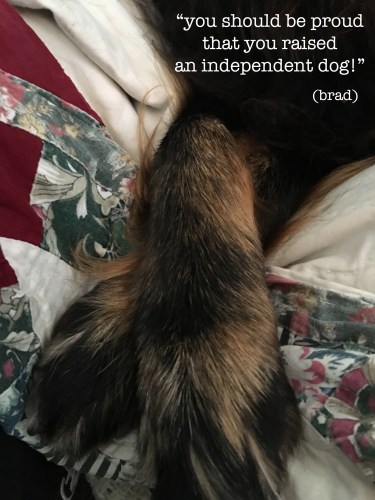
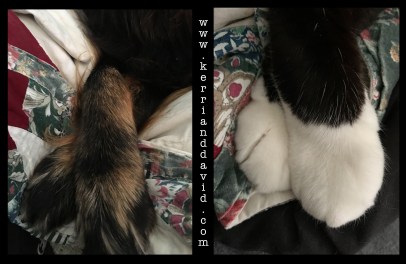
Be Like Your Dog [on Merely A Thought Monday]

independent dog copy

Some people look like their dogs. Some people are like their dogs. I am one of the latter.

DogDog resists all recognizable constraints. He cannot tolerate tight spaces. It’s the reason he won’t climb stairs. It’s not the stairs, it’s the tight passage way. How’s that for a metaphor! I would be more successful in this life if I had better tolerance of constraints.

He is hypersensitive to other people’s feelings. He is, to use a phrase from the Dog Whisperer, an energy-reading machine. He knows when I am sad or angry or frustrated BEFORE I know that I am sad or angry or frustrated. I have, like DogDog, always been able to walk into a room and “feel” where the energy-eddies were swirling. Sometimes I can’t tell if it is my sadness or the person I am sitting with. That takes some time to sort out. I wonder if DogDog has the same challenge in sorting which feeling belongs to which animal.

DogDog is fearful of non-threatening, seemingly ridiculous things. For instance, his food bowl is metal and it sits at the base of the oven. When the bowl makes contact with the oven, metal on metal, he flees to save his life. He hides in the other room until we convince him that the sound-monster is gone. My monsters are just like his. Seemingly ridiculous to outside eyes. Always constituted of the things I do not understand. The sounds that make no sense (what people say, what people do to each other). The future. The past. Metaphoric metal on metal.

What I would like to learn from DogDog? My monsters keep me awake at night. His fears don’t stick – or, rather, he doesn’t carry them forward. Not only is he a profoundly sound sleeper but, the next time there’s kibble, he’s back at his bowl giving it another go.


read Kerri’s blog post about A VERY INDEPENDENT DOG


paws website box copy


Flawed Cartoon Wednesday

SNOWMAN BIG COPY Master

“This surprise that reality is other than expected is weirdly tenacious.” Declan Donnellan

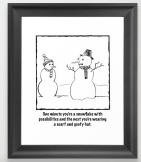
Of all the Flawed Cartoons, and there are many of them, this just might be my personal favorite. I giggle every time I see it – and I wrote it! And drew the image! It is a layer-cake of the human condition, a loving nod to our infinite capacity to generate, invest in, and then get lost in the life-stories of our own creation. I love our surprise that life is a festival of surprises.

Just ignore my snicker the next time you tell me that you know where you’re going.

A SNOWFLAKE WITH POSSIBILITIES merchandise

Flawed Snowman MUG  Flawed Snowman FRAMED PRINT  Flawed Snowman TSHIRT

kerrianddavid.com

read Kerri’s thoughts on A SNOWFLAKE WITH POSSIBILITIES

a snowflake with possibilities ©️ 2016 david robinson and kerri sherwood


Row

may-you-be-small-crop-jpegSometimes the way forward is akin to rowing a boat: facing backward is the only way to get proper leverage. Today, to stir my pot, to get some leverage and new energy, I revisited three books that I wrote but never published (or limply offered to a tiny audience). It was a revelation. It’s as if the man who wrote those books in the past meant for me to read them today. The man who wrote them was not ready or clear enough to birth them. The man who read them today knows just what to do (including rewrite some odd bits). Here is the introduction to the first of the three books:

I’ve generally stepped in every pothole, tripped over every opportunity, broken the family dishes, and made every mistake a person can make. I feel fortunate to be alive. I used to try and hide the mess behind a veneer of “knowing.” Eventually I realized that in order to find what I was seeking I had to stop pretending that I knew what I was doing. I didn’t. I now recognize that the more I learn, the less I know. Life is not about knowing stuff. Life is vibrant when engaging with the un-known. Seeking is messy business. Being human is messy business. To pretend otherwise is…well, to pretend.

One day, while exhausting myself pretending, I realized that I was telling myself a story of fear. I realized that I was the only person invested in my fear story. I realized that I’d cast all the other people in my story as dangerous characters. I believed that if they really knew me they’d shame me. I realized that I was the only person in my story feeling pain, frustration and exhaustion. So, why was I telling myself this story? This was not the story that I wanted my life to tell. That day I began changing my story.

At some point, each of us comes face-to-face with the story of our lives. When we do, we have the choice to retreat further into hiding or to take off the mask, turn around, and walk toward the thing we fear the most. This is to seek the bear.

Every human being who has walked the face of the earth has come to the same crossroad; those that faced their bear left behind clues about how to do it. They left us messages about how best to stop hiding, how to turn and walk toward fear, what to do when it is time to stand in front of the bear’s cave and how to welcome the encounter. The clues and messages are found in the stories they left for us. The stories are maps for navigating our inner geography.

Our ancestors understood that stories are a participation sport. Our lives are mirrored in the tale of adventure. We know what to do in our personal story because we identify with the heroine/hero in the story. Their journey of transformation is a guide to our journey of transformation. Their follies and foibles give coherence and direction to our messy passage. Their death and rebirth is a map for our death and rebirth. Their story is a call for us to step more fully into our adventure-story.

As is true in all life-lessons, it’s a perfect loop. I’m back where I started (apparently) only with new eyes and a few more years of experience. Order from chaos, chaos from order, I suspect we are all, one way or another, rowing in a perfect circle.circle-peace-earth-jpeg

Save

Let’s Be Us

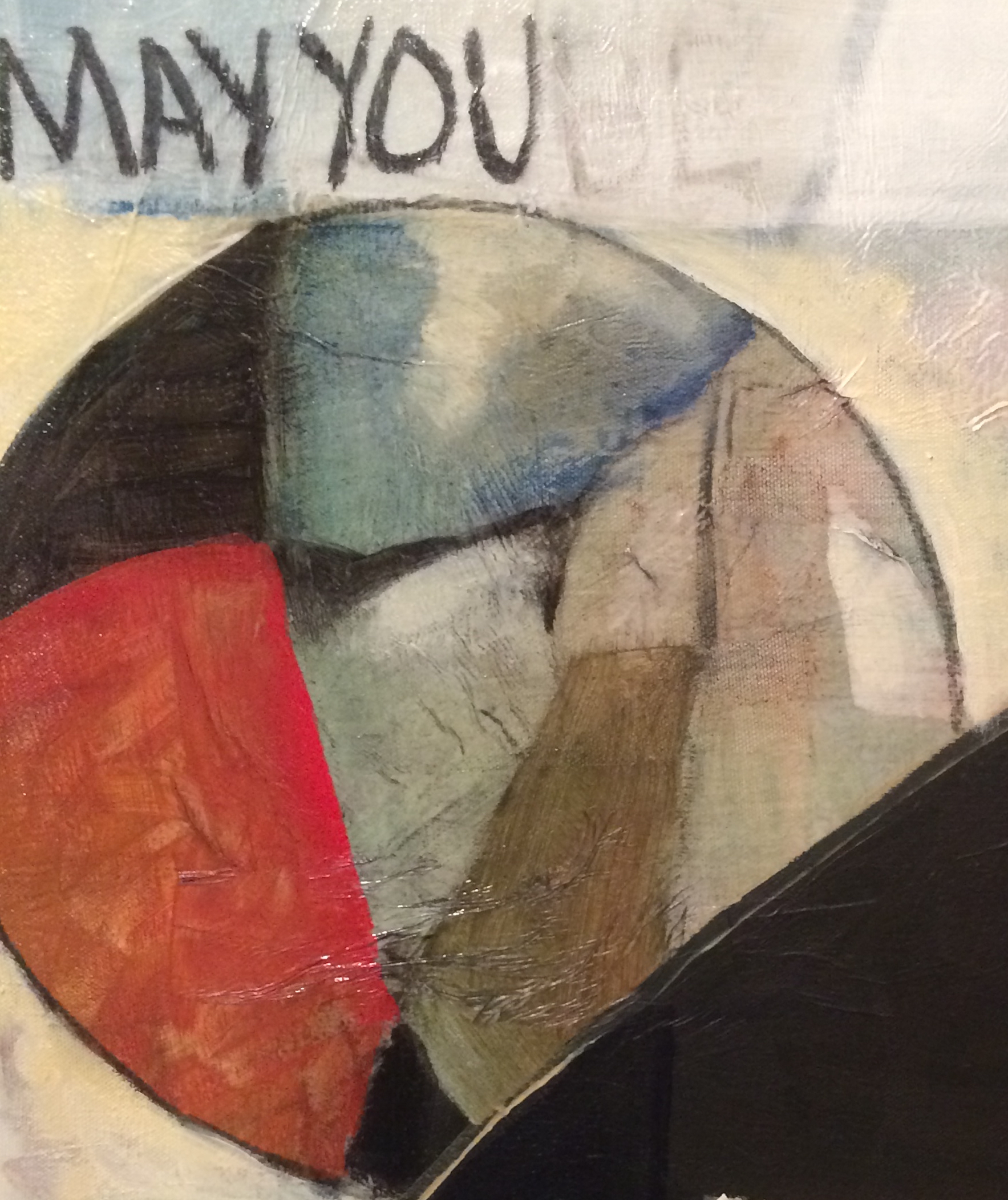
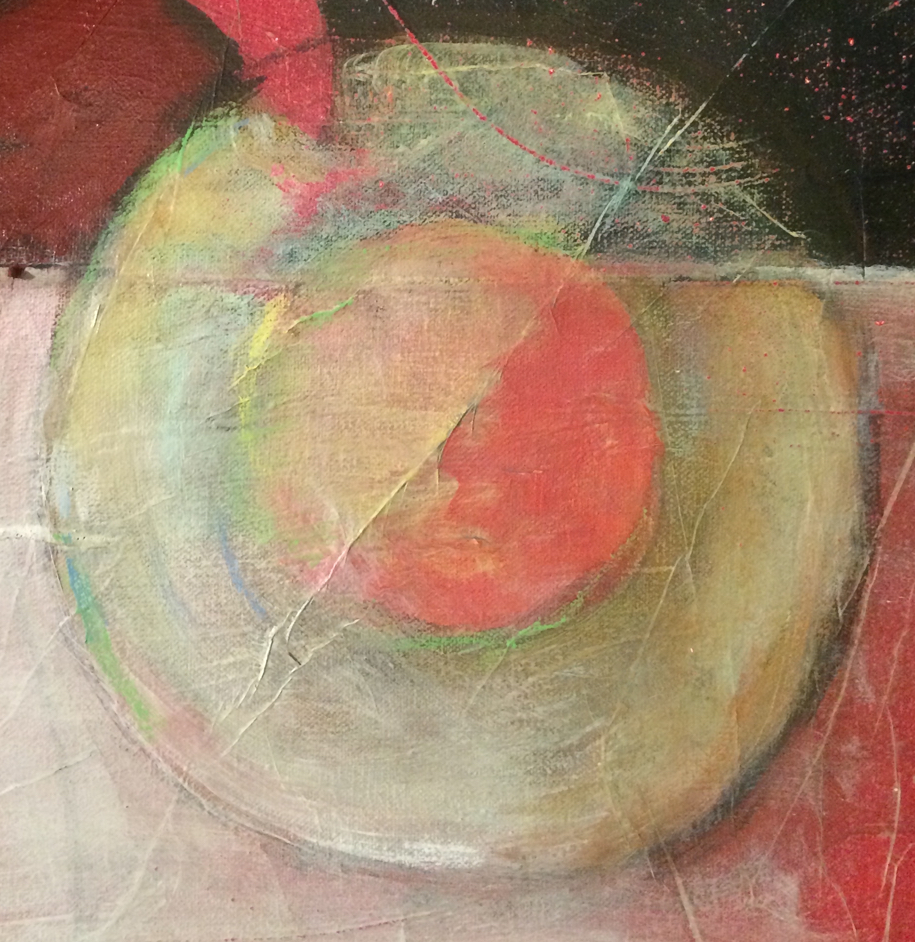
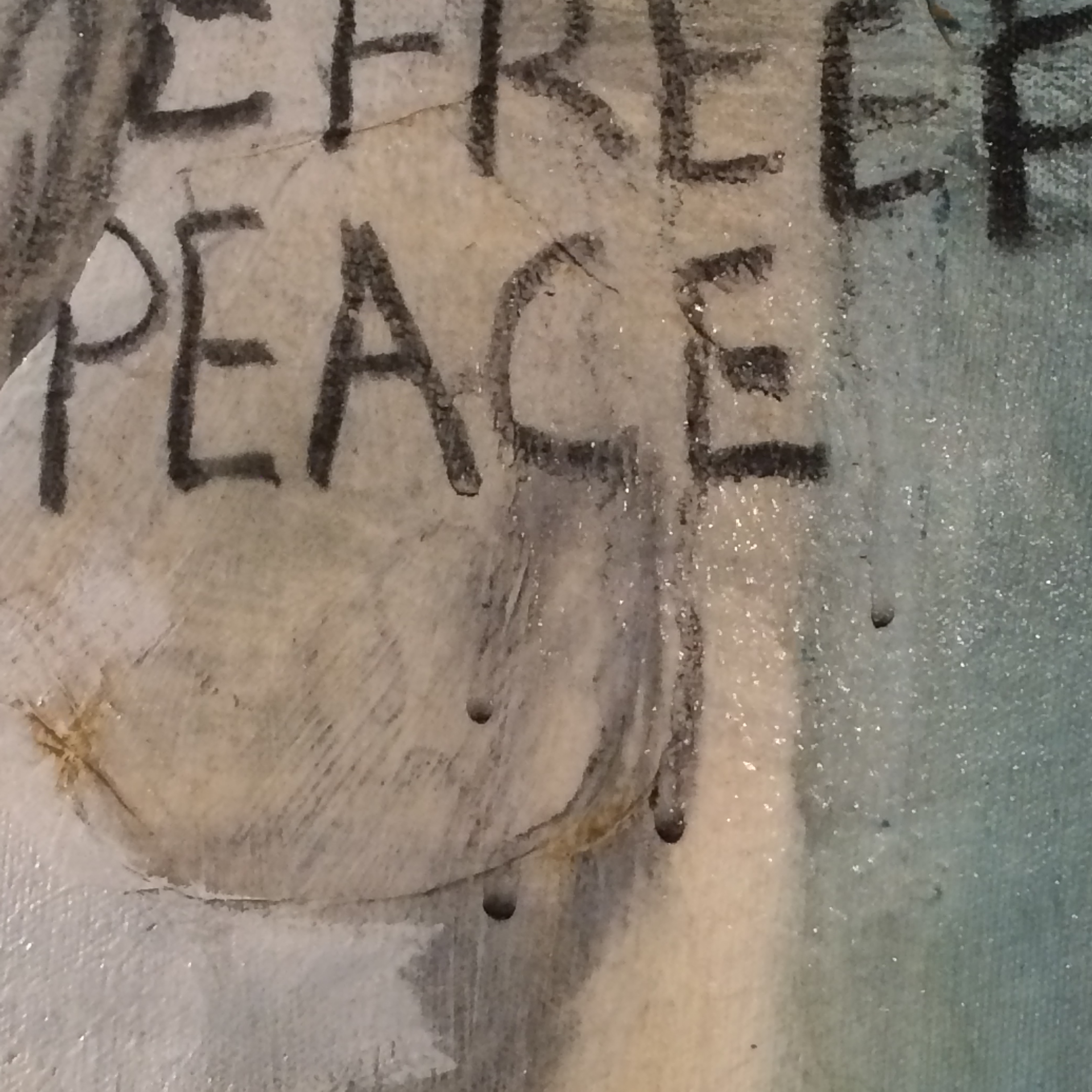
a detail from my painting, May You Be

a detail from my painting, May You Be

[continued from Put Down The Hammer]

It is night and I am sitting alone in the sanctuary. I’ve been setting up chairs for a performance and now that the job is complete I’m taking a moment to savor the silence and review this day.

The temperatures have been unseasonably warm and when I opened the back door this morning for Tripper Dog-Dog-Dog I was greeted by the sound of birds singing. It was an April sound in the middle of December. I was so taken by the sound that I called Kerri, “Come and listen to this!” We stood in the doorway for many minutes. It was beautiful as well as a little disconcerting. “El Niño or global warming?” I asked.

Arnie wrote a comment to my last post. He asked: Can it be that we don’t want the ‘we’ in our society – we aren’t comfortable with the ‘we’ and only feel our identity by living out the “us and them”? I am an idealist but, of course, he is right. David Berreby wrote a terrific book called, Us and Them. We are hardwired to perceive the world through a lens of Us and Them. It’s a survival imperative to distinguish between friend and foe. However, a point that is most salient to me: the delineation of Us is mutable. It is not a fixed state but largely circumstantial. That is especially true in this modern age. There is an out of fashion phrase used to describe these United States: a melting pot. There could not be a better metaphor for an ever fluid definition of US. We need not melt but we do need to acknowledge that we are in the same pot. “Give us your tired, your hungry, your poor,…” is central to our national identity (not always central to our national rhetoric) and is a sacred, central statement of an ever-changing US.

We are among the first humans in history to have the pleasure of seeing our planet Earth from space and, as it has been said, from space there are no visible borders. The definition of US depends upon how far out we pull the camera. From space WE are the human race. There are a bevy of alien invasion movies that carry a common theme: when attacked WE inhabitants of Earth will pull together. Or, said another way, until there is a THEM that invades from another planet, WE will be incapable of recognizing full inclusion in the Earth pot.

To Arnie’s point, there is a lot of responsibility that comes with WE. A few months ago, Kerri and I were in Chicago for the day and passed a homeless man, holding a filthy cardboard sign asking for help. He was young, in his early 20’s, and more filthy than his sign. He was suffering. We walked by him. On the train home we had a long conversation about our responsibility to that young man or to any member of our community that is suffering. Many years ago I was with a student group in Bali. We were invited to Udayana University and one member of our group gave a talk about homelessness in America. Our Balinese hosts were shocked. “How could a member of your community be without a home?” they asked. The concept was abhorrent to them, unthinkable. “You are the wealthiest people on Earth…,” they stammered. Later, a Balinese professor said to me, “When you came here today, we wanted to be like you Americans. As you leave, we are proud to be Balinese.”

Us. Them. We. Like me. Not like me. Me. Little words with far-reaching impact. I am not the same person I was only a few years ago. I find it infinitely hopeful – especially now – that, just like me, the delineation of US is mutable, ever changing. It begs the question, Who are WE? And, to another of Arnie’s points, the answer to the question depends upon where we decide to place our focus.

Step Toward Faith

My latest. An unusually small canvas.

My latest. An unusually small canvas: Will Is Belief.

I began writing this post a few weeks ago, just before the run to Florida and the launch of Beaky’s book. It was a very busy week and I’d forgotten that I started but did not finish the thought. This morning, wanting to get back into the rhythm of writing, I opened my iPad and found these words already written and awaiting my return:

I’m sitting in the choir loft watching the evening sun illuminate the stained glass window. I’m tired tonight and listening to Kerri, preparing for the Maundy evening service, rehearsing Nancy’s solo. Nancy’s voice is like a warm cello, deep and rich, and is working like a sound-massage on my tired bones. I’m giving over to it.

This cycle of services on Easter week is relatively new to me so I’m paying attention to all of the symbols and rituals of this story of rebirth. As is true of every great story cycle, the night is darkest before the dawn (thus, the cliché). This night, called Maundy Thursday in the cycle – I’m told that Maundy means mandate – is the night of the last supper and all the betrayals that followed. It is the segment of the story that is chocked full of crises of faith. If, like me, you are a lover of story you will recognize that some form of betrayal usually precedes a crisis of faith and, in turn, a crisis of faith always leads to growth and new direction; it always leads to sunrise.

Others betray us. We betray ourselves. Betrayal happens on the edges of the dark forest and forces a step into the unknown. Betrayal happens when we fall asleep (that is most often how we betray ourselves – sitting in front of the television to numb us to the richness of our lives). Things crumble: the relationship that we believed was secure, the truth into which we rooted our belief, the career that we thought would carry us to retirement. Security dissolves, identity dissipates, and then what? All the fears bob to the surface. All the dragons come out of the closet.

This was the unfinished thought I found this morning. I have no recollection of where I was going with it. Now, two weeks and a lot of life later, I read it as if someone else wrote it. However, there was one other sentence, detached from the others. It now reads like a mystery to me. When writing, I routinely float a sentence at the bottom of the page because it is the point of what I’m trying to reach. My floating sentence read:

A crisis of faith often has very little to do with faith.

And, as I try to resurrect my thought of a few weeks ago, I can only smile and write the first thing that occurred to me when I scrolled down and found the floater: Faith, like love or truth or time or anything else, is not something fixed. It moves and grows as we move and grow. A crisis of faith is really a step toward faith renewed. It enlivens. It helps us retire old dragons or let go of empty promises. It gets us out of our easy chair and helps us fully feel the day.


Simply Listen

Pieta with Paparazzi

I call this one Pieta with Paparazzi

I am standing in a lobby listening to people compare their tragedies. It is more than comparison; it is a festival of one-ups-manship. “If you think that’s bad, my niece was just diagnosed with a terrible cancer….” The first speaker, now crestfallen, reaches into her story-bag of pain as another member of the group competes, “That happened to my brother just after his daughter was hit broadside by an enormous truck!” The group coos in sympathy, each in a hurry to make their personal story of hurt the center of the conversation. I wonder at their need to outdo each other in tragedy.

I suppose it is human, this feeding frenzy of drama. I want to reject my supposition outright. Suppose it is not human? I wonder if this dis-ease is cultural, an expression of the fragmentation that comes from the too-busy, the clan that avoids internal quiet at all costs, filling every moment with television, gaming, texting, emailing, gossip-news. As Anne Morrow Lindbergh wrote in Gifts From The Sea, it is impossible to know who you are without dedicated inner spaciousness and quiet. To listen to your self is the only way to really know your self. Filling the quiet space with incessant noise withers the root.

Maybe.

All stories require conflict to move forward but it is also true that the point of all storytelling is transformation. Through the conflict we are transformed. Perhaps that is what bothers me as I listen to this pain frenzy: the emphasis is on the suffering. The investment, the identity, is in the wound, not the transformation.

There is a simple Buddhist prayer that I like:

May I dwell in my heart. May I be free from suffering. May I be healed. May I be at peace.

The prayer is like a musical round that progresses from the “I” to the “You” to the “We.” The emphasis is on the transformation. It begins with dwelling in the heart.

Maybe.

What bothers me most is the absence of the capacity to listen. The first speaker needed to be heard, not outdone. I wonder what might have happened if the group had simply said, “Tell us.” I wonder what might have happened if they had been able to be present with another’s pain. To listen, simply to listen, must be a route to free each other from suffering, to heal, to create peace.

title_pageGo here to buy hard copies (and Kindle) of my latest book: The Seer: The Mind of the Entrepreneur, Artist, Visionary, Innovator, Seeker, Learner, Leader, Creator,…You.

Or, you can go here for all forms of digital options


And, you can go here for fine art prints of my paintingsYoga.Meditation


Return To Your Self

DSC_1914

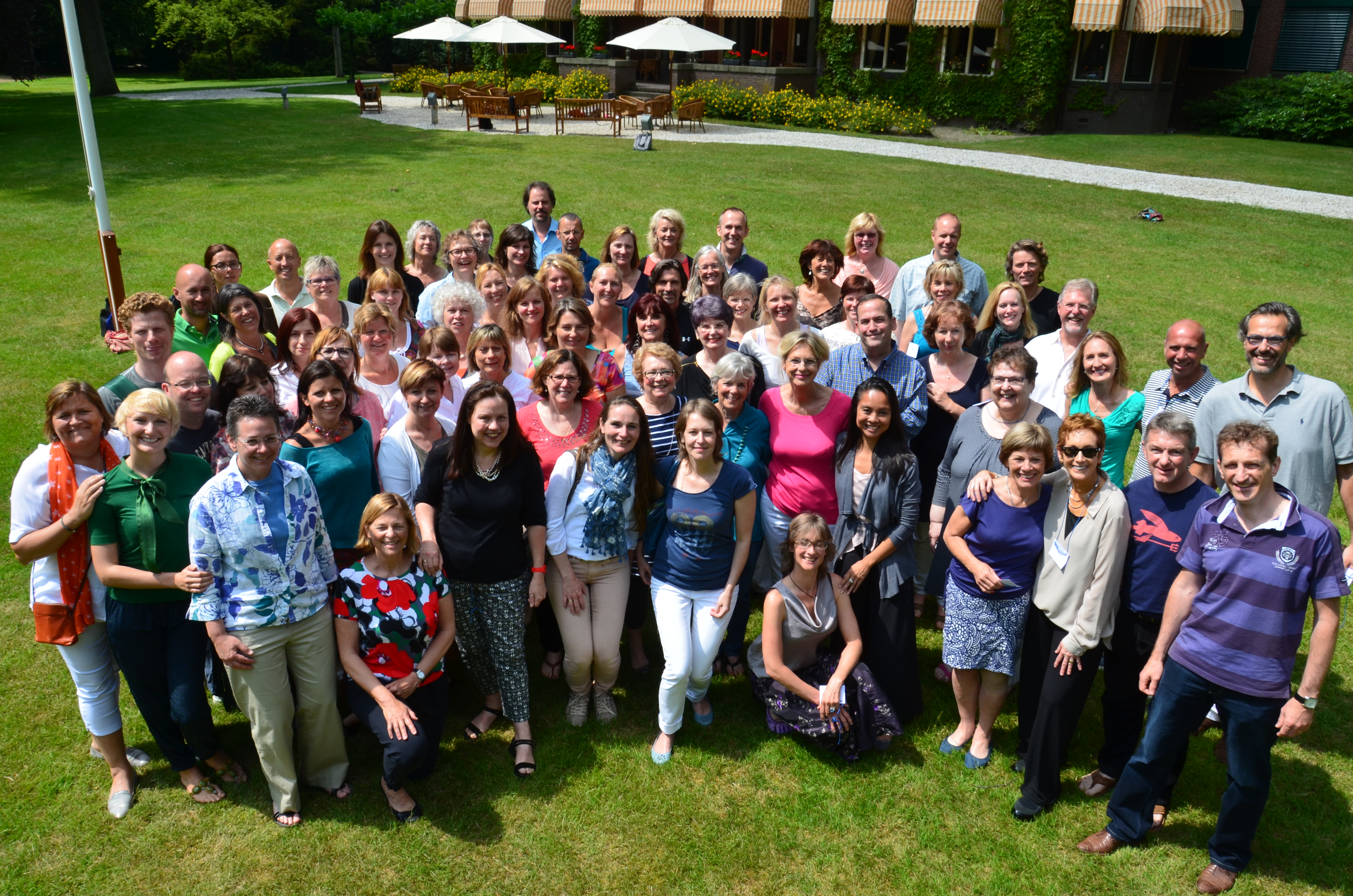
The 2014 Transformational Presence Global Summit in Vught, Holland

While in Holland I led a group through a segment of an exercise called The Dream Police. I created the exercise years ago with John Langs and Lisa Paulson – two master teachers and performing artists – while doing some work with young actors at PCPA Theatrefest. The original exercise is deeply rooted in ritual and communal transformation. The group in Holland was engaged in a more personal exploration so I only led them through the first part of the exercise.

It is surprisingly potent and I’ve learned to use it carefully. The first part of the exercise sounds simple but can be explosive: Write for 5 minutes as if, in 5 minutes, your memory will be wiped clean. All that you will know of your life, of your values, your relationships, your dreams, your identity… will be what you capture in those few moments of writing. After the writing, in a ritual act, the scribbles on the paper are left behind. Most often, people destroy the paper. They shred it. The writing is lost. The question becomes, “Who are you without your story?” It is intended to disorient so the participants might reorient to the essentials of their lives; it is a great exercise for cleaning the gunk. It can be freeing. It can be terrifying. It is always illuminating.

The reorientation process is impossible to do alone. Reorientation is communal. Until Holland I’d never left a group midway, I’d never let the exercise stop in the middle of the disorientation and had always before made sure the reorientation process was at least initiated. IN Holland, the exercise was interrupted. The disoriented community fragmented. Some left the exercise feeling liberated. Others were angry. Some were confused or frightened. All left by themselves. Disorientation makes lonely introverts of us all. Disorientation is an individual sport.

The ritual of coming back to yourself is always a ritual of returning to the community. Clarity is a boon that requires sharing with others. To come back to yourself is to come back to relationship. No one walks this earth alone. No one is capable of saying “This is me,” without the presence and assistance of others. The process can be volcanic. It can be quiet and intense. It always requires another question: “Will you tell me what you see?”

24 hours later we completed the exercise. The individuals returned. They gathered, reoriented and a new form of the community was born. I knew all was well when the newly reformed community asked, “What do we do now?” and the only available answer was, “We don’t know – but let’s find out together.”

Go here to get my latest book, The Seer: The Mind of the Entrepreneur, Artist, Visionary, title_pageSeeker, Learner, Leader, Creator…You.

Or, go here for hard copies.

Locate Your Self

title_pageHere’s a short excerpt from my book, The Seer, dealing with the dance between investments, limitations, and the roles we play in life. This conversation is a kind of coaching session and is happening via online chat:

Me:…All week I’ve asked myself, “why?” Why the dramatic shift in experience from role to role? I’m a bit shocked to realize that I play many, many roles each day. In each role I want something and what I want is different depending upon the people I am with. I realized that my roles are not about me in isolation – and what do I mean by that? I mean that I define my role by how I define the relationship I am in at the moment. For instance, in my workshop, I assumed the role of “guide” and I wanted to lead the young people to some new insights that might help them create their businesses. In my conversation with my parents, in the role of “son,” I wanted them to be pleased with my work. I wanted to share and I wanted their approval. So, my role is defined by relationship and in each different relationship I tell a specific story based on what I want or need. I’ve “cast” myself in these little mini-stories. Or to use your term, “role” is the way I “locate” myself in the story.

Virgil: And how does this knowledge help you with your questions about business?

Me: The first thing that occurs to me is that I have the capacity to locate myself in a different way if I don’t like the role I’m playing. I can change how I locate myself. Also, there is a dance with the words “limitation” and “investment.” I took notes all week and realized that I was using the verb “to invest” over and over again to describe my experience of different roles. So, for instance, during my dinner with my friend Bruce I invested in helping him. I wanted Bruce to know that I cared about his challenges. Then, I watched Bruce invest in being the wine expert. It was his way of caring for me and demonstrating his expertise. I began to see my investments as keys to discerning my limitations. In some roles I’ve invested in the idea that I can’t do something or that I’m not good at something. In some roles I diminish myself; my limitations are investments in being small.

Virgil: Just a caution: as you explore further the dance between investment and limitation, remember to practice suspending your judgment. Remember: you are having experiences first so you can see how you make meaning and begin to choose how you make meaning.

Me: Thank you. It’s a good reminder. I was beating myself up every time I     realized I was investing in being small.

Virgil: We tell ourselves stories. We locate ourselves within the stories. In fact, that is the next recognition: you locate yourself within your story. We do it physically (like your description of choosing the table in the restaurant); we do it through the roles we assume – specifically our assumptions of how we need to play our roles, what is ours to do, etc. Locating is simply a way of establishing comfort. We sort to the known. If you judge how you locate yourself, you miss the opportunity to change how you locate yourself.

Me: Right. Judgment blinds me to the choices I am making.

Virgil: Judgment is always a version of the “things are happening to me” story. In fact, judgment is a way of locating: it is the warning signal when we step too close to discomfort. When I judge myself and say, “I’m an idiot,” I’m actually locating myself, pulling myself back into my comfort zone. When I judge others, “They are idiots,” I’m locating myself in a higher status position. The action of diminishing “them” elevates me back into a comfortable status position. Thus, suspending your judgments removes the easy step back to comfort and allows you to stand in “not knowing” and see what is there beyond what you think is there.

Go here to get my latest book, The Seer: The Mind of the Entrepreneur, Artist, Visionary, Seeker, Learner, Leader, Creator…You.

Or, go here for hard copies.

Let’s Dance

from my cartoon series, FLUB

from my cartoon series, FLUB

[This is a response to my dear friend who believes he will someday be worthy to call himself “artist.”]:

There is a trap that every artist must negotiate: the mistaken notion that “artist” is something you achieve. “Artist” is something that you are (and every child is an artist, wouldn’t you agree?). Art is an exploration of life. Some of the greatest artists in history had no training and no experience. They, like you, enjoy playing with various colors and never followed a textbook or a guideline because art doesn’t happen in textbooks and the only guideline that ultimately matters is in the heart of each individual artist. Art is an exploration. It is a relationship with the mystery.  It is not a prescription. There isn’t A WAY to do it. There is your way. And my way.

Art is an engagement with something intangible and if it is life giving to you, that is all that matters. It gives you life and you bring it to life and that dance of giving and bringing life is the work of the artist. The viewer will never see what you see because they do not have your eyes or your life experience or your heart. They will see what they see and interpret it according to their life-filters. Some people will love your work, some will hate it, most will be indifferent – and that has nothing to do with you. You can’t (nor should you) determine what they see. A painting or photograph is like a doorway: the viewer can step through or not. They can choose to engage or not to engage and you have no power over what they  do or see or feel or think. And, it is vital that you understand that because the notion that you can control what they think is the very thing that leads you to believe that you must pass some credibility test to be deemed and artist. When a viewer engages with a work of art they cease to be a viewer and themselves become an artist. Engagement with art is never passive; it is creative. They enter their own dance of creation. They become creators. Yours is to offer the doorway, not to push people through it.

In truth, the shadow side for the artist in trying to control what other people think is that they give away the essential thing: what they think. Why assign to other people the responsibility for your identity as “artist.” If they like your work then you are an artist? If they hate your work then you are not? You can either serve your heart (art) or please other people but you cannot do both.

I’ve coached a legion of people who set up great studio space for themselves and then never go into it. People are great at creating separation from what they want. They can get close to it (set up the studio) but fear stepping into it (picking up the paint brush) because the act of making art is the act of releasing control. It is to offer without condition. It can be a scary thing to give voice to what you see. It is vulnerable to show your heart to the world. It is only scary until you own it and get out of the trap of valuing other people’s point of view over your own.

Another form of separation is to say, “I will be an artist when I sell my work.” Selling your work does not make you an artist. Making art is what makes you an artist. Acceptance does not make you an artist. Making art is what makes you an artist. 10,000 hours in the studio will make you better and better (meaning freer and freer to express) but it will not make you an artist. You are an artist in the first hour and an artist in the 10,000th hour because you are exploring your relationship with life. You might have better mastery of the tools in the 10,000th hour but “master of tool” and “artist” are two distinctly different things. The  artist uses the tool, the tool does not define the artist.

You have the courage to go to your studio and get lost in an exploration of life through image and color. You lose all sense of time because your relationship with the mystery is pure. And, in the end of the day, who cares if anyone sees you as an “artist;” who cares if you see yourself as an “artist.” All that matters is that you enter that sacred studio place and open yourself to the mystery and say, “Let’s dance.”

Go here to get my latest book, The Seer: The Mind of the Entrepreneur, Artist, Visionary, title_pageSeeker, Learner, Leader, Creator…You.

Or, go here for hard copies and Kindle (Amazon)