A Different Understanding [David’s blog on Not So Flawed Wednesday]

Sometimes color stops me in my tracks. The color of a sunset. The color of a canyon. The color of a flower. This hot coral coneflower stopped all engines.

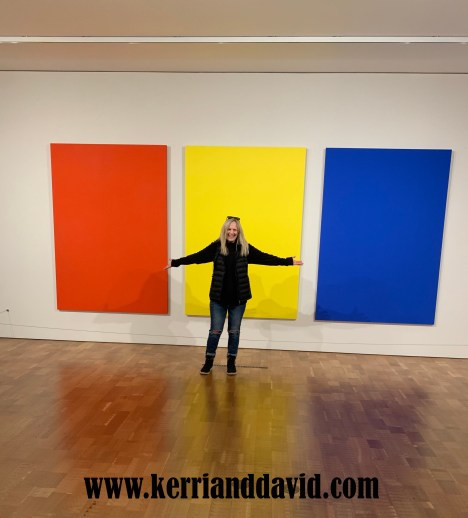
David Hockney is a colorist. Henri Matisse. Judy Chicago. Piet Mondrian. Sonia Delaunay. There are so many painters whose use of bold color, like the coneflower, stops me in my tracks. Ellsworth Kelly. Mark Rothko.

With my love of color you’d think I’d be a colorist painter. Although I’ve had my moments, mostly I sort to earth tones. The neutrals. Once, a viewer of my painting, Unfettered, asked “Were you going for stone?” I wrinkled my nose and let the question hang unanswered.

Many years ago I mimicked David Hockney’s colors. I pushed myself to live in vibrancy. I loved the exploration but was rarely comfortable living in so much visual enthusiasm. I am too much the introvert to comfortably scream from my canvases.

I just washed over my latest painting, County Rainy Day. Kerri was appalled but I’d veered off course and hit color saturation too soon. I needed to reset. I generally work things out in process – instead of doing studies – so wiping off or washing over a canvas is not unusual. Like Kerri, John K used to chastise me, too, saying “Do versions or variations!” Versions and variations are expensive and I’ve rarely had abundant resources in my life. Every action has a history.

Recently Andrew Wyeth has once again caught my fancy. I’d never suggest that he is not a master of color – he is – but his paintings tend toward the neutrals. He captures something deeper, his visual language is as much that of a poet as a painter. A different understanding of color.

I imagine that, like me, on his daily walk, the color of a coneflower or the shape of a leaf stopped him in his tracks. And, one way or another, that startling moment of appreciation found its way into his heart and onto his canvases.

reset: County Rainy Day (detail)

read Kerri’s blogpost about SALMON CONEFLOWER

like. share. subscribe. comment. support…thank you.

On The Cusp [David’s blog on DR Thursday]

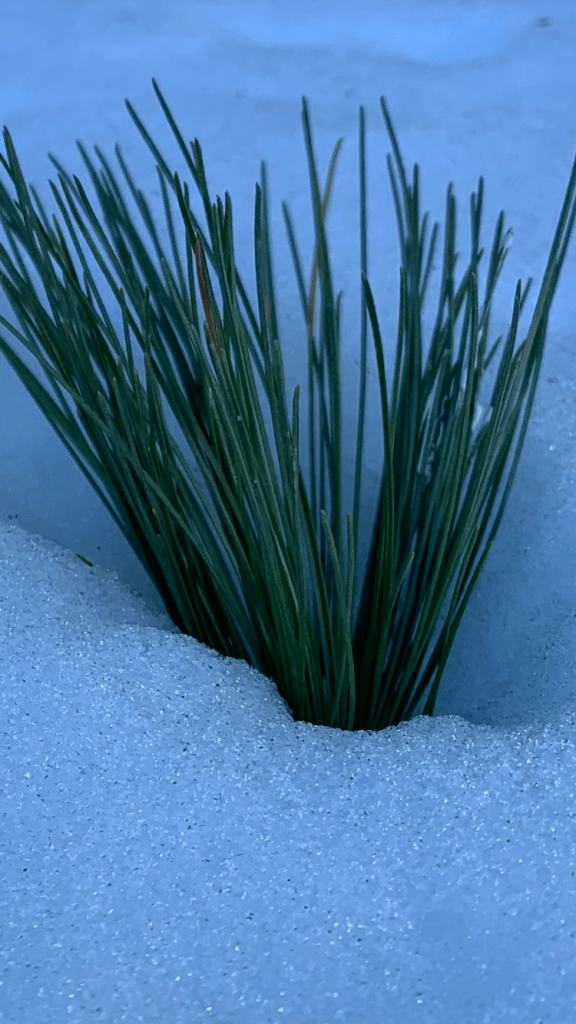
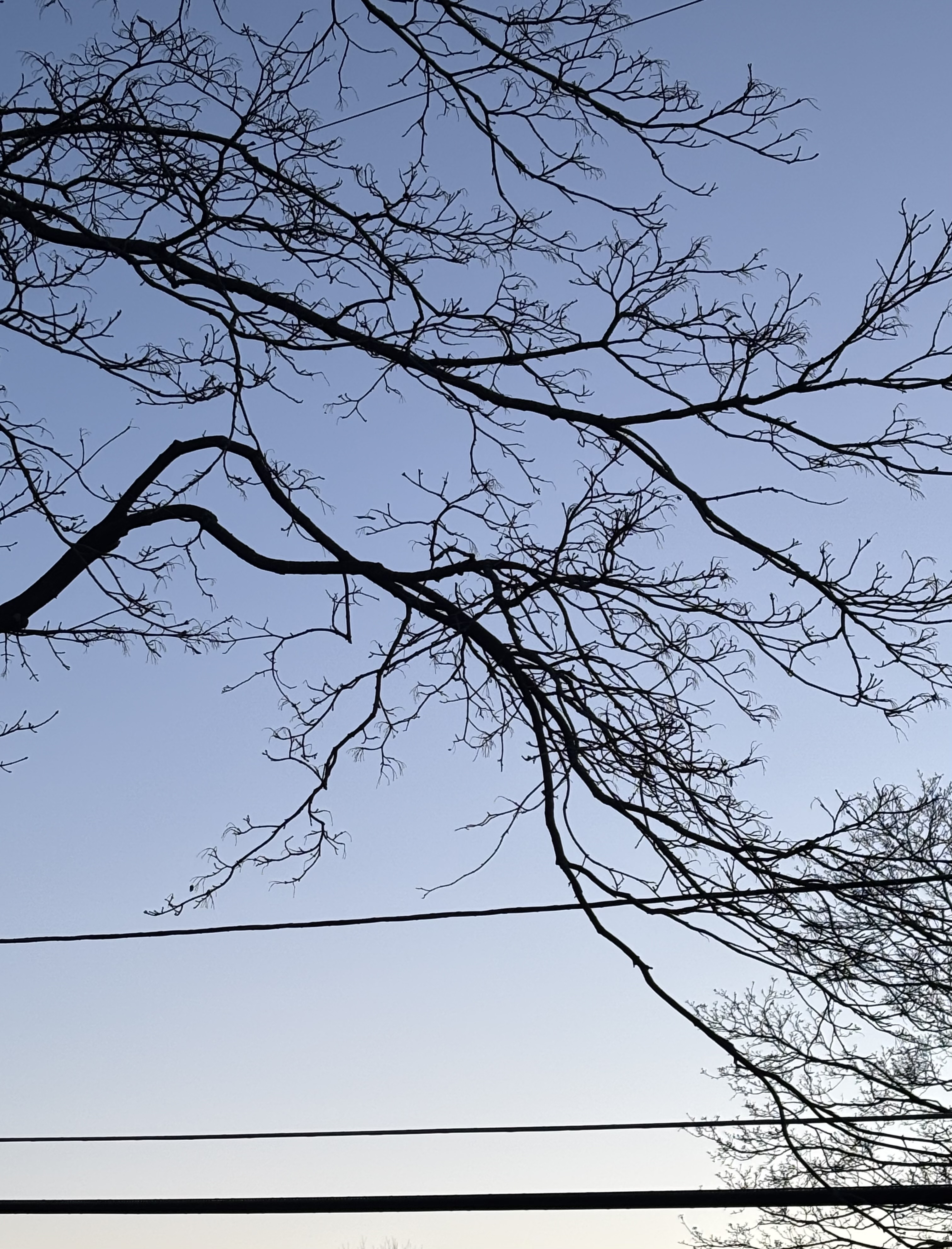
The phrase “On the cusp” can be misleading. There is rarely a single point, a moment of before-and-after in the passage from this-to-that. I smiled when she named this photograph “winterspring.” Yes. both/and. Not-this-and-not-that.

No passage is immediate. Caterpillars do not become butterflies in a snap. Teenagers do not become adults overnight. Transitions take time. Becoming is less a journey with an arrival than a discovery that “I am no longer that.”

Artistry is like that, too. Passions change. Not overnight but over time. What was vital to explore ten years ago seems distant, passé. The body of an artist’s work serves as a roadmap for their becoming, for their dedication to essence. Flip through the work of Matisse or Chagall. They grew simpler at the end of their lives as if pulled into a center. Michelangelo is another. At the end of his life, he broke form, entirely. It took the world 500 years to understand what he was chasing at the end.

We have been on the cusp for quite some time. Not-this-and-not-that.

Yesterday we walked the trail during the eclipse. The glasses were sold out everywhere so we didn’t see it. But we felt it in the light. We felt it when the light returned. The deer seemed to feel it too. Usually skittish, they held a quiet vigil. They allowed us to pass within a few feet. We reveled in the magic we experienced during the moon’s passage between the earth and the sun. We listened to news reports of people cheering. We talked of the intensity of the color.

“Someday we will look back on this time.” I said. “And, this is what we will remember.”

Three Graces, 32″ x 56″, acrylic on canvas

read Kerri’s blogpost about THE CUSP

like. support. share. subscribe. comment. thank you.

Reach Back To Move Forward [on Two Artists Tuesday]

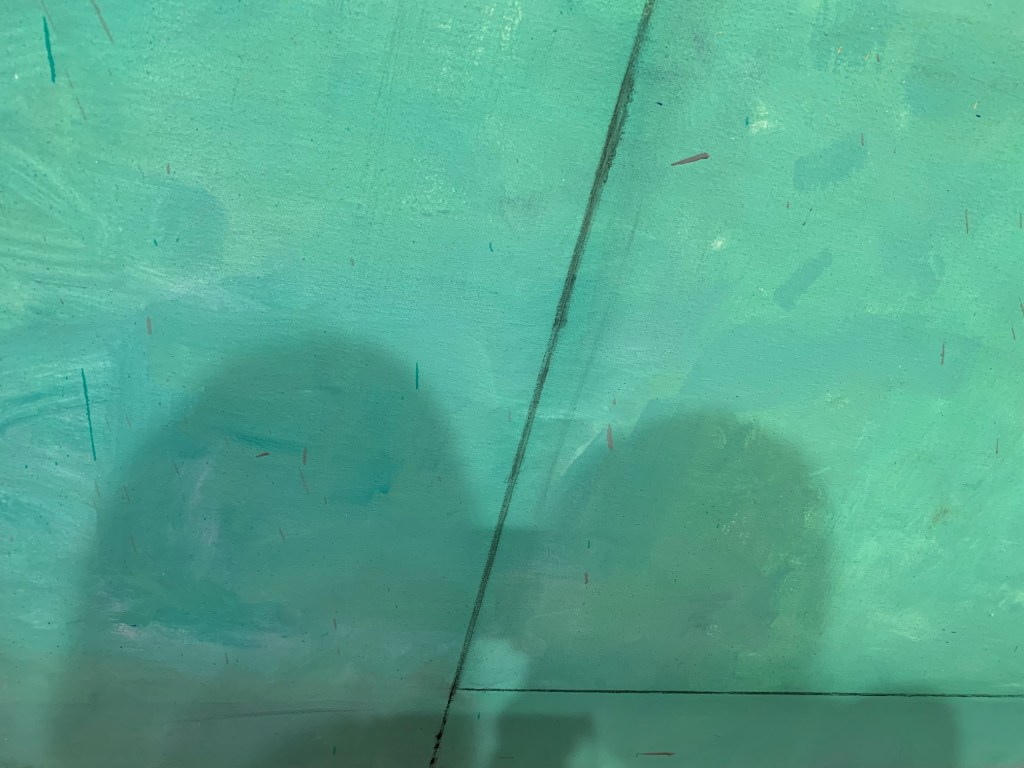
I wrote with great derision of the day I went to the Museum of Modern Art in NYC and watched people line up to take selfies with Van Gogh’s Starry Night. So, more than 15 years later, I howled with laughter at myself when Kerri beckoned me to stand with her so we might take a shadow shot with Diebenkorn’s painting, Ocean Park #68. “We’ll call it ‘Richard and Us!” she smiled.

Kerri recently challenged me to let go of my figurative work, release the image and paint my feelings. The moment before she beckoned me to take the shadow shot, I was having a minor revelation. There’s a reason I have stood in front of this painting for hours. There’s a reason it “talks with me” about simplicity and courage. Early in his life Richard Diebenkorn was a figurative painter. Even earlier, his work was abstract and resembled the paintings of the masters he admired. As his work matured it circled back to abstraction. He didn’t “let go” of his figurative work; he grew through it. He reached through it. In Ocean Park, he fulfilled his unique voice.

I read that his Ocean Park series was greatly influenced by the work of Henri Matisse. I imagined Richard Diebenkorn standing in front of his favorite Matisse, having a quiet conversation about simplicity and the courage to explore. In the gallery light, his shadow cast upon the painting as he moved forward to study the brushstrokes. He leaned in. He reached back to Henri to move forward. Had he lived in the age of cell phones and easy shots, I’m certain he’d have taken a shadow-selfie so he might remember the moment his shadow touched Henri’s.

We were alone in the gallery when Kerri took our shadow-selfie with Richard. We had him all to ourselves. We leaned in. I thought it especially poignant, our shadows cast upon a painting, an artist, who has cast his long shadow upon me. We caught the moment our shadow touched Richard’s. Reaching back to move forward,

read Kerri’s blogpost about RICHARD AND US

Trace The Line [on Merely A Thought Monday]

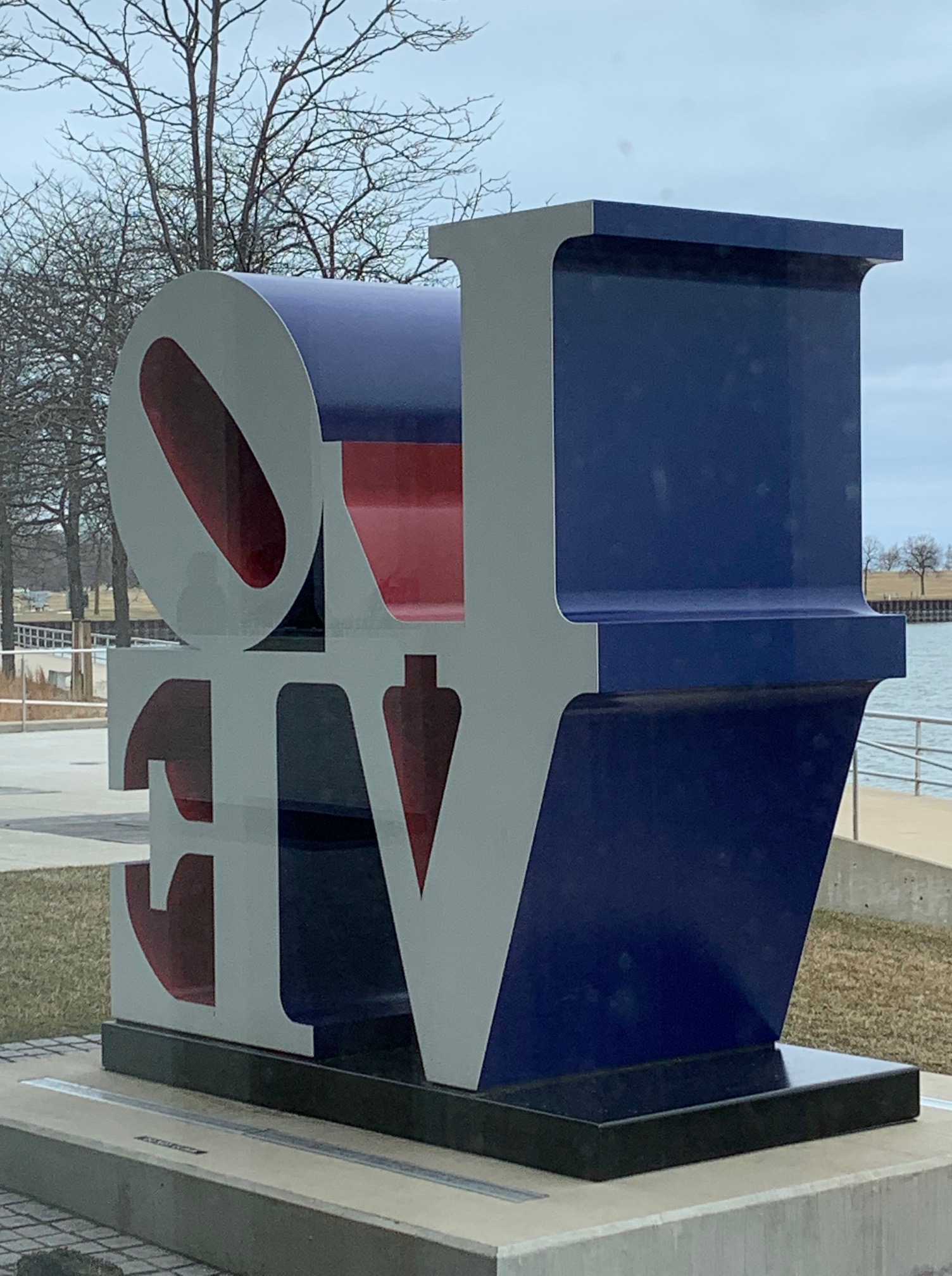
Love has a lineage. Without Piet Mondrian there would be no Ellsworth Kelly. Without Ellsworth Kelly there would be no Robert Indiana. For that matter, without Georges Seurat or Henri Matisse there would be no Piet Mondrian. Without the invention of the camera and the science of optics there would be no Georges Seurat. Of course, I’m referring to Robert Indiana’s sculpture, Love. We are rarely aware of how many lives influence our thoughts and give shape to our passing moments.

Love, the non-sculpted variety, follows the same principle in every life. It has a lineage. Chose any moment – any emotion – and follow the thread. An amazing web of interconnectivity emerges that stretches beyond…beyond. Sometimes I stop on a trail and wonder how I came to be walking through the woods in Wisconsin holding this woman’s hand. A tumble of choices. An immensity of influences and circumstances that quickly become impossible to comprehend. It’s no wonder destiny is such an attractive notion! Phew!

Four simple letters. Stacked symbols designed into another symbol. An aspiration? A graphic design? History placed Love in the box called Pop Art, thereby giving it a location-in-time. A starting point. A relative nod to lineage.

Standing in the museum, gazing out the window at Love, Dale Chihuly’s color explosion to my right, Kerri taking a photograph of the sculpture over the shoulder of a biker seated at a cafe table, the guard lost in his thoughts, a school tour echoing in the next gallery, a mural behind me that I’ve not yet taken in though it’s tapping me on the shoulder…meaning being made and shared and expressed all around me! How is it possible that we ever think we originate on our own? How is it possible that we ever think we walk this path alone?

read Kerri’s blogpost about LOVE

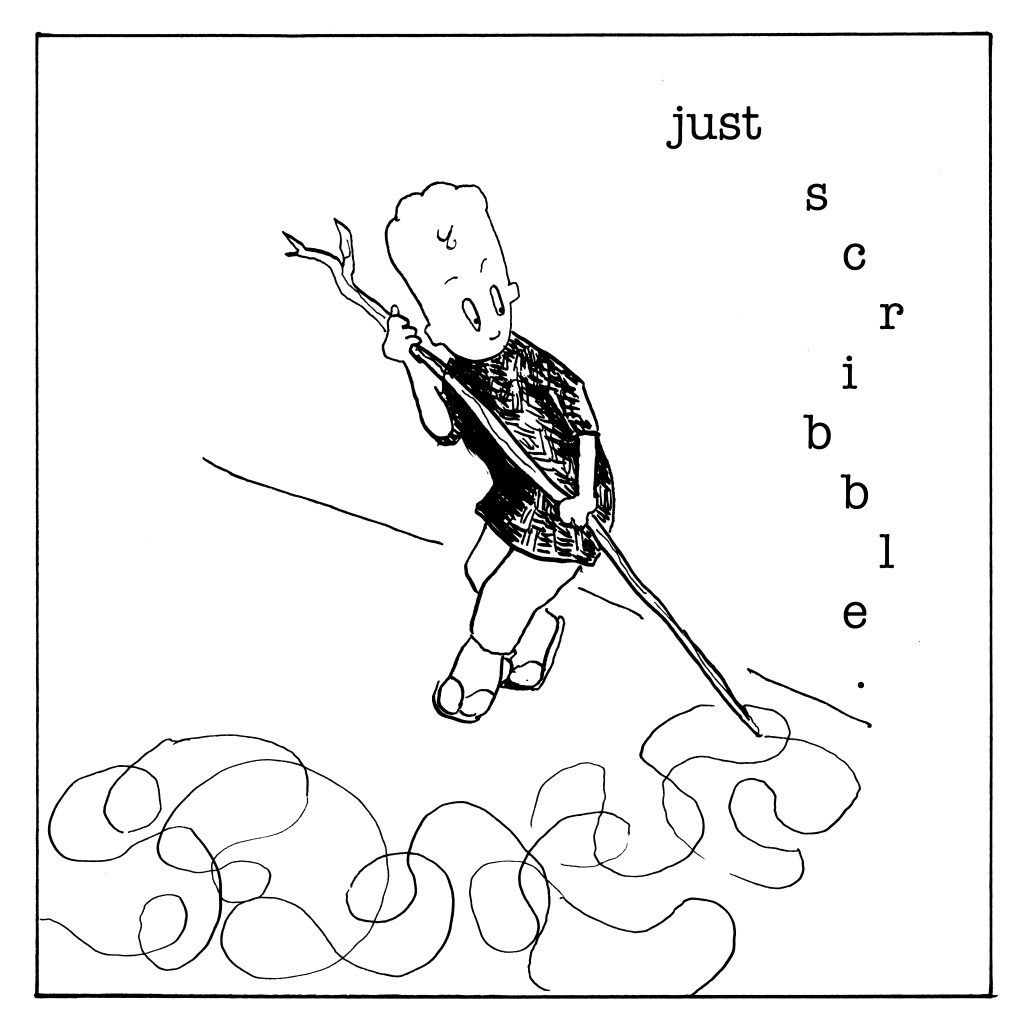
Scribble With Purpose [on DR Thursday]

Henri Matisse said, “Creativity takes courage.” I suppose that is true when considering the enormous pressures to conform to a style or standard. To create what is acceptable or expected. To suss-out what will be rewarded with approval and/or profit. In this context, it takes enormous courage to deviate. To explore. To surprise yourself by breaking form and risking ridicule and rejection and poverty. In this context, it takes courage to show up. It takes courage to punch through.

On the other hand, creativity is the most natural thing in the world. Ask any child. On second thought, please don’t ask any child since it will only confuse them. They have no idea that creativity – to an adult – is a separate thing. What’s scary and vulnerable to the tall people is commonplace to the little critters. There’s help for the older folks: allow the child-inside to scribble with abandon. Recognize that the story of, “I’m not creative,” is a creative act. The story of “It’s scary to create,” is also a creative act. It’s a story.

Creativity runs like wild horses through every day of our lives. Our perceptions and interpretations and fears are pure storytelling. The real challenge is not the absence of creativity but the conscious appreciation of our rampant creativity. The squeeze to conform serves as a heavy curtain obscuring our vibrant expressiveness.

The courage that Henri Matisse references is borne of the tension between the desire to be appreciated (to fit in, to succeed) and the yearning to break new trail or sail into undiscovered lands. To risk. To intentionally and publicly scribble outside the lines. To say aloud what needs saying.

Creativity is the most natural thing in the world. As it turns out, so is conformity. We are, after all, like wolves: animals that run in a pack. Humans die in isolation so serving the will of the group is a high priority. The wrestling match between creativity and conformity is necessary.

The progressive impulse. The conservative impulse. A bowstring drawn taut between these two poles provides the necessary tension to send the arrow of our ideas and dreams sailing toward the distant target. Children scribble with abandon. Grown up children, those telling themselves the story of “I’m a creator,” learn to scribble with purpose.

read Kerri’s blogpost about PUNCHING THROUGH

shared fatherhood, 25.5X40.5IN, mixed media on panel

shared fatherhood 2 © 2017 david robinson

chicken marsala/just scribble © 2016 kerri sherwood & david robinson