Mutually [David’s blog on Flawed Wednesday]

“Objects are such only with respect to other objects, they are nodes where bridges meet. The world is a perspectival game, a play of mirrors that exist only as reflections of and in each other.” ~ Carlo Rovelli via The Marginalian, April 27, 2025

The tree stands beyond our back fence, its limbs spiral and twist, sculpted by time and the force of the winds roaring off the lake. Looking at her photograph, a silhouette against an evening blue sky, I remarked, “It’s a Jackson Pollock painting.” She looked again at her photograph through the lens of my remark, nodding.

Nature sculpts the tree that catches the photographer’s eye, her photograph invokes images of a drip painting. “…interaction is the fundamental reality of the universe, that there are no entities as such…”

We do ourselves a great disservice ignoring interconnection in service to our separation.

It’s human: we need to make sense of things so we compartmentalize. We object-ify, detaching tree from time and wind from photographer, assigning all to discrete little box-identities, placing emphasis on the noun rather than on the interplay, the intertwining verb. In our minds we stop the motion, sever interrelationship into distinct pieces, so that we might convince ourselves that we have a grasp on “reality”. In creating objective “reality” we blind ourselves to the greater mutuality.

Science dissected the world-body into parts which led to the smallest objective part, called a quantum, and discovered it’s a slippery devil, energy, that can only be described subjectively. It can only be known through its relationships. Mutuality.

I’ve yet to hear an adequate definition of the word “woke”. Maga world flings it liberally and with sharp derision to describe all manner of “progressive” ideals, yet stutters when asked what it means. It’s an umbrella term, a catch-all, like the grainy photograph of the Loch Ness monster, shaky proof of something to be feared but mostly unknown. In fox land, this Loch Ness monster is called “socialism”.

To Maga world I offer this definition of Woke: greater mutuality. Woke, like a quantum, cannot be objectified just as compassion cannot be fully defined. It can be experienced. It is an energy, connective tissue.

Woke flies the flag of equality. Woke understands that the suspension of due process for any single person is the suspension of due process for all people. Woke understands that prosperity reserved for the few means poverty for the many. Woke intends shared prosperity, an equal playing field, helping hands. “Float all boats” is a Woke ideology. Woke is not a hand-out, it is a help-up. A moral center – also known as mutuality – is Woke; we can be our brothers’ and sisters’ keeper or we can be their persecutor. Keeper or persecutor: both describe a kind of relationship.

Woke is what defines Maga just as Maga is now clarifying Woke. Maga desires separation. It strives for elevation above others; legislated privilege. Woke desires equality. It strives for a more perfect union: legislated inclusion. The promise of possibility.

We do ourselves a great disservice: we are neither red nor blue. We are not conservative nor progressive. We are not Woke or Maga. Those terms are boxes that ignore the fundamental truth of our – or any – nation. We are interconnected. We are a relationship.

Remove environmental protections and all of the air we breathe and the water we drink will be polluted. Remove election watchdogs and all of our elections will be corrupted. Remove a commitment to truth and lies will define us and pull us apart.

After all, Maga is a made-up-media term just as is Woke. They are boxes meant to give us an enemy, the illusion of separation.

Democracy is not a “thing”, an object. It is a movement, a quantum. We know it by our interactions as defined in our Constitution. We know it as a place where bridges meet. Where people from many places come together.

Whether Maga or Woke, we will feel the loss of democracy equally just as we feel the disintegration of our values, our shared narrative, our aspiration for justice-for-all; mutually.

read Kerri’s blogpost about THE TREE
likesupportsharesubscribecomment…thankyou.

Connective Tissue [David’s blog on Two Artists Tuesday]

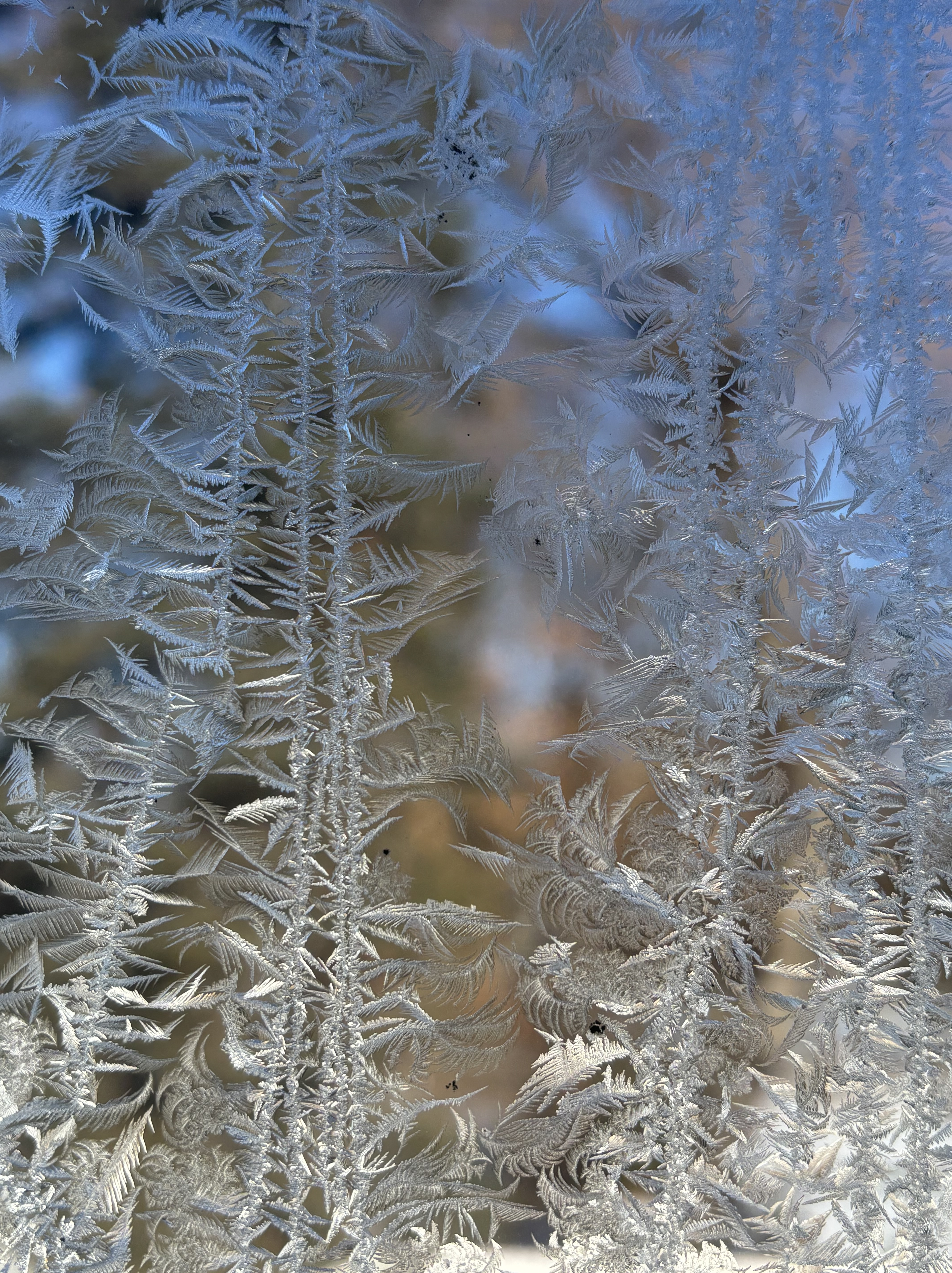
I literally watched the ice crystals blossom on the glass. I was Jack watching multiple bean stalks stretch and reach into the sky. They feathered and connected, the light behind them making the ice-miracle color-lush.

It brought fascia to mind. That is not as arbitrary a thought as it might as first seem. I am reading about fascia. Don’t ask me why. I won’t be able to answer. My reasons are not random, just hard to articulate.

Fascia is the connective tissue of the body. It not only wraps around muscle, organs, and bones, it also embraces every ligament, every joint, every nerve, every artery and vein, every cell of our bodies. Every thing. It is a paradoxical wonder: it is flexible but provides structure, it is soft and loose but provides support. It literally holds our bodies together. It gives us shape. Most amazing of all, it is continuous, a an unbroken tissue-web from the tippy-top of our heads to the farthest molecule of our big toe, from the outermost layer to the innermost core.

When fascia is stressed, it tightens. It grips. It holds down the fort.

It responds to sensory stimuli. It feels. Trauma, physical or psychological, can cause the fascia to lose flexibility; this loss is called “restrictions”. In other words, too much stress makes fascia grip and not let go. The restriction creates an energy eddy that solidifies. A hard spot. A place where toxins congregate.

The good news is that the eddy or restriction can be released – but never through force. Pressure only serves to make the grip tighter. Gentle oppositional touch, fascia yoga, will eventually send the message: you can let go now. Relax. Trust.

I remember watching Koyaanisqasti, the 1982 documentary composed of slow motion and time lapse footage, no spoken words, that explores our relationship with technology and nature. Koyaanisqasti is a Hopi word meaning “life out of balance.” I was awe-struck by the interconnectivity it revealed. We move as one whether we realize it or not. We are not separate from nature or the world in which we live. We are nature. Out of balance with ourselves.

My long lost pal Roger used to say that it is a trick of language that fools us into compartmentalizing our experiences. “When you hurt your toe, it’s not just your toe that is injured; your whole body is injured,” he’d say.

Every “thing” impacts every other “thing”. Separation is an illusion.

The second day. The fascia of the nation is stressed. Hard spots have formed. Our faith in the populace is strained. We tighten our grip. We isolate, circle the wagons and hold down the fort. It is early so we can do little more than shake our heads in disbelief. 77 million of us chose the path of hatred and gross indecency. We fracture. We necessarily emphasize separation, “I am not them.”

And yet, we…The whole body is injured.

Perhaps the fascia has some lessons to teach us about how we might deal with the trauma to our national body: the election of indecency, the elevation of a confederacy of dunces. It certainly provides clues for how we – those of us who did not vote for hatred – might regain a healthy equilibrium. Gentle touch. Send the message to one another, “I am here.” Not only are we more than opposition; we are the carriers of the spark of the ideal of democracy. We are the movement forward. Even though an abomination currently sits at the resolute desk, we are the connective tissue, the shape givers of our nation and of the future.

read Kerri’s blogpost about ICE

likesharesupportcommentsubscribe…thankyou.

Add To The Story [on Not So Flawed Wednesday]

Our water theme continues though, instead of pipes breaking, surprise waterfalls in the basement, or spontaneous fountains in the front yard, we’re dancing on the other side of the theme. What was broken or compromised is slowly, as we can afford it, being fixed or replaced. And, as metaphors go, I welcome what this implies.

It is our very own kintsugi. Golden repair – or in our case – copper repair.

“…treating breakage and repair as part of the history…rather than something to disguise.” We’ve consciously created our home to be a keeper of stories: the driftwood that adorns our mantel, the rock cairns stacked by the plants, the chairs in our sunroom… all tell a story. A walk on a special beach. A mountain top. The day the car broke down in Minnesota. Adventure. Routine. Accident. Surprise.

We have a series of old suitcases stacked in our dining room. They are our “special boxes.” Each is filled with momentos of our life together. Concert ticket stubs, birthday cards, notes, old calendars, the bits chain from Pa’s workbench that we once wore as bracelets… Our story fodder. Connective tissue to our shared history.

The copper that Mike-the-plumber has installed in key locations around the house serve as connective tissue to the era of water. Our house is a special box, too. It’s nearly 100 years old so we are a chapter in its story, stewards merely. The copper repair is a visual keepsake, a golden repair from a time when the old pipes and fittings, having done good work, let us know with no uncertainty that they were retiring.

We love this house. We love being stewards to its story. We love that it is the keeper of our story. And, lately, we especially love being on this side of the water era, putting all the pieces back together again, adding to our entwined history, with undisguised copper-gold.

read Kerri’s blogpost about COPPER PIPES

Roots & Wings [It’s KS Friday]

A composition of elements from studio melange on KS Friday

jacketrfthjpeg copy 2Kerri and I share this in common: behind each composition there is a story. My favorite moment each week as we prepare our melange blog posts is to ask Kerri about the story behind her ks friday music pick. There is always a top-layer story and then a deeper-layer story. And then a deeper story-layer still.

The best art is like that. It opens stories. It reaches deep down to the roots of being and then, through story, propels the human spirit to soar. Art is communal connective tissue.

This week in her blog Kerri shares the story behind Give Me Roots, Give Them Wings.  My story, as I listen and give over to the music is this: the first time I stepped into this house I was overwhelmed with the feeling of “home.” It was something I’d never in my life experienced. It was a warm rush of surprise and I laughed. Give Me Roots, Give Them Wings reminds me of that moment, of stepping through a door for the first time and knowing that I was finally home.


GIVE ME ROOTS, GIVE THEM WINGS on the album RELEASED FROM THE HEART available on iTunes and CDBaby

ROOTS & WINGS gifts and products

ROOTS WINGS product box BAR JPEG copy

read Kerri’s blog post on GIVE ME ROOTS, GIVE THEM WINGS

www.kerrianddavid.com


give me roots, give them wings – album released from the heart ©️ 1995 kerri sherwood

roots & wings designs and products ©️ 2018 kerri sherwood

Touch The Arc

A painting I did twenty years ago of my dad.

Years ago I started a portrait of my dad (we call him Columbus) emerging from – or returning to – a cornfield. At the time it seemed an odd painting, something more elemental than intellectual. Something I had to paint though I didn’t really know why. I thought I’d left portrait painting far behind. Columbus is from a very small town in Iowa so the necessity of the cornfield made some small sense. He yearned to live in the town of his birth and although life took him other places he maintained a deep heart-root to Monticello. For Columbus, Monticello, Iowa was and always will be home.

After laying it out, after applying the under painting, the portrait felt complete – or I felt complete. So, I stopped. I have carried it with me all of these years.

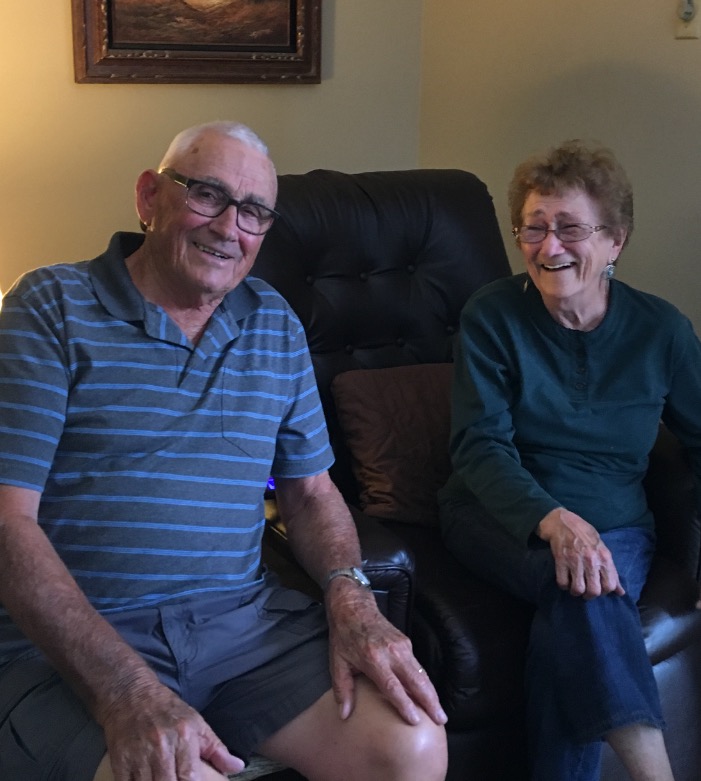
These days, dementia has its slippery tentacles around Columbus. He is a mighty combatant in this tug of war, a war that he cannot win, and feeling his strength waning, his single wish was to one last time visit Monticello. So, this past week, Kerri, my mother, and I – as Kerri likes to say – followed Columbus’ heart around Monticello.

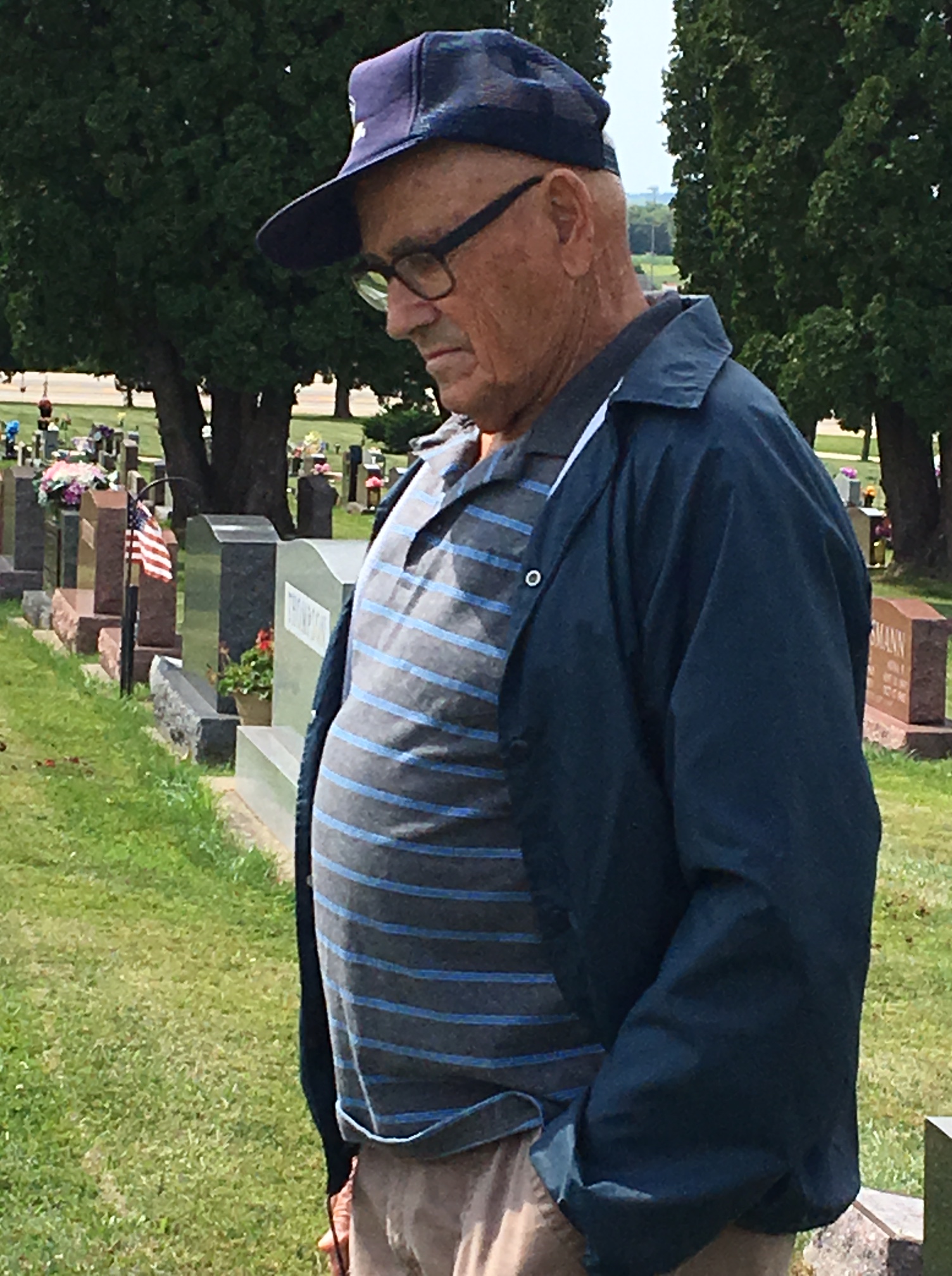
His heart took him three places. The first was to the cemetery. It is the place he will finally rest with his brother, parents, grandparents, aunts and uncles and friends. He wanted to wander. We followed him as he touched stones and told stories – stories he told to us but for himself: a friend who died too young in a car crash, a kind scoutmaster and mentor, an old girlfriend, a high school pal who flew an airplane and their adventures landing in cornfields. We followed, listening, renewed to the deeper truth that the stories we tell of others, the stories of shared time and experiences, both comic and tragic, when combined, scribe the arc of our own lives. Columbus needed to go to the end place to scribe his arc, to touch the depth and arc of his experiences.

The second place was the house that his grandpa Charlie built. It was the place of his childhood, the place of his greatest freedom, the place where all his stories begin and, now I know, where they return. This house is the cornfield. It is, for Columbus, the font of family and the source of his ideals. It is the symbol of his pride. This small house, with no electricity or running water, no indoor plumbing, this house that was pieced together with found material, smacked together with a handsaw and a hammer, an evolution, this house is Columbus’ holy ground. It still stands, just barely. And although now a storage shed for someone, it holds riches beyond words or measure. Columbus needed to stand in the source of his belief.

Finally, we followed his heart to visit his aunt JoAnne. She is only two years his senior but his aunt never-the-less. She is the last living person to know him through the entire passage of his life. She is his connective tissue, the one capable of affirming that it all happened, that the house and the people in it were exactly as he remembers, that this life, although only a minute long, is bottomless in the love that they share. They are the burning point of family, the front line. When we left her, Columbus and JoAnne hugged and cried, saying to each other but not for a moment believing it, “I’ll see you again.”

Stories told at the end place. Stories told from the beginning place. Stories told that connect the places. Columbus counts himself a lucky man. He knows with absolute certainty the trinity of places that hold his life/story. Sitting on the porch he (once again) taught me that stories – lives – are like a river and the flow transcends a single life. He just taught me that the story, a good life, like the painting, is never really complete.