This Storm [David’s blog on DR Thursday]

It seems our weather forecast is regularly filled with dire warnings. Violent thunderstorms. Hail. Tornadoes. We watch the radar as the angry colors move across the map, headed in our direction. So far we’ve been fortunate. In the final approach, the irate clouds veer to the north or break to the south. Sometimes they split and go around us. We catch the margins of the storm, the distant booms, the lesser winds.

After dinner we sat on the deck with 20. Earlier in the evening it was too cold to sit outside, the temperature by the lake was 10 degrees cooler than inland. When I stepped out the back door to cover the grill I was taken aback. It was warm and humid. We relocated outside and marveled at the odd shape and weird color of the clouds. We knew a storm was on the way, the warnings were apocalyptic, but our radar watch confirmed that, once again, it would mostly miss us. Kerri took photographs. 20 and I giggled, lapsing into middle-school-boy humor.

The weather forecast mirrors the augury of our nation. Climate change. Culture change. Waves of anger roll across the land in phallic-shaped storm clouds. We hunker down and monitor the radar. We watch the day’s news for the latest devastation, the senseless chaos, the mean-spirit that blows away our democracy.

Sitting on the deck, we acknowledged that we are collectively holding our breath. We know that there is no avoiding this retribution storm, this oligarchic money-grab. The fight that’s coming will not veer. The fight is already here. The fascist winds have arrived. We stock up as we do for any swelling tempest. We prepare our go-bag as we did during the recent riots. We reassure each other that sense and sensibility will ultimately win the day. Decency will return. And, in the meantime, the warning sirens blare. We do what we can to fight the rising autocracy. We do what artists do.

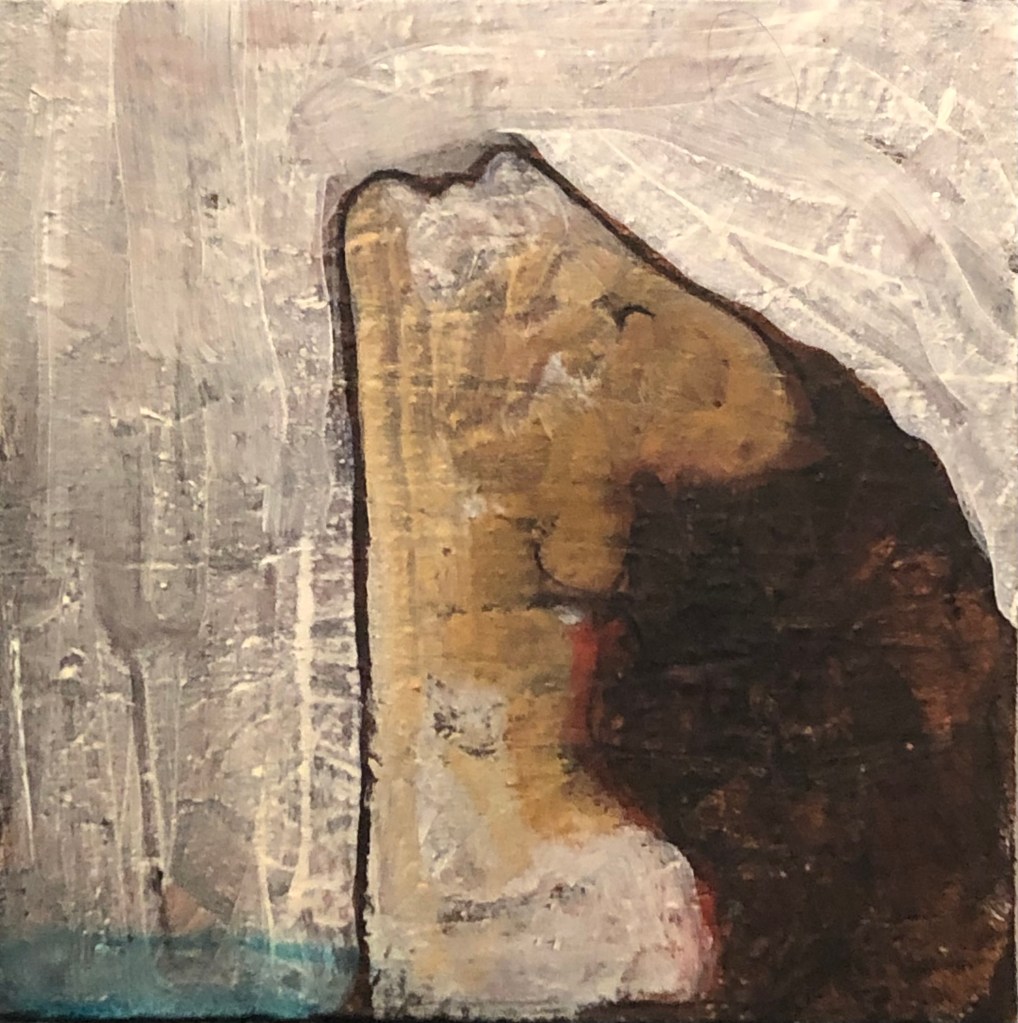
Coming Up For Air (sketch), mixed media on canvas

read Kerri’s blogpost about the STORM CLOUDS

likesharesupportcommentsubscribe…thankyou.

As If [David’s blog on Two Artists Tuesday]

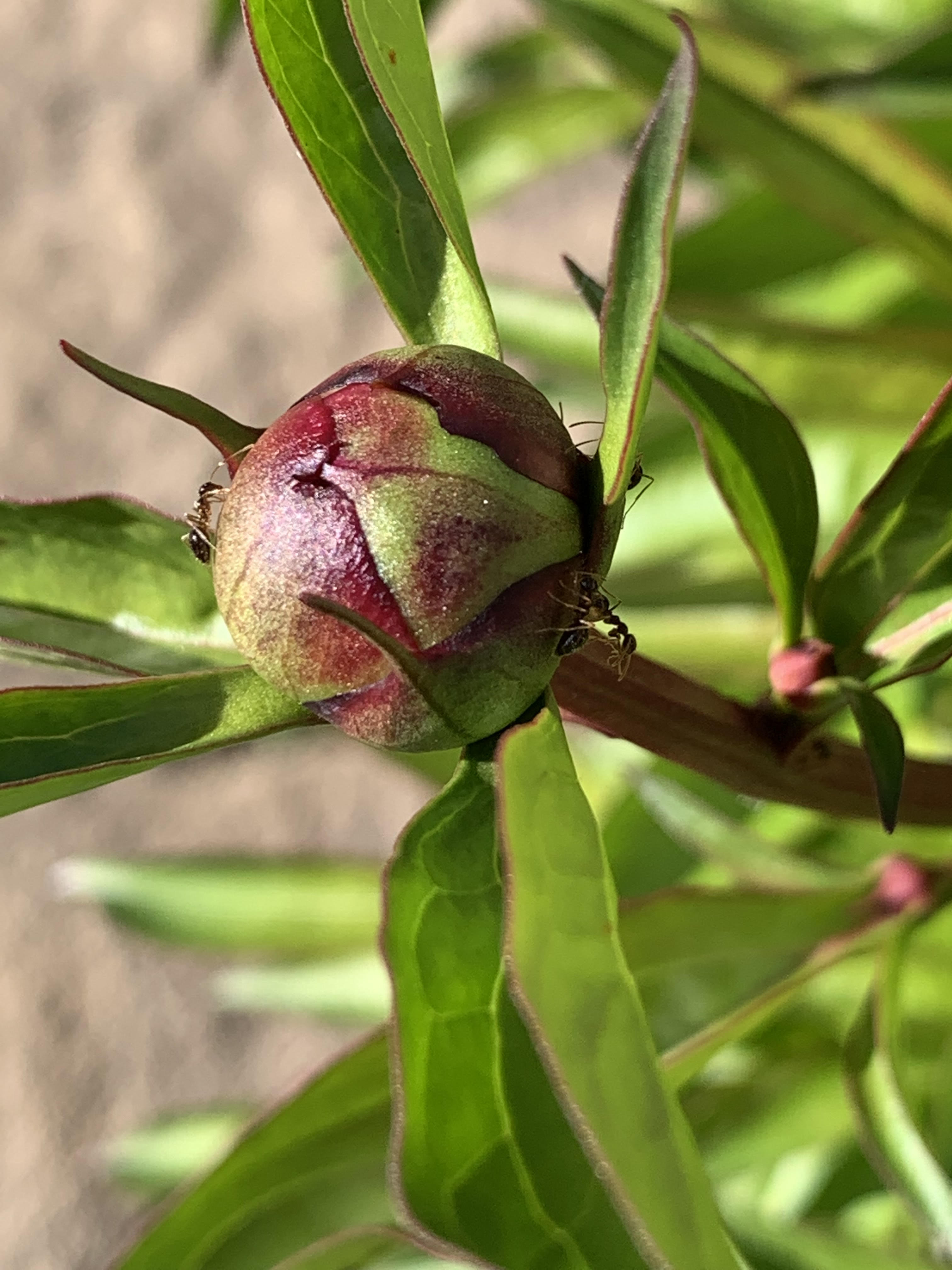
In a festival of irony, the moment we sat down to write about our peony, our harbinger of summer sun and the return of good weather, the sky darkened, the lightning flashed, the thunder clapped, and the rain is now dropping in buckets. The weather alert screeched with a warning for hail and possible tornadoes.

I delight in how readily my superstition-gene leaps out of the murky depths of my subconscious pond and concocts fabulous explanations about current circumstance. That is, as a human-being, a maker of stories – I am quite capable of connecting the rush of the sudden storm with our attempt to write about peonies. As if our attempt to write about peonies somehow invoked the storm!

This is not surprising. It is nothing new. My ancestors – and yours – created all manner of rituals in an attempt to appease the angry thunder-hurling god. To influence the powers of dark and light. To invite good fortune. To bring rain to crops. We have always personified nature and then imagined it is responsive to our behavior. Our behests. All around the globe, in many varied and culturally diverse forms, we do it in houses of worship to this day.

It might seem that I am making fun – and I am – but more than that, I am marveling at our genuine desire to be connected to “something bigger” and yet how rarely we recognize that we already are. We are as the peony, not separate from but a part of the pulse of life. We are of nature – not separate from it. My theory is that we have a hard time recognizing it because we imagine that we can control it. We use it to explain what we experience. We use it to justify our abuses to each other. Chosen people; Manifest Destiny and all of that ugly business. The personality we project upon it is at once beatific and horrific. We wonder why it blows our house away. We thank it for our good fortune.

In truth, we do influence Mother Nature and Father Sky, just not in the magical ways we imagine. Carbon emissions. Tapping mighty rivers dry before they reach the sea. Dumping our trash in the oceans. Fracking. It turns out that our behaviors are powerful and, perhaps, our destiny is in our hands. We need not pray to the gods for intervention and salvation, perhaps we need to be the gods of intervention that we desire to be, recognize and behave as if are not above it all, giver of names, but integral, intrinsic, no more or less essential than the peony.

read Kerri’s blogpost about THE PEONY

like. support. share. subscribe. comment. or not – it’s all good.

Choices?[David’s blog on Two Artists Tuesday]

Today we walked our trail and the frog symphony was in full swing. It stopped me in my tracks. They are about 3 months earlier than last year. Enough said, I suppose. Except for this: it’s not a surprise, is it?

Tom used to ask, “When does a story begin? When does it end?” He was struggling to find a logical place to begin his Lost Boy narrative. Did it begin when he found the box hidden in the wall? Did it begin when the boy died and his mother plastered his life possessions into the wall of the farmhouse? She told no one. Did the story begin with the mother, when she was a little girl crossing the prairie in a covered wagon, the day they buried her little brother on the trail, never to be found? All are good choices. None are right or wrong. They are choices.

The sunset illuminated the brick. Blonde cast with orange and pink. A shadow is cast in the low light. It’s February and feels like May. Tomorrow it will feel like February again…for a day. I told my friend in California that, this year, I’ve not yet touched my snow shovel.

When did this story begin? I can’t point to the moment since the story has been with us for so long. My college sociology teacher was the first person I heard utter the words, “Global warming.” Decades ago. He gave a lecture on choices. “At this point, we have choices.” Not an exact quote but close enough. It was lost on us, the future seemed so far away. Someone else will make the right choices.

It is certainly more present. The tulips are popping up. We are, as I write this, under a tornado watch. In Wisconsin. In February. “Weird!” we say.

A pertinent question: When does this story end?

read Kerri’s blogpost about SHADOWS

like. support. share. comment.

buymeacoffee is a leap of faith, a choice to make, a cake to bake. A gratitude we shake.

Find Hope [David’s blog on Two Artists Tuesday]

To say our weather has been weird is an understatement. It is February in Wisconsin and I’ve not yet used my snow shovel. I know that a mile or so inland there has been some substantial snow – some – but here, by the lake, not so much. We’re having rain and fog. Seattle in Wisconsin. The world just recorded the warmest January on record.

We just finished watching a three-part National Geographic series, Arctic Ascent with Alex Honnold. A scientific expedition across remote Greenland with two objectives: to gather data on climate change from arctic glaciers, and for Alex and his climbing team to make a first ascent of Ingmikortilaq, a wall 1000ft taller than El Capitan in Yosemite. Beautiful, extreme, unimaginable. Breathtaking. The lead scientist on the team, Heidi Sevestre, much to her surprise, finds hope in her research. Although the glaciers all around are melting at an rapid rate, the Daurgaard-Jensen glacier remains stable. “This glacier is holding on,” she said.

Holding on. Across time, human being have been brilliant at spoiling their nests. Societies disappear when they either pollute or exhaust their resources. Historically, we’ve rarely demonstrated the wisdom to change our behavior before losing it all. We are on track for a repeat performance, this time on a global scale, so it was curious that this single glacier, to date, was somehow impervious. Hopeful. “All is not lost,” Heidi Sevestre suggested.

Resilience. Tom used to tell me that he was often stunned by the resilience of some children. They were capable of transcending unimaginable odds, emerging from their fire with humor and balance and wisdom. “They give me hope for all of us,” he said.

Alex Honnold and Hazel Findlay, against all odds, climb an impossible wall. Heidi Sevestre finds impossible hope in the movement of a single glacier. “These are the people I want to emulate,” I tell Kerri. They are upbeat. Positive. Generous with each other. Generous because of each other. “These are the people who give me hope.”

read Kerri’s blogpost on FOG

comment. share. like. support. thank you.

buymeacoffee is a bit of hope in a steep upward climb.

Count The Surprises [David’s blog on DR Thursday]

The weather by the lake is often different than a mile inland. While the rest of our area was buried in snow, we had slush fall from the sky. This was not graupel or sleet. It was as if the 7-Eleven-in-the-sky opened the Slurpee nozzle and it filled up our back patio with slushy like a kiddie pool. Only the color wasn’t neon lime. And then it froze. I grew up in snow country. I’ve lived all over this nation. I’ve never seen Slurpee pour from the heavens. It was a surprise.

The second surprise was even more curious and beautiful. When it froze, the slush formed into polka-dots. Ice circles similar to the phenomena that occasionally occurs on the lake. I’m certain there’s a meteorologist out there who can explain what happened in our back yard – and it’s on my list to investigate – but for now I want to sit in the awe of the tiny circles.

The third surprise came with the blizzard and deep freeze that followed the next day. Again, our area was buried in snow yet we had nary an inch. What we did have was a waterfall that poured in the back door. Lovely and cold. Definitely surprising. I opened the door to let Dogga out and stared through the streaming water – as if I was standing behind a waterfall. Only then did I realize that my feet were soaked. And then I realized that in the sub-zero temperatures, the waterfall was quickly freezing. Kerri met my soaking wet excitement, “We have a problem!” with her usual stoicism. It arises in crisis moments. She took one look at the waterfall, yawned and said, “Ice damming.”

And then she went to boil water. Focus on the solution and not the problem.

We spent the entire day on ladders, pouring the boiling water and using a hair dryer and rubber mallet on the roof of our house, breaking the dam, and draining the reservoirs that formed behind them. Ice damming usually involves the gutters but not this time. Those ice circles, the miracle delivered by Slurpee from the sky and subsequent freeze, made a perfect wall of ice running the length of the roofline.

It was the fourth surprise, something I’d never seen before. The dam was my least favorite and the most labor intensive, but I have no complaints. In a world awash in “same-old-same-old,” I can say with confidence that this week was nothing less than a festival of the unexpected, a celebration of surprises. Who wouldn’t be grateful for that!

visit my gallery site

read Kerri’s blogpost about SURPRISES

like. support. share. comment. warm your heart and ours.

buymeacoffee is…

Tell The Deeper Story [David’s blog on DR Thursday]

Walking on our trail in the middle of December, we rounded a corner and stopped. The dramatic shadows of the trees made long and distinct by the low-to-the-horizon winter sun. “It’s mid-December,” she said, “And the grass is green…” Looking at the photograph I’d guess that it was taken on an early spring day. In the era of climate change, it’s not so hard to see the story behind the story of this green, green grass.

What’s the story behind the story? There’s always a deeper story to tell. Always.

On my easel is a canvas marked with a few charcoal lines. A bare-sketch of two people and a puppy. The story? On a rainy fall day, driving the back county roads, Kerri and I rescued a puppy. It was lost and scared.

The story behind the story? When we saw the puppy we had a long drive ahead of us. We were trying to get to Madison. We spotted it at a crossroads. Turn right and go to the puppy. Turn left and keep our appointment in Madison. We turned left. And then in one swirling circle motion, immediately turned around. The first impulse: we’re late! This is not ours to do. The second impulse: who cares! this is exactly ours to do. The moment the shivering-scared soaked puppy jumped into our arms, nothing else in the world mattered. Nothing. The superficial dropped away and the essential came roaring into focus.

We named him County Rainy Day. Rainy for short. We dried him off and fed him crackers. He didn’t have a collar so we called Jen and asked her what to do. We played and laughed and snuggled with him in the cab of the truck. Finally, after giving our hearts to the puppy, we took Rainy to a shelter. He was reunited with his family.

I confess, we’ve returned to the spot where we found him. Just in case. He stole our hearts but more importantly, he brought us to our hearts. There is always a moment of choice. Turn left. Turn right. The list or the life? Behind each act of kindness is a moment of choice. Behind each act – of any kind – is a moment of choice. The story behind the story.

a detail of a sketch. a work barely in-progress. county rainy day

visit my gallery site

read Kerri’s blogpost about GREEN!

like. share. support. comment. your choice and all are appreciated.

buymeacoffee is a choice made at a crossroads. nothing more. nothing less.

Clear Your Mind [David’s blog on Merely A Thought Monday]

There’s nothing like a walk in a garden to clear your mind. It was the end of the week – or was it the beginning? In any case, our brains were overloaded. We sought a garden.

So the story goes, Adam and Eve lost their spot in the garden. They ate from the tree of knowledge and started to think about things. They became self-aware, a by-product of apple-eating, they had to tell stories of where they’d come from. They had to tell aspirational stories of where they wanted to go. They made rules. Look back. Imagine forward. Neither direction is true in the absolute sense of the word. Memory and imagination are not fixed. They are fluid, changing, like a stream.

Listening to our stories it’s easy to conclude that this good earth couldn’t possibly manage without us. As global weirding progresses, it’s likely that we’ll learn the opposite of our control-story is the case: we can’t possibly manage without the good earth. We may have to adapt our narrative! We may have to consider that the garden and its many inhabitants didn’t really need names; we invented knowledge-management to suit our purposes. We might need to recognize that we invented all forms of management to suit our narrative.

We like to tell stories of being in control, of being at the top of the pyramid. We especially like narratives placing us at the center of the universe – and the micro level variety: being the chosen ones. Believing that it all spins around us is, well, comforting. Or hubris. Or both.

Of course, our story is pocked with kill-joys like Galileo. Though, to be fair, even though his telescope proved beyond a shadow of a doubt that humanity is NOT at the center, it’s had very little impact on our dedication to being all important. Above it all. We are a tenacious bunch when our story of primacy is threatened.

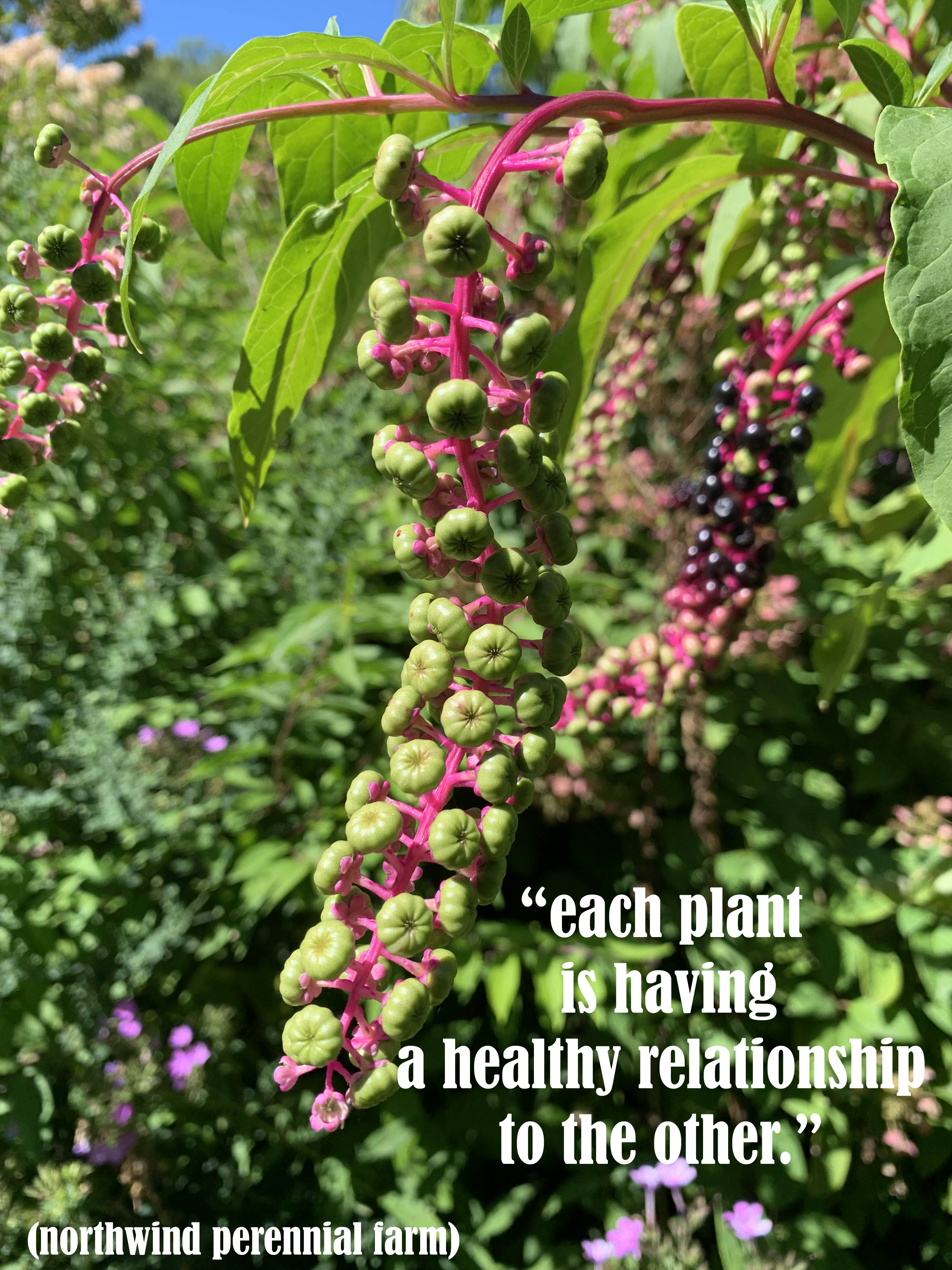
I was especially moved by the sign in the garden and wondered what it would take for us to turn the tables and imagine ourselves as part of the spinning universe rather than above-it-all. There are plenty of examples to draw from, humans in symbiotic relationship with their garden. Listening rather than instructing. Spinning with.

I think that is why, when our brains are overloaded, we head to the garden. A return to our senses. We breathe. We listen. We feel. We clear our minds and, even for a moment, re-enter a naturally healthy relationship.

read Kerri’s blogpost about HEALTHY RELATIONSHIPS

like. share. support. comment. thank you.

Discover Again [on Not So Flawed Wednesday]

Some books sit idle on my shelf for years and then, one day, with no warning, they leap forward and demand to be read. And so it is with Vāclav Havel’s book Disturbing The Peace. It is my new 2-page-a-day-meditation-book. I’m only a few pages in but already finding the words of this playwright-become-president of the Czech Republic, published in 1991, speaking clear thoughts to the un-united-united-states of 2023.

“It seems to me that if the world is to change for the better it must start with a change in human consciousness, in the very humanness of modern man.”

The change in consciousness? It is this:

“He must discover again, within himself, a deeper sense of responsibility toward the world, which means responsibility toward something higher than himself.”

He writes that we must extricate ourselves from “the mechanisms of totality” and the “manipulation” of media. We must “rebel against [our] role as a helpless cog in the gigantic and enormous machinery hurtling god knows where.”

Climate change. Attempts to white-wash history rather than learn from it. Populism and a republican party dedicated to authoritarian rule rather than the democratic ideals they are sworn to uphold. The absence of a moral center and, to use a phrase from the past, common courtesy. Courtesy to the commons.

Vāclav Havel led his country through their great chaos, the tension of their divide, power struggles, and the collapse of repressive communism. He was an absurdist playwright. He did not pretend to have answers. He had abundant questions. He argued for the simplicity of confronting the tasks at hand, tasks that are the responsibility of all the people in a nation, tasks like honestly looking at and dealing with their full history. Tasks like turning away from anger-inducing propaganda, conspiracies and lies – and learning to discern what has merit and what does not. In other words, transcending individual-self-serving-belief-bubbles in order to realize and secure the higher ideals of the community.

Every book has its time. I find it extremely hopeful that this book chose this moment to jump off the shelf.

read Kerri’s blog about SKY-THROUGH-TREES

share. like. support. comment. we appreciate it.

Act For The Benefit [on KS Friday]

We are hunkering down today. The smoke from the Canadian fires has arrived and the air-quality-index reads “Poor” to “Dangerous.” My head hurts. I feel as if I can’t catch my breath. A glaring example of interconnectivity. Airspace knows no nation. Not really. All for one and one for all.

I Googled the phrase “All for one and one for all” wondering if it was yet another clever Shakespearean quote. It is but the good poet didn’t originate it. He borrowed it from the Latin or from Aesop. I read that now-a-days it is the unofficial motto of Switzerland. “Each individual should act for the benefit of the group, and the group should act for the benefit of the individual.”

Aesop was born circa 620 BCE so the idea that we should – and could – act for the benefit of all is not a new idea. It may be the most basic of human survival necessities. Aesop popped it into a fable since storytelling is the original-and-best form of adult learning theory. On a side note, someone who composes and/or tells fables is called a “fabulist.” Had I known sooner I’d have spattered that on every business card, used it at every social gathering: “What do you do for a living, Mr. Robinson?”

(humble chuckle) “Oh, you know, I’m a fabulist. Here’s my card…”

Kerri snapped this photo of Meadow Hawkweed. It’s important to our story of Canadian smoke in American airspace because its healing properties include the treatment of asthma and other respiratory ailments. All for one and one for all includes the world of flora and fauna, too. The whole knows no parts just as the airspace knows no nation.

In my dystopian fantasy, when we warm the globe sufficiently enough that systems collapse and smoky air is the new norm, I’ll corner the market on Hawkweed. Just-kidding. I’ll share what I know with whomever needs help breathing. And, while waiting for the healing to kick-in, I’ll tell some stories of people helping people. Like Aesop, I’ll try and plant the seed for a better world. Once a fabulist, always a fabulist.

in a split second/as sure as the sun © 2002 kerri sherwood

Kerri’s albums are available on iTunes and streaming on Pandora and iHeart Radio

read Kerri’s blogpost on HAWKWEED

Like it? Like it. Or share it. Or comment. Or buyusacoffee. All are greatly appreciated.

Utter Life [on Not So Flawed Wednesday]

The theme of the mural is “humanity represented through different stages of life through song.” Past, present, future. The song of Sorrow. The song of Joy. The song of Hope. It’s painted above the proscenium arch of Chicago’s Auditorium Theatre, designed by artist Charles Holloway, the words at the apex are “The utterance of life is a song, the symphony of nature.” The symbols of his time.

Even as I write this, the birds this morning are in full-song. The utterance of life. The symphony of nature. Dogga barks to round out the bass section. Yesterday, standing on the bridge over the Des Plaines river, as we watched two deer amble across the trail, the ancient sound of Sandhill cranes croaked from above and two gawky-yet-glorious birds careened in for a landing on the sandbar just to our right. “We’re smack-dab in the middle of a National Geographic special,” Kerri whispered.

Sitting in the auditorium I wondered why the song of the past is Sorrow. Hope, Joy…Sorrow? It seemed a mismatch or, perhaps, a wrong assignment. Most of the people I know are suffering in the present moment. They sand off the rough edges of their memories so they remember their life-walk fondly. The song of warmth.

Honestly, the mural reminded me of another painting, a piece by a master-painter that lived during the same period as Charles Holloway. Gassed by John Singer Sargent. It was not something that sprung from his imagination. He witnessed this moment. A man who’d spent his entire life painting portraits of the elite. A genius artist. He painted his composition from what he sketched that day and it has become a symbol. The suffering of his present moment. The sorrows of the past in a world that had lost its mind. As testaments of the horrors of war, it lives up there with Picasso’s Guernica.

I just took a peek out of the window at the bird feeder. In addition to birds eating the seed, at the base are chipmunks, a squirrel, and the adolescent bunny. The song of Joy is also available in the present moment. I wonder, if I was commissioned to paint a mural over the proscenium arch of an enormous theatre, what would I paint to represent the human condition? The songs of past, present, and future?

It was a National Geographic Live event that brought us to the Auditorium Theatre: Coral Kingdom and Empires of Ice. The brilliant underwater photography and the lifetime exploration of a husband and wife team: David Doubilet and Jennifer Hayes. Among other things they’ve documented the impacts of climate change in the oceans. Even amidst the loss of reefs and disappearing ice that sustains life, theirs was a message of Hope. They infused us with their rich hope, drawn directly from their duet with nature. The utterance of life. Interconnected. The song of the future.

read Kerri’s blogpost about THE MURAL

coffee or like it or forward it or talk to us. All are appreciated!