Speak Out Of Turn

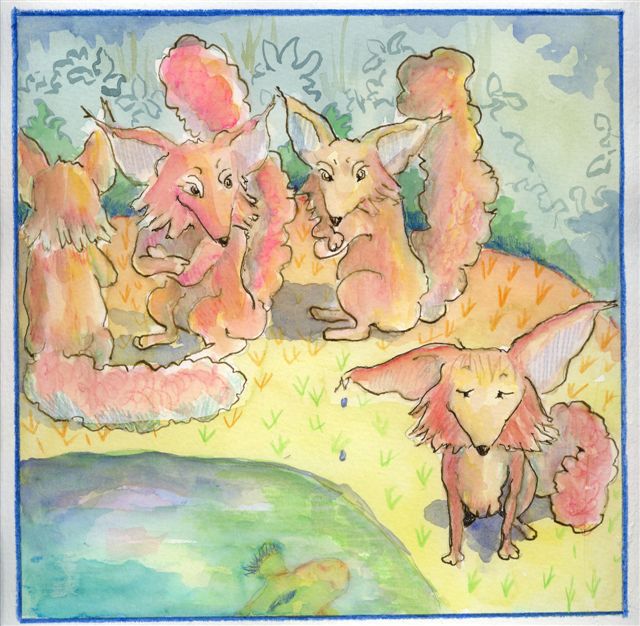
From my book, Lucy & The Waterfox. The waterfox is shunned for deviating from the norm.

From my book, Lucy & The Waterfox. The waterfox is shunned for deviating from the norm.

I’m not supposed to be writing about the system of education in America. It is a topic that I made off limits for myself because I was ranting too much. I finally allowed myself to admit what I’ve known for years but refused to accept. Our system of education is not broken and never has been; it was designed to create maximum docility and is succeeding magnificently. I decided to open the off-limits file because I just posted a question concerning education inspired by my friend and retired superintendent, Arnie Glassberg, and then this morning the same news story featuring the resignation letter of a teacher came across my screen three times. It is tragic to read and resonated with me: after a career playing in the fields of innovation and change in education, I now have a hard time driving by a public school without shuddering.

For grins I googled “origins of education in America (it was the subject of Arnie’s comment to me),” and came up with more than a few options but was struck by how many of the links topping the list concerned the reprehensible origins and intentions behind this thing we continue to call school. Several were articles, speeches, and youtube clips of John Taylor Gatto, a former New York state Teacher of the Year and most well known for his book, Dumbing Us Down. Here’s a bit from a speech he gave several years ago to a home schooling conference in Vermont:

The secret of American schooling is that it doesn’t teach the way children learn — nor is it supposed to. Schools were conceived to serve the economy and the social order rather than kids and families — that is why it is compulsory. As a consequence, the school cannot help anybody grow up, because its prime directive is to retard maturity. It does that by teaching that everything is difficult, that other people run our lives, that our neighbors are untrustworthy even dangerous. School is the first impression children get of society. Because first impressions are often the decisive ones, school imprints kids with fear, suspicion of one another, and certain addictions for life. It ambushes natural intuition, faith, and love of adventure, wiping these out in favor of a gospel of rational procedure and rational management.

Compare this quote (or read the text of his speech) with the teacher’s resignation letter making the news today. I’ve read a similar letter each spring for the past several years; a teacher – probably a great teacher – can no longer participate in the creation of docility in children and in themselves. They admit what they’ve known for years: the intention of they system they serve is the opposite of what it purports: they can no longer wipe out their natural intuition with the gospel of rational procedure (standardized tests).

John Taylor Gatto’s quote reminded me of the first few pages of one of my favorite books, Teaching As A Subversive Activity, by Neil Postman. It was published in 1969. Here’s a snippet from page 2:

In our society, as in others, we find that there are influential men at the head of important institutions who cannot afford to be found wrong, who find change inconvenient, perhaps intolerable, and who have financial or political interests they must conserve at any cost. Such men are, therefore, threatened in many respects by the theory of the democratic process and the concept of an ever-renewing society…Such men as these would prefer that the schools do little or nothing to encourage youth to question, doubt, or challenge and part of the society in which they live, especially those parts that are most vulnerable.

Retarding maturity has long term consequences: a population that is 1) incapable of the necessary self-awareness that comes with maturity cannot recognize how far it has drifted from it’s center and, 2) even if it did see the tower tipping, it is incapable of meaningful action as the conjoined twins of passivity (born of fear of speaking up) and divisiveness (do you really think the red state/blue state nonsense has no origin or implication?) have been so thoroughly thrummed into the national anthem.

To loop back a few posts to Master Marsh’s quote that keeps on giving: I’ve come to believe this is less about can and can’t than about the challenge of doing. And not doing is always easier.

Complaining is no substitute for doing. Neither is ranting, which is why education is off limits for me. I do not know what to do and have no belief that a butterfly will come from a system directed by a few small minds so hell-bent on remaining a caterpillar.

The only thing I can think to do is echo a sentiment offered by John Taylor Gatto in this short clip: the system is great at hammering the individual deviant but is incapable of handling a mass of deviants. To the teacher who resigned in frustration and all those who have, will, want to, or do not yet know they can, join hands. Become a mass and deviate. Do the thing that you’ve been so trained not to do: speak out of turn. Stop raising your hand and join hands. The kids can’t resign and they need you to, as Neil Postman writes, become a “shockproof crap detector.”

Go here to get my latest book, The Seer: The Mind of the Entrepreneur, Artist, Visionary, title_pageSeeker, Learner, Leader, Creator…You.

Go here for hard copies.

Give Yourself Some Advice (3)

A younger version of myself rehearsing for The Creatures of Prometheus. The tats are fake!

A younger version of me rehearsing for The Creatures of Prometheus with The Portland Chamber Orchestra. The tattoos are fake!

[continued from GIVE YOURSELF SOME ADVICE (2)]

Here’s the third and final section of Horatio’s Advice To Myself. He sent it to me in an email last week. Horatio is one of my dear companions in art and artistry and I was so moved by his words that I asked him if I might post his thoughts. Were I still teaching young artists, this would be required reading:

Do not make work that attempts to control others. That is only advertising or propaganda and sustains no one. Make work that connects to others. That is sustaining. 

Do not make work that exalts yourself alone. That separates you from others.

Walking is good for you. Eating and sleeping are good for you. Loving is good for you. All those things sustain and heal you. Make your work like those other things. That kind of work is good for you, and for everyone.

Bragging is not good for you, or for anyone.

Never work in order to be famous or get rich. Never confuse your work with either one of those false goals, even though either or both may come your way.

Fame and riches are burdens and require a whole set of tools and abilities not at all related to the work that may have brought you fame and riches. No one but a very small minority of the rich and famous and a few visionary souls who are not rich or famous understand this. It may be the greatest false idol of human self-fulfillment of all time.

Time is the only asset that really matters. Value and prioritize it. You also need enough food and shelter, which usually means money. But enough is enough. That’s all that matters.

Having enough money for food and shelter is a necessity of doing good work. You have no choice but to figure something out. There are many paths. 

You will make bad choices. Learn from them. Forgive yourself so you can make other choices. Keep pursuing the real work.

You will waste effort and time. You will do work you don’t like. Everyone does. Try again.

All good work contains a discovery, something necessary for human life, even if it’s only that you need to drink water. 

All good work shows how we are all human, both you and your audience, that you connect, that you are the same.

All good work shows that it matters that we are all the same.

[to learn more about Horatio’s films or to read the complete Advice, visit www.Fidalgofilms.com]

Go here to get my latest book, The Seer: The Mind of the Entrepreneur, Artist, Visionary, title_pageSeeker, Learner, Leader, Creator…You.

Go here for hard copies.


Give Yourself Some Advice (2)

Finishing a painting is really about having a conversation with yourself. This one is talking!

Finishing a painting is really about having a conversation with yourself. This one is talking!

[continued from Give Yourself Some Advice]

Here’s the next bit of an email Horatio sent to me with his Advice To Myself. He wrote it following a question from a reporter about advice he’d give to emerging filmmakers. I am particularly fond of this section as many of my teachers, mentors, and guides are now passing away and I am revisiting what is mine to add to this “ancient conversation.” Here is the next section of Horatio’s advice to himself (for the full text, visit his blog at www.fidalgofilms.com):

Respect the boundaries of others; do not seek to control anyone else. You can only control your own choices.

Learn and honor with absolute integrity your own boundaries so that others may not try to control you or your work. Unfortunately, this is usually only learned through a certain amount of trial and error. 

Learning to trust is an art, and absolutely necessary. Learn to trust yourself first. Learn to trust others.

Always respect the tradition of your work, its ancient human conversation.

Connect to tradition, to all your teachers and your teachers’ teachers. Give yourself to it so that it can give to you and to your work. Honor it with rigor and doubt, with hours and hours of study and practice.

Then let your teachers go, follow the path that you understand as truth. You will know it when you see it. It will be your part of the ancient conversation. Likely, you will find that parts of one or two of your teachers have become part of you.

If you do not let your teachers go, your part of the ancient conversation will not be yours, but rather what you think other people want you to add to the conversation. That is not from you and only clogs up the conversation.

[to be continued]

Horatio asks great questions: What is the tradition that you carry forward? I follow the line of Tom and Marcia McKenzie, who learned from DeMarcus Brown, who learned from Eva Le Gallienne, who learned from…. What teachers/teaching do you need to let go?

Go here to get my latest book, The Seer: The Mind of the Entrepreneur, Artist, Visionary, title_pageSeeker, Learner, Leader, Creator…You.

Or, go here for hard copies (Amazon)


Let Owl Guide You

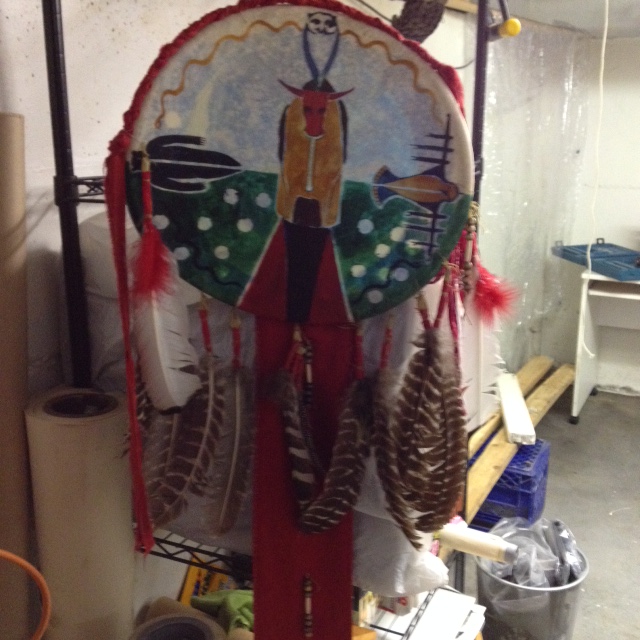
With the guidance of an elder, I made this medicine shield years ago.

With the guidance of an elder, I made this medicine shield years ago.

“Your vision will become clear only when you can look into your own heart. . . . Who looks outside, dreams; who looks inside, awakes.” Carl Jung

For a few disconcerting moments, I thought the crows had followed me across the country. You will remember that while living in Seattle, I was plagued by crows. They swooped me on a daily basis, picking me out of crowds for a sneak attack. I came to the conclusion that they were trying to wake me up. According to Crow Medicine, crows are an omen of change. When crows are around, something special is about to happen, consciousness is about to change and dis-ease will be dispelled. Since we can only connect the dots backward I can now say with great confidence that I took the medicine and it worked. They hammered me on the head for months before I stepped into the void and allowed new forms to emerge. Needless to say, I have a love-hate relationship with crows.

Yesterday afternoon our backyard was a festival of crows frantically barking. It brought back visceral memories and I went on high alert. As it turns out, the crows were focused on our owl and not me. I haven’t heard the owl since autumn and had forgotten that we have an owl in the backyard. I was happy that the owl was back. The crows were not happy as owls are great nest robbers and also, if hassled excessively, will make a dinner of an adult crow.

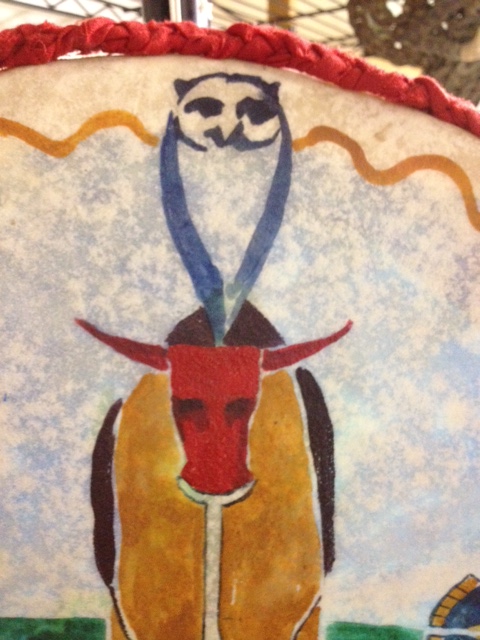
A detail from my shield. Owls have been with me for a long time. The owl is the top symbol.

A detail from my shield. Owls have been with me for a long time. The owl is the top symbol.

Last fall I googled Owl Medicine when the owl hooted above my head almost every night. I learned that, as a totem, Owls have great intuition. They follow their instincts. They see clearly (meaning they cannot be deceived). Owls see what others cannot. For instance, Owls see into the inner life of others; generally, they know more about a person’s inner life than that person knows about him or her self. This is why people do not sit next to me at parties! Also, owls are fierce warriors if something dear to it is threatened.

What a fantastic collision of bird archetypes for the crows and the owl to return to my world at the same moment. The owl was mostly indifferent to the incessant crow barking and attacks. There was no contest. In the evening the owl flew away to hunt and I wondered if there might be one less crow barking in the morning.

Both owl and crow are harbingers of change. They both speak to a comfortable relationship with the unknown and an attraction to the mysteries of life. I laughed when I re-read the symbols as I’ve lately been preaching through my book, The Seer (owls and crows are both seers) to cultivate “not knowing” as a necessary step on the path to health and creative vibrancy. In the practice of “not knowing,” one learns to see.

Later in the night, while driving back from Chicago, Kerri and I were talking about the extraordinary and meteoric changes in our lives this past year. She encapsulated my crow and owl commentary when she said, “We make plans according to what we know. It’s what we don’t know that changes us.” Her thought reminded me of another Carl Jung quote. He famously wrote that, “Religion is a defense against a religious experience.” Just so, a life plan is often a defense against a vital life. Adventure and discovery are never in the direction of the known. When you pay attention to the symbolic crow hitting you on the head you can also rest assured that when you step into the void there will always be an owl waiting to guide you.

title_pageGo here to get my latest book, The Seer: The Mind of the Entrepreneur, Artist, Visionary, Seeker, Learner, Leader, Creator…You.
Or, go here for hard copies (Amazon…Kindle version available here, too)


Return To Life

Tripper-dog-dog-dog listens to birds

Tripper-dog-dog-dog listens to birds

I’m writing this from the choir loft. It’s gorgeous outside and I wonder what I’m doing inside on such a beautiful morning. Kerri is playing the organ for an early morning service. I’ve decided – just this moment – that the organ is an instrument for the dark days of winter. It is heavy and fills your belly like good hearty stew. Birdsong is the music of spring.

Before coming here this morning I was hanging out in the back yard with Tripper-dog-dog-dog. We were watching birds. We were listening to their worship service. He is mystified by them. They are a relatively recent discovery for him. He cocks his head sideways as he stares at them as if to say, “What the heck!” Then he looks to me to see if I’m having the same revelation. I say, “Pretty incredible, huh!” He nods in agreement (no exaggeration. really. no really).

My conversation with the stained glass window continues. The three panels of the window are, of course, the nativity on the left, the crucifixion on the right, and the resurrection in the center panel. It is the largest image. The focal point. The return to life is the center and perhaps this is the meta-point of my window conversation. Many years ago in a class on ritual and life cycles, the instructor said that each one of us would die and be reborn 12 times in the course of our lives. These mini deaths and rebirths were preparation for the main event. Energy does not die, it changes form.

The window is a perfect cycle of the seasons. Throughout the winter the window and I have been talking about the return to life. We’ve talked about birth and rebirth. We’ve talked about pilgrimages. Every life is a pilgrimage. There are long stretches of walking, rich with discovery, sometimes with achy legs and exhaustion. There are days of rest. There are arrivals and departures. Sometimes the weather is fair and sometimes not. The bad weather days make better stories; protagonists need obstacles to move things forward. Flow rarely requires lengthy recounting. Sunrise and sunset are, of course, our daily birth and death cycle, a solar pilgrimage!

Birth and rebirth is the mirror image of death and resurrection and, of course, this is the season of things coming back to life. Both are progressions, movement through the cycle of life. This cycle, punctuated by my first Wisconsin winter, is especially pronounced for me. Three weeks ago we were knee deep in snow. I can see and feel the return of life, the warmth of the sun’s return.

One year ago I was wandering, in the exhaustion phase of my pilgrimage, dropping the old knapsack; it was too heavy to carry any longer. I enacted and presided over one of my mini deaths. This morning I breathed in the cool air and watched the worship of birds. Nests are being built and I am enjoying the sweetness of life’s return.

Go here to get my latest book, The Seer: The Mind of the Entrepreneur, Artist, Visionary, title_pageSeeker, Learner, Leader, Creator…You.

Or, go here for hard copies.

Love Yourself Better

this one is from the archives. I painted this 10 years ago.

this one is from the archives. I painted this 10 years ago.

He said, “The current goal is to love myself better.” And then he added, “Not so much a goal but something that needs teaching from our own mind.” His statement begs a great question, an ages old question: Can the mind teach itself? Really, the question is can the mind see itself clearly enough to teach itself?  Or, the question within the question: Can the mind teach itself to love itself? I scribbled the questions in my notebook and beneath them I wrote, “Is love teachable? Is love reachable through the mind, especially self-love?

We’d been chatting for a while and had covered a lot of territory, from Monte Blanc pens to typewriters to soap use around the world, clean water, the difference between good and bad scotch, the shapes of the 50 states and how they might influence personal identity and we’d somehow wandered into the epicenter: self-love.

His statement nailed the universal dilemma perfectly. It was a declaration of separation. The self watching and wanting more for the self. The separation is in the language: to love myself better. I don’t know anyone who hasn’t made this statement. Which part of the self will better love the other part of the self? Which part of the mind will teach the other to love?

It is where myth meets the everyday. Every human being who has walked the earth has wrangled with separation and the yearning for self-love (re-connection to self, unity). The human journey is a walk from separation (birth, if you want to take it literally) to reunification (death). The story lives in mythologies the world round. If we were still willing to read our mythologies (religions) metaphorically, we’d see it. For instance, being expelled from the Garden of Eden for eating from the tree of knowledge is the story the ancients told of the experience of separation. The inevitable bite of apple from the tree of knowledge brought duality consciousness: male/female, us/them, mine/yours, haves/have-nots, me/you. Separation. The rest of the story, not often told, is how, through out the rest of our lives, we seek the Garden where there lives a second tree: the tree of everlasting life (unity). We journey from knowledge (separation) to everlasting life (reconnection). The death need not be literal. To die to the self is necessary to experience the SELF.

Here’s the great paradox: loving another person is an act of self-love. The path to self-love is found when we serve something bigger than our selves. Think about it: the movement is always from separation to joining, from isolation to connectivity. The obvious question is, “Connectivity to what?”

Self-love is not found when the mind teaches the mind but when the mind gets out of the way of the heart. The love is always there. Love is never missing. Self-love reveals itself when the definition of self grows beyond our own skin. According to our latest neurological science, we experience ourselves as separate because we dull ourselves to our fundamental connectedness to others. In other words, we cultivate a story of isolation and then set about the real work of our lives: to see beyond what we think.

And then he said, “You know what else I just realized?”

“What’s that?” I asked.

“I just landed myself in a blog post.”

Yep.

Go here to get my latest book, The Seer: The Mind of the Entrepreneur, Artist, Visionary, title_pageSeeker, Learner, Leader, Creator…You.

Or, go here for hard copies.

Bang On Stuff

from Lucy & The Waterfox by David Robinson

from Lucy & The Waterfox by David Robinson

John said, “The real challenge is how to help people across the ‘I can’t’ line.” What a great phrase! I imagined myself drawing a line in the sand while my imaginary inner-voice shouted, “Don’t step over this line!”

“Everyone has an “I can’t” line.” John added, “The challenge is never the external stuff. It’s the stuff in our heads that stop us.” Too true!

John is a terrific drummer and extraordinary teacher. He told me that many people come to the drums from the place of, “I can’t” and his job is to hold their hand as they cross the threshold. “Of course they can,” he said, “they just need to know it.”

“How do you do it?” I asked. “How do you help them know it?”

“I have them bang on stuff and I bang on stuff with them.” He smiled.

In other words, gets them to experiment and play. When experimenting, there is no line between can or can’t. It’s a unified space called, “Let’s see!” In play, there is no need for achievement or expertise; there is only play. Bang on stuff and see what happens: it is a great definition for artistry. It is beginner’s mind.

In Austin Kleon’s latest book, Show Your Work, he suggests that we be intentional amateurs. He writes, “Amateurs are not afraid to make mistakes or look ridiculous in public. They’re in love, so they don’t hesitate to do work that others think of as silly or just plain stupid.”

If you desire to step across the “I can’t” line, embrace your inner amateur. Work for the love of your work and not the need to impress or “do it right.” Bang on stuff. Make messes. As Skip says, “Put a stake in the ground and then test it.” Pull on the chain. Walk through the door. Ask questions. Try a new technique. Invent a new technique.

In a bizarre and beautiful chapter in my life I was given a full ride scholarship for a masters degree in costuming. I’d never touched a sewing machine and was a danger to myself and others when trying to cut things with adult scissors. “Why not!” I said to myself and I went for a year. After turning in my first assignment in costume construction, the professor hugged my muslin mess to her breast and laughed, saying, “In the history of garments there have only been 7 possibilities (shirt, pants, skirt, etc.) and you have just created the 8th!” I didn’t know what I could or could not do so I did anything. It was fun. I had no “I can’t line.

John reminded me that the world’s first drum was (and is) a heart. “Everyone’s a drummer,” he said. “The day you can’t drum is the day you are dead.”

Go here to get my latest book, The Seer: The Mind of the Entrepreneur, Artist, Visionary, title_pageSeeker, Learner, Leader, Creator…You.

Go here for hard copies.


Be A Team

can you see the team boosting the child? I have many of these and will soon begin intentionally pursuing this form

can you see the team boosting the child? I have many of these and will soon begin intentionally pursuing this form

Many years ago Judy gave me a book by African writer Malidoma Some. He wrote that, in the village where he grew up, there were no locks on the doors. In fact, there were no doors. The people of the community respected the possessions and privacy of others. Locks were not necessary. The community cared for the health of its members so its members cared for the health of the community. From his point of view, a society that needs locks on the doors is a sick society. Locks are sign of communal breakdown.

I’ve been thinking much about sickness and the need for locks as I prepare to do a workshop for organizations about effective teams. I’ve done too many of these workshops not to recognize that the need to build teams is a sure sign of an unhealthy community. In Malidoma Some’s community, people were aware of and acted from a consideration of the health of the whole. Loyalty begets loyalty. “Acting for the good of the whole” is a great working definition for a team. It’s all you need to know to nurture great teams: make sure everyone in the organization, from the top to the bottom, is caring for the health of all the members. Make sure the choices are made for the good of the whole.

An organization that needs to team build is like a society that needs locks: most organizational systems support a philosophy of “every man and woman for themselves” while the executive suite needs cooperation and compliance to get the job done. No amount of team building can transcend compensation for individual merit. Once, a CEO asked me, “How do I get them to do what I want them to do?”

The short answer: you don’t.

A healthy team, just like a healthy community, requires no leveraging to act. It requires no policing. A team is a not a “thing.” A team is a relationship and just like a sports team or a theatre troupe, everyone needs to feel safe to really bring their game. They have to know the team cares for them as much as they care for the team. Many years ago, while sitting in a jury pool, the judge asked us, “Why do people resent being called to serve?” A lovely older woman raised her hand and replied, “The government offices are inaccessible and unhelpful when I need information or support. Why should I be happy to serve a system that wants nothing to do with me until it needs my money or someone to sit on a jury.” The rest of the jury pool applauded. When loyalty is a two-way street, teams form naturally. When loyalty is a given, people quite naturally offer their service to something greater than themselves.

There are a few other elementary things necessary for the relationship known as, “team,” like a common story (a common center) and a clear intention, but they are not possible when the metaphoric doors need locks. “Team” is something we are, not something we build or do.

Go here to get my latest book, The Seer: The Mind of the Entrepreneur, Artist, Visionary, title_pageSeeker, Learner, Leader, Creator…You.

Or, go here for hard copies.


Embrace The Paradox

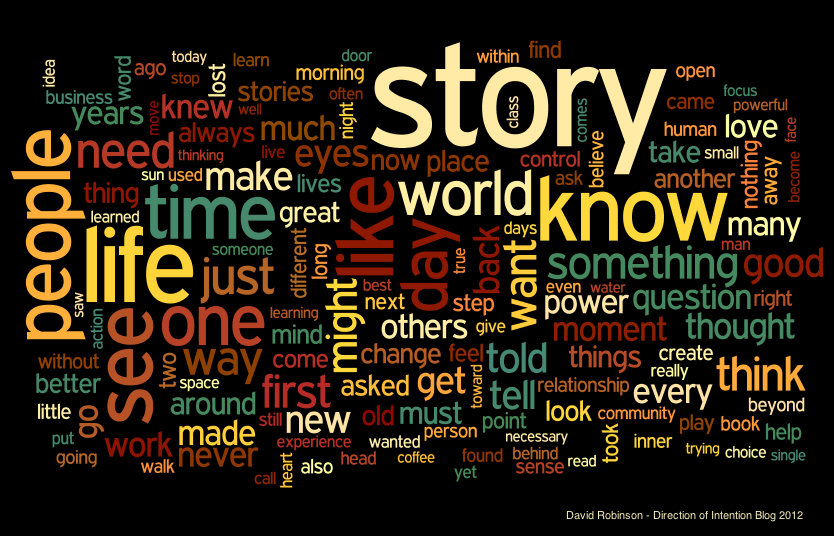
Mark Seely's gift to me: A Wordle of my blog

Mark Seely’s gift to me: A Wordle of my blog!

This is a landmark post: number 1000. When I started blogging I told Horatio that I feared I only had enough thought for 10 posts. He said, “If you can write 10, you can write 1000.” I wrinkled my brow in disbelief but it turns out that Horatio was right. With every step comes a new perspective. Kerri has a phrase I love: take down one tree at a time. In other words, if you can’t see where you are going, take the step that you can see; many single steps translate into miles of walking just as one post at a time can become 3 years of small thought-shares all in a row. What is a lifetime but a long series of days?

I’m writing this from a dining room table. All around me, covering the walls, are long strips of newsprint with a gathering storm of many colored post-it notes. The notes contain phrases, actions, like “Burn Your Trash,” or “Both Feet In, “ or “ Leave the Yuck Behind,” or, as you’ve already guessed, “Take Down One Tree At A Time.” They are story prompts. They are insight and idea prompts. Each prompt is associated with one of Kerri’s music compositions (she has 15 albums to date, with material enough for 3 more). They are building blocks for concert/storytelling evenings or keynote speech/performances. From the more than 60 post-it note prompts (and growing) we can combine any 9 to configure an audience-specific performance. The possibilities are endless. The viable themes are both unique and universal. Our umbrella title is Back To Center. We have a series of workshops to compliment the performances. The workshops illuminate the extraordinary moments and liberate the boundless capabilities of we mortals, we ordinary human beings. The big box is appropriately a prompt: Be A Ray!

Kerri and I are bringing our work together in a new form: Be A Ray!

Kerri and I are bringing our work together in a new form: Be A Ray!

As it turns out, I am a man of my time after all. The notion of a series of discreet component thoughts assembled to create a universal conception is taking over all of my processes – writing, painting, coaching, facilitating. It is the “many small steps making one large journey” philosophy of creation. It has taken over our world. It is contemporary: note the thought behind an App store or an Army of One. It is natural; cells do it. In the blog world it goes by the name of a “plug-in.” Build your own burger: design your car from the available components. It is the illusion of individuality in the midst of a constraint of choices. There is no arrival, just continuing process of expansive and interchanging capability. It is the Kahn Academy. Work at the pace that is appropriate to you. It is yoga: begin where you are, not where others are. It is what the old world of government process (ridiculously obscure tax codes), health care, education…the usual bureaucratic suspects and old school businesses do not understand. The world of rolling process has ascended; products and outcomes are obsolete before they hit the shelves. Story is more accurate than data (data is, after all, a type of story).

Nimble thinking requires nimble processes. Expansive living requires expansive thinking. Cathedrals are built one block at a time but the secret story of a cathedral is that it is never finished. It is always under construction, always changing, updating, repairing and modernizing. That’s the point of a sacred path. Stability, your sacred home, in this modern age is now found in motion, in a pure engagement with a moment. This is what we mean when we say, Be A Ray! Get into motion and focus your intention. Safety is never found in stasis.

Yesterday I wrote that a good life is marked by the capacity to stand solidly in the constancy of discovery. It is a paradox. Another prompt on the wall, one of my favorites, reads, “Embrace The Paradox.” Yes.

Go here to get my latest book, The Seer: The Mind of the Entrepreneur, Artist, Visionary, title_pageSeeker, Learner, Leader, Creator…You.

Or, go here for hard copies.


Sizzle!

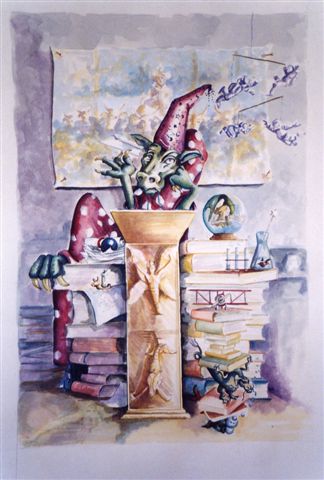
an illustration from a book I never published: A Dragon's Tale

an illustration from a book I never published: A Dragon’s Tale

I’m breaking my book down into component actions almost as if I was dissecting a play script. It’s an interesting exercise because I’m experiencing a measure of creator’s blowback: I’m having the distinct impression that someone else wrote this book knowing that I’d read it someday. The author formerly known as “me” knew that I’d need to know what it contains. It is often true that we teach what we most need to know.

I started my component part breakdown because I’ll soon be throwing people into an exploration of the book’s 9 Recognitions. I wanted to chart the actions of the story and the learning embedded within the narrative. I say, “throw people into an exploration,” because I eschew the word “teaching.” My life has taught me that good teaching is about creating a container for exploration. Good teaching involves no teaching. Good teaching is watching and waiting for the right moment to ask a single simple question: what did you discover? The response will always be personal and relevant to the learner. No amount of control or planning can match the power of relevant personal discovery.

A side note: good teaching and a good life share a common center: the capacity to stand solidly in the constancy of discovery.

The primary thought-river that carries the raft of my book is “to have the experience first and make meaning second.” Making meaning second is what we do even when we think we know where we are going. Life is mundane only when “mundane” is the meaning we assign to it. Life goes bland and gray when we make meaning prior to having experiences.

The word “presence” is shorthand for having experiences before assigning meaning to the experience. If you strive to be more present simply cease thinking that you know what’s coming. You don’t.

And so, this is what my component part breakdown/book blowback looks like:

“Throw them into an exploration.” This is a remarkably different action than, “teach them.” (Another Recognition from my book: the language we use to assign meaning matters more than we know).

“Ask a single simple question” This is also a remarkably different action than, “teach them.” Live in the question and not the need for an answer.

When I was an aspiring actor deep in my acting school studies I learned that the verbs that I choose matter. The actions that I assign to my pursuit can ignite me up or block my path. The same is true on my discovery path: when I am making meaning, use really good verbs. There’s no need to minimize the sizzle of this extraordinary life.

Go here to get my latest book, The Seer: The Mind of the Entrepreneur, Artist, Visionary, title_pageSeeker, Learner, Leader, Creator…You.

Or, go here for hard copies (Amazon)