Meet Shayne

frontcoverscreenshotAbout six weeks ago, Beaky called to discuss her writing and the viability of sharing it. Beaky is a few months shy of 94 years old and puts pen-to-paper almost every day. She calls it chicken scratch and is mostly unaware that she is a fantastic storyteller (actually, I believe she knows it but is too humble to apply the word ‘fantastic’ to herself). She can’t help it; storytelling is in her bones. Some of my favorite days of the past few years have been at Beaky’s side listening to her tell a tale.

At 93 she is reviewing her life and, like all of us, she wants to do more, be more. It is hard to understand for those of us who know her because she is a rare and special person. She is a bringer of joy; Beaky makes people smile. That, too, is in her bones. Some months ago we spent a long night in the emergency room with her. She’d taken a fall and we feared she’d broken her hip. Deep in the night, writhing in excruciating pain, Beaky looked into the eyes of an exhausted attending nurse and through her pain said, “You have the most beautiful smile.” The nurse giggled, blushed and beamed. Laughter, blushing and beaming are common occurrences when hanging out with Beaky. Even while in pain she seeks the giving-moment.

Almost sixty years ago she wrote a trilogy of stories for her children. For months we looked high and low for the folder of her stories. Not long ago we found them and discovered that each had a submission cover page; Beaky wanted to be published. So, we decided to put our heads down and make it happen. I illustrated the first book and Kerri did the layout and design. Today, Beaky’s first book, SHAYNE, is now available; it is published. Beaky is published. Within the next two months the second and third books of the trilogy will be published, too (SHAYNE AND THE YELLOW DRAGON and SHAYNE AND THE NEW BABY). Next week we will travel to be with her as she has her very first book reading & signing party. She is, of course, busy practicing her signature (wouldn’t you?).

Jim has a magnet on his refrigerator that reads, “It is never too late to become what you might have been.” In Beaky’s case I might add: It’s never to late to realize what you have always been AND be a children’s book author, too.

One of my favorite photos: Kerri with her mom, Beaky

One of my favorite photos: Kerri with her mom, Beaky

[check out Beaky’s website! www.beakysbooks.com]

Get Lost

Kerri in Avalon

Kerri in Avalon

I lost Kerri. She is deep in a world of imagination and creative glee and hasn’t heard a word I’ve said in hours.

A few years ago I went to a figure drawing class. It was the first I’d attended for several years. Not only was I unprepared for what I experienced that night but it was and still is my favorite example of generation gap (and I am on the far side of the gap!). That night, those of us that were 40 years old and older drew with charcoal, pencil, and crayon on paper. We had drawing boards and dusty tackle boxes with supplies. We came to the class expecting to get dirty. The younger set, those below 40, drew on a screen with a stylus. They walked in, flipped open their computers, pulled out their stylus and began adjusting their settings. Dirt was nowhere in their equation. I laughed at the brilliance of the moment.

I am mostly old school. Photoshop is still unexplored territory. I am not anti-technology; I often wish I was more tech-savvy and had the range of motion that comes with technology. Time in the studio is precious and when I have it, when I have the choice of learning a program or getting messy, I go straight to the paint. I like the drag of the paper. I like getting my fingers and clothes messy. There are smells and textures and a ritual walk to and from the canvas or paper to gain perspective that I adore. My paintings are often very large and the act of painting is kinesthetic, a dance, a full-body sweep of arm and brush. A mantra from a teacher of many years ago echoes in my bear-brain, “You paint with your whole body, not your wrist.”

Many months ago Div introduced me to Paper, the cool drawing app. We were waiting to film an evening of entrepreneur pitches and he asked why I was such a dinosaur (not his words, mine). He showed me Paper and I played with it on his ipad. I got lost in the possibilities and giggled at what I could do in a matter of seconds. I downloaded it on my ipad and then forgot about it. Until today. I just completed some watercolor illustrations for a children’s book and have run into a familiar wall: scanning watercolor images is remarkably difficult. A successful moonshot is more possible than a decent scan of a watercolor painting. As I sat with Kerri on the couch and pondered what to do, I remembered Div and Paper. What if I could avoid scans altogether? I pulled out the ipad, opened the app, and started to experiment. That’s when Kerri asked, “What’s that?” I handed her the ipad for a short test drive. I am like the  car salesman, standing at the edge of the lot, wondering why I didn’t get into the car with the customer.

image-1The sun has set. We missed a movie date. Every so often I walk back into the living room to check in and see if she has come back from Avalon. I ask to no avail if she is hungry. She sits on the couch, in the blue-green the glow of the ipad, whispering things like, “Cool,” or, “No way,” or, “Who knew?”

Delight In The Question

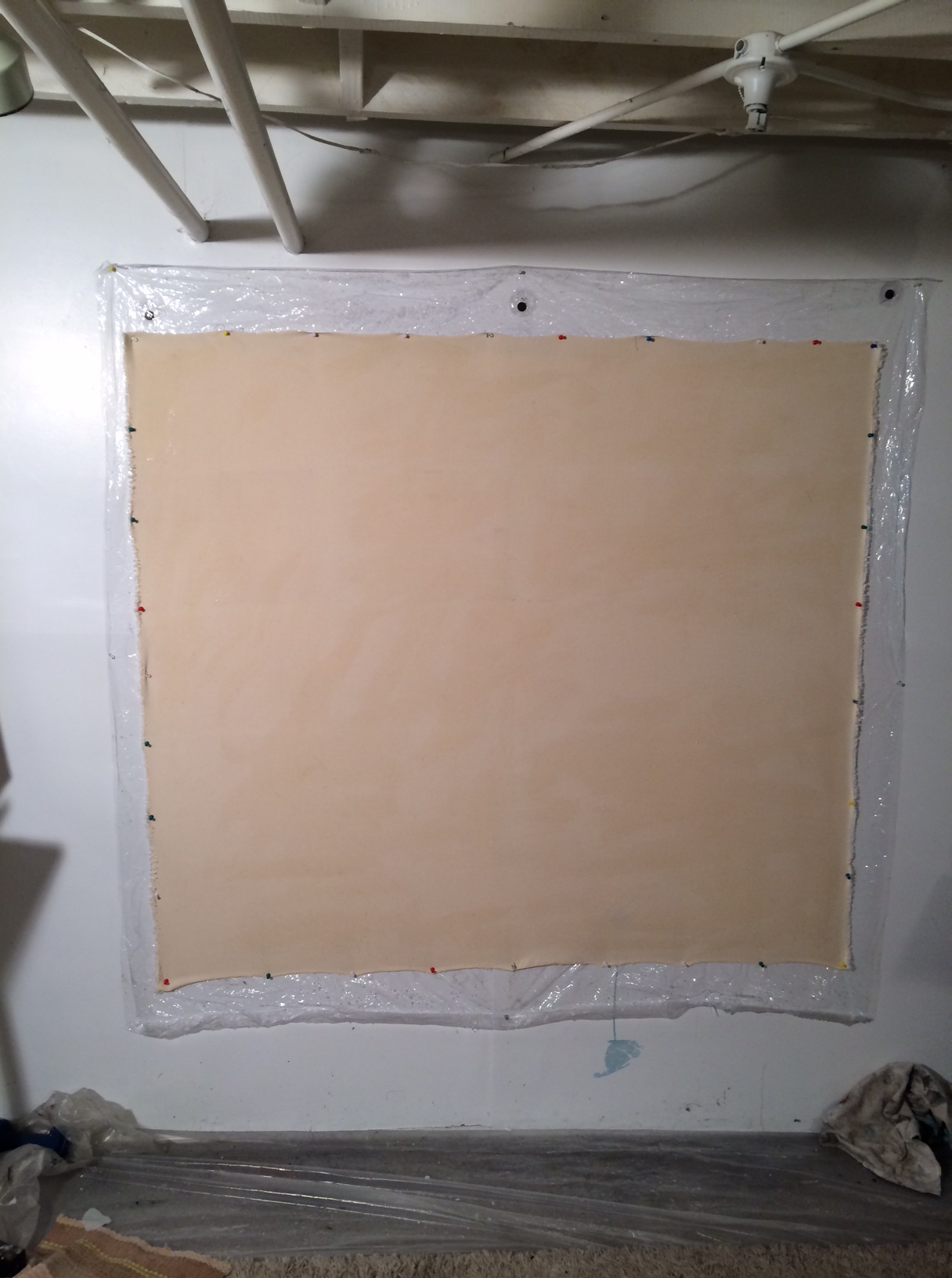
a new canvas, stretched and ready for gesso.

a new canvas, stretched and ready for gesso.

So what is next?

There is a sweet void that follows in the wake of every project and this particular void is vaster than most (don’t you love the phrase, “particular void?”). This project, The Lost Boy, was and continues to be more layered than any other. It pulls on emotional and spiritual roots that have not been available in other performances and so the post-show disorientation is mighty.

I’ve come to appreciate my time in the void. It is the time of reflection. It is the time of rest. It is the time of long walks. It is the time of questions finally answered that invite bigger questions. I’ve learned that disorientation is necessary for reorientation and reorientation never comes as an answer but always comes in the form of a question: so, what’s next?

Yesterday I tacked a large canvas to the wall. It is now covered with layers of Gesso and is ready for paint. I delight in this phase of preparation. It is akin to the anticipation of meeting with an old friend; the conversation will be rich and far reaching. I also bought a new sketchbook and have set myself the task of filling it within the month. Many years ago, while sitting in another void, I was staying with my pals Duncan and Liz while directing a play. Liz, familiar with voids, insisted that, after rehearsals, I do a hundred paintings before I sleep. Each night, tired from a long day of rehearsal, Liz sat with me as I did one hundred paintings, quick gestures with brush and ink, paper fluttering to the floor. We laughed and I felt renewed. After ten paintings en route to a hundred, the notion of judgment and too-much-thinking goes out the window. The joy of the action takes precedence over the illusion of a finished product.

I’ve written often of the lessons Saul-the-tai-chi master taught me. Focus on the field of possibility and not on the opponent. In other words, offer no resistance to those things that appear as obstacles. Sit with gratitude in the void. Paint a hundred paintings before you sleep. Delight in the question.

Forgive

lightghostWe’re already snowed in and the word is that the blizzard – the real blizzard – won’t start for another hour. Looking out the window Kerri said, “This storm is angry.” It is. This is not a gentle snowstorm. The flakes are not fluffy or big; they are enraged bees that sting. We watched cardinals, brilliant red amidst the flurry of white, hunker down, bobbing in branches of the pine tree. Tripper Dog-Dog-Dog slid off the deck into a drift and emerged with a beard of snow and a look of confusion. He ran outside, felt the bite of the wind, and almost knocked me over running back into the house.

We sat in the living room and watched the snow swirl and howl. We talked quietly until the light waned and we noticed that we were sitting in the dark. It was as if the ferocity outside the house required hushed tones inside. Life is like that – inner turmoil often looks like a quiet exterior just as violent storms require us to talk in gentle voices. Balance is always present although not always recognized.

Lately I’ve been meditating much on the word “trespass.” Once, I had an experience with the word “trespass” that was nothing short of mystical. It altered the course of my life. According to the prayer, one must trespass to be forgiven. Life is nothing if not full of trespasses and those who trespass against us. Crossing boundaries and holding boundaries are both learned skills that require a good deal of trespassing.

Forgiveness feels good. Whether you are the giver of the forgiveness or the receiver (or both, when, for instance, forgiving yourself), it just feels good. Those violent outer storms will always lead to inner peace if you follow them far enough. It is the natural order of things. All that is required is a recognition that stories change like people change; that stories change when people let go of old stories. Miracles happens when, in hushed tones, the story of a trespass is retold as a story of forgiveness.

title_pageGo here to buy hard copies (and Kindle) of my latest book: The Seer: The Mind of the Entrepreneur, Artist, Visionary, Innovator, Seeker, Learner, Leader, Creator,…You.

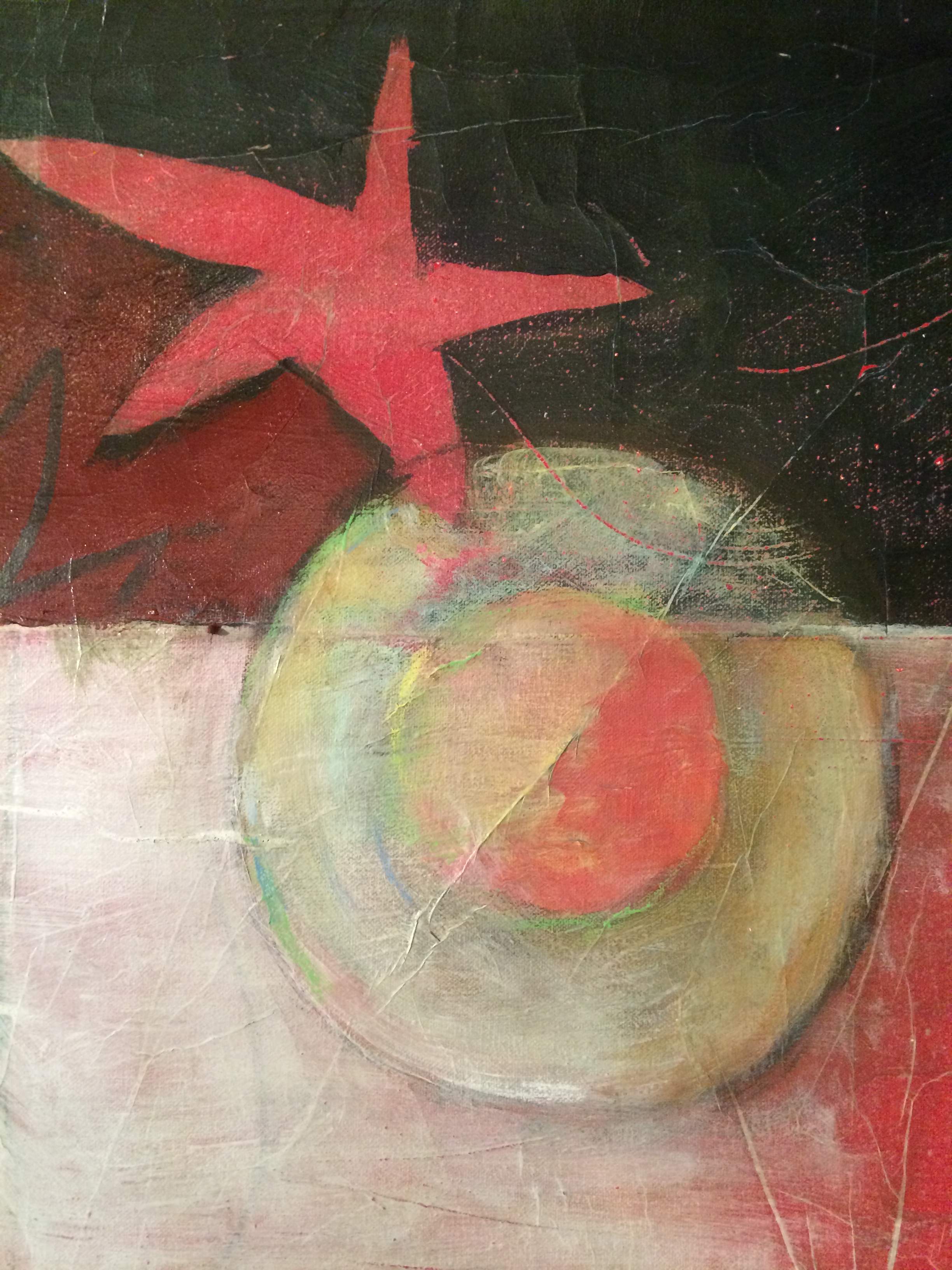
A detail from my painting, An Instrument of Peace

Go here for fine art prints of my paintings, bags and other cool things!

Begin Here

photo-6

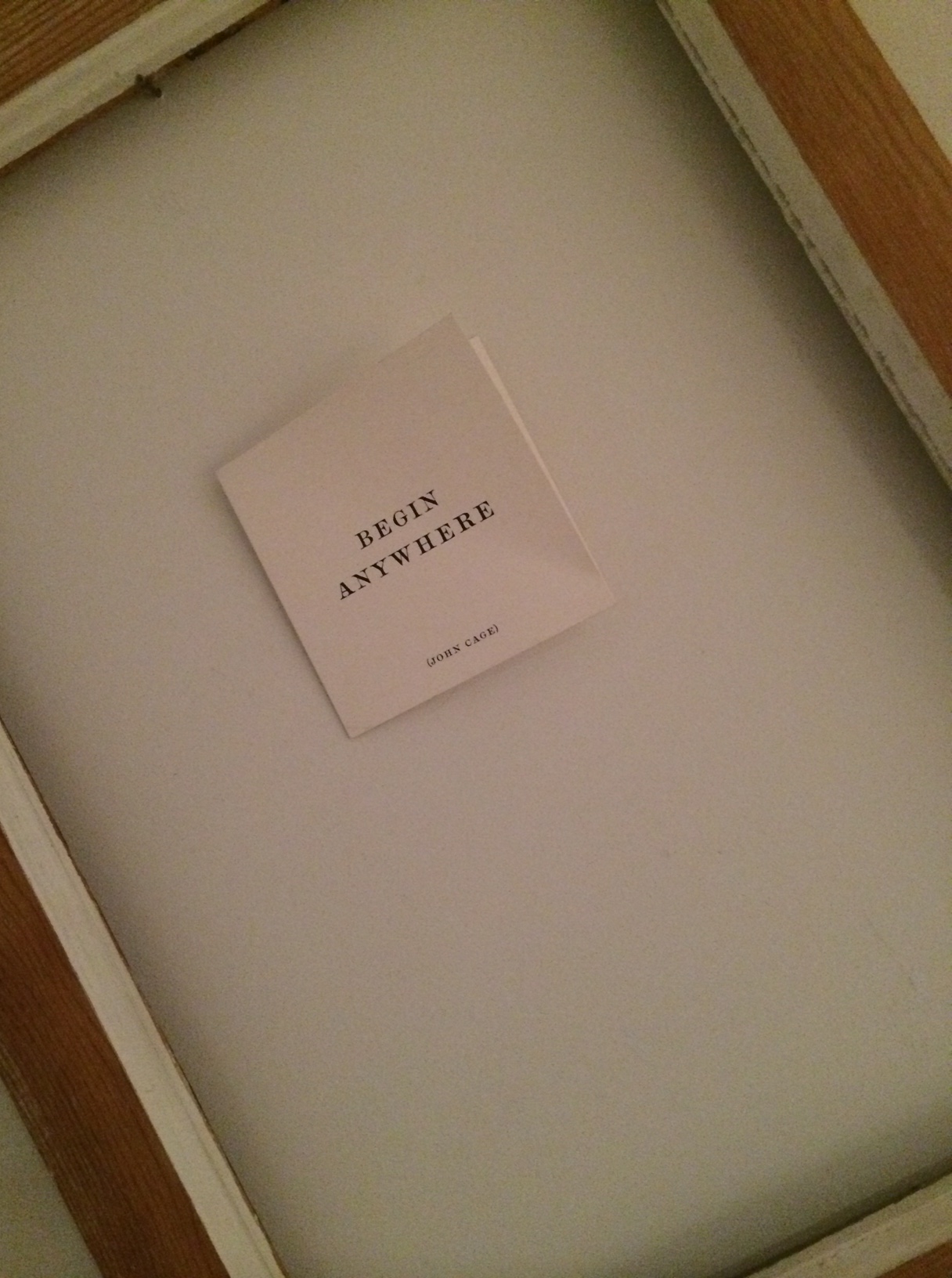
Begin Anywhere

In our house, hanging on the wall like a painting, is an old window frame. In the top pane is a card that reads, “Begin Anywhere.”

Earlier this week I had a great conversation with Diane. She laughed and said, “In my meditations I was whining to God because I wanted to see the plan of my life. I got the clear message that I was never going to see the plan but I could always see the next step. The next step is always right in front of me.” Dancing with what’s right in front of you is sometimes called faith. Sometimes it is called play. Sometimes it is called art.

Diane and I are good reflectors for each other; we are usually on parallel paths. For both of us, the past year or two has been a process of letting things go and stripping things back: paths, patterns, and presuppositions. It has been the mother of all house-cleanings (she had a literal flood!) and, like all good house cleaning it took some elbow grease and few hard decisions about what to keep and what to throw. After the job is done, nothing feels better than a clean house and along with the good feeling, new space, and wide-open possibilities, comes the question, “What’s next?”

Diane told me her story because my next step is so clear that I can focus on nothing else. With such a myopic focus I can see nothing else and that’s why I called her. I must do this play. I must. I cannot see beyond this dance. It is my first thought in the morning. It is my last thought falling into sleep. This step, my dance with The Lost Boy, makes no sense and Diane’s point was well taken: the next step rarely makes sense. Sense-making requires context. Sense-making is a skill of relativity – and since we can never know the plan (if, indeed, there is one), we can only make sense based on old information. That is good news for plumbers but is dubious at best for leaders, explorers, seekers, and artists.

After our call I realized that dancing with what’s right in front of me is how I paint. It’s also the key to a good conversation – and painting, for me, is a good conversation. After my good conversation with Diane, she sent me an email of affirmation and concluded her thoughts with this: “Stay focused on what is before you now and let the creations show you how and when they are ready to play.”

title_pageGo here to buy hard copies (and Kindle) of my latest book: The Seer: The Mind of the Entrepreneur, Artist, Visionary, Innovator, Seeker, Learner, Leader, Creator,…You.

For all digital forms of The Seer, go here

Yoga.ForwardFoldFor posters and prints of my paintings, go here


Be The Fool

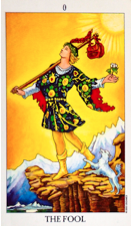
The Fool card from The Radiant Rider Waite deck

The Fool card from The Radiant Rider Waite deck

Each day I open The Bible of Mankind (sadly, now out of print) and read a phrase. It’s a form of daily meditation for me akin to throwing the I Ching; I pick from the reading what seems relevant. Some days the phrase is confusing, some days it is curious, some days it is profound. Every day it is significant. Today, the phrase was from the Buddhist tradition and under the subtitle, Foolishness & Wisdom:

“The man who has learned little grows old like an ox. His flesh grows but his knowledge does not.”

I delighted in the pairing of foolishness with wisdom. I suspect there is only one path to wisdom and it requires a good deal of foolishness. I googled the meaning of the Fool card in the tarot because, as I recollect, when upright, the Fool is about beginnings and bold steps into the unknown. From my search I found other words and phrases like unlimited potential, purity, and innocence. The Fool is ever present and has in his (her) bag all the tools and resources necessary for the journey through life. The Fool came to this earth to learn.

Another phrase that caught my attention was this: the Fool is always whole, healthy, and without fear. He is the spirit of who we are, the spirit expressed and experienced as wonder, awe, curiosity, and anticipation.

Recently, Bruce and I had a great talk about how life looks different at 50 than it did at 30. The main difference is that you know without doubt that it is limited. And, because the big death is visible, all the little death passages, the steps into the unknown, take on more import. Yearning is more electric when mortality is undeniable. All of the belief and investment in outcomes and achievements dissipate. This life is an experience, nothing more. It passes. And, it is dealer’s choice whether the experience is expressed and experienced as fear or expressed and experienced as The Fool: wonder, awe, and curiosity.

The wisdom path is the Fool’s path. The ox, to become a fool filled with knowledge, need only step out of its pen, into the unknown, and be filled with new experiences.

title_pageGo here to buy hard copies (and Kindle) of my latest book: The Seer: The Mind of the Entrepreneur, Artist, Visionary, Innovator, Seeker, Learner, Leader, Creator,…You.

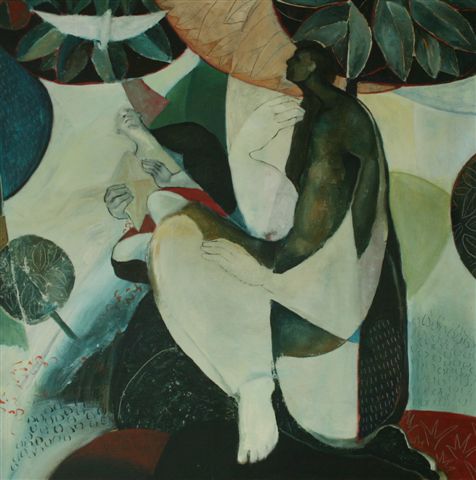
Eve, by David Robinson

Eve, by David Robinson

Go here for Fine Art prints of my paintings.

Change Your Mind

I used this quote by Friedrich Nietzche in The SEER:

“The snake which cannot cast its skin has to die. As well as the minds which are prevented from changing their opinions; they cease to be a mind.”

A few days ago I asked myself this question: What if I never painted another painting or wrote another word? What would happen? Who would I be?

title_pageThe first question, what would happen, is much less interesting to me than the second question: who would I be if I simply put down my brushes forever? When I was younger, I felt driven, as if I had to paint. I needed it. In asking the question I recognize that now I choose it. I don’t have to paint; I want to and consequently I am a much better artist. It’s a paradox: I am a better artist because I don’t need to be an artist. In other words, I don’t need to be, I am.

I’ve been revisiting The SEER. My initial team of wise-eyes unanimously voted the first draft to be “too much.” The book that I published is comprised of the first three chapters of the original draft. I deconstructed them and broke the steps into smaller bites. There were six more chapters outlined and, in my latest revisit, I recognize that I have a trilogy if I want it. So, book two is in process. I’m going to release the first draft in daily snippets as I write it. Everyone gets to be my wise-eyes this time around.

Here’s the launching pad section for book two from The SEER. It’s from the second cycle (story):

You can change your story. That is the sixth recognition. Doesn’t it sound simple? Say it this way: changing your story is the equivalent of changing who you know yourself to be. Changing your story often requires the loss of your illusion, a lot less armor and nothing left to lose. Who are you when you don’t know who you are or where you are going? This was the heart of Virgil’s question to me. Who are you distinct from your circumstance? Who are you when the mask comes off? More importantly, what are you capable of seeing when you are not looking through a [knight’s] visor? No one is immune to the stuff of life. Everyone lives a unique version of the story cycle. It too is a pattern, a natural process.

Go here to buy hard copies (and Kindle) of my latest book: The Seer: The Mind of the Entrepreneur, Artist, Visionary, Innovator, Seeker, Learner, Leader, Creator,…You.

Go here (to Leanpub) for all digital forms of The SEER

Canopy by David Robinson

Canopy by David Robinson

And, for fine art prints of my paintings, go here.


Peel Off The Laminate

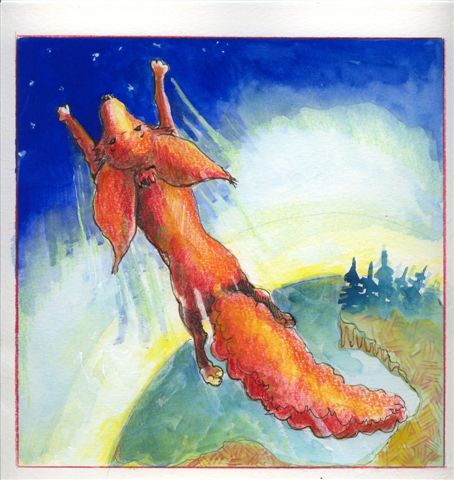
An illustration from my children's book, LUCY AND THE WATERFOX

An illustration from my children’s book, LUCY AND THE WATERFOX

Last week in a fit of frustration I climbed a ladder and scraped the damaged paint off the kitchen ceiling. The paint was compromised a few years ago and needed repair. The peeling paint was on my summer list of things to fix but we were traveling most of the summer. Autumn arrived and the to-do list remained. Scraping and sanding always leads to the necessity of new paint and Kerri said, “If you paint the ceiling it will make the walls look dingy. We better paint the walls, too.”

So, standing in the kitchen, fists filled with paint chips, discussing color possibilities, we realized that all of our color choices were defined by the fading yellow of the ancient kitchen countertop. The counter was at least 50 years old, laminate, and held in place by some well-placed packing tape. We’ve talked often of the day in some distant future when we could afford to replace it and that day seemed very far away.

In that moment, hands filled with paint chip possibilities, we realized that the countertop had became a metaphor. We were defining our choices based on a limitation. Or, said another way, we were limiting our possibilities based on our belief in an obstacle; what we could or could not do.

How often is that the case? What self-imposed limit defines the choices we see? How often do we unwittingly shrink our field of possibility? How often do we allow the things we don’t want to define our actions?

It took less than 30 minutes to pull off the old laminate, break it into pieces, bag it, and get it out of the house. As I wrote in an earlier post, the spontaneous kitchen remodel began when we realized we had the power to remove the limit. We had the capacity to make choices based upon a different set of criteria. Before the spontaneous remodel we believed we couldn’t afford to change the kitchen countertops. The moment of paint-chip revelation made us understand that we couldn’t afford not to change them.

Life is great at applying belief-laminate to us: what we think we can and cannot do. Something profound happens when, in a moment, we understand that we are capable of challenging the limit, of pulling off the laminate, of being forced to step into a greater field of possibility (known from henceforth as the “Now What?”)

It is worth noting that our new countertop, the old plywood support and made exceptionally beautiful with chalk paint and wax, has transformed our kitchen and our actions. We hang out in the kitchen. The colors we are considering using for paint are now based on what we want to create and not on what needs to go with the old yellow laminate.

title_pageGo here to buy hard copies (and Kindle) of my latest book: The Seer: The Mind of the Entrepreneur, Artist, Visionary, Innovator, Seeker, Learner, Leader, Creator,…You.

Go here (Leanpub) for all digital forms of The Seer.

Yoga.ForwardFoldOr, for kicks, go here for Fine Art Prints (and other stuff) of my paintings.


Ask, “Now What?”

photo-1On one of the many Post-It notes that line our idea wall is written, “Say ‘I Don’t Know.” It is especially relevant today as a few days ago, in a fit of spontaneous remodeling, we tore the five-decade-old laminate off the countertops. After the moment of deconstruction we looked at each other, shrugged our shoulders, and asked “Now what?”

I delight in moments like this for two reasons: 1) the first action (tearing off the laminate) always comes from years of wanting change but seeing only obstacles. In what feels like a spontaneous moment, the focus shifts from the obstacle to the action. 2) When the focus shifts only a single step is visible and that step is always some variation of, “I don’t know but I’m going for it anyway!” Second steps are generally invisible until there is a committed action, until there is a first step taken.

These two steps together are a good working definition for the creative process. Shift your focus from the obstacle to the only action you can see. Take the action. Repeat until the action takes hold of you.

The first step generally feels like deconstruction. It feels like breaking things or breaking out of things (like a focus on obstacles). A committed step into, “I don’t know” creates motion and motion begets motion. Rip off the old laminate without a plan and a plan will emerge. Or a mess will emerge followed by a new plan.

title_pageGo here to buy hard copies (and Kindle) of my latest book: The Seer: The Mind of the Entrepreneur, Artist, Visionary, Innovator, Seeker, Learner, Leader, Creator,…You.

Go here for all digital forms of The Seer.

Or, go here for fine art prints of my paintings (and other stuff, too)

Eve, by David Robinson

Eve, by David Robinson

Aim For The Field

An illustration from my children's book, Play To Play

An illustration from my children’s book, Play To Play

Lately, Saul the Tai Chi master has been much in my thoughts. It is now September and it has been a year since he taught me a lesson that has become the new mantra of my life: orient to your own concern. Actually, he said that I should look beyond my opponent into the field of possibilities and orient to my own concern. “In this way,” he instructed, “you will no longer have an opponent.” He used the word “opponent” loosely. Any limitation or form of internal resistance is the opponent.

Beyond the opponent is a wide-open field of possibilities.

In the intervening year I have learned that I have been both my greatest opponent and the one who can look into the field of possibilities. Isn’t this true of all people? All stories worth telling (and hearing) are ultimately tales of transcending the inner opponent. If you need help identifying your personal mythic journey simply listen to the areas in life in which you say to yourself, “I can’t.” In that place you will find your opponent. You will also be surprised to find that your inner opponent is most often an orientation to other people’s concern; the fear of what others might think is a mighty inner-monster creator.

I’ve also learned that Saul’s lesson has come to me in many forms throughout the course of my life. For instance, many years ago I directed plays and, because I am also a visual artist, I was often in the position of designing the sets as well. With great love and humor, another terrific mentor watched as I struggled with my dual role. He gently showed me that I was orienting my designs according to the budget and construction limitations I perceived. I was working in the wrong order, asking “how” before lingering in the potential.   He told me that I needed to “Live first in the possibilities.” Design/orient according to the potential and not the limitations.

To live first in the possibilities is to walk the imagination without a leash. It is to let the imagination run wild. What is beyond your capacity to imagine? What is possible beyond the boundaries of belief? At one point in my life cell phones were science fiction. Today, they are ordinary.

Look beyond the opponent. Orient to your own concern. Imagine how life might change if instead of asking, “Can we do this?” we began by asking, “What’s possible?” And then aim for the field.

title_pageGo here to buy hard copies (and Kindle) of my latest book: The Seer: The Mind of the Entrepreneur, Artist, Visionary, Innovator, Seeker, Learner, Leader, Creator,…You.

Go here for all digital forms of The Seer.

Yoga Series 7Go here for fine art prints of my paintings