


FOR TODAY’S FEATURED PRINT FOR HUMANS, GO HERE…
Filed under: Art, Education, Possibility, Prints for Humans, Surprises, Truly Powerful People | Tagged: education, growth, learning, Self Growth, self knowledge | Leave a comment »
FOR TODAY’S FEATURED PRINT FOR HUMANS, GO HERE…
Filed under: Art, Education, Possibility, Prints for Humans, Surprises, Truly Powerful People | Tagged: education, growth, learning, Self Growth, self knowledge | Leave a comment »

Illustration from Play-to-Play
It’s very late. I was deep asleep and am suddenly wide awake. That is happening often these days. My inner light switch is tripped and there is no going back to sleep.
I woke up thinking about something Judy told me yesterday during our phone call. Judy is wise. She told me that she believes the real work in a life is never achieving a goal or arriving at a destination. It is not something with a direction. The real work is to learn to stay open. Stay open to possibility. Stay open to choices. Stay open to feeling. Stay open to changes. Stay open to experiences. Stay open to surprises.
It is not the kind of advice that children generally get in school but it is exactly the kind of advice an elder might impart if asked – and only if asked. Learn to stay open. Life has a way of making us want to close, to armor up, to dull our selves, to turn our backs and whisper, “There’s nothing I can do.”
It sounds too simple, “Stay open to life.” It’s not. What is simple is sinking into the easy chair and falling asleep in front of the television. Simple seems like a good idea until you realize you’ve been doing it for years. That is, of course, the point of the easy chair. The easy chair is a destination. It is a direction.
Staying open is a practice. Turning toward life and facing it with all of its force, heat, and pressure is not simple. Opening to the grief as well as the joy, feeling the pain as well as the pleasure, requires intention. Opening to the full spectrum of living engenders liveliness. Life begets life.
In a recent post I included a quote from Carlos Castaneda that just popped to mind:
“Oppressors and oppressed meet at the end, and the only thing that prevails is that life was altogether too short for both.” Carlos Castaneda, A Separate Reality
Filed under: Awakening, Edges, Identity, Possibility, Truly Powerful People | Tagged: alive, awakening, choice, feeling, open heart, open mind | 1 Comment »
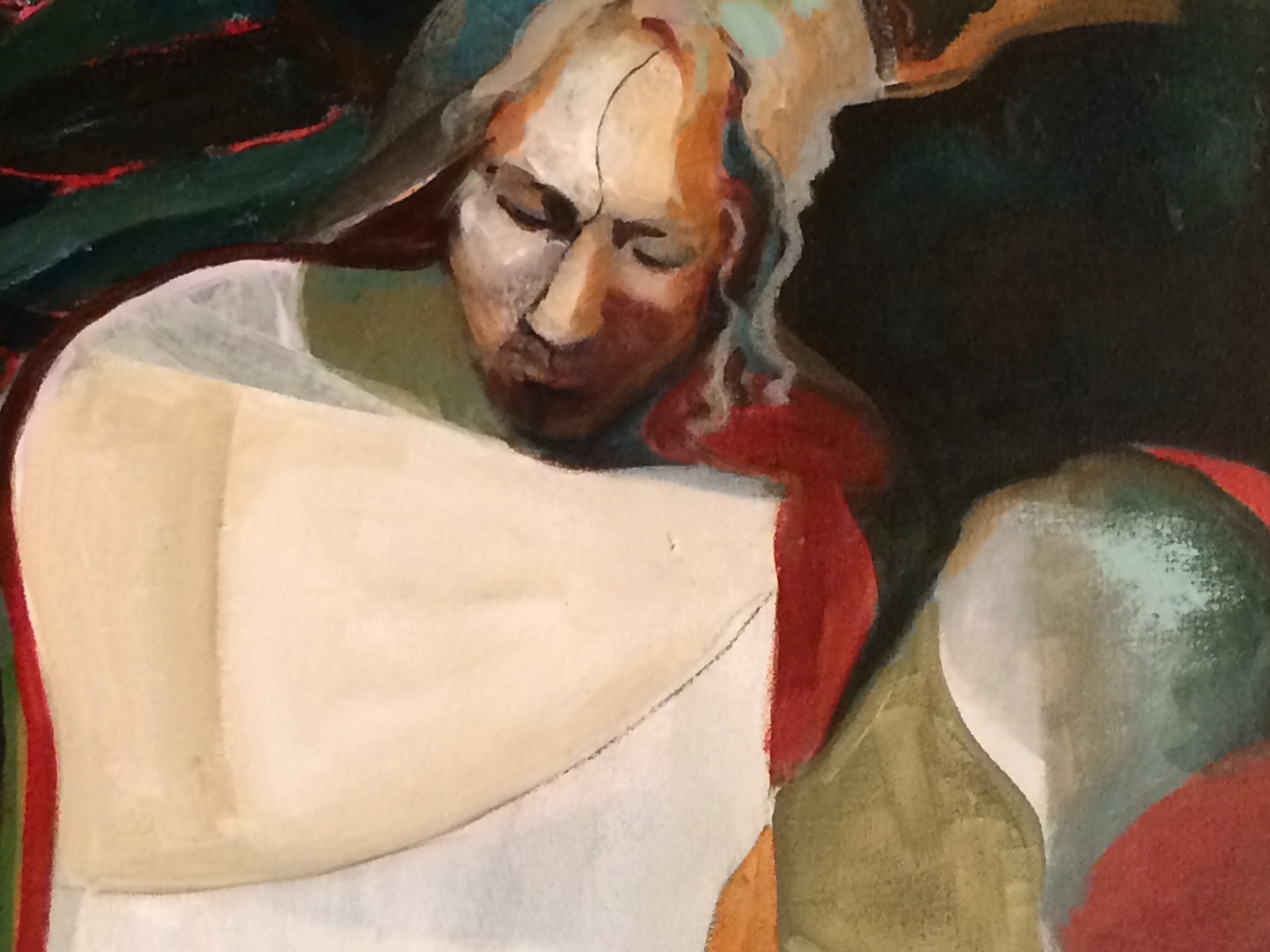
a detail of my painting, “John’s Secret.”
I’ve been thinking a lot about forgiveness. Earlier today, Kerri read an article to me and the author, someone with terminal cancer, wrote that blame is a waste of energy. Life is too precious to waste on blaming. Forgive and move on.
My meditation on forgiveness has inadvertently become a meditation on blame. As it turns out, forgiveness and blame are often dance partners.
My favorite phrase of this week: Blame, no matter where you place it, does no good. To me, the crucial concept within the phrase is this: blame requires placement. Although it might feel otherwise, blame is not a passive act. We place it. We aim it. It is a way of making meaning of things that don’t feel good. I’ve written that blame is like sugar; it is addictive. It is choice wearing the mask of it-happened-to-me. Oddly, as an active choice, blame actually inhibits action and as an inhibitor it does no good either for the placer-of-the–blame or the recipient. It stops motion. It is an energy eddy. It is destructive both ways.
Forgiveness is also not a passive act. Forgiveness takes more effort because forgiveness is an unmasked choice. It, too, requires placement and aim. It is also a way of making meaning of something that doesn’t feel good. But, unlike blame, forgiveness does great good for both the giver-of-forgiveness and the recipient. It creates motion. It is generative both ways.
Filed under: Awakening, Navel Gazing, Possibility, Truly Powerful People | Tagged: blame, forgiveness, meaning, meaning making | 3 Comments »

these hands will change
The woodpecker hammered high atop the ancient television antenna. He seemed not to be bothered by his lack of progress, beak on metal. At first I thought it made no sense and then it occurred to me that progress was not the goal. Perhaps the woodpecker hammered for the pure pleasure of the sound of it. It need not make sense. This woodpecker was an artist to his or her core!
Yesterday was a “no-power-tools” day. No sharp objects were allowed. No walking near ledges permitted. I was distracted; tired to the core. Late in the day we drove 45 minutes to a bakery called ‘Simple’ in Lake Geneva. They make the world’s best flourless chocolate cake. “This makes no sense,” Kerri said as we stepped out of the bakery with our cake. We laughed and ate a slice in the car; pure pleasure before driving home.
Every time the neighbors let their dogs out, Tripper Dog-Dog-Dog runs a frenetic figure eight in the backyard, over and over and over. He exhausts himself. He is having some exotic shepherd fantasy or perhaps he cannot contain his delight. It makes no sense for him to run a trench in our backyard for dogs he’s never even seen. He runs for the pleasure of it.
We sat in the sun this morning drinking coffee. The sky was cloudless, the air was cold but the sun was warm. We leaned against the house, saying little, feeling the warmth seep into our bones. We both knew that on this day we would do nothing. There would be no visible progress toward any defined goal. The wheels of society would have to grind on without us. We needed most to stop, to sit, to stare, to laugh at the Dog-Dog.
 I started a painting a few weeks ago. It is a figure falling through space. Something has been wrong all along and sitting in the sun I figured it out. The hands are all wrong. Rather than reaching for something to grasp they ought to be letting go.
Filed under: Art, Possibility, Random, Truly Powerful People | Tagged: art, artistry, painting, pleasure, productivity, sense making | 2 Comments »

From the archive: ‘Angels At The Well.’
Paul used to tell the acting students at the conservatory that they should never underestimate their power to impact another person’s life. In other words, their work – how they brought themselves to the stage – mattered. Simply by doing their work they had the capacity to open a mind or challenge a story. The caveat, of course, was that, in all likelihood, they would never know the impact that they had.
His lesson applies as much or more in daily life as it does on the stage. What if we lived as if we understood our power to impact others? What if we recognized that the small stuff matters? What if we didn’t need to know – but simply brought ourselves to our days knowing that our actions and attitudes mattered?
Sitting outside at a Starbucks in Wesley Chapel, Florida, a young woman Skyped into a bridal shower happening in Pennsylvania. It was her bridal shower and, because she was starting a new job, she couldn’t get the time off to fly home. So, via Skype, she checked in on the party and giggled at the celebration. Kerri and I sat at the next table listening to the conversation, the love and festivities. I watched as Kerri, stricken with the grief of her mother’s passing, change. Her heart lightened. It changed her focus. The young woman, with no knowledge, eased Kerri’s grief. Kerri ran into the store and bought the woman a gift card. “Congratulations on your wedding,” she said as she gave the card to the young woman.
In coffee-desperation we pulled off the highway in Salem, Illinois. We bumbled into the M&M Coffeehouse on Main Street. Mike, the owner is a master chef. He told us the story of love that brought him to Salem, the story of his love for making food and how he became proprietor of a coffeehouse, the story of how the community was embracing his gift and returning the love; the coffeehouse was now also a catering business. He was teaching cooking classes and volunteering his time to the monthly Elks club hamburger dinner fundraiser. The Elks were raising tons of funds since he started making the meals. “You never know where life is going to take you,” he smiled. Mike never knew the gift he gave us; he was simply being chatty with strangers. We needed a good dose of hope and encouragement to carry us the final 6 hours of our long drive home. He filled our hope-tank to the top.
Whether we know it our not, it matters. Always.
Filed under: Gratitude, Love, Perspective, Possibility, Power, Seeing, Truly Powerful People | Tagged: angel, hope, mattering, power | 2 Comments »
 About six weeks ago, Beaky called to discuss her writing and the viability of sharing it. Beaky is a few months shy of 94 years old and puts pen-to-paper almost every day. She calls it chicken scratch and is mostly unaware that she is a fantastic storyteller (actually, I believe she knows it but is too humble to apply the word ‘fantastic’ to herself). She can’t help it; storytelling is in her bones. Some of my favorite days of the past few years have been at Beaky’s side listening to her tell a tale.
At 93 she is reviewing her life and, like all of us, she wants to do more, be more. It is hard to understand for those of us who know her because she is a rare and special person. She is a bringer of joy; Beaky makes people smile. That, too, is in her bones. Some months ago we spent a long night in the emergency room with her. She’d taken a fall and we feared she’d broken her hip. Deep in the night, writhing in excruciating pain, Beaky looked into the eyes of an exhausted attending nurse and through her pain said, “You have the most beautiful smile.” The nurse giggled, blushed and beamed. Laughter, blushing and beaming are common occurrences when hanging out with Beaky. Even while in pain she seeks the giving-moment.
Almost sixty years ago she wrote a trilogy of stories for her children. For months we looked high and low for the folder of her stories. Not long ago we found them and discovered that each had a submission cover page; Beaky wanted to be published. So, we decided to put our heads down and make it happen. I illustrated the first book and Kerri did the layout and design. Today, Beaky’s first book, SHAYNE, is now available; it is published. Beaky is published. Within the next two months the second and third books of the trilogy will be published, too (SHAYNE AND THE YELLOW DRAGON and SHAYNE AND THE NEW BABY). Next week we will travel to be with her as she has her very first book reading & signing party. She is, of course, busy practicing her signature (wouldn’t you?).
Jim has a magnet on his refrigerator that reads, “It is never too late to become what you might have been.” In Beaky’s case I might add: It’s never to late to realize what you have always been AND be a children’s book author, too.

One of my favorite photos: Kerri with her mom, Beaky
[check out Beaky’s website! www.beakysbooks.com]
Filed under: Heroes, Love, Possibility, Truly Powerful People | Tagged: becoming, children's books, joy, life review, publishing | 2 Comments »

Kerri in Avalon
I lost Kerri. She is deep in a world of imagination and creative glee and hasn’t heard a word I’ve said in hours.
A few years ago I went to a figure drawing class. It was the first I’d attended for several years. Not only was I unprepared for what I experienced that night but it was and still is my favorite example of generation gap (and I am on the far side of the gap!). That night, those of us that were 40 years old and older drew with charcoal, pencil, and crayon on paper. We had drawing boards and dusty tackle boxes with supplies. We came to the class expecting to get dirty. The younger set, those below 40, drew on a screen with a stylus. They walked in, flipped open their computers, pulled out their stylus and began adjusting their settings. Dirt was nowhere in their equation. I laughed at the brilliance of the moment.
I am mostly old school. Photoshop is still unexplored territory. I am not anti-technology; I often wish I was more tech-savvy and had the range of motion that comes with technology. Time in the studio is precious and when I have it, when I have the choice of learning a program or getting messy, I go straight to the paint. I like the drag of the paper. I like getting my fingers and clothes messy. There are smells and textures and a ritual walk to and from the canvas or paper to gain perspective that I adore. My paintings are often very large and the act of painting is kinesthetic, a dance, a full-body sweep of arm and brush. A mantra from a teacher of many years ago echoes in my bear-brain, “You paint with your whole body, not your wrist.”
Many months ago Div introduced me to Paper, the cool drawing app. We were waiting to film an evening of entrepreneur pitches and he asked why I was such a dinosaur (not his words, mine). He showed me Paper and I played with it on his ipad. I got lost in the possibilities and giggled at what I could do in a matter of seconds. I downloaded it on my ipad and then forgot about it. Until today. I just completed some watercolor illustrations for a children’s book and have run into a familiar wall: scanning watercolor images is remarkably difficult. A successful moonshot is more possible than a decent scan of a watercolor painting. As I sat with Kerri on the couch and pondered what to do, I remembered Div and Paper. What if I could avoid scans altogether? I pulled out the ipad, opened the app, and started to experiment. That’s when Kerri asked, “What’s that?” I handed her the ipad for a short test drive. I am like the car salesman, standing at the edge of the lot, wondering why I didn’t get into the car with the customer.
 The sun has set. We missed a movie date. Every so often I walk back into the living room to check in and see if she has come back from Avalon. I ask to no avail if she is hungry. She sits on the couch, in the blue-green the glow of the ipad, whispering things like, “Cool,” or, “No way,” or, “Who knew?”
Filed under: Art, Creativity, Play, Possibility, Truly Powerful People | Tagged: art, generation gap, ipad, new territory, Paper, possibilities | 1 Comment »
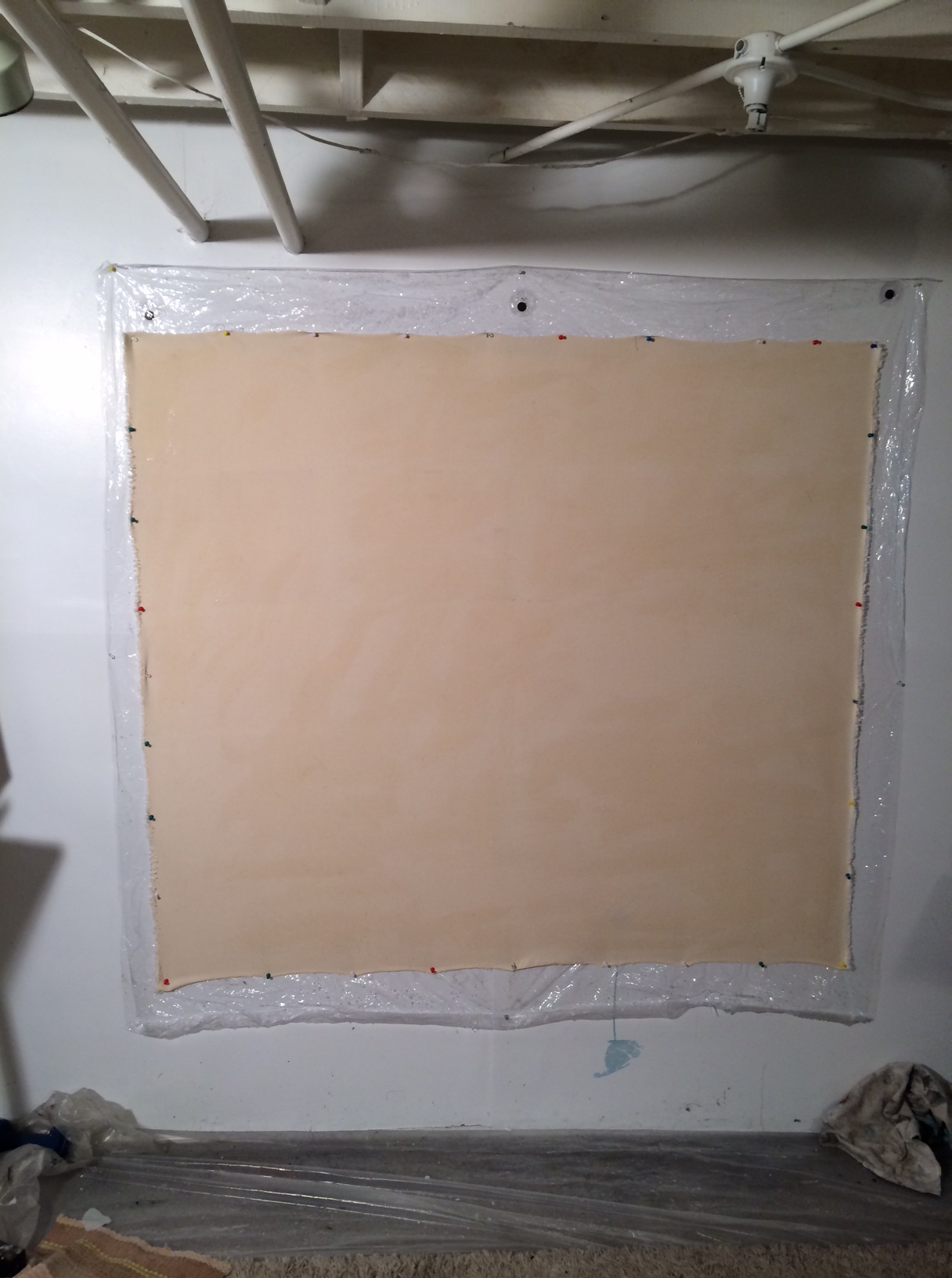
a new canvas, stretched and ready for gesso.
So what is next?
There is a sweet void that follows in the wake of every project and this particular void is vaster than most (don’t you love the phrase, “particular void?”). This project, The Lost Boy, was and continues to be more layered than any other. It pulls on emotional and spiritual roots that have not been available in other performances and so the post-show disorientation is mighty.
I’ve come to appreciate my time in the void. It is the time of reflection. It is the time of rest. It is the time of long walks. It is the time of questions finally answered that invite bigger questions. I’ve learned that disorientation is necessary for reorientation and reorientation never comes as an answer but always comes in the form of a question: so, what’s next?
Yesterday I tacked a large canvas to the wall. It is now covered with layers of Gesso and is ready for paint. I delight in this phase of preparation. It is akin to the anticipation of meeting with an old friend; the conversation will be rich and far reaching. I also bought a new sketchbook and have set myself the task of filling it within the month. Many years ago, while sitting in another void, I was staying with my pals Duncan and Liz while directing a play. Liz, familiar with voids, insisted that, after rehearsals, I do a hundred paintings before I sleep. Each night, tired from a long day of rehearsal, Liz sat with me as I did one hundred paintings, quick gestures with brush and ink, paper fluttering to the floor. We laughed and I felt renewed. After ten paintings en route to a hundred, the notion of judgment and too-much-thinking goes out the window. The joy of the action takes precedence over the illusion of a finished product.
I’ve written often of the lessons Saul-the-tai-chi master taught me. Focus on the field of possibility and not on the opponent. In other words, offer no resistance to those things that appear as obstacles. Sit with gratitude in the void. Paint a hundred paintings before you sleep. Delight in the question.
Filed under: Art, Creativity, Possibility, The Direction of Intention | Tagged: art, Gratitude, possibility, question, theatre | Leave a comment »
 We’re already snowed in and the word is that the blizzard – the real blizzard – won’t start for another hour. Looking out the window Kerri said, “This storm is angry.” It is. This is not a gentle snowstorm. The flakes are not fluffy or big; they are enraged bees that sting. We watched cardinals, brilliant red amidst the flurry of white, hunker down, bobbing in branches of the pine tree. Tripper Dog-Dog-Dog slid off the deck into a drift and emerged with a beard of snow and a look of confusion. He ran outside, felt the bite of the wind, and almost knocked me over running back into the house.
We sat in the living room and watched the snow swirl and howl. We talked quietly until the light waned and we noticed that we were sitting in the dark. It was as if the ferocity outside the house required hushed tones inside. Life is like that – inner turmoil often looks like a quiet exterior just as violent storms require us to talk in gentle voices. Balance is always present although not always recognized.
Lately I’ve been meditating much on the word “trespass.” Once, I had an experience with the word “trespass” that was nothing short of mystical. It altered the course of my life. According to the prayer, one must trespass to be forgiven. Life is nothing if not full of trespasses and those who trespass against us. Crossing boundaries and holding boundaries are both learned skills that require a good deal of trespassing.
Forgiveness feels good. Whether you are the giver of the forgiveness or the receiver (or both, when, for instance, forgiving yourself), it just feels good. Those violent outer storms will always lead to inner peace if you follow them far enough. It is the natural order of things. All that is required is a recognition that stories change like people change; that stories change when people let go of old stories. Miracles happens when, in hushed tones, the story of a trespass is retold as a story of forgiveness.
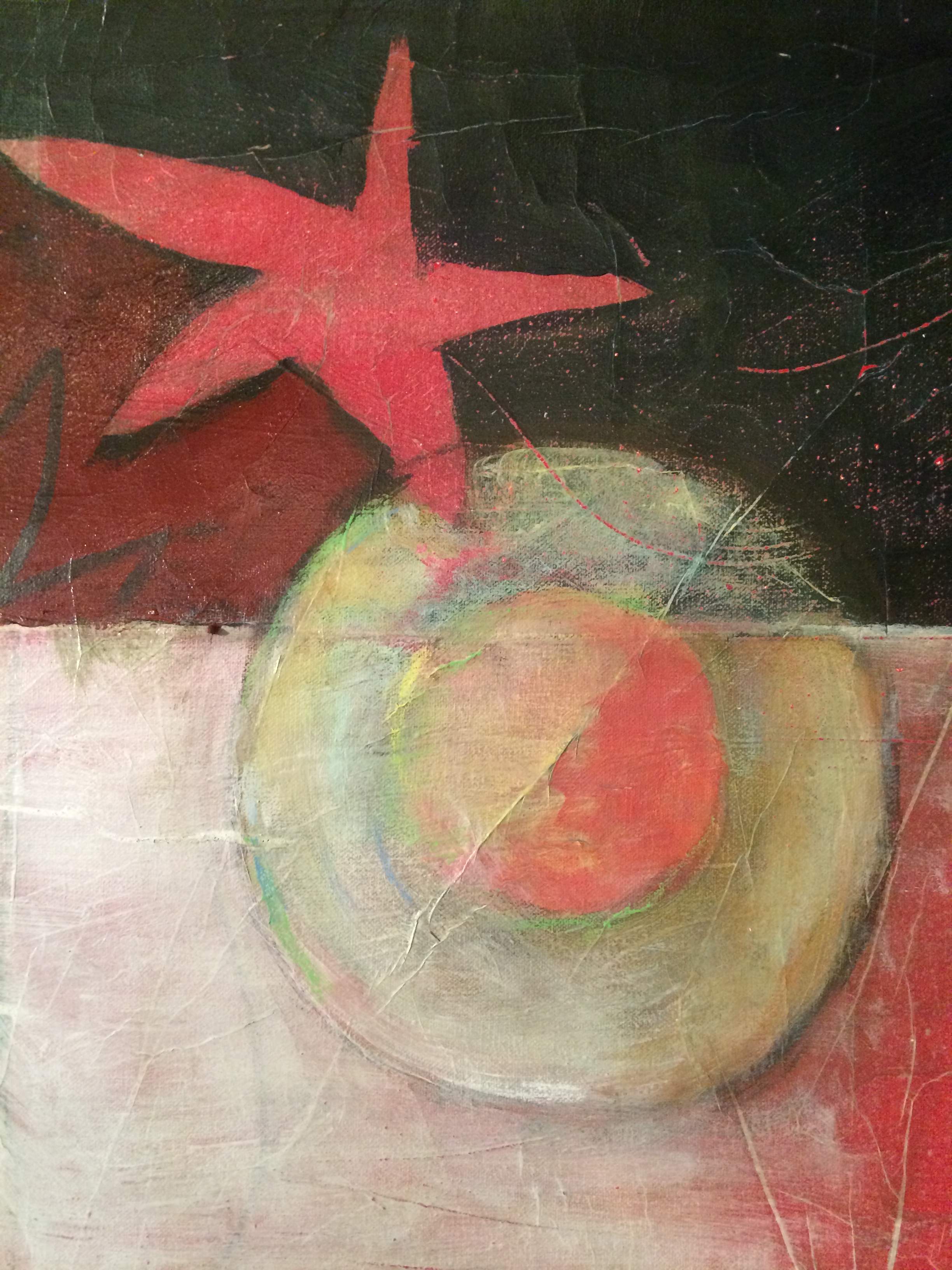
Go here for fine art prints of my paintings, bags and other cool things!
Filed under: Navel Gazing, Perspective, Possibility, Story, Truly Powerful People | Tagged: forgiveness, inner peace, life, peace, prayer, storms, trespass | Leave a comment »
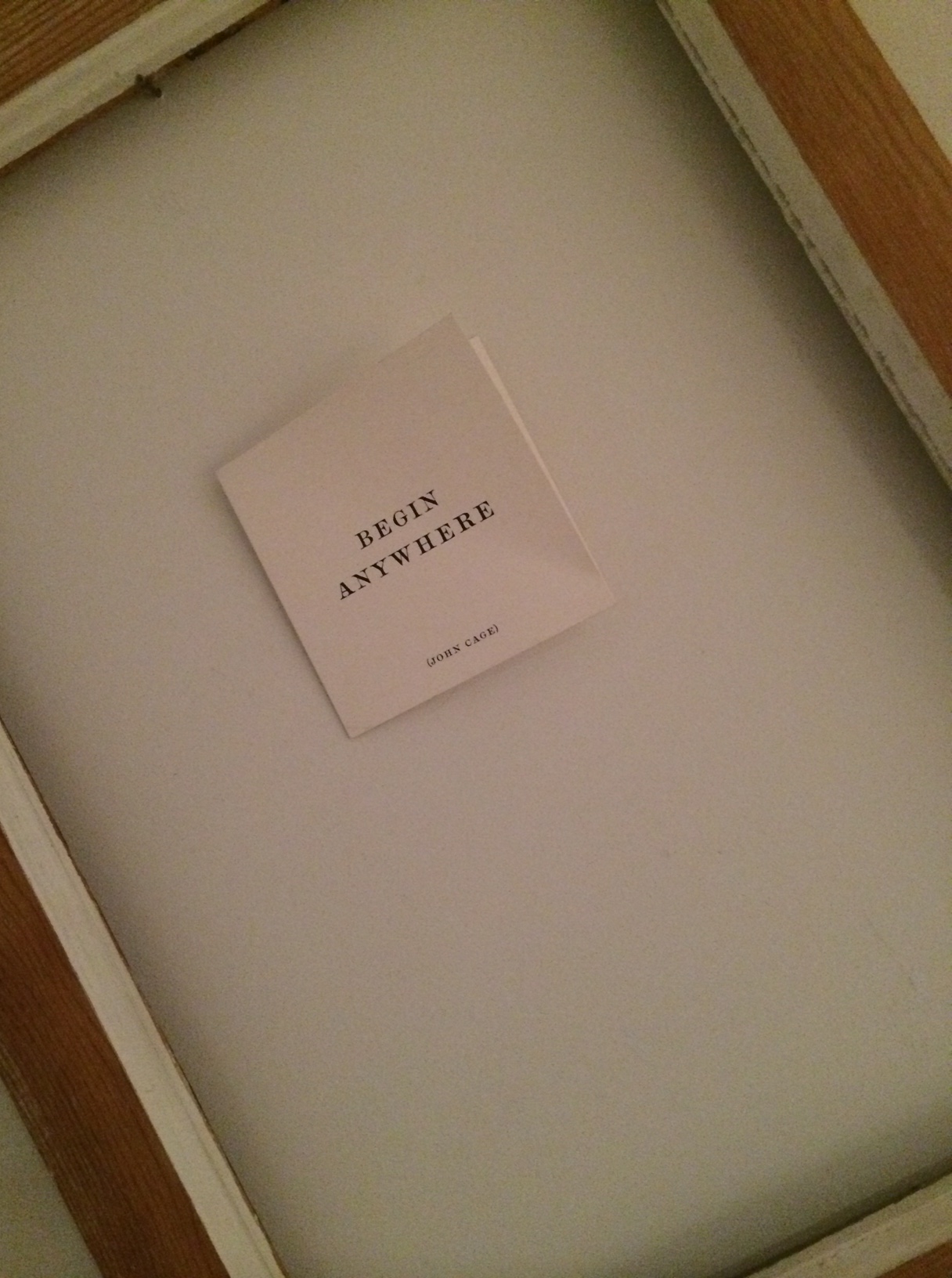
Begin Anywhere
In our house, hanging on the wall like a painting, is an old window frame. In the top pane is a card that reads, “Begin Anywhere.”
Earlier this week I had a great conversation with Diane. She laughed and said, “In my meditations I was whining to God because I wanted to see the plan of my life. I got the clear message that I was never going to see the plan but I could always see the next step. The next step is always right in front of me.” Dancing with what’s right in front of you is sometimes called faith. Sometimes it is called play. Sometimes it is called art.
Diane and I are good reflectors for each other; we are usually on parallel paths. For both of us, the past year or two has been a process of letting things go and stripping things back: paths, patterns, and presuppositions. It has been the mother of all house-cleanings (she had a literal flood!) and, like all good house cleaning it took some elbow grease and few hard decisions about what to keep and what to throw. After the job is done, nothing feels better than a clean house and along with the good feeling, new space, and wide-open possibilities, comes the question, “What’s next?”
Diane told me her story because my next step is so clear that I can focus on nothing else. With such a myopic focus I can see nothing else and that’s why I called her. I must do this play. I must. I cannot see beyond this dance. It is my first thought in the morning. It is my last thought falling into sleep. This step, my dance with The Lost Boy, makes no sense and Diane’s point was well taken: the next step rarely makes sense. Sense-making requires context. Sense-making is a skill of relativity – and since we can never know the plan (if, indeed, there is one), we can only make sense based on old information. That is good news for plumbers but is dubious at best for leaders, explorers, seekers, and artists.
After our call I realized that dancing with what’s right in front of me is how I paint. It’s also the key to a good conversation – and painting, for me, is a good conversation. After my good conversation with Diane, she sent me an email of affirmation and concluded her thoughts with this: “Stay focused on what is before you now and let the creations show you how and when they are ready to play.”
For all digital forms of The Seer, go here
 For posters and prints of my paintings, go here
Filed under: Art, Gratitude, Identity, Play, Possibility, Truly Powerful People | Tagged: affirmation, art, faith, focus, present, sense, sense making | Leave a comment »





