The Spirit Of Play [David’s blog on DR Thursday]

In a fit of serendipity, while awash with an overwhelming feeling of loneliness, this morning I opened The Marginalian and found musings about loneliness:

“Jungian analyst Robert A. Johnson groups all the possible lonelinesses into the three core kinds that pulsate beneath our daily lives and govern our search for love: the past-oriented loneliness of missing what once was and never again will be, the future-oriented loneliness of longing for what could be but has not come to pass, and what he calls “the profound loneliness of being close to God… The first two lonelinesses are rooted in time…The third kind of loneliness deals not with the temporal but with the eternal; it exists outside of time — like music, like wonder, like love.“[Maria Popova, The Marginalian, April 20, 2025]

Yearning for the past. Fear of the future. Disappearing into the now.

I’ve spent my entire life standing in front of an easel. The younger me was trying to get to something behind the eyes. He was reaching into the mystery to try to understand it. Paint was the means to get there. I miss that man. A later version of me became burdened with trying to get eyes to see what I had painted. He was trying to reconcile the inner pursuit of the mystery with the outer necessity of paying the bills. His valuation became wonky, sometimes confusing personal worth with sales of his paintings. His intention split. He questioned the price of pursuing the mystery. When the acknowledgment finally set in that he would never have pieces in museums or coffee table books written about his work, he struggled but soon realized his struggle was akin to a butterfly breaking free and shedding a cocoon.

Two kinds of loneliness. No one can go with you when you gaze into the past; sense-making what-was is a solo journey. Similarly, no one can accompany you into the cocoon or know what lies beyond.

I loved this phrase in the article: “…the existential disorientation of feeling your transience press against the edge of the eternal, your smallness press against the immensity…” That perfectly describes how I now feel standing before my easel: small.

Kerri sat with me in the studio. I have two tiny canvases sitting on the easel. As I was describing what I was intending she stopped me and challenged me to do something new. She challenged me to let go of what I know. She asked me to step beyond my comfortable place into the mystery. I knew she was right. I know it is the only way forward. That is why I miss terribly the younger version of me who didn’t know any better. He threw paint with enthusiasm because he didn’t know any other way. He lived each day on a new trail; exploring.

I heard Horatio in my head: “Paint crap!” he said, howling, a laughing Buddha. “Paint lots and lots of crap.” Stepping onto a new trail is lonely. And, that’s the point. There’s nothing like not knowing what’s ahead to open the eyes (and heart) to the greater mystery (read: possibility), to fill-up withwonder, to resurrect the spirit of play.

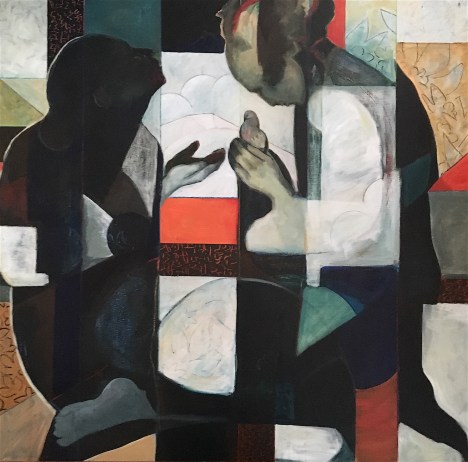
from the archives: LAUGH, 18″x24″ oil on canvas (the collection of Marian Jacobs)

read Kerri’s blogpost about THE FENCE

likesharesupportcommentsubscribe…thankyou.

Teach The Moment [David’s blog on DR Thursday]

As I watched the curtain of grasses sway I thought they’d make an excellent set piece for a production of The Tempest. Their movement was hypnotic. I had the good fortune to design a minimal-budget-production of The Tempest several years ago and used huge pieces of driftwood and a bamboo curtain. I loved it.

The Tempest was on my mind because earlier in the day while doing some research I bumbled across the question, “Why is The Tempest a banned book?” The answer is a very sad statement about our times, the reason our nation cannot seem to mature: “The Tempest,” one of the playwright’s classics, is among the books removed, as teachers were urged to stay away from any works where “race, ethnicity and oppression are central themes,” the website Salon reported.

In our nation race, ethnicity and oppression are the central themes of our history: “246 years of brutal enslavement; the rape of black women for the pleasure of white men and to produce more enslaved workers; the selling off of black children; the attempted genocide of Indigenous people, Indian removal acts, and reservations; indentured servitude, lynching and mob violence; sharecropping; Chinese exclusion laws; Japanese American internment; Jim Crow laws and mandatory segregation…” (Robin Diangelo, White Fragility)

You’d think we might want to encourage teaching The Tempest and other great works so we might consider and discuss the full scope of our history. So that we might learn about ourselves. So that we might become capable of addressing and putting to rest the ugly fear – rooted in race, ethnicity and oppression – exploited for gain by the Republican party, that gave birth to the MAGA movement. It’s the Confederacy by another name.

In a nation of immigrants, you’d think it might be a first principle to teach our children about race, ethnicity, and oppression so we might learn how to reach across – and put to rest – division rather than perpetually recreate it.

The AI overview provided another related and currently more salient reason to teach The Tempest: “The main message of Shakespeare’s The Tempest is that forgiveness and reconciliation are preferable to revenge and punishment, especially when it comes to the restoration of social order and personal peace.

If social order and personal peace are the goals, our current path of revenge and punishment will not take us there. In the play, Prospero chooses release from his island prison through the power of forgiveness and redemption rather than perpetuating his imprisonment by seeking revenge.

In this teachable moment Prospero’s choice is an analogy worth teaching: a path provided to us by a play written in 1610 by one of the greatest poets of the English language; a way out of our national-soul-imprisonment.

I suspect that is why The Tempest and other great works of literature dealing with themes-that-matter are being banned. In the minds of this administration, continued imprisonment, revenge and punishment seem to be the goals.

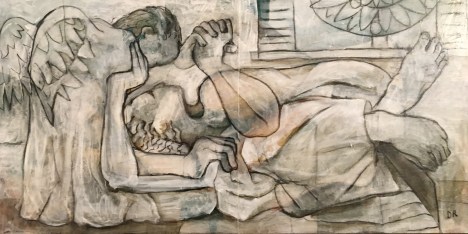
Angels At Our Side, 24″x48″, mixed media on board

read Kerri’s blogpost about THE GRASSES

likesharesupportsubscribecomment…thankyou.

Joyfully Jump [David’s blog on DR Thursday]

“The true work of art is but a shadow of the divine perfection.”Michelangelo

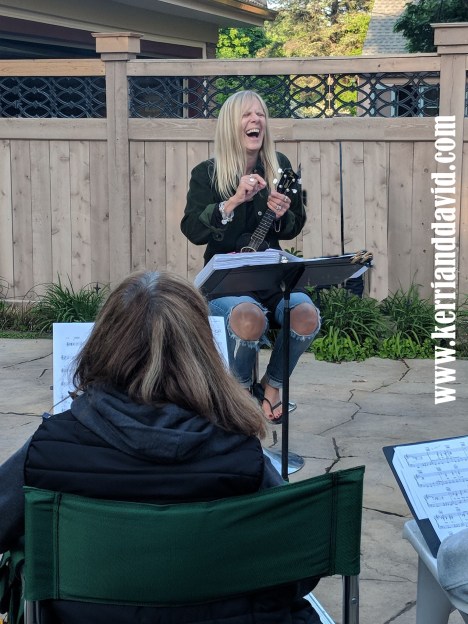
I still marvel even though I’ve grown used to it. Without warning she suddenly jumps up and races to capture an image. Walking on the trail, mid-conversation, she suddenly disappears; I turn and find her kneeling in the dirt, her camera aimed at a new bud or the methodical march of a caterpillar. Her muse is not gentle. Her muse demands immediate action.

At first her sudden bursts of energy frightened me. I thought she saw a snake or was leaping to dodge a tarantula. I jumped, too, usually crying out, “WHAT? WHAT?” After the hundredth scare I learned to temper my response to her bursts of inspiration. I’m painfully aware that with my new conditioning it’s likely that she will someday leap to avoid a rattlesnake while I step on it, thinking she’s having a muse-call. I am certain that she will get an excellent photograph of the snake biting my ankle.

In The Artist’s Way, Julia Cameron wrote, “Creativity is God’s gift to us. Using our creativity is our gift back to God” She continued with a more tangible sentiment, one that every human being experiences: “The refusal to be creative is self-will and is counter to our true nature.”

Blunting ourselves is not natural. It is what KDOT is teaching me. Do not doubt or delay the muse. Jump with both feet into the beauty when it beckons. Play with the moment. Share what you find there.

We forget that we, too, are works of art. We’re not finished pieces but ongoing shadows of divine perfection. We express. We are most alive when we are uninhibited in our participation and celebration of what we experience. It’s called “connected”. Plugged in. Present. Flow.

The muse will open the door and like Kerri, we could all learn to joyfully jump through it. Anything less is unnatural.

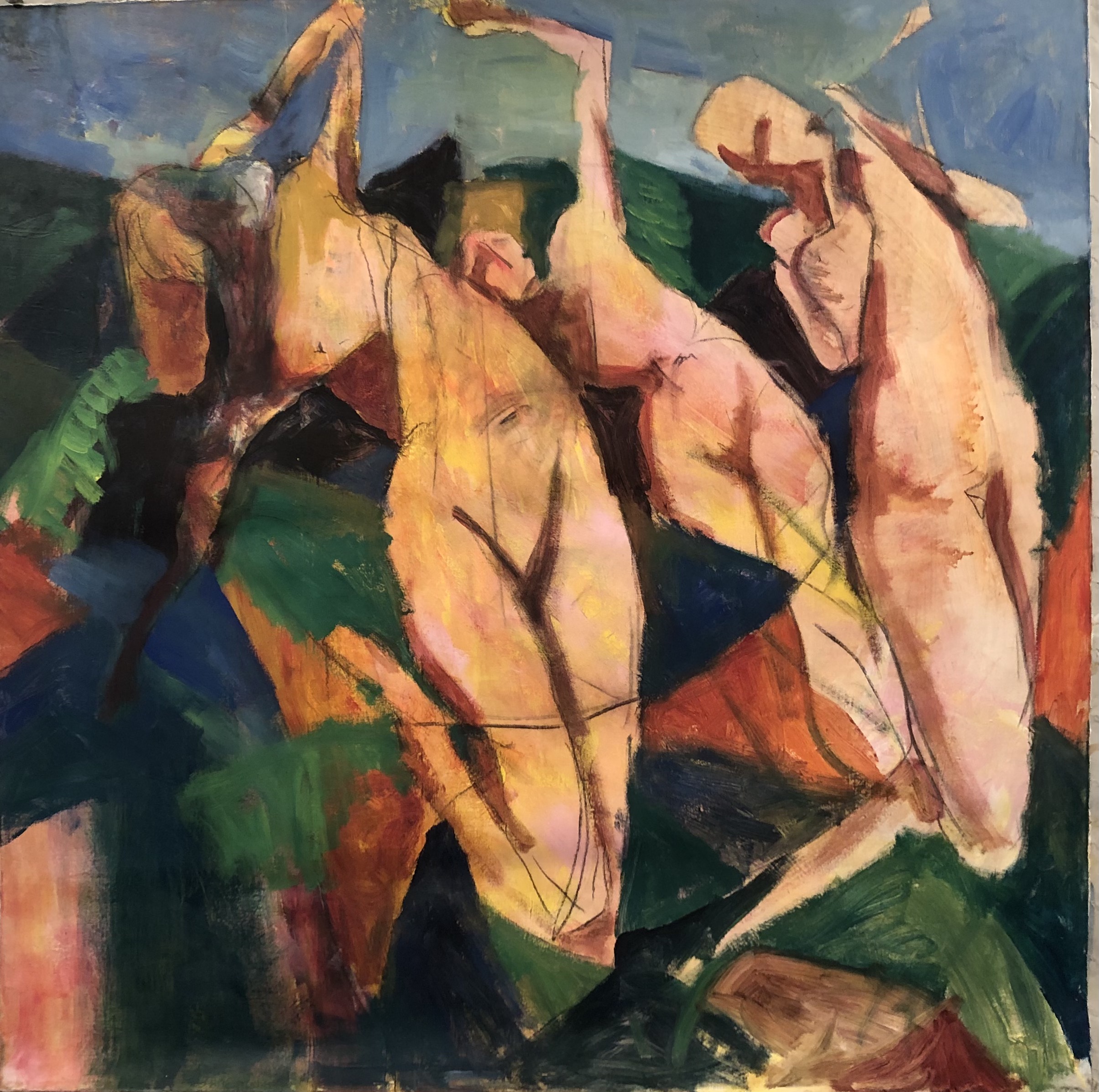
from the archives: Maenads

Go here to visit my gallery site

read Kerri’s blogpost about THE MUSE

likesharecommentsubscribesupport…thankyou.

What Grows In Us [David’s blog on DR Thursday]

For several months we kept a book on our bedside table: Benedictus by John O’Donohue. It’s a book of poems in the form of blessings. Each morning we’d select one at random, and read it aloud. It was one of our strategies for starting the day with a meditation on goodness rather than a doomscroll through the news.

It’s an ages-old adage: where you place your focus grows. Focus on fear and that’s what you’ll see. Focus on your blessings and that’s what populates your garden.

I believe in the adage but I also know that no mind, heart or soul is healthy if singularly focused. I also believe fear can be useful, anger can be generative, and grace is most often found on a walk through despair. Focus is not an end goal or an achievement. It is not meant to fortress us from “negative” emotions since experiencing the full spectrum of emotion is, after all, how we learn and grow. A full palette of feeling is what makes us human. Focus is the choice of a conscious mind.

Fear can be a prayer. Loss is one of the many shades of love.

I’m aware that most of what we write about these days is about the dismantling of democracy. Some of my pals are worried that I am lost in a dark land or too focused on the negative. And with each outreach I am reaffirmed in the certainty that I am a fortunate man to have so many who care so much about me. I do not write this as a platitude. I know to my bones that I am a fortunate man.

I am fortunate because I have known shame and terror. I have made titanically stupid choices. I have learned and questioned and followed my wandering heart into every valley that beckoned and climbed every mountain that called. I have fought battles that did not exist and found my seemingly good intention was destructive for others. I have felt deeply. I ran when I should have stood my ground. I betrayed myself. All of these experiences have expanded my life-palette and given me some small understanding of the power of focus. These experiences introduced me to the gorgeous people who now surround me, who worry that I am lost in a dark land.

This morning we sipped coffee in bed. Dogga was asleep on the quilt at our feet. We listened to the bird chorus come alive with the rising sun. We held hands as we always do. At the exact same moment, we had the overwhelming realization that life does not get any better. I was so taken with the gorgeousness of being alive that words failed me. We sat in utter appreciation of all that we enjoy.

That happens for us multiple times every day. It is where we choose to place our focus. It is what grows in us. It is the same place – this love of life and gratitude for all we enjoy – that necessitates writing with such urgency about what’s happening in our nation. We do not write to solve a problem. We do not write to complain or blame.

Do you recall the story of Kitty Genovese? She was a young woman who was raped and murdered in NYC in 1964. Although many people heard her cries for help, either no one listening recognized the horror of her plight – which lasted over half an hour – or no one cared. In any event, no one called the police; no one came to her aid. It was the inception of what we know as the “bystander effect”: everyone thinking someone else will take the responsibility. Focus elsewhere.

Our national house is on fire. The rights of women around this nation are being brutalized. The rights of all people of this nation are under assault. It’s no time to be a bystander. We write because Kitty is screaming. All that we love and enjoy makes it impossible to turn away and turn up the volume of the television. Were we capable of turning away, were we actually pretending that what is happening is not actually happening – as is the republican congress – then we would be in a very dark place, indeed.

Prayer Of Opposites, 48″x48″, acrylic on panel

read Kerri’s blogpost about DOGGA

likesharecommentsupportsubscribe…thankyou.

The Many, Many Things [David’s blog on DR Thursday]

Although I see signs of spring everywhere, it wasn’t official until we received a text from The Grass King that the reality of the earth’s orbit set in. He’s monitoring the ground temperature and will let us know when it’s the perfect time to seed and fertilize. Like all of the plants, we yearn for some time in the sun.

For her birthday six years ago I gave her a paint bucket containing 60 slips of paper: 60 things I love about her. There were – and are – many more than 60 things so I had to edit. A few years after the bucket, among other things, I gave her a piano tuning. She has yet to cash in the tuning but I have hope that this is the year. True confession: my gift of tuning was selfish since I love to hear her play. Broken wrists et. al. has made those opportunities few and far between but I see signs…This truly may be the year.

Today she completes another lap around the sun. It’s her birthday. Dogga and I will spoil her to the degree that she allows (she generally resists being coddled). The day promises to be beautiful so we will take a nice walk. Perhaps a small adventure will beckon. 20 will come for dinner so there will be abundant food and laughter. Our celebrations are mostly low key – rather than fill them with events we tend to clear the space and follow our hearts.

13 years ago I followed my heart and stepped off an airplane to meet in-person this woman named Kerri. I’m so glad I did. Now, I could fill hundreds of paint buckets with slips of paper telling her of the many, many things I love about her.

Go here to visit my gallery site

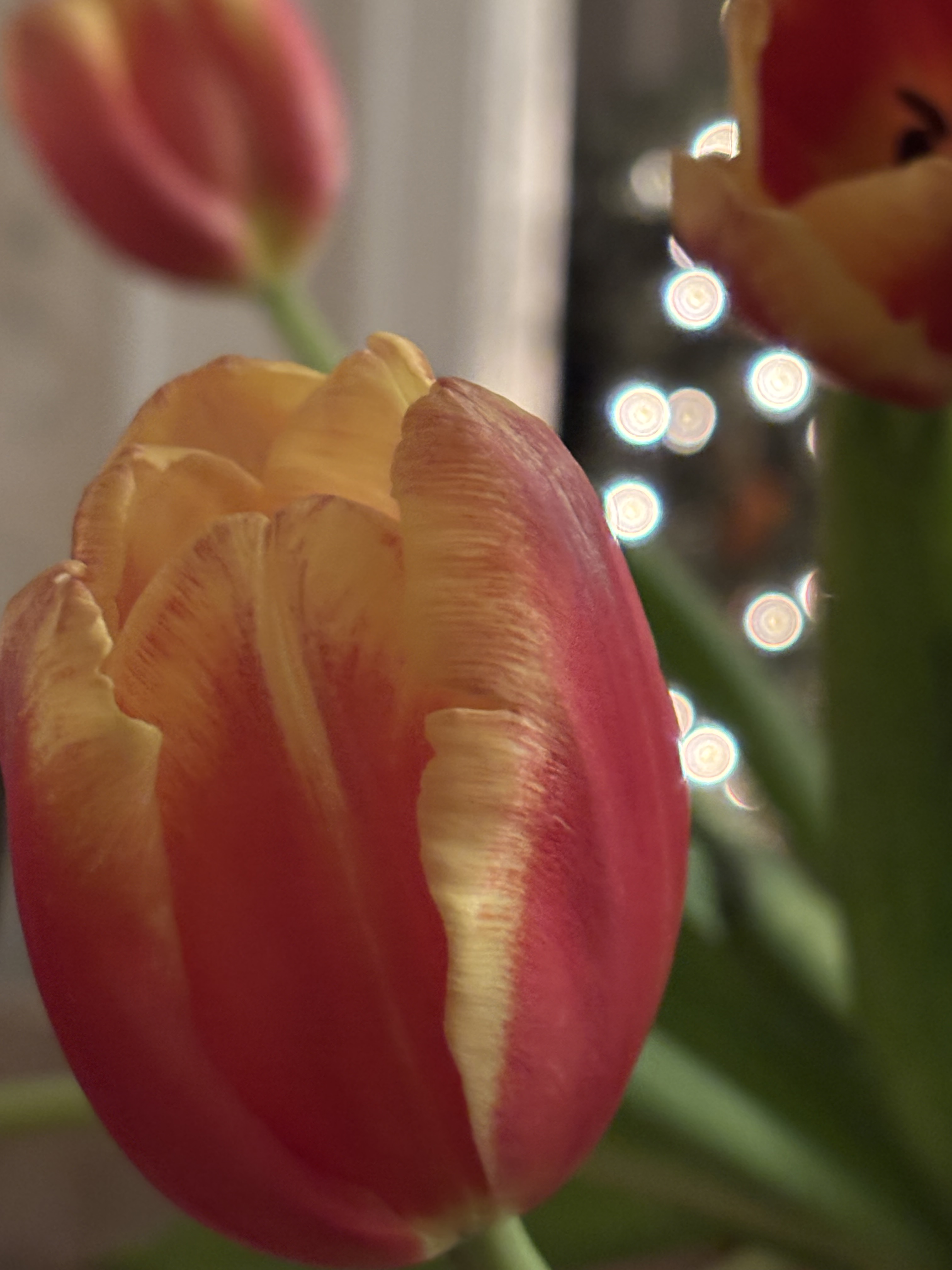
read Kerri’s blogpost about TULIPS

likesharesupportsubscribecomment…thankyou

The Pizza Thing [David’s blog on DR Thursday]

My latest painting I did for Kerri. It is a painting of invocation. I did not paint it from knowledge or plan. I felt my way through it.

On the day I thought I’d completed the painting I asked her if she wanted me to make any changes. After staring at the image for a few minutes she said, “I love it,” and then asked, “But what’s up with the pizza thing?”

In the many art openings I’ve had in my life I’ve learned that what I paint is rarely the whole of what a viewer sees. I used to be surprised by what others saw in my paintings but now I expect it.

“Pizza thing?” I asked.

“You know, the thing they use to put pizzas in the oven. A paddle.”

“Where is it?”

She pointed to a series of connected shapes on the canvas.

Once someone sees something in an abstract image – like a dragon in a cloud – they can never again not see it. I knew the painting was not-yet-done. She would always see a pizza paddle in the painting if I didn’t alter the shapes. “Do you want me to change it?” I asked. She nodded, afraid I was offended.

It is the great challenge of perception: people rarely look in the same direction and see the same thing. We do not share experiences until we…share them, talk about them, compare notes, come to a common perceptual ground.

A younger me would have defended the painting as I saw it. This older version of me feels no need to defend what I see since I don’t expect others to see what I see. I want to learn what they see. I want to step into a common ground, a space of collaboration. That doesn’t mean that I necessarily must change the painting. It does, however, afford me the opportunity to make it better if I so choose, if my question, “What do you see?” actually opens my perspective.

It’s why I feel the need to shout into the winds of our current political and national circus. It is unimportant whether or not we see eye to eye. It is most important that we share notes, ask questions, discuss discrepancies…discern what is fact from what is fiction. We have to want to step into common ground.

When we walk she often stops and aims her camera at the ground. “What do you see?” I ask.

She snaps the photo and shows me the screen. “A heart,” she smiles. “Do you see it?”

“Now, I do.” I say. I would have stepped over the stone and never seen the heart. And aren’t I fortunate to walk through life with someone who is surrounded by hearts and takes the time to show me what I do not see?

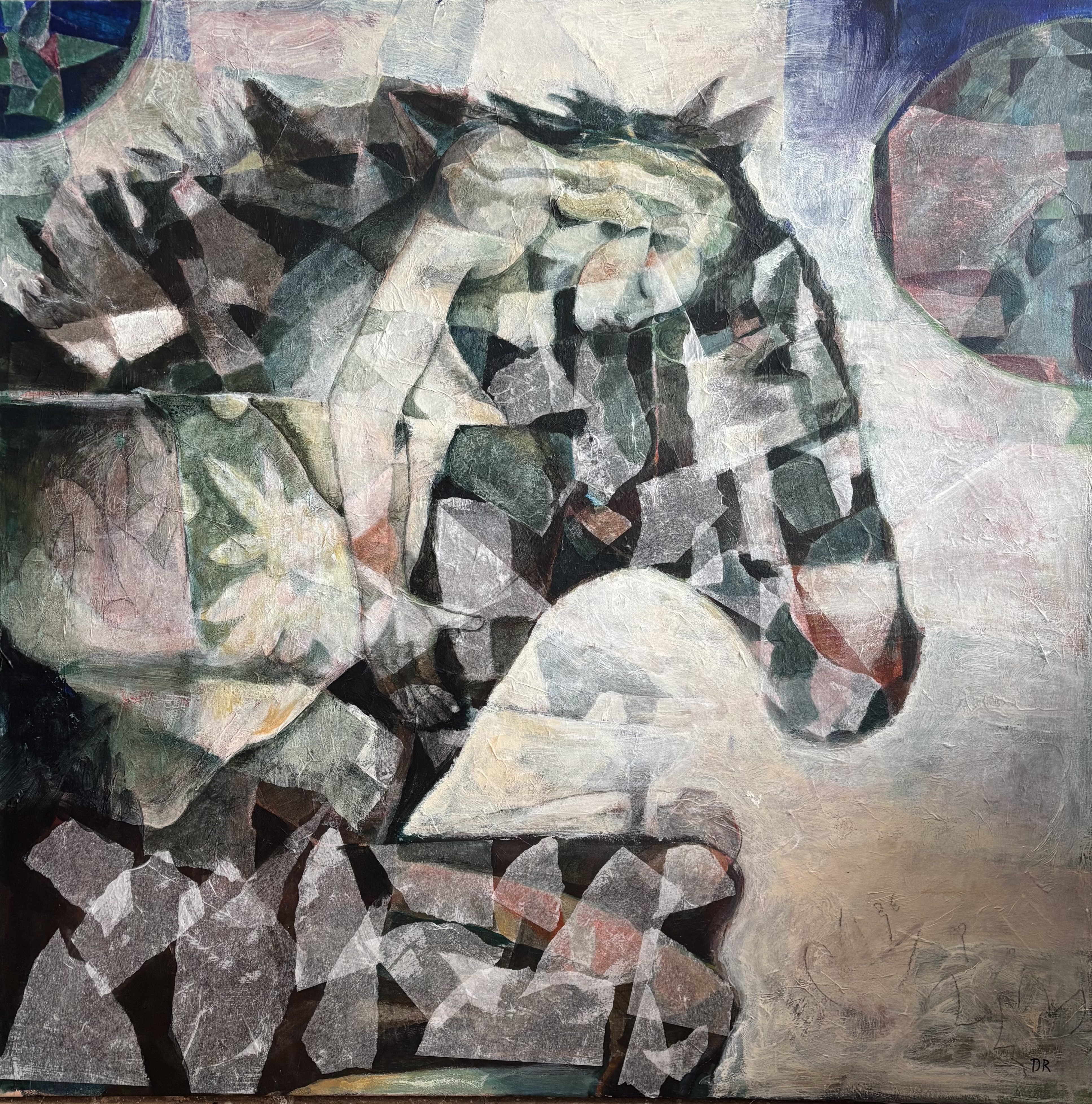
In Dreams She Rides Wild Horses (finished, without the pizza thing)

read Kerri’s blogpost about HEARTS

likesharecommentsupportsubscribe…thankyou.

Opossum Is Asking [David’s blog on DR Thursday]

It was the second time we saw the baby opossum. The first time it was with its mother. The moment they saw us they beat a hasty retreat to their den . It was a cold day and no one had walked the trail since the polar freeze. We surprised them.

This time we rounded the bend and the baby was perfectly still, standing in the middle of the trail. It was as if it was waiting for us. We stopped and returned its stare. After a moment or two it slowly waddled into the safety of the tall grass.

Later, at home, I looked up the symbolism of an opossum crossing your path.

“…in essence, Opossum is beckoning you to use your brain, your sense of drama, a surprise to leap over some barrier to your progress.” (Medicine Cards) Survival. Resourcefulness. Opossums are adapters and thrive in challenging and changing environments.

It’s considered a very good omen and right now, in our rapidly changing and challenging environment, we could use a good omen. And, the message within the symbol matched our concerns of late: how do we become more resourceful in order to survive the havoc being wreaked on our nation? It’s an open question for us, an ongoing conversation.

Last night I had a rare text exchange with my younger brother. “The near future looks bleak but we need to focus on what we really care about and can influence,” he wrote. “I have a wife, daughters, dogs, and a community of friends. I’m still blessed in challenging times.” Our exchange reminded me of the aspect of the opossum that resonated most with me: adapt to thrive in a challenging and changing environment.

To thrive we need to focus on what we care about and can influence.

Bernie Sanders came through town this weekend and thousands of people attended his rally. I was heartened by the energy and the overwhelming turnout. What we need to do to influence the current course of this criminally-stupid-administration: show up, speak out and call out the hypocrisy. Or all of the above. En masse. Non-stop.

When we come together to protect what we care about we thrive. It seems opossum is asking us to use our brains, unleash our sense of drama, so we might surprise the authoritarian and leap over the barriers he/they erect to our progress. There is power in a collective focus. There is unstoppable energy in the collective action of the people. That power and energy is the beating heart of a democracy.

In Dreams She Rides Wild Horses (in process), 42″x42″, mixed media

read Kerri’s blogpost about the OPOSSUM

likesharesupportcommentsubscribe…thankyou.

Sit In The Circle [David’s blog on DR Thursday]

Somewhere in my past a teacher suggested that it is helpful for a writer to know to whom they are writing. Who is your audience? And more specifically, is there one person that your words are meant to reach?

The question came up for me on our trail. The snow dampens sound. Some people find a winter landscape bleak but I find it beautiful. Distinct. Thought provoking. Ideally suited for an introvert like me. Quiet life. Stands of warm sienna reeds sharp against the ice blue snow. The creaking-moan of tree limbs rubbing in the cold breeze. Perfect for inspiration and reflection.

Much is changing in the world broadly and in our world close-in. I am not writing as I once did. I am not painting like I used to. When I first began writing my audience was a community of international coaches, interculturalists, and diversity, equity and inclusion facilitators. I wrote broadly. I had points to make. A brain to flex.

Now I am bereft of answers and have only questions. Some days I write specifically – for Alex or Buffalo Bob. Some days I write for Horatio or Judy or Dwight or 20. Sometimes I write to members of my family though I know they don’t often read what I write. Sometimes I write for Kerri. Many days, probably most days, I write to myself. I reach in. I am asking myself questions about what I believe.

The people who populate my audience – my community – now and in the past – are bonded in their empathy. They care about others. They strive to make the world a better place for others. They are modest. Humble. The opposite of elitist. They are kind. They ask questions. They are thinkers who seek truth in all things; they are open hearts, open minds, with finely-tuned crap detectors. They care enough to fact-check what they hear. They are learners, curious about difference, unafraid of stepping beyond what they know. They are the people I want to hang out with.

On my walk in the snowy woods I realized that I need them now more than ever. A community that inspires hope, that fuels the creative fires burning inside of me and others. A bevy of goodhearted people I admire and believe in. A community of sanity – my community of sanity – in a country deliberately trying to lose its mind and sell its soul.

I write each day so I might sit for a few moments in the circle with these good people, whether they know it or not.

Instrument of Peace, 48″x91″ mixed media

read Kerri’s blogpost about REEDS AND SNOW

likesharesupportcommentcareaboutotherssubscribe…thankyou.

Lift [David’s blog on DR Thursday]

An Ode To Lift.

To raise or hoist. To heave or haul.

Dissipating fog, cloud dissolve.

Upward force, curved surface of a wing.

Pump up the volume, make eardrums ring.

Buoy the spirits, sing the reprise.

Pick a pocket; go ahead, plagiarize!

Boost the revenue, Jack-up the price.

End the embargo, melt political ice.

Stop. A thumb’s out, give it a ride.

Encouragement, boost, stimulus, pride.

“Which floor?” Push the button. Soon you’ll arrive.

***

“Lift” is one of those words. A noun and a verb. Four letters, when combined, result in many more than four definitions, some completely contradictory. Lift a spirit/Lift a wallet.

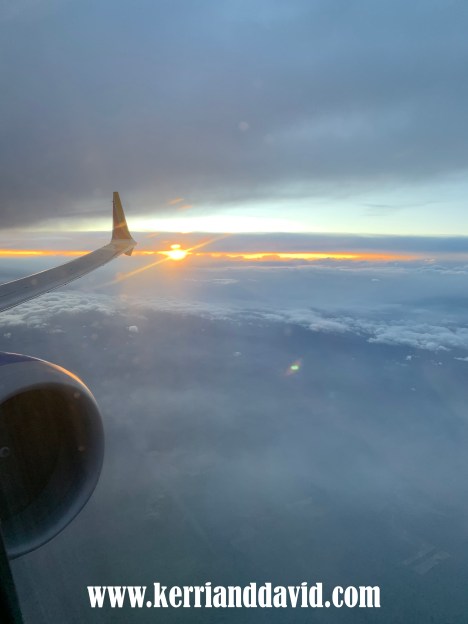
Somewhere in time, it occurred to a human mind that flight did not necessarily include flapping but the opposite. Lift. In my imagination the Wright Brothers flapped their arms in excitement when their theory took flight. Lift: the upward force that allows an aircraft to stay airborne. “The curved upper surface of a wing causes air to flow faster over the top than the bottom, resulting in lower pressure above the wing and higher pressure below, generating lift. According to Bernoulli’s principle.”

I nearly flunked physics in high school so don’t ask me to expound or explain. In fact, I try not to think about lift when I board an airplane. It’s enough to know that I am willingly entering a tube that will hurtle through space while a kind person offers me coffee and snacks from a rolling cart. I flap my arms in excitement every time the plane safely lands.

Each and every time, sitting very still, buckled into my seat, I close my eyes during the moment of lift.

And really, it all boils down to this: “People who are truly strong lift others up. People who are truly powerful bring others together.” ~ Michelle Obama

read Kerri’s blogpost about FLIGHT

likesharesupportliftcommentsubscribe…thankyou.

Meet Guttah [David’s blog on DR Thursday]

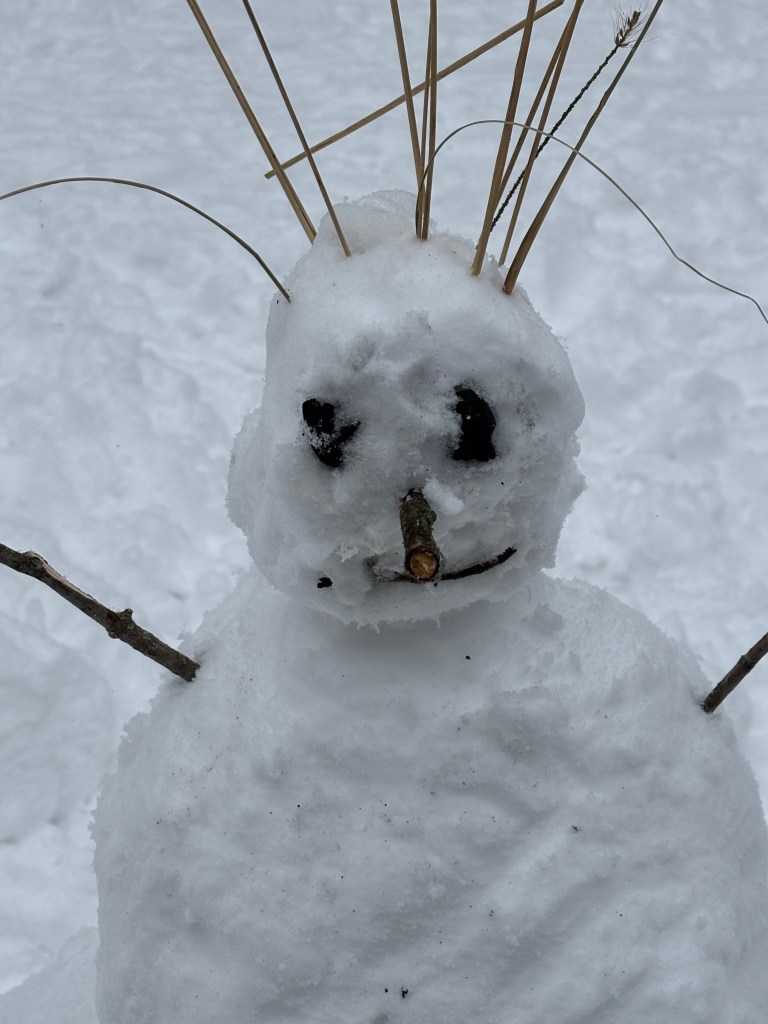
Meet Guttah. He is no ordinary snowman. He is made from snow scooped off of the roof.

A snow-rake and a wobbly ladder were necessary to acquire the makings of Guttah.

I did not climb a ladder on a bitter cold day with a snow-rake in hand in order to make Guttah. Had Guttah been on my mind, had Guttah been the original mission, I would have used the snow on the ground. There was – and is still – plenty of snowman fodder in the backyard. No. The conditions were perfect for ice-damming. A wet snow followed by a sunny day. And then a freeze. We jumped into prevention-mode since historically an ice dam on the roof is capable of channeling water into our house. “Is that a waterfall…on the wall?” I asked the first time I experienced it.

“Damn it!” Kerri exclaimed, jumping into action.

You might say that Guttah is a side-effect of ice-dam-prevention. With plenty of snow on the roof, standing on the icy rungs of an old wooden ladder, with every pull of my snow-rake cascading snow and ice onto the deck far below, rather than think, “I could die,” I chose to ask a question of distraction: “What will I do with all of this snow piling up on the deck?”

Like much of the art created across time, Guttah was borne as a distraction from death-fear. Not that I consider Guttah art (he certainly does not view himself with such hubris) but thoughts of a snowman sculpture kept me scooping and gave me the necessary focus to stay safely perched upon my shaky rung.

My favorite part is his hair. It is how I imagined my hair under my hat while scooping snow from the roof. Guttah, after all, is my doppelganger, my double-walker, the outer-snow-image of my inner-snow-scooping-self.

latest detail of a painting-in-progress

read Kerri’s blogpost about GUTTAH

likesharesculptcommentsupportmakeartsubscribe…thankyou.