Stand In Ambiguity [on KS Friday]

Liminality: the quality of ambiguity or disorientation that occurs in the middle stage of a rite of passage, when participants no longer hold their pre-ritual status but have not yet begun the transition to the status they will hold when the rite is complete.

Here we are, just like you, standing in the in-between place. The liminal space. The previous way is all-but-gone. The new way has not yet arrived.

We did not know in January when she fell and broke both wrists that the fall would signal the beginning of a transition. Therapy was interrupted by a pandemic. Job loss. More job loss. Job reduction. A wet floor, a second fall on an already injured wrist. More disorientation, a step further into uncertainty. “Who will I be if I can’t play?” she asked. Her question has layers. “Who will I be if I can’t play like I used to?” “Who will I be if my hands are no longer the hands that I know?” She has artist’s hands. Musician hands. This is no small question.

Given a whirl of disappearing norms, we are doing well within the ambiguity.

2020 will serve as a marker for all of us. There was a way of life before the pandemic. There was a way of life before the liar-president. New ways will arise. Out of chaos, order. Right now, there is full-press-disorientation.

Our threshold seems to stretch in all directions, inner and outer. Personal and national. Professional and spiritual. The rite, we know, is not yet complete. The ritual wound is still open and hurting. Our only certainty is that we stand in this not-here-not-there place, filled with mostly unanswerable questions, letting go of what-has-been.

Nothing is ever black and white and that is more true now as we slowly turn to face a new way.

IT’S NOT BLACK & WHITE on the album RIGHT NOW is available on iTunes

read Kerri’s blog post about IT’S NOT BLACK & WHITE

it’s not black & white/right now ©️ 2010 kerri sherwood

Approach The Question [on DR Thursday]

a watercolor sketch circa 2002

Looking at the sketch, Kerri said, “I think that’s how a lot of people feel right now.” I asked her what she would name it. After a moment she sighed, “Collective Exhaustion.”

Horatio and I spoke this morning. He began our conversation with this: “The real deficit today,” he said, “is in truth-telling.” He just ran for local office and experienced the truth-telling deficit firsthand.

Horatio is reflecting on these past several months and, in the absence of truth-telling, asked, “What’s the point?” It is a great question and perhaps the single question we-the-people ought to be asking. What, exactly, is the point?

Is the point to win at any cost? To lie, slander, obstruct? To enable? Get-your-own-way? To keep your seat no matter the cost? To make profit?

Or, is to participate with honesty in the hotly collaborative process otherwise known as ‘democracy’?

Managing civilization through the necessary debate of differing points of view is, historically speaking, a relatively new aspiration. One that requires good intention and a commitment to shared values like…truth-telling.

Democracy as we understand it is a nascent experiment. Whether or not the experiment succeeds or fails, to a certain extent, teeters on Horatio’s question. In our recent national dedicated-rejection of truth-telling and embarrassing romper-room-enabling, we have no alternative but to ask, “What is the point?”

That we even need to ask the question is exhausting. That we need to answer it is essential.

read Kerri’s blog post about COLLECTIVE EXHAUSTION

collective exhaustion ©️ 2002 david robinson

Walk In Circles [on Two Artists Tuesday]

The breeze like a puppeteer had the trees waving their limbs so the leaves whirled down all around us. It was a moment of trail magic, the kind that stops all inner-thought-rambling and pulls you to the surface, into full presence and delight.

Life lived in circle-time is much more gentle than the hard-time line we are accustomed to embracing. That is why we walk. We leave the line and step into the circle. Precisely because the circle goes nowhere and can only arrive at here. It pops like a soap bubble the illusion that life might be found elsewhere. The leaves rain down. Life is here. It is autumn again. It is familiar and mysterious, both.

It is very possible to think that life passes, a mile marker on a road. It is equally as possible to experience life as a single moment, the center of a cycle. Both/And. I will pass but the cycle will remain.

When I am on the line I cease seeing the full spectrum of color because my mind is blending the miracle into an elsewhere. When I am in the circle, the spectrum of color explodes, greens in yellow, warm purples and cool blue.

The line pulls life out of me. The circle fills me up. It is why we walk the trails, to refill.

The Ditch Trail in Colorado. The aspens radiant in orange and yellow. Snow was clinging to the shadows. Vibrant green grasses. “Concurrent seasons,” Kerri said, as she stooped to snap the photograph. There was water rushing in the distance, wind quaking the tree tops. The sun warmed my bones. “This is what hope feels like,” I whispered to no one, eyes closed, face to the sun.

“I don’t want to leave this place,” Kerri said, completely captured by the sense of her senses. Refreshed.

“Me, either.” Color popping and hopping all around me.

read Kerri’s blog post about CONCURRENT SEASONS

Try, Try Again [on DR Thursday]

shared fatherhood

This morning, as I looked through my stacks, I could find no more relevant painting for this day, for our times.

Ironically, I made two runs at this painting. Both times it evolved into something else. It started in violence and ended in shared fatherhood. In the final paintings, you cannot see is the inception, the original impulse, the story that made me pick up my brushes. Polynices and Eteocles. Brothers fighting for the control of the kingdom. Both die. They kill each other rather than share.

The story is ancient. Like all Greek stories, it’s a cautionary tale. It’s a story of fate. Oedipus’ children. An original sin playing to its inevitable conclusion. It’s been one of my metaphors for these now-ridiculous-united-states. Brothers fighting for control, forgetting that they are brothers. It’s a lose/lose story. Hubris kills all.

The mystery to me is why – in both attempts – did my if-wishes-were-fishes subconscious kick-in and transform this horror story into something positive? Out of the fire, I argue in the naive recesses of my being, we will forge a union.

I’ve always known that I am an idealist but, this morning, listening to the trickster fox whip its gullible crowd into an election fruit-smoothie, amplifying the bloviated rants of a shyster, creating fraud-fantasies from thin air, I recognize that I am perhaps the most foolish of all, the blue ribbon winner of witless. Perhaps not.

I will make a third go of this painting. I have the drawings. This time, my realist might punch through the wall of hopeful idealism. The tale is cautionary. It is ancient. It is worth telling. To look with clear eyes at “what is” does service to “what might be.”

Kerri just reminded me that, on our walk yesterday, I waxed poetic about how what we focus on matters. It’s true. Possibility needs to be firmly rooted in reality.

Bubbles always burst.

The brothers kill each other rather than share a kingdom. Is it their fate [our fate]? Is it inevitable – human nature – to be so blinded by the lust for control that we plug our ears to possibility, that we refuse to see the promise we lose in our petty penny struggle? Do people always need to sacrifice the greater for the lesser en route to waking up?

The pandemic rages. The Fox feeds lies to hungry-angry listeners. The brothers fight over something as silly as a mask. The map sprouts virus-red. The populace dies in the struggle.

Is this merely a chapter in the story of becoming? I guess we’ll see.

read Kerri’s blog post about SHARED FATHERHOOD. With any luck, her thoughts will be more hopeful.

this is my second run at my subject. Shared Fatherhood 2

shared fatherhood 1 & 2 ©️ 2017 david robinson

Climb The Mountain [on DR Thursday]

motherdaughter, mixed media, 20 x 25.5IN

Double – Haiku from the road:

A mother daughter

relationship is complex.

It’s Push-me/Pull-you.

Steep hike up a hill,

She extends her hand, support.

High mountains of love.

The era of roadtrip hotel posts is almost at an end. You will miss these moments of brevity. Thanks to my ‘given’ daughter Kirsten for taking us on a high mountain hike to Lower Lost Man Lake. I’m still shaking my head at the beauty, and the care you gave your mother (and me) during the ascent.

read Kerri’s blog post about MOTHERDAUGHTER

motherdaughter ©️ 2019 david robinson

Study Opposites [on DR Thursday]

a haiku for today.

study opposites,

we reach forward, move backward.

life is a yoga!

read Kerri’s FORWARD BACK haiku

forward back ©️ 2012 david robinson

Define ALL [on Two Artists Tuesday]

Kerri named this photo “peace shadow.” It brought to my mind a project begun by a group of artists in 2009, The Peace Shadow Project. They make and collect shadows all over the world. When the atomic bombs were dropped on Hiroshima and Nagasaki, the force of light released by the bombs burned shadows of people into the walls. As a way to enter a conversation about nuclear weapons and advocate for a nuclear weapons free world, the artists “burned” shadows of survivors – with strong light on photo paper – and displayed them all over the cities. Then, they asked people all over the world to send their shadows.

It’s what I love about artists. They (we) believe that art can transform consciousness. And so, a shadow might make us think of what we do, why we do it, how we do it. Pipe-dreamers all!

It made me ponder what art project I might offer these once-united-states. What might make us think? What could transform our consciousness so that we might occupy a single story, join together in a bigger identity?

I believe that all the many forces at play that ail us can be boiled down into a single word. ALL. We wrote this word in our documents of inception. “All men are created equal.” We have, since the beginning, wrestled with this word, ALL. Who does it include? Who does it exclude? BLM is the latest challenge to the word ALL.

The men that wrote the word ALL into our documents of inception meant white-land-holding-males. They believed that they were chosen, that their destiny was manifest, granted by god. By definition, when you believe yourself to be chosen, the word ALL becomes complex at best. It only applies with caveats.

Does ALL apply equally to women? What about black Americans? LGBTQ people? What about new immigrants? What about people who worship Allah? Or Shiva?

My art project would be the ALL project. I’m not sure what shadow might be burned or face might be photographed – what might be the art of the ALL project. I know that it would be intended to transform consciousness – to confront the forces of ugly exclusion. It would be meant to open doors not only of acceptance, but of belonging.

read Kerri’s blog post about PEACE SHADOW

Listen To The Crows [on DR Thursday]

“Sculpture,” they said. “We think you need to do some sculpture.” They were pushing me to get out of my painter-comfort-zone. It was our agreement as an artist collective: help each other grow. Our group shows were driven by a clear intention. Challenge the art-wheels to exit the art-rut.

All of my life I’ve had a special relationship with birds. Owls show up at auspicious moments. Hawks visit when I need to step back and take the long view. The surprise turkey on our roof, harbinger of good things to come. At the time of my sculpture challenge, I was, each and every day, assaulted by crows.

I read that crows have facial recognition so I told myself the daily assault was a case of mistaken identity. I’d never done harm to a crow. Yet, everyday during my walk, I was dive-bombed. Once, a crow was so relentless that I took refuge in a coffeehouse.

The worst was the day, lost in thought as I approached the door to my studio, at the last moment, I saw a baby crow perched on the door step. I heard them before I saw them. An entire murder of crows came to the baby’s defense. I leapt over the baby and into the studio. They pounded the door and pecked at the windows. They circled my studio for hours. Angry cawing. It was a scene straight out of Alfred Hitchcock.

Crows seemed like the obvious subject matter for my first stab at sculpture.

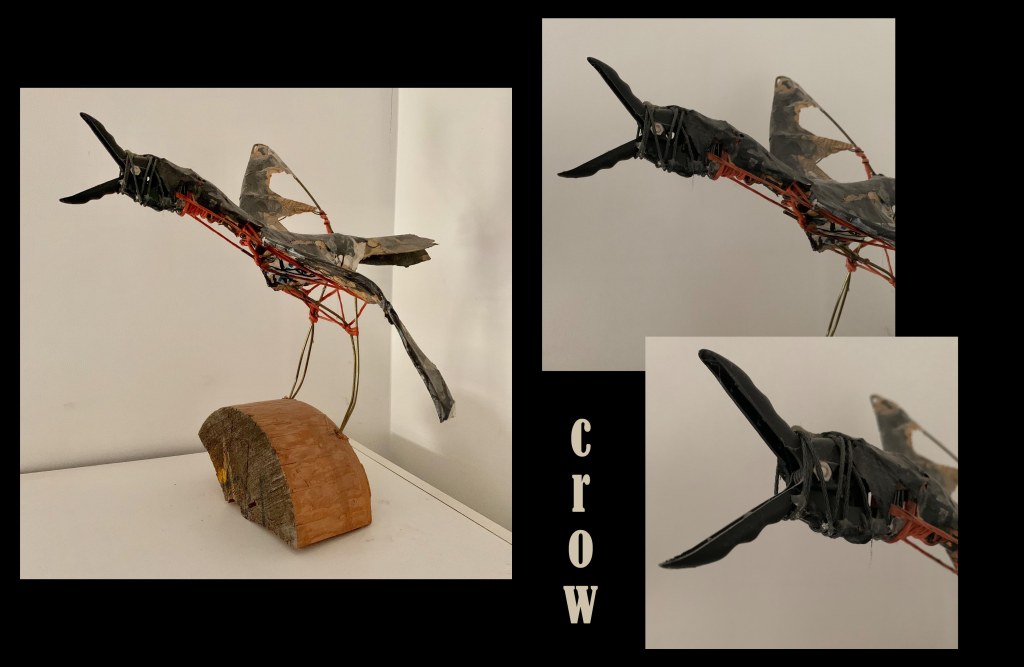
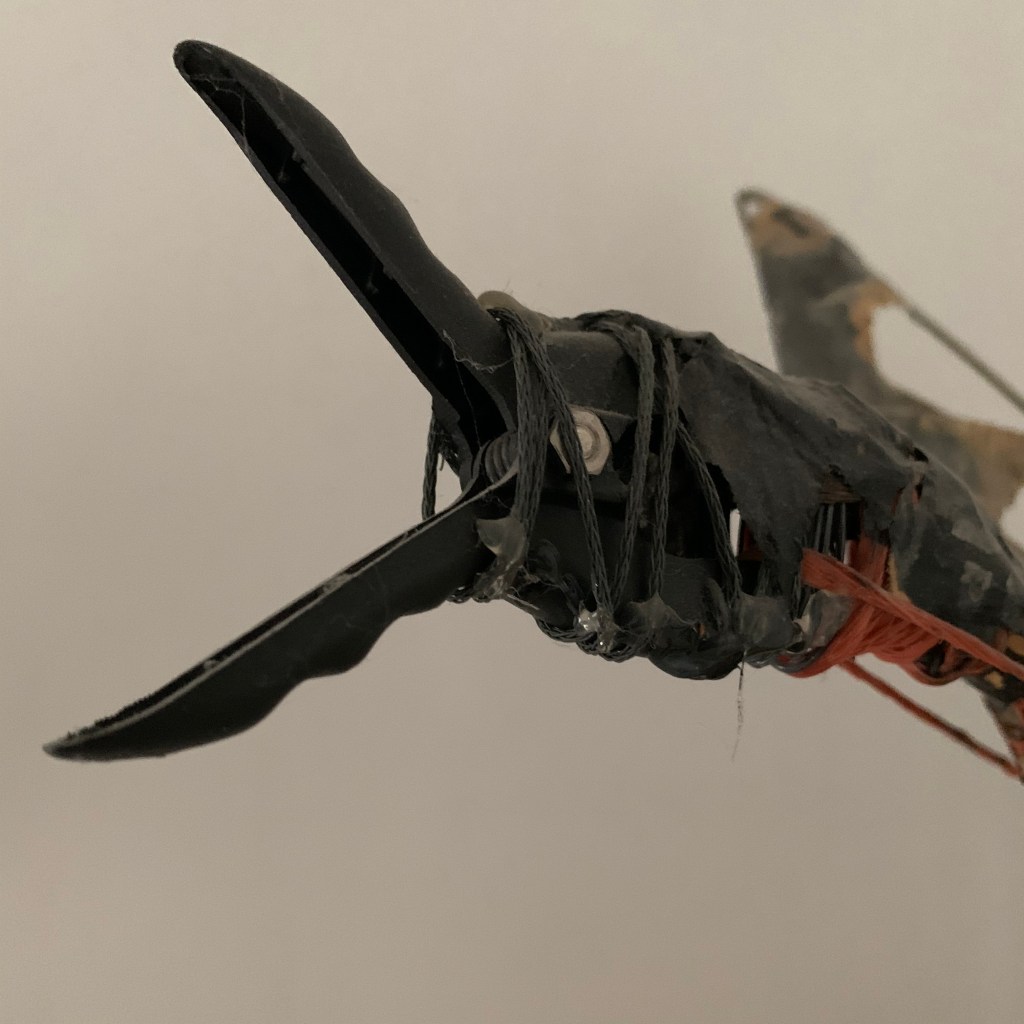
I decided to use found objects: wood, wire hangers, newspaper, string, a plastic clamp. India ink and glue.

Creating my sculptures became something of a meditation. As I bent the wire and glued the paper it occurred to me that perhaps the crows weren’t confusing me with someone else. Perhaps their attacks were meant for me. Perhaps I needed to listen. In some traditions, crows are the keeper of sacred law. They are heralds of consciousness change, shape-shifting. They thump you on the head when you need to wake up, when you are not living in alignment with your best interests. That was certainly true of me at the time. The crows were literally hitting me on the head.

I loved making my sculptures. I love what they brought me to understand. My artist-friends were more right than they knew; I needed to do some sculpture. I needed to exit my rut and step into a scary void and, in that way, invite new seeing, new forms, and finally, a new way of being.

read Kerri’s blog post about CROW

crow ©️ 2010 david robinson

Leave The Studio [on DR Thursday]

Kerri calls this snippet REACH

One day at the farmer’s market we saw a little girl chasing an enormous soap bubble. She was gleeful, squealing with delight. Looking at the faces of the adults watching the little girl, it was clear that they wished they were also racing across the grass, gleefully chasing bubbles. It was clear that they yearned to feel that carefree. In some distant place, they remembered.

These days I occasionally sit in my studio but I do not touch my brushes. There is a canvas on the easel. It’s good and worn and chunky just as I like them. It is waiting. I am waiting.

I believe, as Tom McK. taught me, that “a writer writes and a painter paints.” There is no magic to it. Well, that’s a lie. There’s plenty of magic when the painting begins, when the artist disappears. But first, the paint has to hit the canvas. Before disappearing the artist has to show up.

Yesterday, Skip sent me this lovely reminder. It’s from a tweet:

“I believe it was John Cage who once told me, ‘When you start working, everybody is in your studio – the past, your friends, your enemies, the art world, and above all, you own ideas – all are there. But as you continue painting, they start leaving, one-by-one, and you are left completely alone. Then, if you are lucky, even you leave.'”

That little girl chasing bubbles, her glee, is what happens when “even you leave.” All of the ideas of who you are or what you need to do or achieve, the expectations, the burdens and worries, the pandemic, the politics, the notions of success and failure, all leave the room. That’s when the bubble chasing begins. That’s when there is ample space for glee and delight.

Kerri chose this morsel for today and I’m so glad she did. “I want to do another version of this painting,” I said. That little girl, so long ago chasing an enormous soap bubble at a farmer’s market, is calling me back to my easel, she’s pointing to the studio door and asking me to leave.

Chasing Bubbles, mixed media, 33.25 x 48IN

read Kerri’s blog post about REACH

reach/chasing bubbles ©️ 2019 david robinson

Value The Cake [on Two Artists Tuesday]

available copy

When you choose an artist’s path the odds are you will always be looking for work. In the United States it is the rare artist that makes their living through their artistry. Staying afloat requires a layer-cake-strategy: the bottom layer is the job you take to make money (waiting tables). The second layer is the job you take that somehow relates or comes close to the artistry (teaching). The top layer, the holy grail layer, is the art itself. Few artists resent or resist this reality. They are called to it. It’s more a question of who they are than what they choose to do. It’s also true that few artists survive the hardship beyond the age of 30.

In my life I have dug ditches, cleaned chicken coups, delivered bread, unloaded mattresses from semis, waited tables and been licensed as a massage therapist (to name only a few). I’ve been credentialed twice, been an adjunct professor a few times, founded an experiential learning program, been a general manager and managing director of theatre companies, and an artistic director twice. I’ve had a consulting practice, an international coaching practice, run around in the world of entrepreneurs, drawn cartoons and children’s books. I’ve painted all my life. I’ve directed plays and written plays. I have seven book outlines in my files, none of which will make it to a final form. I’ve performed with symphonies, written and told stories at conferences. At this point, I have a very hard time answering the dinner party question, “So, what do you do?”

What do I do? My friends in Seattle used to tell me that I was the most successful unsuccessful person that they knew. Yes. I am an artist.

If I answer the dinner-party-question with the truth, I am an artist, the inevitable follow-up question,”Do you make a living doing that?” used to make me cringe and feel as though I needed to hide or make excuses for my life. Or lie. “Well, I have this layer cake…” Last year my dear friend, Dwight, popped back into my life for an evening. He asked the question and I started the old tap-dance. I thought if I talked long enough I might find credibility in the eyes of my friend. And, then I remembered that the life lesson is not to find credibility in my friend’s eye, but in my own. I stopped the dance and said, “I don’t know what I’m doing.” We laughed.

I do know this: I am an artist. I chose this path and it chose me. Sometimes I make money through my work. Mostly I do not. I’ve tried putting that piece of myself on the shelf in the closet and I failed. I can’t do it. Artistry, for me, is about much more than making paintings or plays. It is not something I do. It is something I am. It’s a path, a way of fully living this life.

I am in the job hunt cycle again. Writing resumes feels akin to answering the dinner-party-question. How can I make you see that I have value when the only value you recognize is monetary? I can’t. How can I make potential employers see value in my rich diverse set of experiences and, therefore, skills, when the bot weeds me out because I am not singular? I can’t. What the HR-world sees as unfocused is, in actuality, a hyper focus. How can I make the HR-world see the rich value of an artist when they only understand the word as an ego-uplift-phrase for hard working sandwich makers? I can’t.

I just read this question: what are the limits you have set for your life? Many years ago I worked with a man. He owned a tent and party supply business. He worked very, very hard. He drank too much. He bought the business on the day he forever stopped playing his trumpet for a living. I asked if he ever missed playing. He looked away and said, “I can’t think about it.”

I think about it everyday. And, luckily for me, I know beyond doubt that my artistry is central, essential. It is who I am, not what I do. It is not a word I’d pair with “sandwich.” It is what calls me beyond limits. It serves as a constant threshold. It stirs me, challenges me, causes me to listen deeply and feel keenly. It requires me to take chances. It asks me to open my eyes and see beyond what I think. Is there value in that?


read Kerri’s blog post about ARTISTS (sandwich and otherwise)


donnieandmarie uke website box copy