A Place Called “Home” [David’s blog on KS Friday]

“We need, in love, to practice only this: letting each other go. For holding on comes easily; we do not need to learn it.” ~ Rainier Maria Rilke

I’ve never been a big fan of the holidays. Most of my life I’ve lived far away from family. Most of my life I’ve been a wanderer, detached from any meaningful feeling of “home”. I’ve never been a believer in any religious tradition though I understand to my bones the deeply human necessity of celebrating the solstice, observing with ritual the return of the light. It’s mythic, this annual journey through the darkness and back into the light.

It’s an experience common to all people on earth. No matter the story wrapped around it – birth or rebirth or journey or emergence – the commemoration of light’s return springs from a shared human experience. Literally and in metaphor, our lives parallel the movement of our planet around the life-giving sun. Would that we could recognize our sameness instead of fight over our perceived differences!

As I’ve previously written, the moment I stepped into this house was the first moment in my life that I felt “home”. In my imagination I saw the word “home” written on the wall. As a dedicated wanderer it frightened me. Now, more than a decade later, I am grateful for the intense struggle the wanderer-in-me fought and lost to finally – finally – arrive home.

We decorate our house for the holiday over many days. It is a work in progress that is both intentional, improvisational and responsive. We discover as we go. This season, in a nation filling itself with darkness, we have more reason than ever to create a space in our home that celebrates the return of the light.

We are also learning, in the midst of this looming shadow, how to fill ourselves with light. How to let go. We are learning how to stand in a center of intentional light in the midst of the swirling darkness. We are more than ever understanding the necessary delineation between solid-center and fluid-circumstance, how to root in the center without grappling with the passing state of affairs.

As we clean out, as we practice letting go of our stuff, both literal and metaphoric, we also decorate. We create a beautiful space, simple and warm, a place called home, safe and solid, where we turn to the sky and witness the return of the light.

The Lights on the album of the same name © 1996 Kerri Sherwood

Kerri’s albums are available on iTunes and streaming on Pandora

read Kerri’s blog post about DECORATING

likesharesupportsubscribecomment…thank you.

Share The Symbols [David’s blog on KS Friday]

When I was a wee-turnip I found a textbook on the shelf from a course my dad took in college. Comparative religions. It’s a big-big book full of many-many comparisons. It now resides on my shelf. This book sparked a life-long fascination for me. The universal nature of myth and story across individual cultures and how these stories and symbols are, over time, pulled and twisted like taffy, co-opted, integrated and sometimes claimed as the private property of religion x or y.

Today, as I write this, we sit squarely on the solstice. I thought a few tidbits of story-symbol might be fun to visit so, together, we might taste the taffy.

In Italian tradition, La Befana is the goddess of the solstice. She rides a broom through the skies leaving candy and presents to the good little boys and girls. As a broom-riding pagan goddess, she predates Saint Nick by more than a few centuries. The Christian tradition snagged her and after a bit of twisting, she became a character in the Magi story. On a cold, cold night she gave shelter to those three wise-men but declined to join them on their quest because she had unfinished chores. After they left she had a change of heart but couldn’t find the manger on her own so she gave the gifts she had in tow to the nice children she met during her manger-search.

On the solstice, the goddess Isis gave birth to her son Horus, the sun god. Leta gave birth to Apollo on the solstice. The Persian god of light, Mithra, was born on the solstice. These births were technically virgin births since the conception in every case was immaculate. Egyptian. Greek. Persian. These stories predate the Christian story by centuries. It’s a ripple across time and culture of the same human impulse: after a long dark season to celebrate the return of the light.

We lose more than we know when we – to borrow a great term from Joseph Campbell – concretize a symbol. The stories and myths are meant to open us to greater unity with each other and the world we share. They are not meant to be taken or understood literally. Holding them literally slams the door on their greater meaning and unifying power. It renders them a possession, a plot point on a map.

On this winter solstice I can imagine no greater gift to this divided world than to recognize we are, through our unique symbols and characters, telling the same story, yearning for the same possibilities, sharing the same ideals whether they soar through the air on a broomstick or in a sleigh, both rides brimming with toys for good girls and boys. We borrow each others best ideas and ideals, rewriting them to fit our unique audience. From Isis and Horus to Mary and Jesus, it’s time once again to celebrate the rich warm return of the light through our myriad forms and cultural traditions, to feel the push and pull of something ancient and deeply human. Together.

this season/this season © 1998 kerri sherwood

Kerri’s albums are available on iTunes and streaming on Pandora and iHeart Radio

read Kerri’s blogpost about THE HOME IN THE TREE

like. share. support. comment.

buymeacoffee is a surgically implanted intention, a medicinal tradition stretching back eons to a time when beauty and analytics held hands and shared meals. together.

Welcome The Next Normal [on Merely A Thought Monday]

There was a time when my marker of the holiday season was the return of Pirate Christmas Ale; a rich and happy stout. It tickled me that the return of the holiday season was signaled with a Pirate and not jolly Ole Saint Nick. I drank one-a-night, from the day I saw the Pirate’s return to the store, through the end of the year. Pirates-in-holiday drink in moderation.

It’s been many years since I walked with the Pirate through the threshold of light’s return. With my move to Wisconsin came the establishment of a new normal. And then came COVID. I think we’ve both come to the realization, after a few years of deep disruption, that there will not be a return to normal. Just as with my move from the west coast to the upper-midwest, there will be the creation of a new normal. Just what that will be remains to be seen.

We know the new normal means leaving the house. We work at home and have mostly isolated these past few winter seasons. Cabin fever is getting to us. So, we’re taking calculated adventures. A visit to the Botanical Gardens. A walk around the small town of Cedarburg. A drive into Chicago. We continue to hike our trails but we’re both feeling the call of exploration, the desire to sail our ship toward the horizon. We really wanted to go to a concert but chose not to – COVID considerations remain central to our weird calculus.

Yesterday, while walking the streets of Cedarburg, we saw a tent behind the Stilthouse. Tables and heaters. We grabbed a spot under a heater, ordered lunch and lingered over a glass of wine. It sounds so normal yet, what was once commonplace, what was once something done without much thought – was a rare and delicious treat. We savored every moment.

Lately, we’re getting this reminder again and again. When the water line into the house broke – and we were without water for a day, the return of the water through the faucet brought cheers and happy dancing. There’s so much we take for granted. There’s so much to be savored in the commonplace, in the everyday, especially when we understand it might not be available forever.

Mostly, there is this: during the darkest days of every year, people come together in many ways to light candles, to exchange gifts, to make meals, to offer hope, to help each other through the dark time. Whether they realize it our not. The light returns. The earth spins. There’s water in the pipes. A heater and a table. Merlot in the bottle. Good friends. Good cheer. New work. The beginning of the next normal.

read Kerri’s blog post about GOOD CHEER

[this post marks the 200th consecutive week of the melange. Corks are-a-poppin’]

Look Beyond The Wish [on DR Thursday]

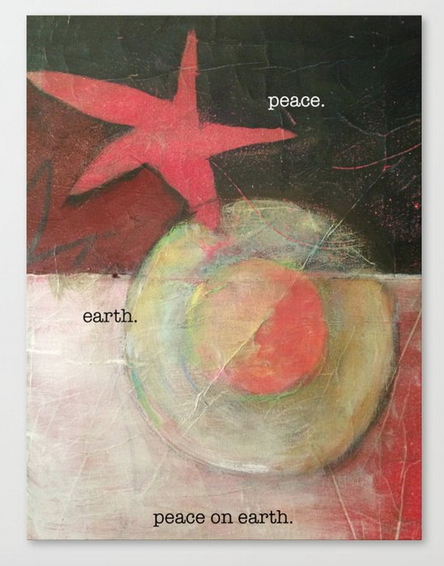
Peace on earth. It is something to be wished for, and, in fact, it is something we wish for every winter solstice. We sing. We hold hands. We light candles. We wish.

Wish [verb]: a strong desire or hope for something that is not easily attainable; want something that cannot or probably will not happen.

For months I’ve been taking notes and doing research for a play that I want to write. One of the themes of my someday-play is control-by-division and I find myself constantly tripping over stories and mythology with control-by-division as the central tenet. It’s everywhere. For instance, The Tower of Babel features a unified humanity – speaking a single language – who attempt to build a tower to reach heaven. The god’s response was to blast their language, split them linguistically so they were incapable of understanding each other. Plato’s Symposium tells a similar tale. Humans united are too powerful so fearful gods go to great lengths to keep humanity divided. It’s the history of these intentionally-divided-united-states as understood through the lens of Bacon’s rebellion. It’s a repetitive pattern, a living system.

Peace is something the gods, the 17th century aristocrats, and the current republican party do not want us to have. A united populace is capable of peace and a prerequisite of peace is equity. Good will toward men and women and neighbors and speakers of languages other than ones own. The desire for everyone to prosper, for everyone to be safe. Everyone.

When I was young and perhaps more naive than I am now [if that is possible], I explained to rival gang members that they were essentially puppets doing exactly what the powerful expected them to do: fighting and killing each other. Division serves as a useful preoccupation. It keeps eyes and minds off those who were controlling them, keeping them poor. As you might imagine my blather fell on deaf ears and those beautiful young people were back on the streets killing each other before the sun went down.

This is what I read in all of the myths, in all of the stories of intentional-division: peace is our natural state. It takes extraordinary effort and manipulation to divide us.

Peace. Reaching across division. Division that is often – as we have lately seen all too clearly – trumped up to keep us from coming together, from building our too-tall-tower and approaching heaven. United, we might turn our eyes toward the powerful few and ask, “So what are you really doing?”

United, we might ask of ourselves to do something more than our annual-ritual-of-wishing.

read Kerri’s blog post about PEACE