Survival Tips [David’s blog on Two Artists Tuesday]

MM asked if we had any snow yet. He lives in California but entered the earth in Iowa so he knows snow. We swapped tales of cars sliding on ice and other seasonably appropriate tips for survival.

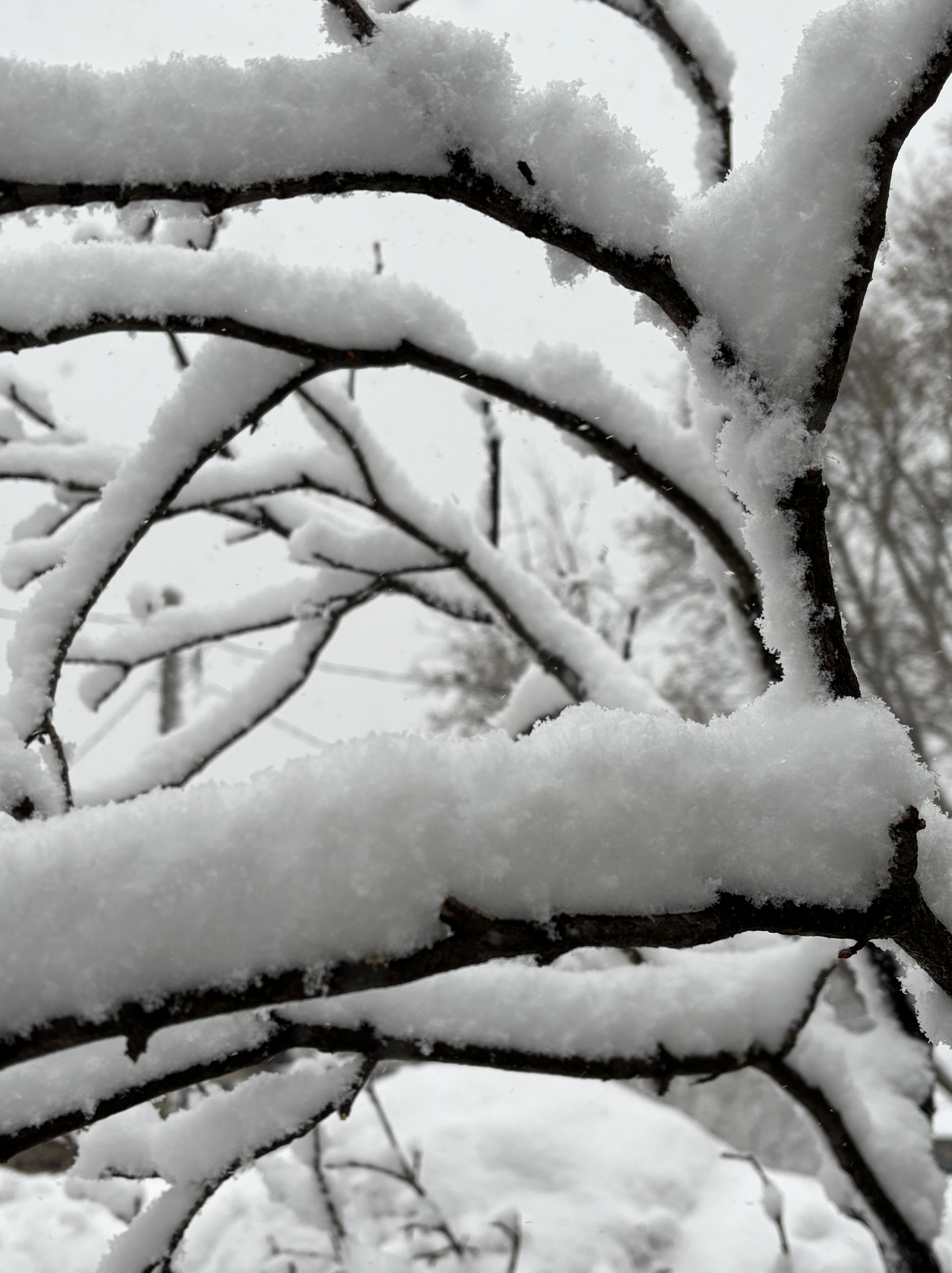
As I write this it’s in the single digits outside. We have more than our feet under a quilt. Consider “write while buried in blankets” a winter survival tip.

Our ice-damming issue is not yet resolved but it’s so cold outside that the water is not flowing. The heat of the house is no match for the polar freeze so nothing is melting. Here’s another survival tip: When there’s nothing to be done about the problem then it’s a good idea to do nothing. Get under the quilt and write. If writing is not your thing then just get under the quilt.

We are fans of Life Below Zero. All too often the people in the episodes ride their snowmobiles down frozen rivers or across the icy tundra when the temperatures are minus-fifty-degrees. It never fails, at the same moment we say, “I couldn’t do that.” Which, as it turns out, is another survival tip: know your limits.

We discovered our ice-damming issue in the middle of the night which meant I was climbing a ladder in the cold-dark-night with pitchers of boiling water to open the gutters and downspout and give the water a path that did not include the inside of the house. After a few hours the aluminum ladder was covered with ice (former boiling water that splashed); my gloves – also wet – were sticking to the ladder. Sometimes it is not enough to know your limits; you must act on what you know. Consider this an important survival tip.

If you know your limits and honor the limit you know, then your chances of living another day are greatly increased. Here is perhaps my best survival tip: when you find the limit but are tempted to cross it with delusions of grandeur or inflated feelings of importance, imagine a mug of hot coffee, pumpkin pie and warm quilts – the simplest joys of survival, the epicenter of thriving. When standing at the bottom of a frozen ladder at 2am with yet another pot of boiling water, it will help put things into perspective.

Having some perspective is, perhaps, the most awesome survival tip of all.

read Kerri’s blogpost about SNOW

likesharesupportcommentthankyou

Peri Winkle Rabbit [David’s blog on KS Friday]

The birds on a wire brought my Periwinkle book to mind. Context is everything. It is now as relevant as the day I wrote it:

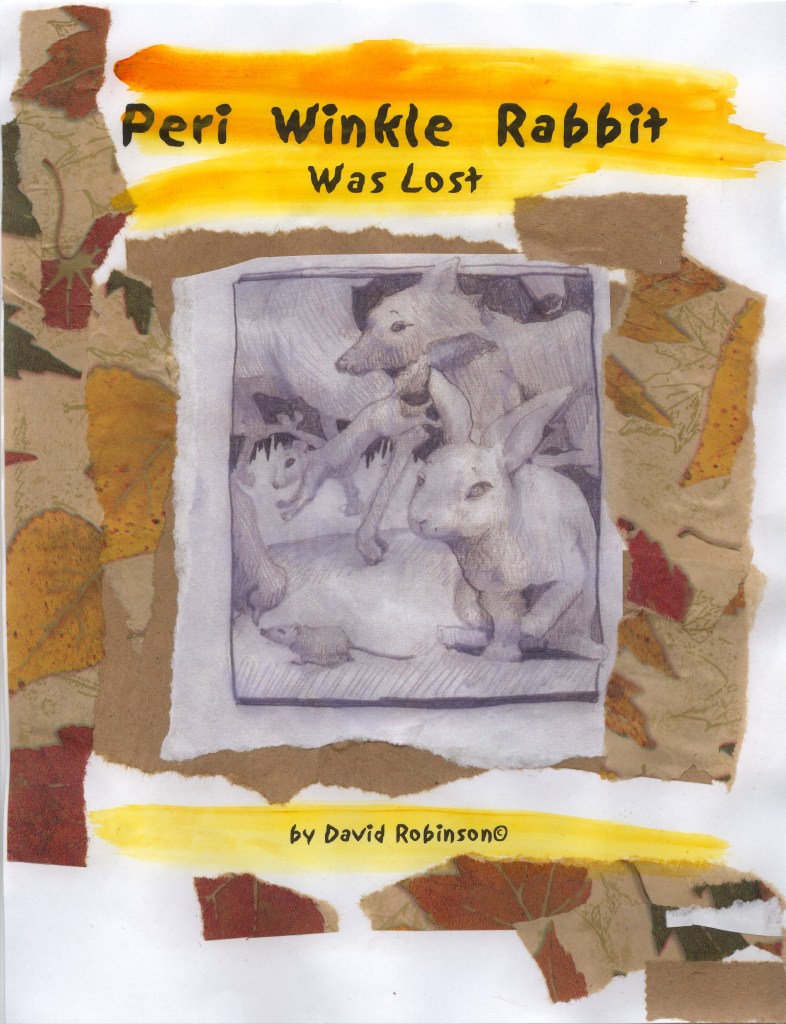
Peri Winkle Rabbit was lost.

All the other animals were lost, too!

There had been a fire. Peri Winkle was asleep when grandpa Harry Winkle Rabbit shook her awake and said, “RUN!”

Peri ran. At first, Peri ran with her mom and dad, her sisters and brothers and grandpa Harry Winkle, too.

All the other animals were running, too, the deer and the bears and the foxes and the squirrels. Some were running in circles but most just ran away from the fire.

It was confusing. There were so many legs and paws running this way and that. Peri could no longer see her parents. She couldn’t see her brothers or sisters. Even grandpa Harry Winkle Rabbit was nowhere to be found.

Peri stopped and got knocked down. She hopped back up and called out for her mother. She called for her father. She couldn’t see them anywhere.

A great paw scooped her up and she was suddenly eye to eye with a bear!

“This is no time for still standing, little ears!” said the bear.

“I can’t find my family,” squeaked Peri Winkle Rabbit. The bear was holding her very tight.

“We’ll find your family, little ears,” puffed the running bear, “But first we have to find a place safe and beyond the fire.”

The bear held Peri Winkle Rabbit close to his chest. Peri could hear the boom-Boom of the bear’s big heart as he ran swiftly away from the flames. Peri Winkle Rabbit felt so sad and so tired, she couldn’t help it when she fell fast asleep.

“Good morning, little ears!” The bear smiled as Peri blinked open her eyes.

“Where am I?”  asked Peri.

“I don’t rightly know, “ said the bear, “but we’re now safe and far from the fire.”

That’s how Peri Winkle Rabbit came to be lost. She looked around and saw that the forest was gone! The other animals looked and they saw it too. All the green was now black and the mighty trees were charcoal twigs twisted in ruins on the ground.

The animals started to cry. Even the big bear cried. Peri cried, too. Together, they made lots of loud crying sounds and it felt good to wail the loss of their forest home.

And then, they each told their stories of escape from the fire. They told of their lost homes and missing family and friends. They told the stories of their cuts and their bruises, their fears and their worries.  They told of how they came to be together, in that place at that time. Peri Winkle Rabbit told her story, too.

“What do we do now?” a red fox asked, which was exactly the question that Peri Winkle Rabbit was thinking!

No one said a word for a very long time. They looked at each other, all covered in soot, dirty and singed and ruffled and tired.

“Well,” a great ram began, “I am sure footed, I can help carry what’s needed.”

A hawk landed on the ram and said, “I can see far away and can help find your missing families and friends.”

The great bear said, “Yes, and I have a nose that can smell good smells for many miles, I will help supply all of my new friends with food!”

“I can gather nuts!” cried the squirrel, rubbing his nose with his hands.

“I have great ears!” cried Peri Winkle Rabbit! “I can hear what is needed and help find who can do it!”

And all the animals offered their great gifts in service to their new friends. They slowly began to do what was needed with whatever they could find. They found water and food. They found shelter from the rain. They looked for their families. They made new friends.

 “Remember, a forest must grow back slowly, one day at a time,” said the bear when Peri felt impatient.” Our job is to help it grow.”

“It is all different than before,” said Peri, suddenly missing her old home.

“Yes,” said the bear. “We are all different now, little ears. The fire has changed us forever.”

Peri Winkle Rabbit wrinkled her nose.

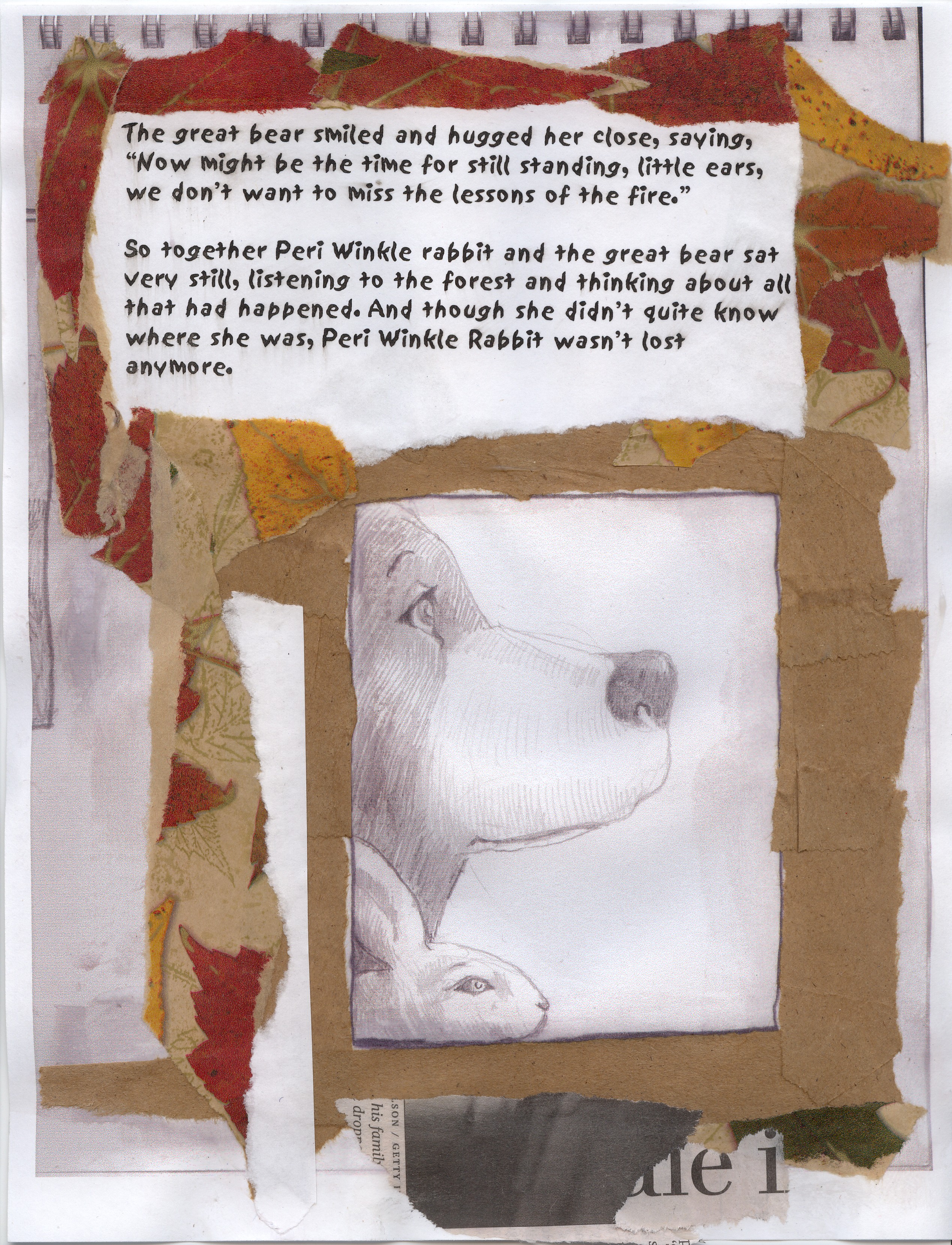
The great bear smiled and hugged her close, saying, “Now might be the time for still standing, little ears, we don’t want to miss the lessons of the fire.”

So together Peri Winkle rabbit and the great bear sat very still, listening to the forest and thinking about all that had happened. And though she didn’t quite know where she was, Peri Winkle Rabbit wasn’t lost anymore.

Periwinkle Rabbit Was Lost © 2005 David Robinson

A one-copy book made for a child who lost their family during Hurricane Katrina. I’ve never published the full text but thought it was time. I included photos of a few of the pages.

Kerri’s albums are available on iTunes and streaming on Pandora

read Kerri’s blog about BIRDS ON A WIRE

like. share. support. comment. subscribe…thank you.

Act For The Benefit [on KS Friday]

We are hunkering down today. The smoke from the Canadian fires has arrived and the air-quality-index reads “Poor” to “Dangerous.” My head hurts. I feel as if I can’t catch my breath. A glaring example of interconnectivity. Airspace knows no nation. Not really. All for one and one for all.

I Googled the phrase “All for one and one for all” wondering if it was yet another clever Shakespearean quote. It is but the good poet didn’t originate it. He borrowed it from the Latin or from Aesop. I read that now-a-days it is the unofficial motto of Switzerland. “Each individual should act for the benefit of the group, and the group should act for the benefit of the individual.”

Aesop was born circa 620 BCE so the idea that we should – and could – act for the benefit of all is not a new idea. It may be the most basic of human survival necessities. Aesop popped it into a fable since storytelling is the original-and-best form of adult learning theory. On a side note, someone who composes and/or tells fables is called a “fabulist.” Had I known sooner I’d have spattered that on every business card, used it at every social gathering: “What do you do for a living, Mr. Robinson?”

(humble chuckle) “Oh, you know, I’m a fabulist. Here’s my card…”

Kerri snapped this photo of Meadow Hawkweed. It’s important to our story of Canadian smoke in American airspace because its healing properties include the treatment of asthma and other respiratory ailments. All for one and one for all includes the world of flora and fauna, too. The whole knows no parts just as the airspace knows no nation.

In my dystopian fantasy, when we warm the globe sufficiently enough that systems collapse and smoky air is the new norm, I’ll corner the market on Hawkweed. Just-kidding. I’ll share what I know with whomever needs help breathing. And, while waiting for the healing to kick-in, I’ll tell some stories of people helping people. Like Aesop, I’ll try and plant the seed for a better world. Once a fabulist, always a fabulist.

in a split second/as sure as the sun © 2002 kerri sherwood

Kerri’s albums are available on iTunes and streaming on Pandora and iHeart Radio

read Kerri’s blogpost on HAWKWEED

Like it? Like it. Or share it. Or comment. Or buyusacoffee. All are greatly appreciated.

Open Your Mind [on DR Thursday]

peace on earth copy


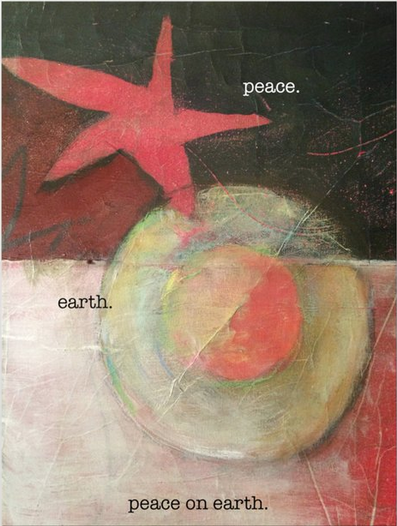
Peace on Earth is a nice seasonal phrase but I’m willing to bet that most folks think it is pie-in-the-sky. A utopian ideal. So, pondering what to write about Peace on Earth, I flipped open a book and the first phrase I saw was this: An Open Mind.

Horatio is wise. He once told me that in these United States we are divided because we have competing narratives. Narrative #1: Every man for himself. Narrative #2: I am my brothers’ keeper. I think he is right. Generally, you can toss every national debate into one of those buckets. This morning, for my Peace on Earth rumination, I’d redefine those two narratives this way #1: Closed Mind (every man for himself) or #2: Open Mind (I am my brother’s keeper).

The ‘every man for himself’ narrative is predicated on the notion that there is limited pie in this vast universe. The goal is to grab a big piece of the limited pie. It’s necessarily a fight because there’s not nearly enough pie to go around. It’s fear-based and fear closes minds. Every year people get trampled in the national-celebration-of-limited-pie known as Black Friday. Get yours. It’s true, through this dark lens Peace on Earth is nothing more than pie-in-the-sky.

The inverse narrative, ‘I am my brothers’ (and sisters’!) keeper’ is predicated on the notion that there is plenty of pie to go around. In fact, the goal is not to grab but to create and then to give. Not only to share our toys and our gifts but to cultivate the base layer of Maslow’s Hierarchy for everyone: security & safety. Communal self-actualization follows the same path as personal self-actualization. Morality, respect, and generosity are the blossoms of feeling secure. So is an Open Mind. Peace on Earth, through this lens, is like more pie in the oven.

The ‘every man for himself’ story is a great recipe for closing minds. With fear and studied ignorance at its center, this narrative begs us to ignore a simple truth: no one does this alone. We are, in fact, dependent upon each other for our survival, our identity and our esteem. In isolation, a human being cannot thrive. Withhold interaction and love an infant will not survive.

I have a theory (okay, a belief) that the ‘I am my brothers’ and sisters’ keeper’ narrative is the truth of us. When the chips are down, when another person in peril, firefighters run into the building, they don’t run away. Everyday people leap in harm’s way to save the life of another. It is their instinct. It is our nature.

Like everything, believe it or not, what we embrace is a choice. Narratives are powerful.

An Open Mind is a door into Peace on Earth. It’s possible there’s more pie in this vast universe, this abundant earth, than a closed mind wants you to see.


read Kerri’s blog post about PEACE ON EARTH


peace on earth products copy 2click the link and scroll down to find all of the available designs & products


cropped head kiss website copy


peace on earth design/products ©️ 2018 david robinson & kerri sherwood

Reach The Other Side [on Merely A Thought Monday]

lifebelowzeroquotesueaikens copy

Nope. This is not a political comment. Though it could be. Context is everything though I couldn’t blame you for assuming this is a statement of ideological division. Simple statements are rarely friendly in divided environments. They are meant to reinforce the division, to broaden the divide. We are inundated with divisive simplicity. We are drowning in out-of-context sound bytes.

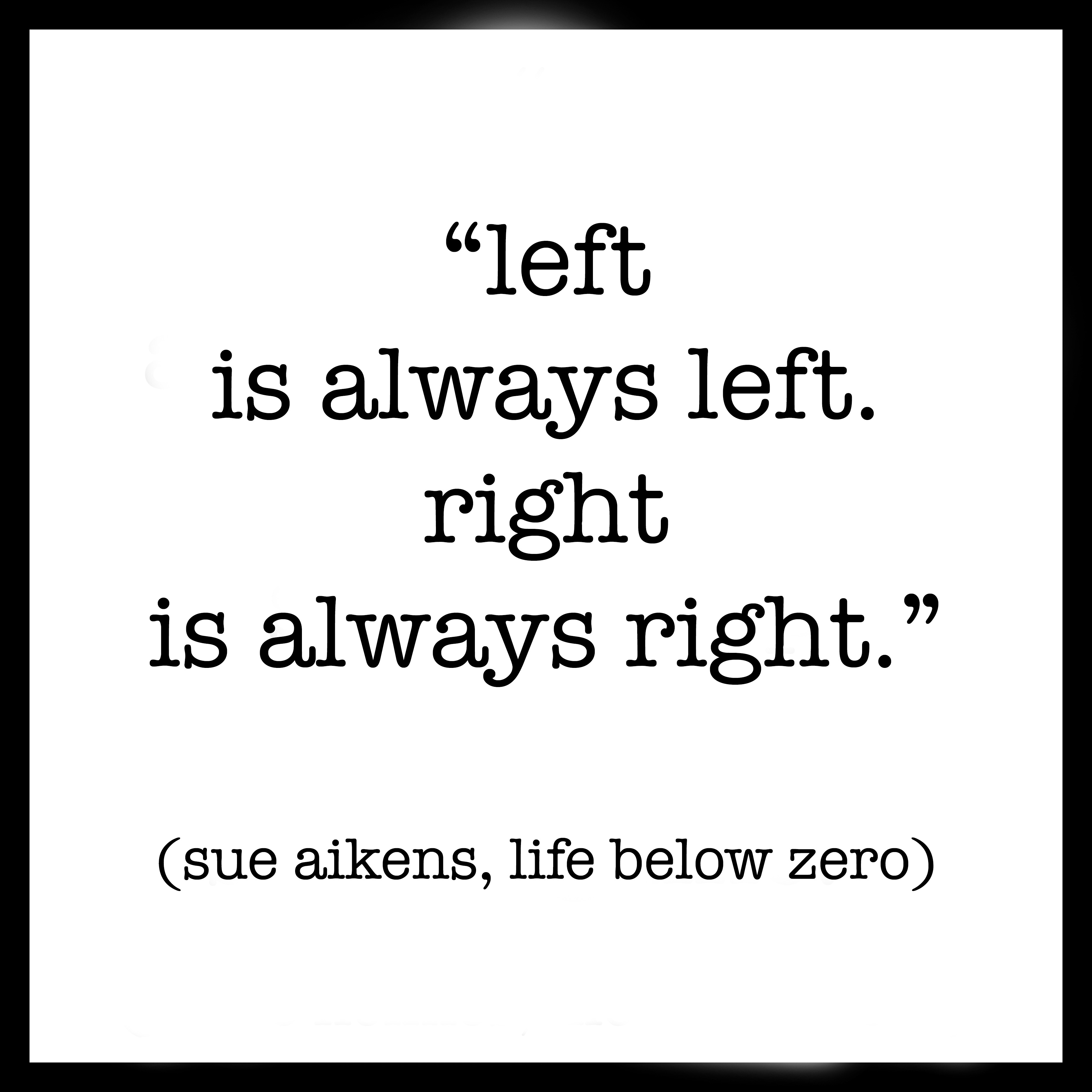
No, this saw concerns the simplicity of survival. It’s quote from an episode of Life Below Zero. Sue lives above the arctic circle. She measures and ties guide ropes on to  her buildings so she can find her way around her compound in white-out conditions. If she reaches the knot in the rope – a knot that marks the exact distance to the door she seeks –  and hasn’t yet reached the door – she knows she must hang onto the rope and scribe an arc. Left is always left. Right is always right. The door will be there. If it’s not, if things go awry and she can’t find the door, she can follow the rope back to the safety of the place she just left.

Sue is a font of simple maxims born of the harsh necessities of her environment. Her rope is a statement of preparation. Her rope ups her odds of survival. No rope, she dies. Her simplicity is not ideological. It is necessary. It is meant to cross divides, to help her reach the other side.

On second thought, maybe this is a political statement after all. Or, perhaps an appeal in our harsh environment. Maybe Sue will come down to the lower 48 and teach us how to use a rope and give us a few simple suggestions for how to reach the other side.


read Kerri’s blog post about LEFT AND RIGHT


hands across tree WEBSITE BOX copy


Cooperate

714. Join me in inspiring truly powerful people. Each day I will add a new thought, story or idea to support your quest and mine.

During my drive from Champaign to Omaha, just after sunset, it began to snow. There was a swirling wind and in a matter of moments it was a white out. The road was mostly invisible. Cars immediately fell in line behind cars. Trucks slowed and set a careful pace. People cooperated without debate, without knowledge of the other drivers’ political affiliation, gender, race or sexual orientation. We needed each other. There was no power game or status imperative. All the silly illusions fell away. We needed each other and we did what came naturally. We cooperated.

There is a collision of two great thoughts that I appreciate. The first comes from my friend Roger, a director of plays and studier of humans; he once told me that denial was one of the strongest human impulses. The second thought comes for E.O. Wilson (I’ve rattled this off more than a few times) who said that the strongest human impulse is to belong. Combine the two thoughts and you get an amazing collision of impulses: a species called humans that need to belong to each other but deny it. This contradictory impulse makes possible The Gap or Old Navy; can you deny that you shop at a chain store to express your individuality as a way to belong? I can only imagine that the Martians are having a hey-day studying us.

And then the illusion drops, the second strongest impulse retreats and only the first remains. We need each other. We drive into a white out. The hurricane wipes our city off the map, the earthquake knocks our houses off their foundations. We pull together, put down our need to be right, and line up to help. We see our belonging. We see this thing called “”the common cause,” namely, survival.

The question, then, is obvious: do we need to wait until we’ve exhausted our fuel supply, depleted our aquifers, or warmed our globe before we suspend our denial and see this thing called “the common cause?” More and more contemporary science is finding that we have it all wrong: survival is not something achieved by the fittest; survival is a cooperative art.