The Only Question [David’s blog on KS Friday]

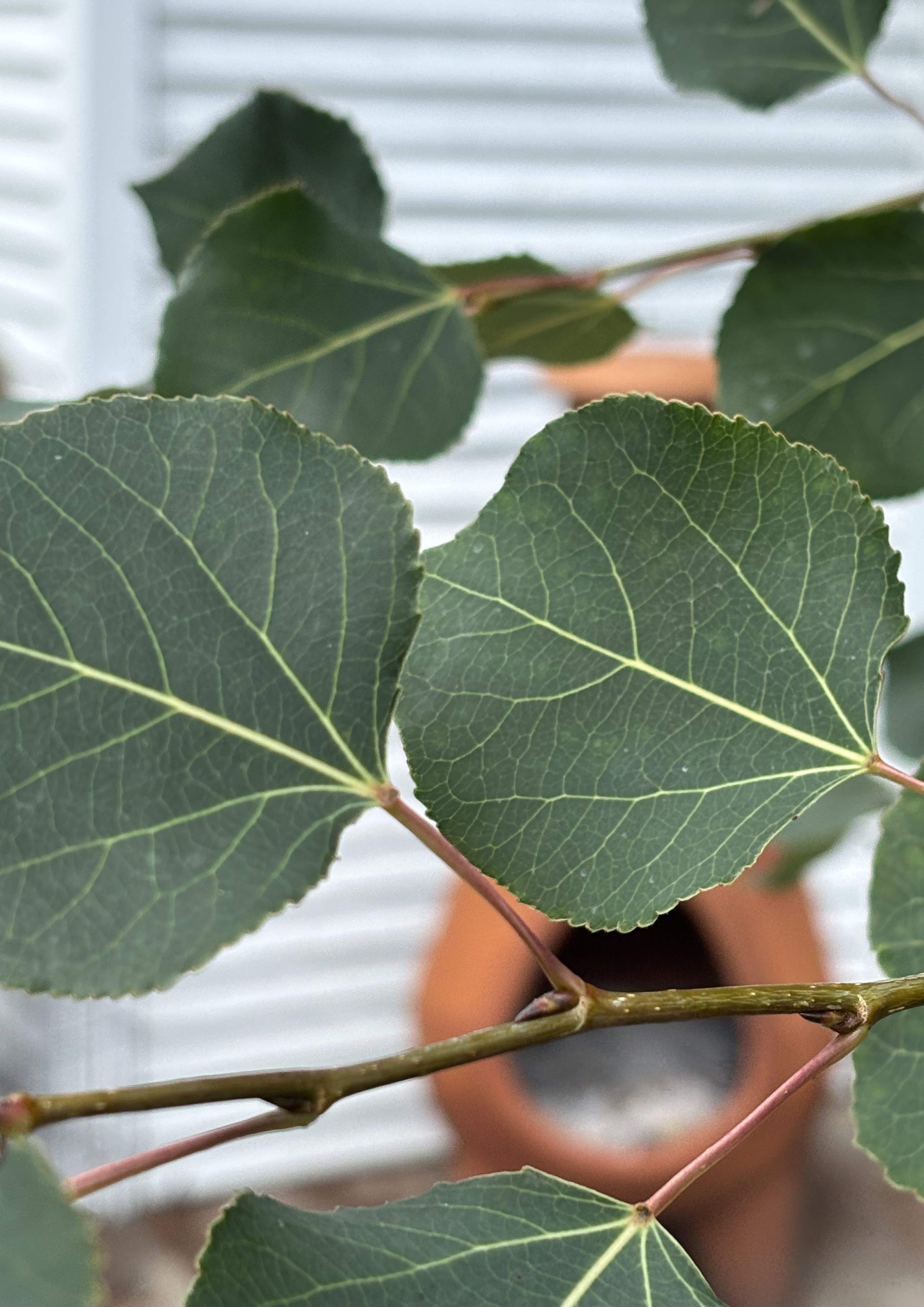
Breck the aspen tree is no longer a sapling. Since May she has grown a few feet taller. Her trunk is now the sturdy stock of a mature tree. Her bark is taking on the whitish hue of mature aspens. We stand at her base, crane our necks looking up, and marvel. In a few short months we have watched her come-of-age.

In a contentious time, an age of the disappearance of justice and the rise of a criminal, Breck is a reminder for us of all that is good. When we need a dose of sanity, when we need a reminder that nature takes little notice of human folly, we sit with Breck. We allow ourselves to be soothed by the comforting shimmer of her quaking leaves.

Joseph Campbell wrote The Hero With A Thousand Faces in 1949. I almost spit my coffee this morning when I read, “The tyrant is proud and therein resides his doom. He is proud because he thinks of his strength as his own; thus, he is in the clown role, as a mistaker of shadow for substance; it is his destiny to be tricked.”

I know it is a mistake to conflate myth with biography, yet, have you ever read a more perfect description of our authoritarian wanna-be?

Myth meets the historical moment. The tyrant is a clown. He is a mistaker of shadow for substance. He thinks his strength is his own. His destiny is to be tricked. Campbell also wrote that, in the mythic cycle, the tyrant, “usurps to themselves the goods of their neighbors, arise, and are the cause of widespread misery. They have to be suppressed.”

Usurping to himself the goods of his neighbors? Check.

The cause of widespread misery? Check.

In mythology, the tyrant is the harbinger of the hero’s rise (note: the hero need not be a male). “The great figure of the moment (the tyrant) exists only to be broken…The ogre-tyrant is champion of the prodigious fact; the hero the champion of creative life.”

The word “prodigious” in this sentence = unnatural, grotesque.

Locked in a shadowy lie-about-the-past with a monstrous clown? Or, progressing forward toward actual possibilities? We are a nation quaking to come-of age.

The tyrant exists only to be broken – and it makes sense in mythology and in the patterns of history. Breck can only grow in one direction. The same is true of us. The only question is how much damage will the tyrant do before we-the-people, the actual hero in our tale, awaken, open our eyes and rise?

WATERSHED on the album AS IT IS © 2004 Kerri Sherwood

watershed,(noun): an event or period marking a turning point in a course of action or state of affairs.

Kerri’s albums are available on iTunes and streaming on Pandora

read Kerri’s blogpost about BRECK

likesharesupportcommentsubscribethankyou

Get Some Perspective [on Not So Flawed Wednesday]

“Oh, god…I feel a fit of moralizing coming on….” ~ Words to myself, uttered just a moment ago.

This would seem like a no-duh: perspective requires distance. Said another way: to see the mountain, one cannot be standing atop of the mountain.

Much to Kerri’s dismay, I think out loud about these things. A lot. She has to listen to my ruminating. Marriage requires her to be in the same space with me and I talk endlessly about the things rattling through my mind. Just ask her. Let’s just say she has no distance from my incessant blather so she lacks perspective. Or, her capacity to ignore my noise is the result of experience which provides her solid perspective. Don’t ask me. I am not in the position to offer an opinion.

When you dip your mind into the pool of information technology as I have, it’s nearly impossible to NOT think about the absence of perspective. Actually, if you read or listen to the news-of-the-day or take a swim in the social media cesspool, and are able to step back from it (thereby creating some distance), you’ll find that meaningful perspective has long ago fled the building.

For years I’ve been reading about the pace of change. At some point – and we’ve arrived at that point – the event horizon (that which enables perspective) is no longer in front of us. We sit on top of it. Information comes too fast and without pause. And, often without substance. Without perspective, the context of our lives is as fleeting and changeable as “Breaking News” or the latest posts on social media. Since the algorithms are driven by the most “likes” not the most relevant, the ugliest and loudest noise-makers garner the most attention and dominate the air-time (thank goodness for cute pet posts providing some humor in the onslaught).

Attention-getting is not known for its grounding in solid perspective. Just ask the boy who cried wolf.

As we know, crying wolf works well – for a while. Attention-getting is addictive. Once hooked, people will do or say anything to keep their buzz going. Sitting directly atop the event horizon, the only way to keep the attention is, of course, to scream louder and louder. Escalate the outrage. A news cycle churns as fast as the social media stream. Remember: the algorithms are not based on meaningful substance but on the ability to grab attention. Louder/uglier wins the day.

Without perspective, escalating outrage – the loudest and nastiest train wreck – will always win the attention grab. It’s human nature. We sort to the negative. It’s why we share complaints with anyone who will listen but dribble-out the good news to a select few.

There is an important disappearance that accompanies the loss of perspective: crap-detecting. Awash as we are in a raucous bluster of vapidness, the only hope we have is to take a step back and question. To descend from the event horizon and ask, “Is this or that assertion true?” Or, is it meant to make me mad, fuel my anger? Is it tailor-made for my perspective-less bubble?

Stepping back, gaining perspective, asking relevant questions. Crap-detecting. If a better world is what we desire to create, dedicated crap-detecting is the necessary first step in being-the-change we wish to make.

read Kerri’s blogpost on PERSPECTIVE

Know The Value [on Two Artists Tuesday]

paint by number copy

“What’s it worth?” This seems to be the least answerable question of our times. Its cousin question, “Is it real?” is under assault and so qualities like ‘value’ or ‘worth’ are less and less discernible.

For instance, I laughed heartily recently when I listened to a podcast Horatio sent my way. It was about the billions of dollars spent on our educational system of testing that has produced minimal results. It doesn’t work. Data, brain science, and common sense have known this for years. I can hear Tom now (and see his famous sigh-with-eye-roll), “It has to be real. It’s about relationship. It needs direct application.” Do the tests make for better education? No. Of course not. The opposite. And, we knew that before implementing the system of testing. So, what is real? What was it worth? The system consumes itself.

A few years ago, Kerri and I went to the Chicago Art Expo. We came upon a gallery installation, a single piece. It was priced at $40,000.00. A line of twine stretched across the booth. Clipped to the twine was a single household sponge. It had been dipped in paint. Kerri, using her outside voice, said to all who could hear, “ARE YOU KIDDING ME?” It was purchased. What was it worth? Was it real? It was the precursor to artist Maurizio Cattelan’s recent piece. He duct taped a banana to a wall. He’s now sold three versions for $120,000 apiece.  What is it worth? What is real? Art commenting on art. The system consumes itself.

Politics in America. It’s all about crowd size regardless of what the photograph reveals. [sorry, I couldn’t help myself]. There are so many that we actually keep a running tally of the presidential lies. We are slack-jawed at those who nod their heads and bellow their agreement with the demonstrably untrue. What is real? What’s it worth? The country hungrily consumes itself.

We haunt antiques stores. We rarely buy anything but enjoy the exploration. At School Days Mall, one of our favorite adventure antique grounds, Kerri turned and gasped. A paint-by-number landscape wearing a Minnie Pearl tag. “I recognize this painting!” she said, wide eyed. Her mom, Beaky, liked to paint and had a paint-by-number phase. The painting evoked a good story. It evoked a momentary possibility that this might be THE ONE Beaky painted. Kerri sent a text to her sister. They shared a memory. They reached through time and had a moment with their mother. Priceless.

Watching Kerri, so excited, text with her sister, it occurred to me that one reason we go to antiques stores is to touch stuff that comes from a time when value and worth were better understood. We go to the throwaways to find some substance. What is real is not in question.

Banana taped to the wall or paint-by-number landscape? What’s real? What’s it worth?


read Kerri’s blog post about PAINT-BY-NUMBER


tpacwebsitebox copy

Slow Down And See [on Two Artists Tuesday]

kindnessSCHITTSCREEK copy

There is a theme emerging in my posts this week. Substance vs. the appearance of substance. The flattening of importance.

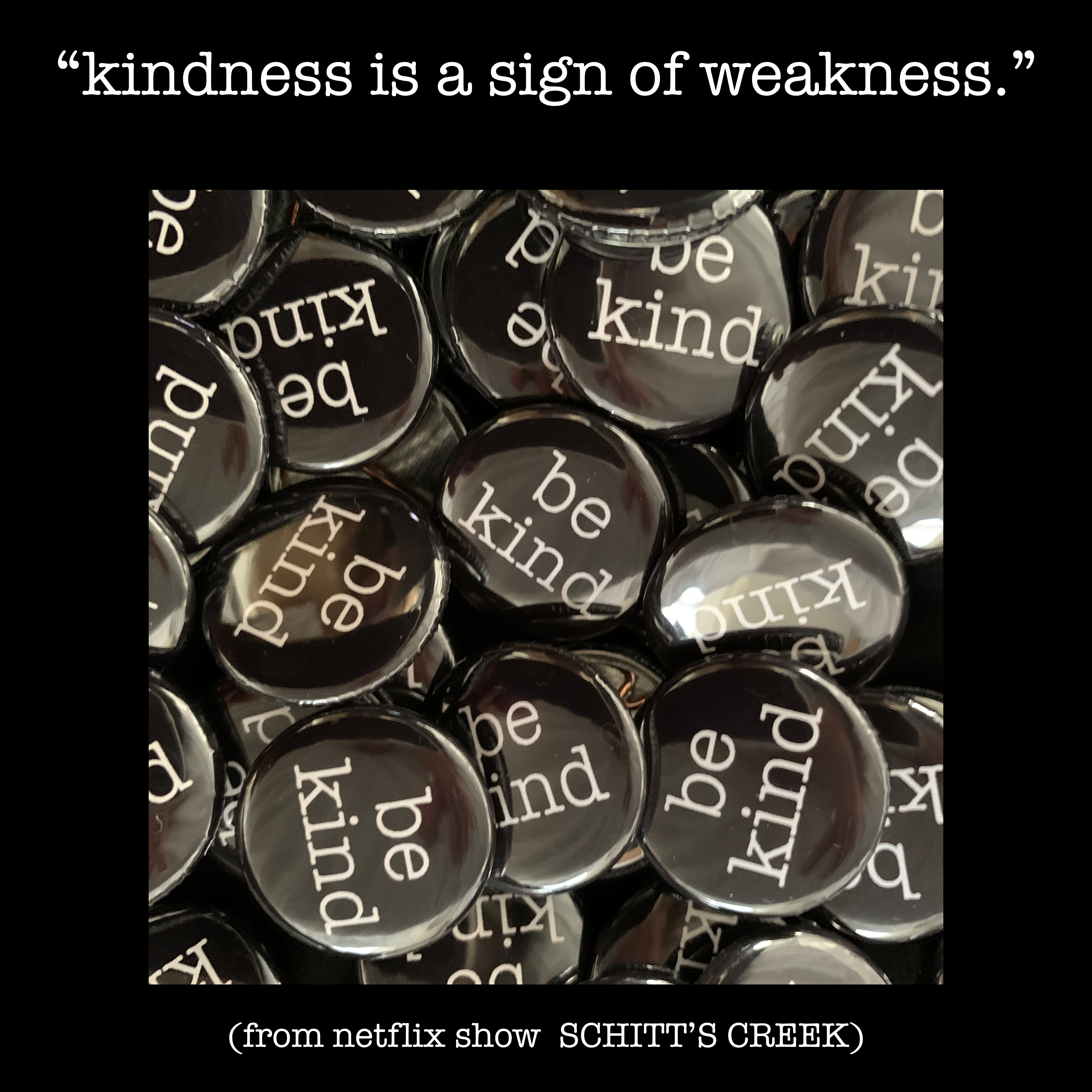
During an exceptionally stressful and contentious period this summer, we streamed the entire run of Parenthood. Six seasons of escapism!  “Let’s go to  California,” we’d say, all too ready for a leap out of reality. And then, in a moment of horror, the episodes of Parenthood ran out. Our escape hatch closed with a bang. In desperation we surfed and landed in Schitt’s Creek. It was a series a bit too relevant to our circumstance and we howled when one of the characters, in the face of kindness, said that she’d been raised to see that “kindness is a sign of weakness.”

“That’s our problem,” Kerri said, “we see kindness as a virtue.” She was raised to be kind.

That night we had a long discussion about kindness and its general absence in public discourse.

I’ve been thinking much about our conversation since we found ourselves meditating on kindness in Schitt’s Creek. This is my observation: mean is easy. It is fast. Like all forms of reactivity and thoughtlessness, meanness and contention are elementary.

We are surrounded by friends who are kind.  They are kind because they cultivate kindness, thoughts of others, as essential to their character. That’s why we are attracted to them. We are the recipients of unbearable gifts of kindness through our friends. They break us open. They make us bigger.

Kindness is a virtue. It is also a strength. And, it takes time. Kindness is like poetry. It takes development and some higher order thinking.

Lions eat zebras for food. People hurt people for a lesser reason.

In a world obsessed with speed, it is all too easy to run past substance in pursuit of the superficial. Slowing down, taking some time to see, exposes all manner of beauty.


read Kerri’s blog post about KINDNESS


heart in island sand website box copy