Move The Eye [on Two Artists Tuesday]

“If you think good work is somehow synonymous with perfect work, you are headed for big trouble. Art is human; error is human; ergo, art is error.” ~ Art & Fear, David Bayles & Ted Orland

The winterberries came as a shock. Vibrant red pops in a bleak landscape of brown and grey. “They look like maraschino cherries!” Kerri laughed as she waded into the brush to get a photograph. In Wisconsin, the mere mention of maraschino cherries invokes immediate and widespread mixing of brandy old-fashioneds. Even though it was early in the day, I imagine people for miles around sensed the invocation and sprang toward their liquor cabinets.

“Sour or sweet?’ I asked, trying to be clever, but she was too engrossed in her photograph to hear my quip.

Watching her crouch to capture the shot, I thought, “Red makes the eye move.” It’s a lesson I learned beyond the abstract and used in my narrative paintings – a series that I’ve had on the back burner for ages. Limit the palette, move the eye with winterberry red. It’s a director’s thought. Guide the eye. It’s a playwright’s plot; tell the story through the anomaly. Create movement through curiosity rather than control.

Explode the idea. Run toward the edge. Extol the sore thumb!

I let my eye roam across the fields. Winterberry shock to Winterberry shock, electric reds pulling my eye across muted purple and drab green. The wind rattling branches, antlers clacking in the sky. I breathed it all in as she waded through the grasses back to the path. “Make big mistakes,” I heard Quinn whisper.

“The bigger the better,” I whispered in reply.

read Kerri’s blogpost about WINTERBERRIES

Beg A Good Question [on Merely A Thought Monday]

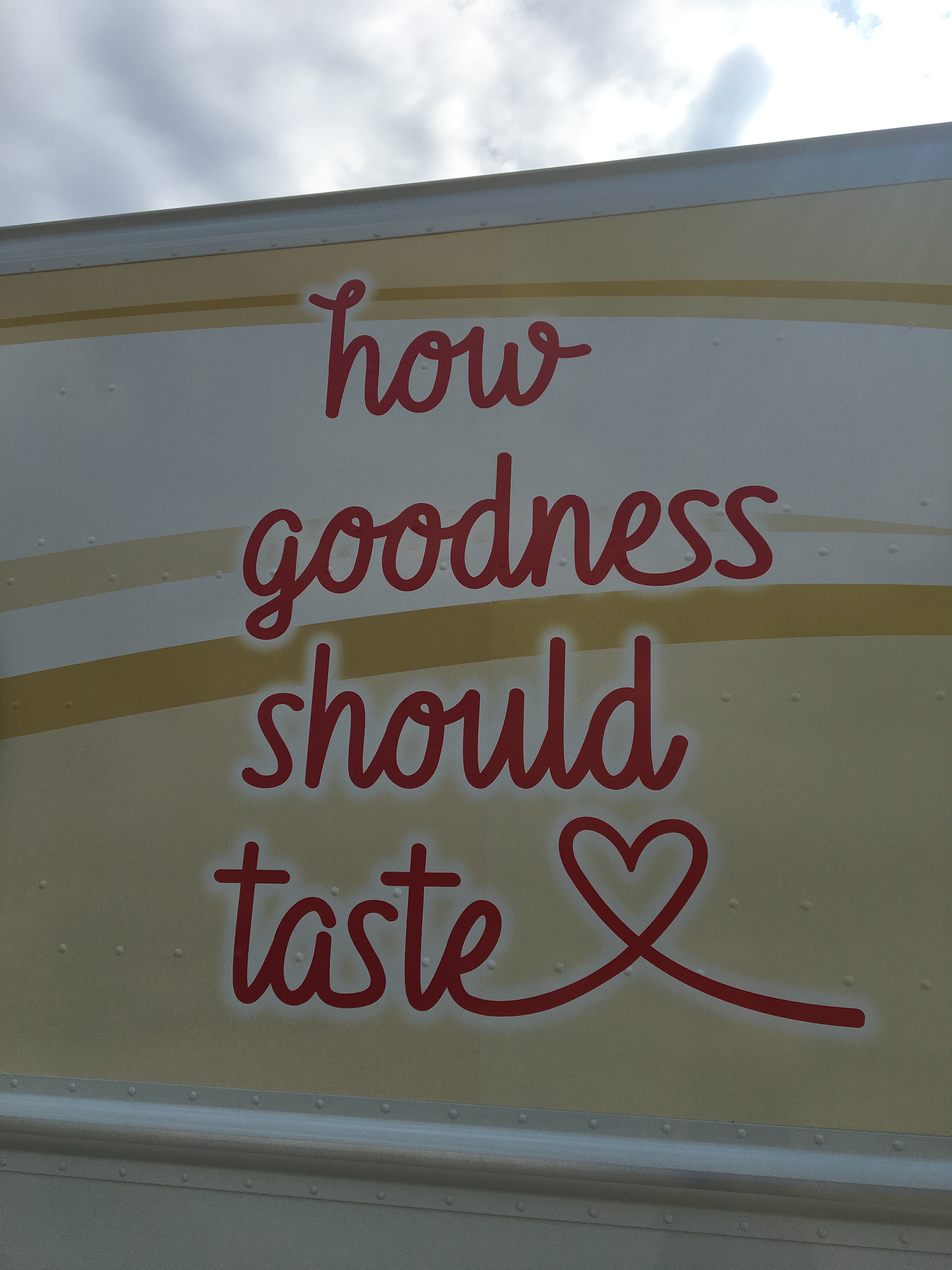
She stopped, turned and went back to the truck. “What are you doing?” I asked. She pulled her camera from her purse and snapped a photo of the Sara Lee truck. She showed me the photo and slid her phone back into her purse.

“I thought this would make a good blog photo,” she said, adding, “If it wasn’t a marketing phrase it would beg a good question.”

How should goodness taste?

How should equality look?

How should community sound?

How should generosity smell?

How should love feel?

We experience the world through our senses. And then we make a story of what we sense. Senses first. Story second. It’s how the brain works. The language capacity, putting words to experience, is essentially a translation function. It does not lead, it follows. It’s why, for the most part, we choose the story we tell.

The word that strikes me the most on the bread truck photo is “should.” How should goodness taste?

How does goodness taste? To you?

How does equality look? To you?

For you, what’s the sound of thriving community?

To me, generosity smells like fresh baked bread and hot dark coffee. You?

And love? There are no words. But you know it when you feel it.

read Kerri’s blogpost about GOODNESS

Be Us [on KS Friday]

always with us prayerflags copy

It is times like these that the grand illusion of every man/woman for themselves drops away. It doesn’t take long in a crisis to reveal how interconnected and interdependent we really are. As New York Governor, Andrew Cuomo, said this morning, what I do impacts you and what you do impacts me. There is, in essence, no such thing as you and me.

This is true in good times, too. It is true in all times. It is simply true. What I do affects you. What you do affects me. What I do is often a ripple of what you’ve done and vice versa. We are not nearly as separate nor independent as we like to pretend.

The delusion plays itself out. The run on TP. We’ve all seen the lines at the gun store. Sooner or later it will occur – as it always does – that the best form of self-protection is participation in community. Participation is protection.

Ironically, it is the sturdy fabric of the interconnection – in good times – that allows us to delude ourselves into thinking that – in bad times –  we can do it all by ourselves. Stop for a moment, look at the food on your plate and ask yourself how many people were necessary for you to enjoy your meal. The rings of interdependence will run farther than your capacity to imagine. That is always the case.

An article shot crossed my email this morning. It was from an artist sharing her realization in the midst of this pandemic that she does not create art for audiences, she creates with audiences. Like her, my paintings are not complete until people engage with them. People are not complete in the absence of art. Listening to Kerri play is more life-giving than any of the news broadcasts we’ve been glued to. There are levels to meaning making and the heart level rarely requires data but always requires other people and their gifts.

This morning we are hearing of the real difficulty of social distancing: mental health is stressed in isolation. We do not do well in quarantine. We, do, however, get creative. Jen prompted us to text images of all things green so we are looking around the house for green things. Emails and phone calls are on the rise. Mike reminded me last night that Shakespeare wrote King Lear while in quarantine for the plague. He meant it as a challenge, “Any takers?” he winked.

Rob wrote, “In times like these we NEED art.” Yes. We need art because we need to create with people. To experience with people. To story our experiences with people. To grieve with other people. To laugh with other people. With. Always. Us.


ALWAYS WITH US from the album AS IT IS available in iTunes & CDBaby


read Kerri’s blog post about ALWAYS WITH US


hands website box copy


always with us/as it is ©️ 2004 kerri sherwood