Move Toward Wholeness [on Two Artists Tuesday]

When I look at the bowl of green tomatoes, each plucked from the vine before we pulled the plants from their pots, still moving toward red ripeness, I think of Joe. He was fond of saying, “Life moves in the direction of wholeness.” It’s important to note that his fond phrase included nothing about outcomes. Joe was particular and knew that life is movement and not arrival.

I am revisiting the word ‘rehearsal’ these days only this version of rehearsal is not on the stage with creative minds. It is over Zoom with decidedly analytical minds. Actors in rehearsal halls move through a process of exploration that leads to specific choices. The goal, if there is one, is to embody a state of moving presence within a story. The analytic mind comes with a template overlay that is placed atop the experience before it actually occurs. The language reveals all: content items. Telemetry. The mathematics of movement. Rehearsal is predicated on precision.

As I’ve probably written ad nauseam, these minds are not in opposition. They are complimentary. Freedom of artistic expression comes from years of study of technique. The path to mastery winds through repetition and constraint. Saying more with less comes after a lifetime of saying less with more. The creative mind is one step closer to the senses. The analytic mind applies language, gives voice, to the experience.

Many years ago I participated in a workshop with an actor/director of Noh Theatre. The process was strict, exacting. The movements precise. There was no room for error. We, the participants in the workshop, knew we’d never achieve proficiency since it takes years and years of rehearsal to perform even the simplest of symbolic gestures. No one sings opera in a day. We did our best and failed and failed and failed. That was the point. That is always the point. Each failure is actually an exercise of muscle memory. The body learns. The mind is impatient. Rehearsal is rarely about the mind, despite what the mind insists. At the end of the day, our workshop leader gave a short demonstration of his art form. His ease of movement, born from years of repetition within constraint, was breathtaking. He was free.

Many years later I was helping John in his wood shop. He was a master wood worker. I watched him look over his lumber, preparing to build a cabinet. He ran his hand over the wood, feeling his way into his project. “Ah,” he said, laying his hand on a piece of cherry wood. “This is it.” John was like the Noh actor.

“How did you know?” I asked.

“I don’t know,” he said, “it just feels right.” Then he smiled and added, “Plus, I’ve built a lot of crap.”

Life, moving toward wholeness.

read Kerri’s blog post about TOMATOES
Try To Explain [on Merely A Thought Monday]

It’s nearly impossible to explain. I’ve had the conversation a thousand times and I know it’s fruitless from the outset. Why did I choose a life without a safety net? A life with stability and benefits? Why was I willing to work 80 hour weeks for not-very-much-pay? I’ve heard more than once that “Artists are indulgent.” Or, “Artists are fools.”

Maybe. I’ll never know because it is impossible to explain to someone who operates from a different imperative. I’ve thought myself foolish more than a few times, and, usually, when I measure myself by the standards of 9-to-5.

For me, like all the artists I know and admire, there has never been a distinct line between work and play. Given any amount of free time, I’d rather be in the studio than anywhere on earth. When I was directing plays and running theatre companies, I couldn’t wait to get up in the morning and get back to work. The time between productions or studio time, what most people call “vacation,” was-and-is meant to catch up on sleep and fill up the well for the next project. Often, this thing called ‘vacation’ was an opportunity to visit museums, drink in art/inspiration or stand in a castle or sit in the city where the next play is set.

For most of my life, even before I really thought about artists or artistry, vacation involved a sketchbook. I sat in the back of the station wagon and drew Colonel Sanders from the bucket of chicken or tried to copy a photo from the National Geographic magazine. Fun and play involved a deep dive into the world I could create/discover through a pencil on blank pages.

I can spend hours sitting and watching people. Small dramas. Gestures. Manipulations. Kindnesses. A little burst of love that would otherwise go unnoticed. Traveling for work meant time spent in airports, a goldmine of observation-time. Work or play?

Perhaps that is why there is no line between work and play. I see it in Kerri, too. We are constantly noticing. Paying attention to what is beautiful or interesting. Feeling what is needed and what is not. We’ve talked endlessly about being empathic. Feeling what others feel. I’ve watched Kerri walk into a rehearsal and “know” where there is pain, where there is joy, know when she needs to wrap some humor around a bruised community. Many years ago, a wise-old-artist told me that I had to learn to distinguish between what was my “stuff” and what was not. What were my feelings and what was not. Sage advice. I’ve been witness to many artists imploding, carrying other people’s garbage as their own.

When we walk, Kerri takes photographs. “I’m sorry,” she says, stooping to focus on a leaf or stone. Why does she apologize for noticing? Here’s a hint: all of her life she’s been asked to explain why she stops to notice. What value can there possibly be in stopping forward motion, especially in a world hell-bent on “getting there faster.” What is the value-proposition of noticing? “Can you please explain why you have to stop and see and, of all things, make it into music?” Or a story. Or a painting. Or a dance.

“Why did you climb that tree?” the adults asked. “It’s where I write poetry,” she explained. Work or vacation? Is it play?

Every Saturday we go through Kerri’s photos from the week and choose five as prompts for our Melange. We collect phrases we hear, words that inspire or disturb. Those end up in the Melange, too. Are we working? Is this play? We delight in sitting each day and writing together. We laugh at our Smack-dab cartoon. They are fun to write and draw and color. None of this makes us any money. Is it work or is it vacation?

I’m currently drawing cartoons and tossing thought-bombs into a community of software entrepreneurs – the boss understands that I notice things and can translate what I notice into other shapes and expressions. Is there value in that? Is it work? Is it play? Will it make money?

Are there possibly other measures of value?

It’s nearly impossible to explain.

read Kerri’s blog post about VACATION

Play The Same Stuff [on Merely A Thought Monday]

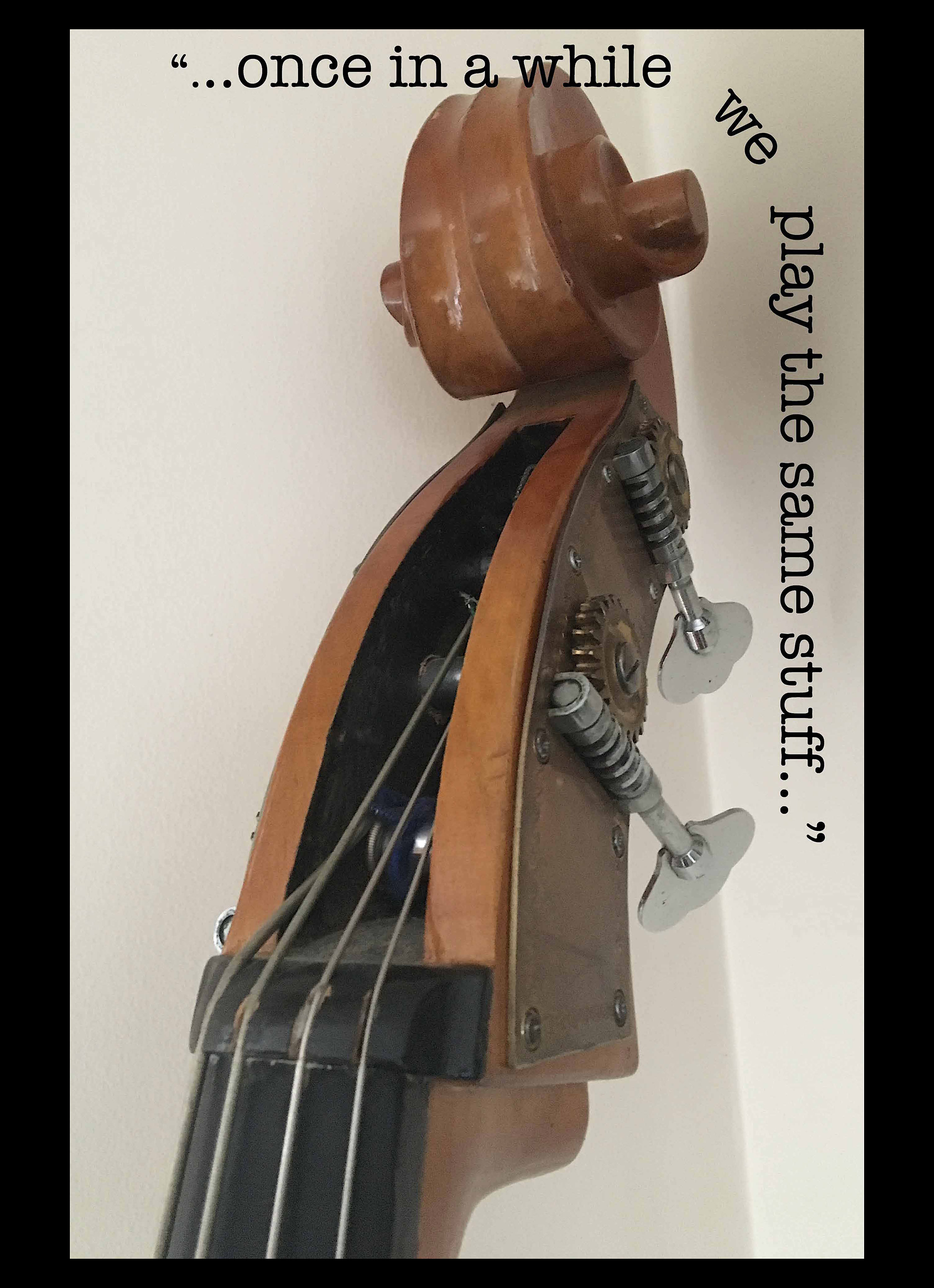
string bass with frame copy“If you are a chef, not matter how good a chef you are, it’s not good cooking for yourself; the joy is in cooking for others – it’s the same with music.” ~will.i.am
I lived most of my life believing I didn’t have a musical bone in my body. I was convinced that I had a tin ear. I was afraid to sing. I carried a guitar (I named her Magnolia) with me for years – a gesture of hopefulness amidst my absolute commitment to my ineptitude – and finally gave it away to someone who could play it. An instrument needs to be played and I felt I was being selfish holding onto a guitar that I would never play. Oh, how I wish I had Magnolia today.

I didn’t just make up my fear of music. I had plenty of reinforcement, lots of shaming, before I committed to a story of I CAN’T. Over time, with more and more horror experiences, my story solidified into I WON’T. Ever. Close the door. Kill the desire.

When I met Kerri – a consummate musician – I told her this: “You have to know two things about me. I don’t sing & I don’t pray.” A few months later we were driving back roads in Georgia, windows rolled down, a James Taylor CD blaring, Kerri singing at the top of her lungs, I thought it was safe to sing along. She’d never hear me. But, she did. She burst into tears and pulled the car off the road. I shook like a leaf but we sang together and it was grand.

It took her about 15 minutes to identify my obstacle. I had to relearn how to hear. That’s it. It took a few months and a willingness to mightily miss notes and my scary story of CAN’T crumbled. I learned how to feel the sound. The music was there all along.

Here’s the magic for a beginner like me: when I am rehearsing with the ukulele band or singing in the choir, I am capable of so much more than when I am practicing by myself. Playing the same stuff elevates everyone. It’s as if we transcend ourselves. Actually, we do transcend ourselves. We sync up and the energy uplifts everyone. Even me. Especially me, a toddler in knowing that I CAN.


read Kerri’s blog post about PLAYING THE SAME STUFF


at jonathans with bear website box copy


Hear The Voices

photo-2This is the most unusual rehearsal process I’ve ever navigated.

First, I wrote the play and in preparing to perform it, I’m discovering it anew as if someone else wrote it. There have been brilliant and funny moments when I ask myself, I wonder why he wrote that? The good news is that I remember whom to ask.

Second, the play was originally meant for Tom to perform and since the story is Tom’s family narrative, I wanted the language and syntax to be Tom’s. In development, I recorded hours of conversation with him. Much of the first draft was a transcription so that I might capture word-for-word his language choices and speech patterns. Those structures survived the several rewrites that happened after Tom’s death. In preparing to perform the play I’m wrestling with the language. I’m wrestling with his language. It is almost as if I am discovering my own speech patterns and syntax – in telling Tom’s story I’m finding it necessary to tell it my way, not his. Essentially, as is true in all good storytelling, I am finding myself, my voice, through his story.

Tom and me a long time ago.

Tom and me a long time ago.

Finally, the music is a character in the play and the musicians, Mom’s Chili Boys, are madly rehearsing in California while the actors (Kerri and I) are rehearsing in Wisconsin. The internet is a beautiful thing as, each day, we pass notes, record voices, email questions; we will only be together in the same room 3 days before the first performance. We’re essentially workshopping the play from two locations. It is akin to rehearsing a symphony in parts and the parts only come together in the final day. They get to experience the whole symphony, the fullness of their music as played through all of the voices, only in the final hour. And that will be true of this play.

Each day I rehearse and I hear Tom’s voice in my head, telling me the stories that comprise the play. I am reminded that, whether artist or audience, art is a living thing. It is a relationship and ultimately that relationship is with your self.

title_pageGo here to buy hard copies (and Kindle) of my latest book: The Seer: The Mind of the Entrepreneur, Artist, Visionary, Innovator, Seeker, Learner, Leader, Creator,…You.

For all digital versions, go here (Leanpub)

Untitled by David Robinson

Untitled by David Robinson

Go here for fine art prints of my paintings.