Meet The Firewall [David’s blog on saturday morning smack-dab]

I’ve decided that I am stuck in the past. I used to call my doctor when I needed immediate doctoring, when I had the flu or, like this week, a suspicious bug bite that slowly started to take over my body. I admit to being a slow-study. It’s taken more than a few experiences to learn that when I need some medical attention from my “primary care physician” I will always – always – be met with a firewall called “the next available appointment”. Sometime in 2027.

A relevant side note: please keep in mind Master Marsh’s wise insight: “Customer service is a firewall against serving the customer.” I’ve discovered the same might be said of doctoring in these un-United States. My relationship with my primary care physician is, in fact, a firewall against primary care.

I’ve finally learned my lesson. As a first step, from this day forward, I will always go to urgent care. Or, I will join the legion of people clogging the arteries of the ER for non-emergency but very costly services. But I will never-ever call my doctor. I’ve learned at last that PCP stands for Periodic Care Physician.

In truth, I feel badly for my PCP. During my last visit for an annual physical he raced in and out with his rolling computer cart to maximize the seven minutes he was allowed to spend with me before he rolled on to his next seven minute patient encounter. He was moving so fast that he “mis-coded” my annual physical as a “welcome visit” so, apparently, in his mind, we sipped scotch and took a tour of the property. Sad. He barely had time to listen to my heart and has no time to listen to his own heart. I’m certain he went to medical school to help people but has found himself doing factory work and we-the-patients are his assembly-line-widgets.

I doubt that this was the career he imagined. It’s an unimaginable system that is designed for excessive billing and, therefore, is fantastically profitable – our healthcare system costs seven times more than any other developed nation – but has little or nothing to do with health or with care.

(Hey. Wait a minute! A spider bite was how Spiderman got started! I’ll keep you posted if I find that I am suddenly able to scale walls or swing through the city from self-generated webbing).

read Kerri’s blogpost about HEALTHCARE

smack-dab © 2025 kerrianddavid.com

likesharecommentsupportsubscribethankyou

Control The Burn [David’s blog on Merely A Thought Monday]

Controlled burn. A fire set intentionally to maintain the health of the forest. It’s an interesting concept. A useful metaphor: what does a controlled burn look like when you are the forest? What are the invasive species growing uncontrollably in your mind? Your body? Your spirit? What overgrowth is choking out the light?

“Organizations are like people,” the younger version of me was fond of saying. “The path to health for an organization is the same as it is for you and me.” My business partner and I were hired for many reasons: leadership questions, change processes, diversity…but beneath the surface reason was always a deeper question: the health of the organization was awry. There was a dis-ease that looked like leadership issues or my personal favorite organizational illness indicator: change management initiatives.

What is balanced activity? A good diet (eating bad information is akin to gobbling bad food)? What is the value of laughter (holding it all lightly)? Above all, the single magic pill capable of healing every ill: attend to the relationships. Process (kindness) should never take a backseat to productivity. People are not widgets or replaceable bulbs. There will be plenty for all if the essentials are respected.

The hard part, especially when there’s pain, is to admit that the only way forward is to stop, turn around, and take a good honest look at what you are doing and why you are doing it. Politics and profit are great creators of darkness, fabulous justifiers of abuse. An alcoholic has to admit their problem before they can address it. The same is true for an organization (or a nation).

Taking an honest look is akin to starting a controlled burn. Opening space. Welcoming light. The destruction of an illusion is a literal eye-opener.

It’s not so very hard. What is true for individuals is true for organizations is true for nations. It’s simple to talk about. It’s hard to do. I learned this too: no one willingly stops and turns to take a good honest look until the darkness becomes…too dark. Until the only path forward is to pop the illusion. Often that begins by stopping to light a fire – first to see and assess the darkness – and then controlling the burn.

read Kerri’s blogpost about CONTROLLED BURNS

comment? share? support? like? change? burn? see? hide? seek?

buymeacoffee is…

Celebrate Renewal [on KS Friday]

“When bankers get together for dinner, they discuss Art. When artists get together for dinner, they discuss money.” ~ Oscar Wilde

Rebecca reminded me of David Bayles and Ted Orland’s remarkable book, Art & Fear. I flipped it open to this quote and laughed heartily. We discuss what we desire but do not yet possess.

On the opposite page I read this tasty bit: “Once you have found the work that you are meant to do, the particulars of any single piece don’t matter all that much.”

Years ago, watching me draw in an Italian Street Painting festival in San Luis Obispo, Roger commented that making art was what I was meant to do.

The other day, Kerri asked me if I wanted to hear a carol. She stood at her piano and played. There was no doubt – it was visible and electric – the carol she played was one of her compositions. I watched a brilliant artist do what she is meant to do.

Art is born of a service motive. Banking is born of a profit motive. It’s hard to explain a life of artistry in a world that exclusively values the profit motive. It seems foolish until you consider this: bankers, in retirement, play golf. Artists, in retirement, make art. There is no greater gift in this very short life than having an inner imperative. It tips contemporary valuation on its head.

Rebecca sent this quote from Art & Fear. She’d just asked me if I was still painting and I stuttered. “What separates artists from ex-artists is that those who challenge their fears, continue; those who don’t, quit. Each step in the art-making process puts that issue to the test.” I am currently challenging my fear.

Last night the Up-North Gang gathered for dinner at Jay and Charlie’s house. Jay is a remarkable artist. Everywhere I looked in their house I saw her artistry. The meal she made was a bold step into the unknown and it was delicious. She is doing what she is meant to do and it spills out in every room.

At dinner, we talked about our children coming home for the holiday. I was the only person at the table who will never know the full depth of the desire of parenthood. I am a step, not a birth father. The joy of their children glowed in the faces seated at the table. All else seemed irrelevant.

There is a place beyond service and profit motives, a lovely dinner conversation where artists and bankers come together at one table. Family. And isn’t that – in the end – what we are all meant to do. To sit side-by-side and celebrate our renewal?

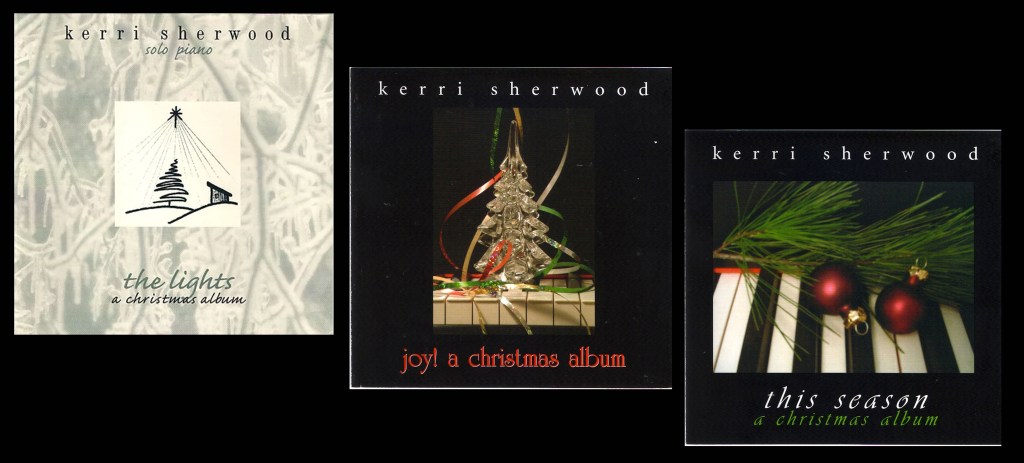
Kerri’s albums are available on iTunes and streaming on Pandora

read Kerri’s blogpost about THE HOLIDAY

i wonder as i wander/the lights © 1996 kerri sherwood

Make Sense [on Merely A Thought Monday]

I told Kerri she was going to be fired two years before the ax fell. I needed no crystal ball and was not reading tea leaves. In my consulting life I’d seen it happen a few dozen times. When a not-for-profit organization promotes to leadership those who believe everything needs to run like a business, the people holding fast to the actual purpose and mission of the organization have to go.

It makes sense if you think about it. Profit is the purpose of a business. When profit is the purpose, the organizational structures and levers-of-power evolve according to the purpose: profit. People are expendable.

There’s a reason arts organizations, churches, educational institutions,…are called not-for-profit. They serve a different purpose. The organizational structures and levers of power evolve according to the central purpose: service. The creation of art. Learning. Health. Feeding the hungry. Helping the victims of disaster. Worship. The people, usually not well-paid, are dedicated to the deeper organizational mission. Not profit. The people are not expendable. In fact, they are the keepers of the flame. They are very hard to come by.

The quickest way to kill a service organization is to apply the power-levers of business. The purpose dies. The good people – the keepers of the organizational heart – have to be fired, whipped into compliance, silenced, or forced to leave. It’s not rocket science. That process takes a few years.

It’s sometimes hard for us to make sense of what’s happening in our nation and world yet the same principles that apply to organizations also apply to countries. The purpose of healthcare is not profit. The purpose of education was never supposed to be profit. We currently have in our vernacular phrases like “predatory lending” – people making millions from students who believe the dream is only accessible through higher education. It’s the message embedded in our mythology. The levers of business have twisted our vision. Just as prisons should never be money makers, healthcare-as-a-business obliterates the purpose. It profits a few. It crushes the many.

Apples cannot be oranges. Make sense?

What’s happening in our nation makes perfect sense. Big business, regularly bailed out or given tax breaks to the tune of billions of dollars, is protected. No questions asked. Yet, try to correct a corrupt lending scheme, a successful (highly profitable) application of business levers to education, built on the backs of working people trying to go to school, and the “it-has-to-run-like-a-business” crowd will move heaven and earth to keep profit at the center of the mission. Our education system, once the best in the world, is spiraling. Ridiculous. It’s inevitable when protecting the interests of business supersedes serving the purpose.

We may find our way through, we might return to our senses, when we stop pretending that business is somehow sacred, that the making-of-money is moral and a proper north star for all things. It is not. It is great for some things. It is devastating, senseless, for the most important things.

read Kerri’s blogpost about SENSE