Grok The Rule [David’s blog on Two Artists Tuesday]

“A good poem looks life straight in the face, unflinching, sincere, equal to revelation through loss or gain.” ~ David Whyte

A good rule of thumb in the visual arts: areas of high contrast, in color-or-value, come forward while areas of low contrast retreat. Landscape painters use this rule to create the illusion of foreground and distance. Abstract painters use this rule to move the eye around a composition.

Storytellers and poets use the same rule. High contrast creates interest. It grabs attention. Low contrast sets the environment, the mood. “Some kind of relaxed and beautiful thing/ kept flickering in with the tide/ and looking around./ Black as a fisherman’s boot, with a white belly…” Dogfish by Mary Oliver.

Misused, it’s the rule-behind-the-reason that most of our news is “Breaking News!” False contrast. Hype. It’s the reason our national portrait is continually painted as divisive. High contrast pulls focus. The money follows the ratings so attention-grabbing is highly prized. Low contrast – like agreement, collaboration, sameness, community…truth – doesn’t generate the same level of interest or income.

Like all rules, there are worthy reasons to wield them. In the arts, the contrast principle is used to illuminate unity. To break an individual through to the experience of something bigger. To open questions. In our news-of-the-day, the rule is used to whistle a song-and-dance of discord and distraction. To separate into tribes. To manufacture the illusion of depth while sitting in shallow water.

The reasons to wield the rule are diametrically opposed.

It was a sad day when the young man, standing in our living room, told me that he would educate his child at home. His reason? He didn’t want his son to be stuffed with ideas. “Just the facts,” he said. “Just the facts.”

“Poor souls,” I thought of this man and his young child. How will they ever stare into the fiery face of democracy – an ongoing idea born of high contrast and wild ideas – the artistic kind, meant to bring people together in one nation under every possible god – like a poem. They won’t recognize democracy’s death when without question it slips like ashes through the fact of their fingers.

As for me, I’ll stick with the high and low contrast of Rumi, MLK, Shakespeare, Kahlil Gibran, Mary Oliver, Maya Angelou…

“Your task is not to seek for love, but merely to seek and find all the barriers within yourself that you have built against it.” ~ Rumi

[another worthy rule of thumb: never read the headlines prior to writing a post. All the icky-mush rushes to the foreground and permeates my brain]

read Kerri’s blogpost about FOG

like. share. support. comment. let us know you are out there.


buymeacoffee is a counterintuitive, highly appreciated, offering of support amidst a high contrast environment that keeps the artists among us hopping and hoping.

Arrive At Magic [on saturday morning smack-dab.]

It’s true. We read to each other. We read poetry to each other.

Lately, Kerri’s reading to me from Pablo Neruda’s Book of Questions. First, she reads the question in Spanish and makes me guess what Neruda asks. It’s important to note that she doesn’t know Spanish. Her first poetry pass is lyrical Spanish-sounding-gobbledygook-syllables followed by a studied look of expectation (remember, she’s a composer and musician – even her gobbledygook sounds lovely). “Well?” she asks, arching her brow. I make up an answer or stare dumbly. After I fail miserably, she hits me with the English translation. Lovely either way, coherent and incoherent.

Lovely either way. The bluebells and dark hazel can come to us through the yummy words and imagination we share or while slow-walking a trail. We may not have the power to invoke a well-timed Amazon delivery but, truth-be-told, I much prefer the way we arrive at our blue-bell magic. Coherent or incoherent. Either way. Lovely.

read Kerri’s blogpost about POETRY

smack-dab. © 2022 kerrianddavid.com

Taste It Fully

ice circles on the lake

ice circles on the lake

We heard the angry barking of crows before we saw them. They were haranguing an owl. It flew into a tree only a few yards in front of us. For several moments, through the ruckus of the crows, we stared at the owl and it stared at us. Time stopped. Nothing else existed. The owl’s eyes, our breathing, the crow’s chorus.

For our wedding gift, H and Teru sent several collections of poetry, “Manuals on marriage,” they wrote in the note that came with the poems. Kerri and I are savoring the poems, reading one or two aloud to each other every day. They are a source of warmth and inspiration during these cold dark winter months. A poem cannot be rushed or read merely. It must be slowly tasted. It is meant to be entered like a meadow; to be experienced. Try to make sense of a poem and you will miss it. Just like life.

She said, “inner quiet is low maintenance,” and I laughed. Yes it is. The trick is in getting quiet. It is not something that can be found or achieved. It is not a place or a state-of-being. It is what happens when you stop looking for it. Like the hermit says to Parcival when the Grail Castle suddenly reappears, “Boy, it’s been there all along.”

For years Sam the poet was afraid of his poems. Like all great art, his poems, his art, revealed the artist, and so he kept them locked up, un-tasted. He came alive and supremely dissatisfied when he finally unleashed his poetry. He let himself want more but also refused to let himself experience more; one foot on the gas, one foot on the brakes. To taste fully one must be willing to be tasted.

A snippet of a poem (a koan imbedded in a poem), RELAX by Ellen Bass:

The Buddha tells a story of a woman chased by a tiger.
When she comes to a cliff, she sees a sturdy vine
and climbs halfway down. But, there’s also a tiger below.
And two mice – one white, one black – scurry out
and begin to gnaw at the vine. At this point
she notices a wild strawberry growing from a crevice.
She looks up, down, at the mice.
Then she eats the strawberry.

Taste your moment. Taste it fully.

I wrote in my black and red notebook a simple recognition. The field of possibilities cuts both ways: in your despair you must remember that anything is possible. In your joy you must remember that anything is possible. Tiger above (the past), tiger below (imagined future). Do not reject your moment or attempt to hold on to it – both are methods of missing the moment. Taste it regardless of the circumstance. Taste it fully.


Share A Poem

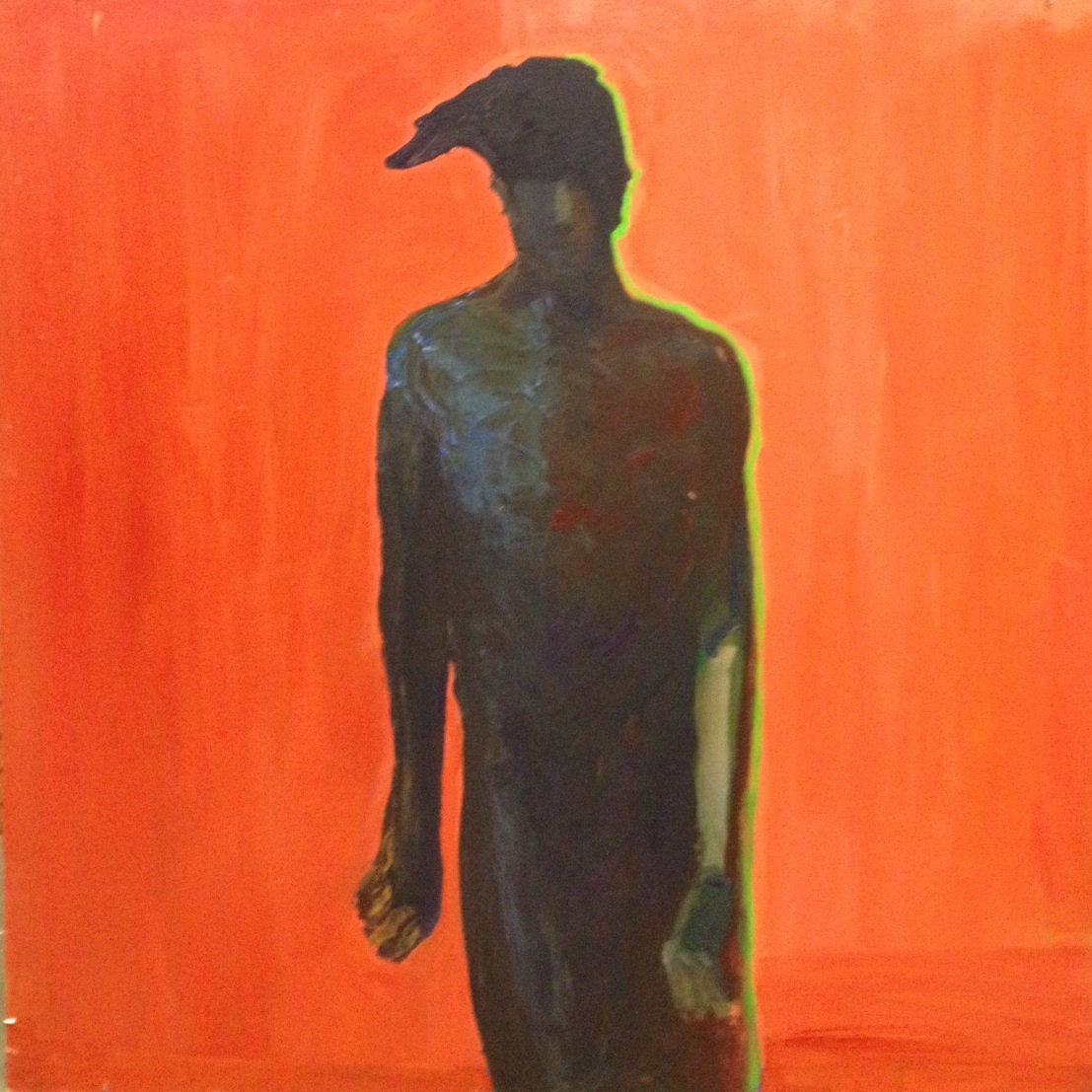
An old painting from my archives. This is "Hermes."

An old painting from my archives. This is “Hermes.”

One day, out of the blue, Doug came out of his office, stood at the door to my office and asked me to follow him. Doug was a bull in a china shop, gruff on the best of days, and his request was more of a command than an invitation. He’d spent his early life in the military, did two tours in Vietnam, and a piece of him was still fighting that war; the rigor, structure and discipline he’d acquired as a soldier was still saving his life. I’d worked with him long enough to know that he was soft to the center. Doug was a big heart wrapped in pit bull clothes.

I followed him back to his office and he asked me to close the door, a sign that usually meant battle was to ensue. I closed the door and sat opposite his desk, curious that the lights were off. The dim room was illuminated by a single thin window partially obscured by a bookcase. He sat. He took a deep breath and looked around as if he was worried that others might be listening, and said, “I want to show you something.” He took another breath, slid open the bottom desk drawer, and pulled out a book so worn and deteriorated that it was barely recognizable as a book. I knew immediately what it was and caught me breath. “I want you to see this,” he said. I gently held the tattered brittle pages and read the first poem in the book and, as I read it, Doug recited it. Tears came to my eyes.

I’d heard the story of the book many times. Doug told the story when he was in pain, when one of his students was self-destructing or when he was once again standing at the edge of his own personal abyss, a place that was never far away. He told me the story each time he was trying to find a shred of humanity in his very dark world.

When Doug was on his way to his first tour in Vietnam, he was not yet 18 years old, he was angry and alcoholic, and for reasons he could never explain, he stopped in an airport bookshop and bought a book of The World’s 100 Greatest Poets. When telling the story, Doug would say, “I’d never read a poem. I hated poetry! I was nearly illiterate! But I bought that book and stuffed it in my bag.” He told me that the guys in his platoon teased him the first night he brought out the book of poetry and read it. Initially he read the poems aloud to bother his mates. They’d shout and throw stuff at him. Every night he read poems aloud. Soon, after the horrors of the day, after the fears of being killed or having killed, they asked him to read poems to them. They had favorites. They made requests. They talked about what the poems meant. They asked him to find a good poem to send to their loved ones at home. Over the year, Doug learned to recite by heart each one of those poems.

Doug told me that poetry saved his life. The book saved his humanity. That day in his office we spent nearly an hour reading poems to each other; each poem had a story, a memory. He told me that people don’t understand the reason for art, the necessity of poetry. “It’s not a luxury,” he roared, “it’s the goddamn center.” He carefully placed the book back in the drawer and pushed it closed. I thanked him for sharing it and he waved me off. The moment had passed; he closed the drawer on his sharing, too. It was too much.

That day was nearly twenty years ago.

Doug Durham

Doug Durham

Jim sent me news that Doug passed away this week. The last time I saw Doug he showed up at my apartment in Seattle just as he’d showed up at my office door: out of the blue. He sat in my living room for fifteen minutes, fidgeting, unable to sit still. “I just wanted to see you!” he trumpeted. “I wanted you to see that things are good with me!” He was deciding whether or not to open that metaphoric desk drawer. He had something to share or say but had not yet decided whether it was the right time. He had cancer even then but was on top of it.

“Well!” he announced, standing, “it was good to see you.” I asked him what he wasn’t saying and he gave me the “be careful” look. He wasn’t ready and I knew better than to push him. “Stay in touch.” I said, as he climbed into his big red truck. “You know better than that!” he smiled, waved, and drove away.

Go here to get my latest book, The Seer: The Mind of the Entrepreneur, Artist, Visionary, title_pageSeeker, Learner, Leader, Creator…You.

Or, Go here for hard copies.