Meander. A gentle word, that brings to mind a slow stroll through a sunny day with no place in particular to be. It is a word without to-do lists and achievements.
Kerri’s composition and performance of Meander invariably opens my heart/mind to a slow stroll through memory, a warm gallery of small hopeful moments. A barefoot walk in a mountain stream. A sunrise, that moment that the warmth hit my face. A meteor shower and the scent of sage at midnight. The puppy smell of Tripper Dogdog when he first came home.
On this KS Friday, from studio melange, give over to Meander. Let this amazing piece of music inspire you – as it does me – to step out of the race and take a stroll, real or through memory, to those rich and sunny fields beyond hurry-up and go-go-go.
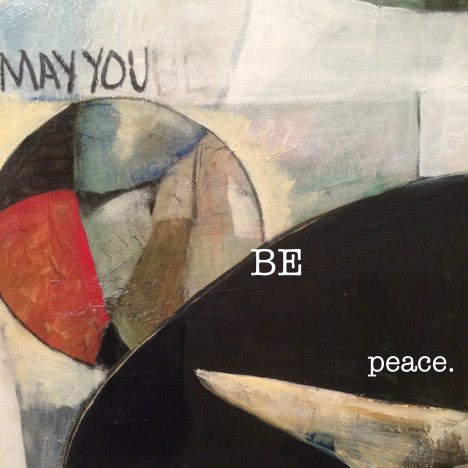
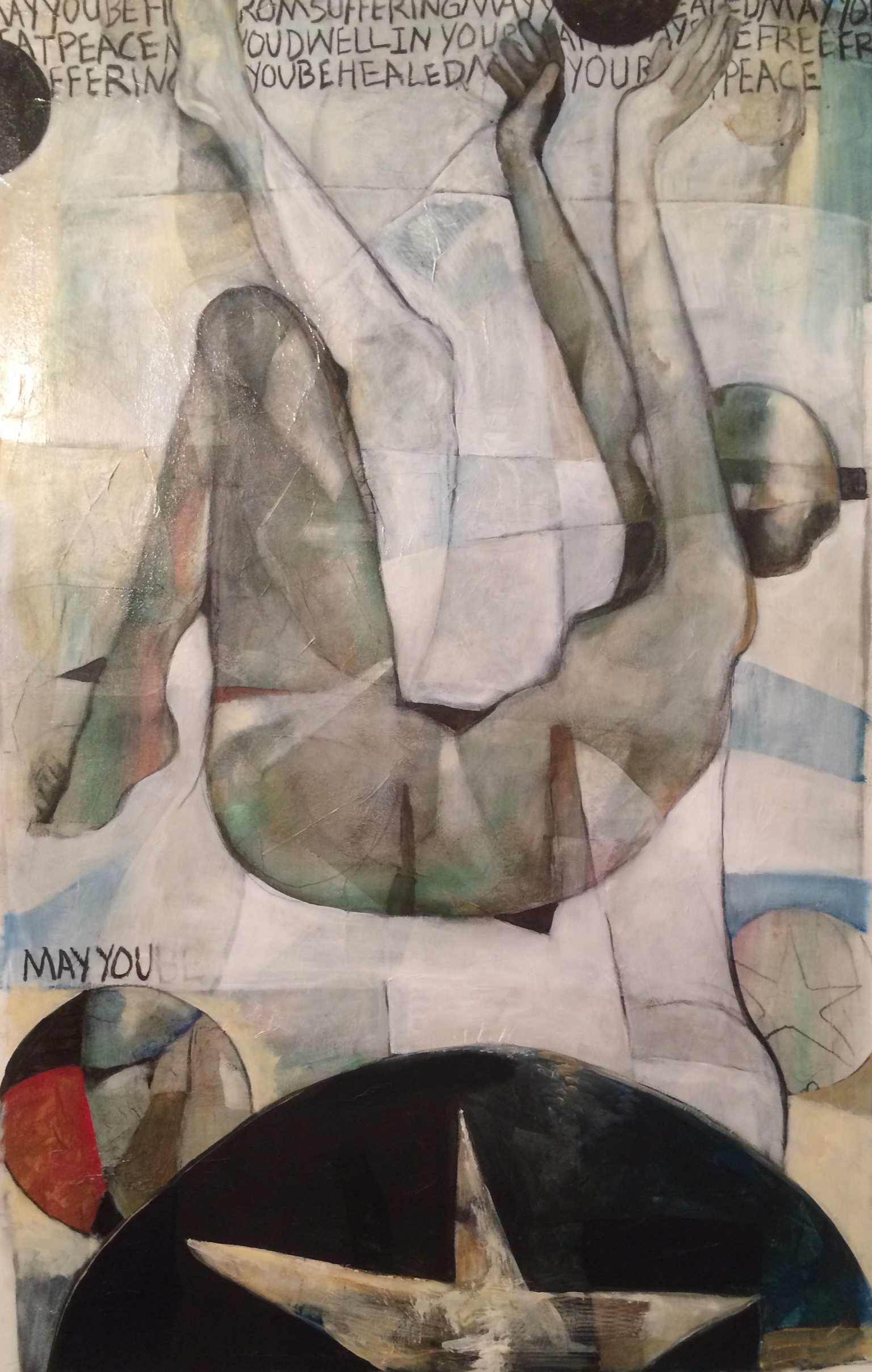
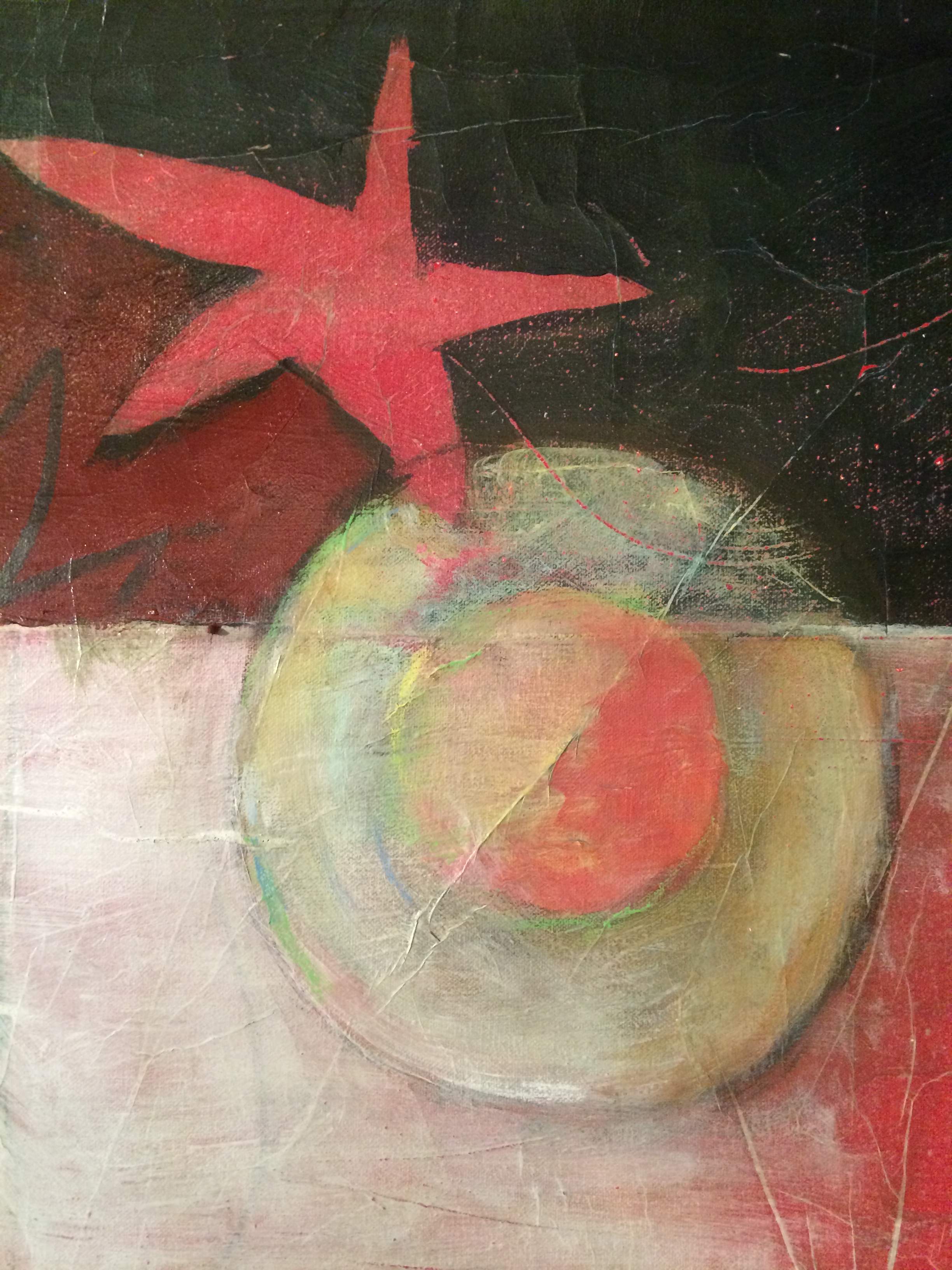
Kerri calls them “morsels”: snapshots of a portion of one of my paintings. May You Be Peace is a morsel. I love watching her take the shots. I delight in how she helps me see my work anew. I appreciate how each morsel is a complete work of art in itself.
Shift the focus. Pull in the frame of reference. We live in a world of cameras and microscopes and telescopes and compartments; what we see and believe is very much determined by where we place our focus. Georgia O’Keeffe knew it; she was a master of the close-up.
A few years ago I began taking photographs of my paintings-in-process. The camera helps me sees aspects of the painting that would otherwise remain invisible. It’s odd. I stand before a canvas stapled to the wall and see one thing. I aim a camera at the canvas stapled to the wall and see a wholly different painting. Just imagine the infinite perceptions and perspectives at play in our world!
My photo-painting-practice is a constant reminder that my perspective, my perception is mine alone. You are most certainly looking through a different set of lenses.
Peace, I think, has nothing to do with sameness and everything to do with the celebration of difference, the capacity to help each other see our lives anew.
Posted on August 19, 2017 by davidrobinsoncreative
I asked Kerri which of my recent paintings most accurately represented me as an artist. I was building a new website and wanted my home page to highlight a single painting. Without hesitation, she said, “The one titled, He’s A Stubborn Pain In The Ass.” I’d have protested but I knew my protests would be drowned out by her gales of laughter.
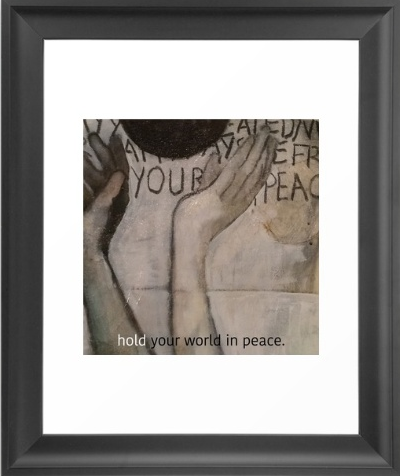
When she could breathe again, she said, “Use ‘An Instrument Of Peace.’ It’s the painting that best defines you as an artist. It’s what you bring.”
I am always excited to enter the studio to work because, for me, it is a place of peace. It is THE place of peace. And, as such, it is the place of clarity. When painting, my mind is silent. Peace is a quiet place. It is dynamic, immediate.
It’s a paradox that I enjoy. Peace is more practical than paradise. It lives beyond the turmoil of story and ideals and points of view and resistance. It lives beyond thinking and striving in any form. It is methodical-miraculous.
Horatio and I have often talked of entering the studio and disappearing into work, of becoming present. In other words, we stop ‘becoming’ entirely and simply ‘be.’ The epicenter of the paradox: creating in the absence of striving. It sounds like an ideal, doesn’t it? It sings like an impossible hippie aspiration or a Bob Dylan lyric. The Buddhists have a shorthand phrase for this practical peace: chop wood, carry water. In other words, it is not found in what you do. It is enlivened by how you are within what you do.
Krishnamurti wrote that if you want peace in the world you first must be peaceful. The phrase, Be Peaceful, is appropriately redundant: you will be peaceful if at first you learn to BE.
The trick, as someone once taught me, is to make all the world my studio. After all, it is not the place, not the studio. It is me. I can’t think of anything I’d rather bring to the world than to create as an instrument of peace, to –maybe- be an instrument of peace.
I dug out an old drawing this morning. I’ve been thinking about it for days and finally decided to heed the impulse and find it. I drew it years ago, a study for a large canvas I intended to execute but the timing wasn’t right or the thought was not complete. I can’t remember. It would have been a statement piece, based on a myth. Polynieces and Eteocles, two brothers fighting for control of the kingdom after the death of their father, Oedipus. They refused to share the riches. They lost sight of the kingdom in their lust for control and killed each other in their battle. Both lost.
I remembered the drawing after reading the daily news. It popped into my head as an image that seemed relevant as I listened to the intensity and insanity of the blues and the reds. These days I hear a lot of rhetoric about what is good for “the American people” and I am certain – it is among the dwindling things I am certain of – that these diverging rhetorical paths are not good for anyone. The kingdom is nowhere to be found, so lost are we in the power struggle, the alternative-truth-games and all of the accompanying hyperbole.
Recently 20 came over for dinner. He read to us a disturbing article from the newspaper and asked, “So, do you think we have it all upside down?” It was, of course, a rhetorical question. The article was from a February 12th issue of The New York Times, Husbands Are Deadlier Than Terrorists, by Nicholas Kristof. It was an appeal to stay focused on what matters in the midst of so many smoke-and-mirror-power-play intentions. It was a plea to not be lost in the diversions:
“Consider two critical issues: refugees and guns. Trump is going berserk over the former, but wants to ease the rules on the latter….In the four decades between 1975 and 2015, terrorists born in the seven nations in Trump’s travel ban killed zero people in America, according to the Cato Institute. Zero.
In that same period, guns claimed 1.34 million lives in America, including murders, suicides and accidents. That’s about as many people as live in Boston and Seattle combined.”
It’s also roughly as many Americans as died in all the wars in American history since the American Revolution….”
There is, admittedly, much to fear in this world but it is rarely where we pin the blame. Insanity almost never recognizes itself.
According to the myth, Oedipus put a curse on his sons. That was the reason they could not peacefully share the rule of the kingdom. It was a curse. They couldn’t help it. So, it was their fate. No lesson learned. No growth possible.
We have a long legacy of using inequity to create and reinforce division. Perhaps that is the curse we inherited? That is the “reason” we cannot find common ground and shared governance? Is it our fate to murder each other and project the danger onto the people least capable of defending themselves: the current wave of immigrants? It seems lazy but certainly appears to be effective.
It might now be time to execute my painting. I’ve lately been focusing on grace and images of internal peace. I seem to be out of accord with the times in which I am living. According to the data we are killing each other faster, more efficiently and more eagerly than any external threat. All the while our ruling class seems singularly devoted to keeping us in primary color-coded camps rather than working with the creative tension that moves divisions in a unified direction. And, we seem singularly devoted to playing along, not a hint of purple to be found.
Art is, after all, an expression of who we are and I can find no other more relevant American image. It will, of course, be a symphony of reds and blues.
I find myself once again standing at an intersection of seemingly unrelated conversations and experiences and am in awe of the common thread.
Yesterday was Ash Wednesday. The imposition of the ashes is a reminder of mortality: we came from dust and to dust we will return. Last night I watched the ritual from the choir loft. It is new to me and beautiful – a lifelong fascination of mine – to witness the power of people gathering to participate in their rites of transformation. Life made vibrant through the realization of its limits.
After a long hiatus, this week I picked up my art discussions with Horatio. He is wise and I have sorely missed my conversations with him. During my Seattle years we often met downtown for coffee and talked about all things artistic. We’d compare notes, challenge assumptions, share inspirations, complain about obstacles, wax poetic, and laugh at the fears and foibles of life on an artist’s path. A few days ago we scheduled a call and picked up our chat as if no time had elapsed. He is an accomplished visual artist and filmmaker and told me that finishing a drawing (or film) always feels insignificant, anti-climactic. “There is no such thing as completion,” he said. “The product always feels empty. Doing the work is vibrant and alive. The life is in the process!” Horatio told me that he disappears when he goes into the studio. I know that feeling well. It is not an experience of losing your self, it is the experience of transcending your self. It is a ritual of transformation
This morning I read in our local newspaper that the University of Wisconsin, Parkside (the campus in our town) launched an initiative to inspire peace through the arts called “PeaceWorks.” They were inspired by this quote from Eleanor Roosevelt: “It isn’t enough to talk about peace. One must believe in it. And, it isn’t enough to believe in it, one must work at it.” I read that there will be over 20 artistic events from all disciplines that deal in one way or another with peace – or the absence of peace. Peace is likely to be found when a community gathers to participate (not just witness) in the transcendence of self. There are few things like the arts that can facilitate that.
One of the latest paintings from my Yoga Series
The ride is limited. The achievements of this life are of little importance if the process (the moment) is missed. Peace, inner or outer, like all high ideals, begins with an intention and is usually possible when, looping back to the beginning, we realize that this ride of life is finite and precious.
Posted on January 14, 2017 by davidrobinsoncreative
“Our search for truth must be wide open, even when it takes us in directions we preferred not to go. This is the difference between propaganda and truth. Propaganda has a certain end in mind, and so it marshals and manipulates the ‘facts’ to support its conclusion. Truth weighs evidence, seeks proof, is appropriately skeptical of authoritarian claims, welcomes questions, and doesn’t fear dissent.”Philip Gulley, The Quaker Way of Living*
Kerri and I often read books aloud to each other. On cold winter days we sit beneath a blanket, Dog-Dog at our feet, BabyCat snoring by our side, sip coffee, and read. We like to discuss and compare perceptions, ask questions, and re-read passages for clarity or the simple poetry of the language. Sometimes we savor a book, moving through it slowly. Sometimes we devour a book and go back to reread especially potent sections.
“Propaganda resists close inspection and must continually be defended. Truth welcomes doubt and skepticism; indeed it is best served by questions, suggestions, and corrections.”
I am guilty of burying my head in the sand. My move to Wisconsin came with an intentional unplugging from the news. I was tired of pundits shouting each other down. I was weary and wary of conversations with family and friends that seemed to be territory-guarding regurgitations of our news-channel-of-choice. I was using the language given to me by my news sources and rolled my eyes at the predictable language leveled by the “other” side. One day as I raged at family members to pay attention to how they were being manipulated by their news source, I thought that it was probably a good idea for me to do the same. At the time, unplugging, stepping out of the toxic stream, seemed the only option to clear my mind.
“The search for truth begins within the seeker, for if we are not honest with and about ourselves, we will find it impossible to be honest with and about others.”
On a recent trip to Indiana, Bill and Linda suggested a book for us, The Quaker Way Of Living by Philip Gulley. They read it with their church group and found it compelling, especially given our corrosive political climate and collapse of civil discourse. We bought it when we returned home and a few days ago started reading it together. We couldn’t put it down. It asks some powerful questions. It doesn’t pretend to have answers [that, I’ve learned, would be the antithesis of the Quaker Way] but it does speak directly to the quandaries of personal and communal integrity in a climate of self-righteousness, blame, and distrust. It is hopeful and funny and places the onus of creating a better world squarely on the shoulders of each and every one of us. It reminded me that burying my head in the sand is not very useful while also affirming that their are options beyond planting a flag in the sand.
“To say a person has integrity means several things. Most commonly, we mean the person is honest, that his or her word can be trusted…. But there is another level of meaning that has to do with the integration of our values and lifestyle. In that sense, to say we have integrity is to say the separate parts of our lives combine to form a unified whole. What we believe is consistent with how we live. Our beliefs influence the work we choose, the way we use our time and spend our money, the relationships we form and the goals to which we aspire. This integration is critical for inward peace.”
While reading, I’ve been thinking a lot about a conversation I had a few years ago with Jim Marsh, one of the people I most admire in this world precisely because he walks his talk. He told me of an issue in his community that had deeply concerned him and that he’d been grousing about for long time. One day he’d had enough and to move forward he recognized that he had three options: First, to stop complaining (he said, “to just shut up.”). Second, to move away. Leave. Get away from the source of his irritation. That didn’t seem like a healthy option. The third was to strap on his boots and do something about it. To act instead of complain. But, (and here’s the reason why I adore him) not to act against, but to work to create what he wanted. His responsibility was not to fight or resist. It was to create.
“We preserve our integrity and wholeness when we are aware of what threatens it and then choose to act deliberately and prudently when tempted. When we fail to do this, we disintegrate, creating a chasm between who we are and who we wish to be.”
I practice tai chi and had the good fortune to have, for a few years, a master teacher, Saul, whose teaching transcended the specifics of tai chi. He was teaching me how better to live. One day, while I was in a fit of resistance, he quietly showed me the power of looking beyond my “opponent” and placing my focus, instead, in the field of possibility. I understood (intellectually) that the opponent was always of my own making and my dedication to having an opponent (inside or out) would always pull me off balance. In other words, as long as I invested in resistance I would always pull myself off balance.
“Integrity isn’t conditional…There is a seamless nature to integrity that transcends situations and relationships. Integrity does not present one face in public and another in private. It delights in transparency, having nothing to hide.”
Now, with my head freshly out of the sand, I understand Saul’s teaching beyond my thinking (I’ve had a lot of time to meditate on things with my head in the sand) and, taking my cue from Jim, I recognize that I have three options but only option-number-three holds the promise of integrity. The best news: no one creates alone…
*all quotes in this post are from the chapter on Integrity from The Quaker Way of Living by Philip Gulley
We’d been out in the canoe for more than an hour. The morning was warm and the water was still. We hugged the shore, cruising the lily pads. Dan told us some of the lily pads were over 150 years old. I was amazed at their capacity to reach through time but also reach through long stems to the water’s surface to drink the sun.
The turtle emerged from nowhere. It appeared from the depths, through the lily pad stem forest, and rose to within inches of the surface. It was big for a lake turtle, perhaps the size of a dinner plate. I let my paddle trail in the water. It was so close I could have reached into the water and touched it. We glided forward and turned the canoe so Kerri might see it but the turtle had already disappeared.
the view from the canoe
Turtle is perhaps the oldest known symbol for the earth. In many traditions, turtle carries the world on her back; the earth is her shell. She is a great reminder to go slow and persevere, to live grounded amidst the chaos of life. She symbolizes patience and ease. I was struck by how similar are the symbols of turtle and lily pad. Peace. Ease. Both are extraordinary symbols of grounding or rooting. Both cross the boundary of elements: the turtle lives in water and land. The lily pad reaches through the water to find air and sun. Both inhabit the depths and reach to the surface.
It feels as if I came into this world with art already in me. From an early age I drew pictures, not because I wanted to but because I had to. Like the lily pad, I was reaching for something unknown. I drew the same images over and over again: a cabin in the woods, eyes, clowns. I wasn’t drawing to master the image, I was drawing and painting in order to reach beyond the image. There was something there, beyond, deep in the depths, a root, rich soil, the void. There was a force behind the image that pulled me. My artistry felt like a descent into the caves of the ancients, a search for sources mythological.
Sometime during these past few years, the direction of the pull reversed itself. Like Orpheus in the underworld, I turned around. I walked toward the surface. In essence, the pull to the depths became a reach to the light. The sun called. Balance, in this life, at long last necessitated light and warmth.
Tom once told me that inheriting his family’s ranch and subsequently finding a trunk hidden in the wall of the house containing his ancestors possessions served as an affirmation that he had finally come home. Sitting in the canoe, the turtle rising by my side, I felt the affirmation. I am now only inches from breaking the surface. I drink the light because I know the depths and am adept at walking in the dark unknown.
the first layer of under-painting for my next piece
I am working much slower now. I am in no hurry to get anywhere. And my art, my life, is the better for it.
The lake is very still today. Usually the lake, Lake Michigan, behaves more like an ocean than a lake. The breakers roll onto the beach. It is famously fickle and can change moods in a heartbeat. It regularly swallows tankers. This winter it swallowed more than a little bit of the shore. The Coast Guard routinely practices search and rescue missions off the coast; we’ve stood on the rocks many evenings and watched the helicopter go through its paces. Today there is calm. Today there is peace.
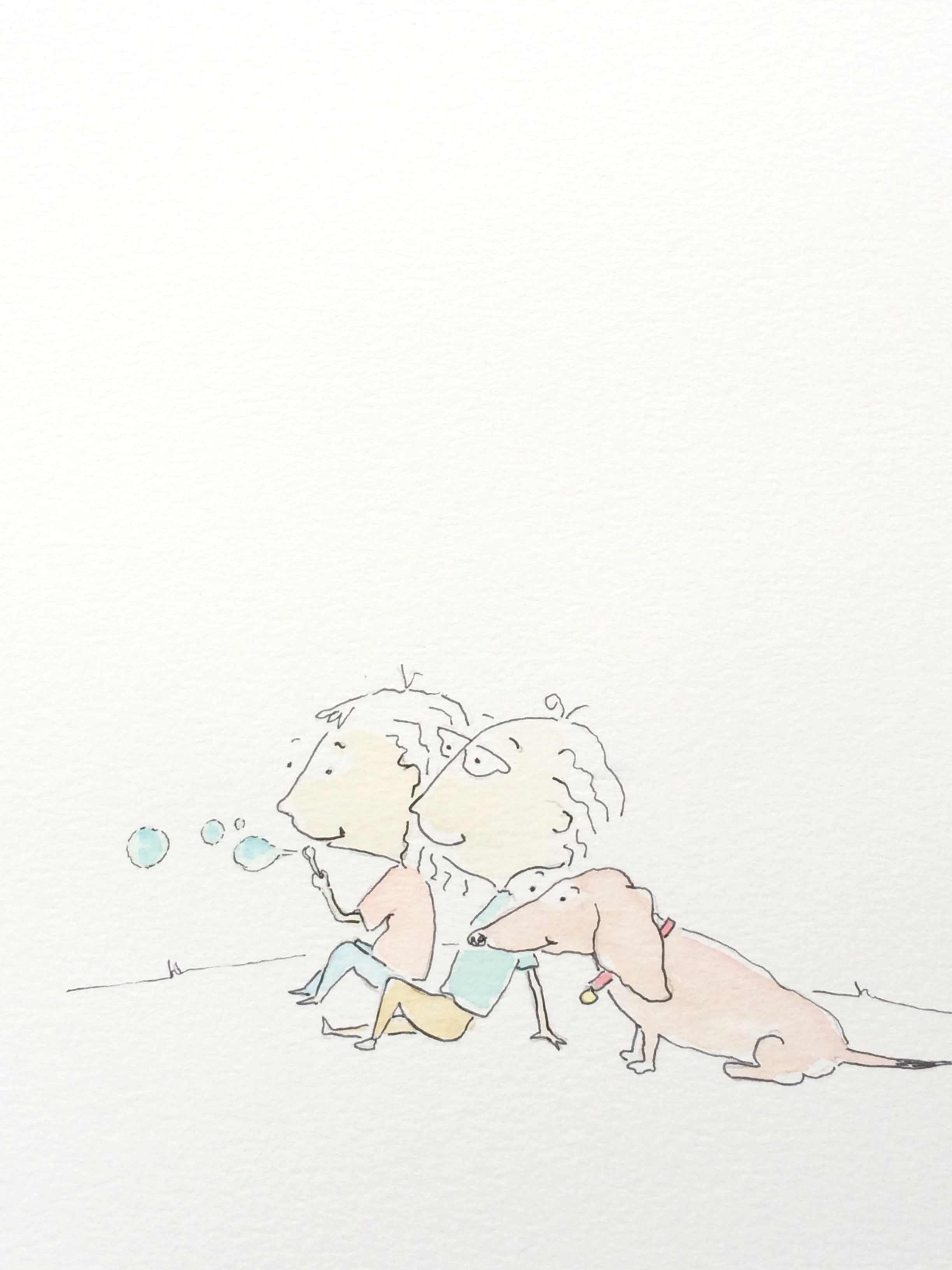
This afternoon I completed the 65th and final illustration in the Shayne Trilogy. Like the lake, when I cleaned my brush and put it aside, I was quiet inside. In the middle of March, after a call with Beaky, we decided there was nothing more important than illustrating and publishing the manuscripts that she’d written. And, there was no time to waste. We illustrated, designed, and published the first book of the series in record time. Beaky had her very first-ever book reading and author signing on April 11th. It was a triumph. That day I knew I that I would never do anything more meaningful or important in my life.
When Beaky passed away at the end of April, the second book was midway through the design phase. The illustrations were complete and Kerri was working furiously to publish it by May 1st. Beaky’s passing, of course, derailed all progress and I wondered if we would be capable of bringing all of her books to the finish. We were still for many weeks. We were breathless.
And then, last week, out of nowhere, a strong wind caught our sail and we were back at it with the same fervor as before. It was as if someone threw a switch; we did not get out of bed that day intending to resume the work, but by noon I was drawing the next batch of illustrations and Kerri was layering words over images. The second book, Shayne And The Yellow Dragon is, at this moment, a single click away from publication. Yesterday Kerri began laying out the final book in the trilogy, Shayne And The New Baby. At this pace, we are a few short weeks away from finishing what we started a lifetime ago in March.
the creative team
The illustrations are simple. They came easily – as do all labors of love. They are just what Beaky wanted. “You two did all the work!” Beaky protested as we wheeled her toward the over 70 people that gathered for her reading. I teased her that she must have forgotten that she wrote the books. “We make a good team, Beaky,” I said, and she smiled.
Posted on February 2, 2015 by davidrobinsoncreative
We’re already snowed in and the word is that the blizzard – the real blizzard – won’t start for another hour. Looking out the window Kerri said, “This storm is angry.” It is. This is not a gentle snowstorm. The flakes are not fluffy or big; they are enraged bees that sting. We watched cardinals, brilliant red amidst the flurry of white, hunker down, bobbing in branches of the pine tree. Tripper Dog-Dog-Dog slid off the deck into a drift and emerged with a beard of snow and a look of confusion. He ran outside, felt the bite of the wind, and almost knocked me over running back into the house.
We sat in the living room and watched the snow swirl and howl. We talked quietly until the light waned and we noticed that we were sitting in the dark. It was as if the ferocity outside the house required hushed tones inside. Life is like that – inner turmoil often looks like a quiet exterior just as violent storms require us to talk in gentle voices. Balance is always present although not always recognized.
Lately I’ve been meditating much on the word “trespass.” Once, I had an experience with the word “trespass” that was nothing short of mystical. It altered the course of my life. According to the prayer, one must trespass to be forgiven. Life is nothing if not full of trespasses and those who trespass against us. Crossing boundaries and holding boundaries are both learned skills that require a good deal of trespassing.
Forgiveness feels good. Whether you are the giver of the forgiveness or the receiver (or both, when, for instance, forgiving yourself), it just feels good. Those violent outer storms will always lead to inner peace if you follow them far enough. It is the natural order of things. All that is required is a recognition that stories change like people change; that stories change when people let go of old stories. Miracles happens when, in hushed tones, the story of a trespass is retold as a story of forgiveness.
Posted on November 15, 2014 by davidrobinsoncreative
‘The Wind’ by David Robinson
Someone threw a switch and it’s winter. There was no gentle drop in temperature, no ease into the cold. Monday was balmy. Tuesday was bitter. Today, the pond is frozen and I am watching the front edge of the snowy season dip its toes into the world. Last night we cut short our usual walk; we were shy a few layers of clothing and feeling was leaving all fingers and toes. We laughed for warmth and walked faster.
Life changes fast. We are reminded of that when tragedy strikes. When death comes to the too young or the fire consumes the neighbor’s house and all their treasures, we say, “Remember how precious this life is! Remember to be more grateful for what we have!”
Sometimes that seems to be the single salient point of tragedy: to make the rest of us stop, remember and appreciate what has real value. And, the moment of appreciation, like all moments, is passing. We get caught again in the dull pull of routine and stop seeing the miracle.
I just entered an art competition (note: isn’t it strange that “art” and “competition” can exist in the same sentence?); the theme is peace (note: isn’t it strange that the theme of a competition could be peace?). In my artist statement I wrote that peace is a practice, not an outcome. It is something people bring to the table, not something negotiated at the table. Conflict is at the core of every story and, therefore, is the engine of movement in every story. That is also true in every life story. We tell stories of enmity and we tell stories of amends and, if we are paying attention, we realize that both are a single story told from a different point of view. The story we tell, like peace, is something we bring to the table, not something we find there.
Flip the switch, stand in the others’ shoes, laugh for warmth and walk faster or simply slow down and feel the cold. Life not only changes fast, it passes fast, too. It seems impossible that I moved here a year ago. It seems like last week. Today, looking out the window as big snowflakes float to the ground, watching the Dog-Dog chase them with great delight and snap them out of the sky, I made a conscious decision to see the miracle and forgo the necessity of a thump to wake me from dullness. This winter is like no other.


 Meander. A gentle word, that brings to mind a slow stroll through a sunny day with no place in particular to be. It is a word without to-do lists and achievements.
















 The Direction of Intention