Knead And Listen [on Two Artists Tuesday]

rustic bread copy

I am now among the legion of people that turned to baking bread during the pandemic-stay-at-home era. This loaf is gluten free, made with rice flour, since Kerri is allergic to gluten.

In truth, I’ve wanted to bake bread since I knew Brad the baker in California. He was a genuine hippie, a believer in peace and simple living. “Bread is a living thing,” he once said as I watched in fascination his kneading of the dough. You can tell a true master craftsman at work by watching their hands. They feel something in the dough or the wood that the rest of us do not.

My loaf was not made by a master. Not even by an apprentice.

Bill sent a photo of his first loaf and I asked for the recipe. It came as screen shots and I scribbled them into a recipe on notebook paper. Easy steps to follow but I knew from watching Brad that I would not find in my recipe any easy guidance on how to feel the life in the dough. That would come with time. Maybe. If I was lucky and diligent and practiced listening through my hands.

I’m not surprised people are turning to bread during this time of pandemic uncertainty. It is essential. The making of bread, the cultivation of wheat, made civilization, as we know it, possible. It is, therefore, a central symbol in many belief systems. Separate the chaff from the wheat. A time for harvest. This is my body. Eat.

Brad told me that the dough kneads you as much as you knead the dough. It’s a simple relationship between living things and requires complete focus. Mutual respect. Attention must be proffered.

Perhaps that is why we turn to bread in times like these. Simple relationships of attention and mutual respect are increasingly rare. Bread reminds us of what is possible, what is healthy. It reminds us of the patience that is required if we are to find our way to harvest. It reminds us of the necessity of knowing what is chaff and what is wheat, or remembering that there is a direct relationship between what is planted and what is grown.


read Kerri’s blog post about BREAD
 

ely website box copy


Blink [on Merely A Thought Monday]

it flies by as it drags on copy

Yesterday was Father’s Day. 20 showed us a photo. His children when they were kids. “Where does the time go?” he asked. Thirty years. “That was the blink of an eye.”

We put together a video collage for my dad using images dating from the time that Kerri first met him. Seven years. “Doesn’t that seem like yesterday?” We had a hard time remembering the order of events; what visit came first? We looked for clues. The length of my hair. The color of stripe on my dad’s shirt.

In one of the photo sequences we are in Iowa, the little town where my dad grew up. In the photos he is showing us the house his grandfather built, the house where his father grew up. It is tiny. Today, it is someone’s storage shed. To my dad, it is holy ground, the place where as a child he ran free. This was his last touch. His final visit.

We  had a phone conversation with my sister. Her pandemic experience is vastly different from ours. To her, it is a minor inconvenience. “People just can’t stay in forever!” she exclaimed. “I’m worried more about the suicides than this virus.” Time, 100 days, to her community, is an eternity. “People gotta live!” she says.

Eternity. “What day is it?’ I ask. Kerri looks off into space. Weird calculus. “Thursday, I think.” she says from some far off place.

Locating ourselves is not so easy in these times. The landmarks are covered over. The geography is changed.

“What is it you plan to do with your one wild and precious life?” Mary Oliver asks.

What did you do with your one precious life? With this day, this time, pandemic or not?

We look at each other and laugh. “I’m getting old!” We cringe. Look at me!” We wear our age and it surprises us.

“Time,” Kerri sighs, looking in the mirror. “It is so strange.”


read Kerri’s blog post about TIME


onthedeckstepsWI website box copy


Read Marc’s Notes [on DR Thursday]

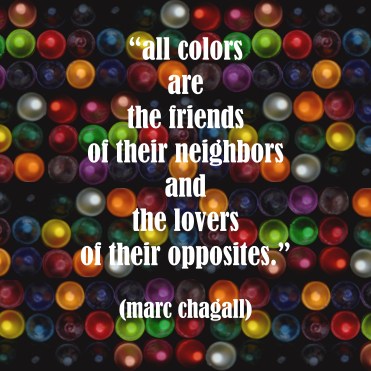
marc chagall quote copy

One of my most prized possessions is a handmade notebook, stitched together by a young DeMarcus Brown, mentor of my mentor, in a time before corner drugstores and readily available school supplies. It is filled with the fading pencil notes Marc made when he was a student learning about color, probably in 1918 or 1919. It occurred to me as I wrote that guesstimate of time that he was scribbling notes about color during a pandemic.

It reads like an enthusiastic discovery of miracles. On page one the word COLOR is triple underlined. “Light is a form of radiant energy transmitted by wave movement through SPACE and is perceived VISUALLY. Opposite is DARKNESS. Qualities of Light: 1) Physically – Life giving. 2) Mentally – Intelligence. 3) Spiritually – Divine Wisdom.”

From Marc, on page one, on day one of his study of artistry, I learned that color is life giving, intelligent, and a source of divine wisdom.

“Objects reveal light.  All forms and substances REFLECT or ABSORB LIGHT. THINK OF COLOR AS LIGHT REFLECTED.”

There are other words and phrases: vibration, proportion, visual sensation, light is individualized by its contact with substances into color. COLOR is Light PROPORTION.

All of this awe is written in block letters on the first two pages. His enthusiasm is palpable. As you move through Marc’s notebook of discoveries, his writing shifts to cursive, he matures in color and intention. His passion intensifies. He is beginning to see.

Toward the end of his notebook, in his growing sophistication, you’ll read these phrases:  “Train our eyes to DEGREES of Neutrality. Establish relationships of Intensity. Hue. Value”…and a reminder “vibrating surface!”

The stitching that holds the notebook together is impeccable. Beautiful. Careful. Considered. It took him time to make his notebook. It mattered.

I can’t help my metaphor mind from finding a universe of guidance in Marc’s notebook for a nation that perpetually struggles with color – or, ironically, the negation of color. The fear of color relations. A commitment to a narrative of dominance, this or that but never both. A palette of loss. We’ve limited our color study to a polarity and eliminated the infinite shades of possibility in the picture we might paint. Insistent chiaroscuro.

What happens when the door of possibility opens? When change, that big blank canvas, sits on the easel?

In the middle of his 90’s, Marc gave me his paint brushes, his paint box. “Use them!” he said, “Don’t save them for remembrance.” He knew I was sentimental. “Reverence is off limits. These are not meant to collect dust on a shelf.” He laughed, “Use the damn things. Don’t be safe!”

Color. Vibration. Relationship. Proportion. Life Giving. Intelligent. Divinely Wise. Walk into the unknown. Learn to see.


read Kerri’s blog post about COLOR


their palettes website box copy


Look Out [on Two Artists Tuesday]

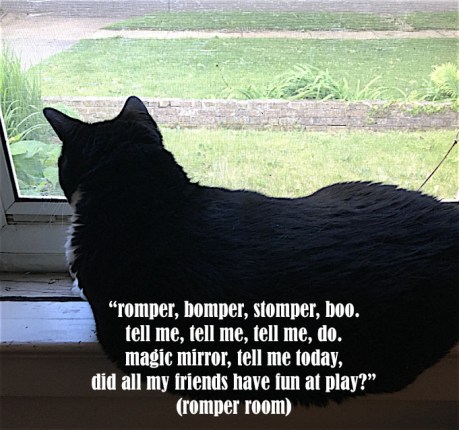
bcat in the window romper room copy

I was one of those teachers who encouraged my students to stare out of the window. Visiting administrators occasionally admonished me for allowing my students to “daydream.” Imagination, I would explain, requires much more expanse than a classroom can provide. Looking out the window let the imagination-horses run free.  At graduation, I would remind the administrator, they would almost certainly endorse the graduates to follow their dreams so facilitating the pursuit of dreaming was, perhaps, the most useful skill they may ever acquire. Besides, keeping noses perpetually focused on the grindstone can be a great dream killer.

Mike wrote that Shakespeare penned King Lear while in quarantine for the Black Plague. “Any takers?” he challenged. What do you do when you can’t really go out and play? My bet is that good William stared out of his window between ink dips and parchment scratching. I’m finding, as we move deeper into our home stay, that I am repelled by electronic things that fill my time. Things that pull my focus down and in. I find that I want to stare out of the window. I want to go out and walk.

There are plays I want to write. There are paintings I want to paint. There are the necessities of life banging at my door (where will the next work come from?) Uncertainty surrounds us. I know there is no point in fretting; fretting and worry are inverse forms of imagination. Hornets buzzing inside the head because they haven’t enough space to become horses and run free. The best thing to do when your head is full of hornets? Find a good window and dream.


read Kerri’s blog post about THE MAGIC MIRROR


rhode island website box copy


Expect The Magic [on Two Artists Tuesday]

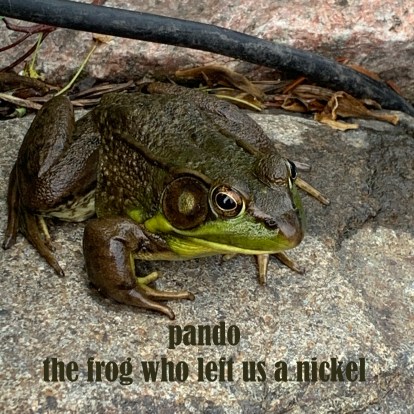
pando copyIt reads like a quirky children’s book. One day the frog appeared in our little pond. It was fully grown. This was no pollywog-becoming-a-frog, it did not originate in our pond. It sprang forth fully frogged.
Kerri named it Pando for the year of the pandemic. I thought it sounded like a Commedia character but it seemed to like its name so it stuck. Pando feasted on the local cuisine. It sat still and let Kerri pet it on the head. It had a deep basso voice.

Truth be told, Pando was not our first frog visitation. Most years since we dug our little pond, fully mature frogs one day appear. Once we had twins. Where do they come from? We speculate endlessly, making up stories of adventure or wrong frog turns that somehow lead to our backyard. Apparently, Mr Toad’s wild ride passes through our pond. Mostly, they’ve become for us a sign of hope, of good things coming or an affirmation of good things already here.

Most of our frog visitors check in for a season. Pando was different. A few days after he appeared, Kerri went out to check on him and he was gone. Vanished. But, on the stone path that leads to the pond, she found a copper Jefferson nickel.

“Look what Pando left us,” she said, showing me the nickel, “He isn’t there anymore.”

Clearly it must be a talisman. It must have magic powers. What else could it be? A frog with a deep bass voice mysteriously appears. The frog just as mysteriously disappears but leaves behind a strange coin that betrays its inner alloy. It must be magic! Or, I suppose it could just be the story we want to tell.

It is, after all, what I love about us: we like to tell stories that include surprises, the impossible, and magical happenings. Life is better like that, when we allow ourselves to entertain the full spectrum of vibrant color. In any case, we can’t wait to discover what the frog magic brings.


read Kerri’s blog post about PANDO


sunsetonisland website box copy


Listen To The Hatter [on Flawed Wednesday]

keep yo mouth shut copy

“I don’t think…”

“Then you shouldn’t talk!” said the Hatter

~ Lewis Carroll, Alice in Wonderland

The entire world is down the rabbit hole though, we citizens of the U.S.A., have fallen into a deeper darker hole. We’ve found a way-out-wacky cast of characters at the helm that challenge in strangeness the inhabitants of Wonderland. Truth, as it turns out, is much stranger than fiction.

Sometimes out of the mouth of madness comes a whisper of truth. If you do not first think, you should probably not talk. The Hatter’s advice is sage.

For kicks, I asked the mystic Google this question: What did Alice learn in Wonderland? It’s been a few years since I held her hand and went down the rabbit hole.

Alice learned that bullies are really two-dimensional and ultimately vapid. The pandemic is exposing our very own Queen of Hearts, a man who, like the Queen, gets his excitement from belittling others. Diminishing others is really the only card in a bully’s  deck. Here we are.

Alice learned that a bully is powerless without the support of minions. So, to garner support, a healthy cadre of minions must also agree to be flat and loud but remain thought-free. As it turns out, minions are powerless without a bully. It’s a loop. Well. Here we are.

The Caterpillar asks Alice, “Who are you?” She has no answer. She finds herself in a wholly strange world. The rules of life as she understands them no longer apply.  It is madness everywhere she looks. Yup. Here we are.

Her experiences with the madness expose who she is. That is my favorite of Alice’s lessons. Our madness is also exposing many things about us. It’s revealed the bully. It has called forward the courageous. It has uncovered the minions. It lays bare the deep cracks in our foundation. And, perhaps, to take some advice from the Hatter, since the bully and his crew has undermined science, morality, ethic, facts, jurisprudence, and is taking partisan bites from the constitution, it might be time for us to start thinking.

“Hold your tongue!” said the Queen, turning purple.

“I won’t,” said Alice.


read Kerri’s blog post about Mouth Shut


donnieandmarie uke website box copy


PigeonPier copy

pigeon pier


Consider Madness [on Not So Flawed Wednesday]

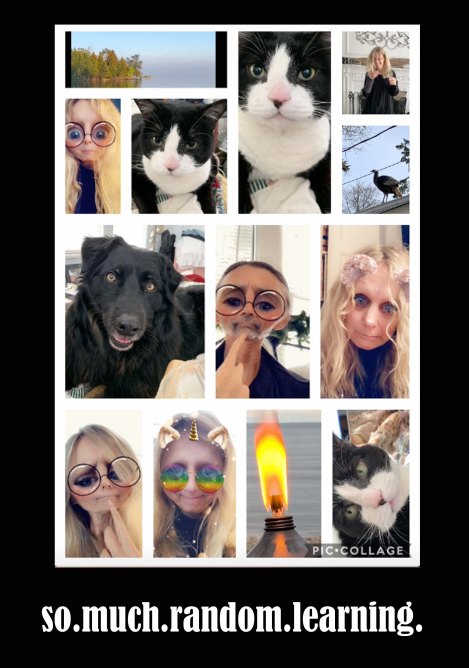
so much random learning copy

Our scene opens in a global pandemic. A camera collage reveals people, young and old, furiously tapping away at keyboards; through the miracle and misery of technology, people are working from home.

The shot settles on a couple – definitely NOT technology natives – working hard not only to do their work but simultaneously learning the technology necessary to do their work. They are recording audio files, making slideshows, movies, translating files from one format to another format, posting and pulling down the work they just completed because this platform does not accept the same type of file as THAT platform. They nuance, tweak, twist, crash, rinse and repeat. Their learning curve requires ropes, crampons, and pitons (it is a steep climb).

They are also creating language combinations that will certainly make this film unsuitable for small children.

Their technology is old by modern standards. Ancient, really. They are children of depression era parents so they make things last rather than regularly trade up or buy new. The proof is in their kitchen: their stove is almost as old as they are – three of the four burners are still working – so they see no reason to buy something new. Imagine this mindset meeting the computer age! The combined age of their laptops is greater than the age of a graduating college senior. That is to say, although they do not yet know it, they are becoming masters of making old programs work with new software. Electronic-duct-tape-solutions.

Occasionally a madness overtakes them. Their test projects border on the insane, the utterly silly. They cackle. They pop the cork a few minutes earlier than might be advisable. They consider posting their mad-mad test project instead of the sober iteration that they’d intended. They leap from the sanity ledge and plummet into the ridiculous, pulling the rip cord at the last possible moment, slowing their fall. They post the sober work and heave a sigh of relief. Bullet dodged! The absurd remains a secret.

What would the world think if they actually saw the rough draft? The test project? We slowly fade to black as the couple closes their laptops, clinks their wine glasses, refusing to acknowledge the madness that nearly overtook them. They casually walk to their ancient and simplistic stove, asking, “So what shall we make for dinner?”

[music swells. roll credits]

read Kerri’s blog post about RANDOM LEARNING


snapchat website box copy


Why Ask Why [on Two Artists Tuesday]

even nature is asking why copy

A rare warm day, walking the Des Plains River trail. I should have been startled when Kerri suddenly jumped off the trail but I’ve grown accustomed to her spring-loaded-photo-impulsive-gambols. I actually love the passion of her image capturing so I’ve learned not to be surprised when she leaps and snaps. There is no danger. There is a photo opp.

“SEE!” she exclaimed, showing me the photo. “Even nature is asking ‘Why?'”

My first thought: Which “why” is nature asking? Why a pandemic?  Why so much division?

Simon Sinek has made a career of teaching people to ask “Why?” before asking “How?” It makes sense: you should probably know why you want to scale the mountain before asking, “How will I do it?” People need an answer to “why.” And, because we are human, the answer to “why” need not be reasonable or rational. “Because it is there,” is an acceptable answer to “why?” I want to. I need to know. I want to feel. I need to see what is there.

“How?” is a question that can only be answered after the fact. “How” is known through reflection. There is the plan. There is the reality that comes when the plan meets the unknown forces. The plan changes. The only honest answer to “how” is: do what makes sense and we’ll talk about it later.

Amidst a pandemic, it is only human to throw up our arms to the sky and demand an answer to our “Why?”  To borrow a lyric from Nick Cave & The Bad Seeds: “I don’t believe in an interventionist god. But I know, darling,  that you do.” In other words, viruses are intention-free. Sometimes, even though we want an explanation, there is no “why.”

There is, however, always a plan, there is a path to “How?”  How do we protect ourselves? How do we deal with it? In fact, there are layers to the question “how?” The first layer of ‘how’ is simple: social distance, wear a mask, wash your hands. Looking back from this vantage point, we know it is the best we can do short of a vaccine. Simple science.

The second layer of the how-cake is more complex and, like all ‘how’ questions, we will only be able to talk about at some point down the broken road. Maybe a vaccine. Maybe herd immunity. Maybe, maybe, maybe. Maybe we will be foolish, like the Philadelphia parade during the Spanish flu and escalate the death toll to the point that we wake up and listen to the first ‘how?’

The virus is a force like a tornado is a force. Why did it take my neighbor’s house and not mine? Why did the forest fire rage through this neighborhood and not that neighborhood?

Here’s the only “why” question we really need to consider: in the face of this virus-forest-fire, why did we rush out to light matches (pack into bars and onto beaches), parade around screaming about our individual rights instead of metaphorically rushing into the fire to save our neighbors in the only way we knew how (social distance, masks) –  as we would have done in an inferno?

I don’t believe in an interventionist god. But I do believe in intentional human beings (conscious and otherwise).

Nature need not ask “why?” We do. It’s a sure bet that our answer will make little or no sense at all.


read Kerri’s blog post about WHY


? website box copy


See The Whole [on Not So Flawed Wednesday]

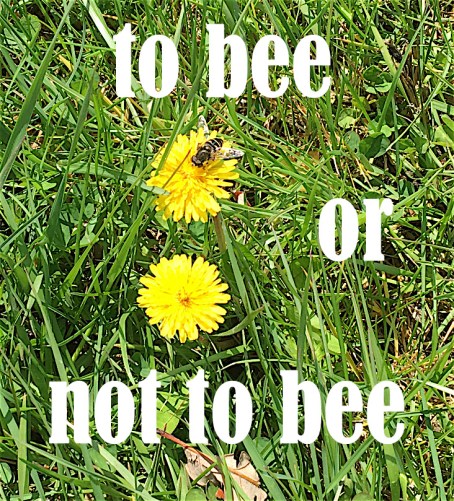
to bee or not to bee copy

The joke from my master’s program was that you couldn’t graduate until you could explain in a sentence what the degree meant. Whole Systems Design with an emphasis on Cultural Mythology and Transformational Art. I designed an individual track so I named the emphasis myself. Just don’t ask me what it means. I’ll kill the party going on and on and on. You’ll never get to the snack table. Really. Don’t ask.

Whole systems is the study of how everything – everything – is interrelated. It is only a trick of our brains and the limitations of language that anything can be compartmentalized and understood as separate. Everything interacts as a single system. Roger used to say, “When people hurt their toe they say that it is only their toe that is injured. NO! It’s their whole body that is injured.” Walking funny with a broken toe always gets you in the back and then becomes a pain in the neck. And then you become a whiny pain in the neck and create headaches for everyone in the family. The family complains to their friends and the broken toe spreads discord throughout the land.

Roger’s statement is a whole system’s statement. It highlights the illusion language places on our interrelated world. Language necessarily reduces. It provides the funny fantasy that we are separate, individuals, having little or no impact on the world with our individual actions. If you want an example of the fantasy in full force you need look no further than doubters of humanity’s impact on climate.  All you need do is breathe and you are interacting with the environment. 7.6 billion people driving 1.4 billion cars, not to mention the over 100,000 planes in the air each day, the deforestation of the Amazon…and it is gob-smacking that we require science to state what should be obvious with every breath we take.

I found that the real challenge of defining whole systems design to people at dinner parties was not the reality of inter-relatedness. The notion evokes the inner Mother Teresa in everyone at the table. We all matter and can have an impact. No, the real challenge was that the concept places us – humans – within the system and not sitting atop the creation pyramid. It makes us participants and not landlords. It makes us responsible to the system.  We matter. We have impact.

There is no greater teacher of interrelation than this pandemic. There can be no denying that our actions matter, we are intimately connected, that the smallest choice impacts the whole. Stay at home. Wear a mask. All you need do is breathe and you are interacting with the rest of the world. Literally. Everyday is a master class in interconnection. The polluted air is clearing, the animals are reveling in our quarantine.

And, we’re experiencing the magic language-compartmentalization-game in full force: words like “economy” are being placed against words like “health” as if we need to choose between one and the other. Who lives. Who dies. We’re hearing a ridiculous (and dangerous) framing of reality: the cure can’t be worse than the disease. There is no separation. The system is whole, dynamic and supports the actions and choices of all members in the system.

The toe is pandemic-broken. The whole body is hurting.


read Kerri’s blog post about TO BEE


heart rock website box copy


Yoga-Waiting and Knowing sharpened copy 2

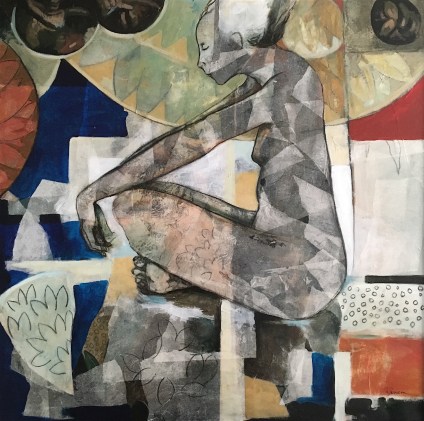
knowing and waiting, mixed media, 48 x 48IN

Find The Deeper Impulse [on Two Artists Tuesday]

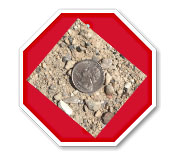
stop sign quarter copy

See a penny, pick it up. All that day you’ll have good luck. 

I saw a penny in the parking lot of the UPS store and, wanting to have a full day of good luck, I swooped down and picked it up. Kerri, horrified, said, “What are you thinking? Put that down!” I was marched back to the truck and slathered myself with hand sanitizer.

My penny swoop debacle in the parking lot of the UPS store is how I mark the beginning of the pandemic. It was the first time that the danger of a simple action, touching what someone else had touched, penetrated. The penny dropped [sorry – I couldn’t help myself]. It was early in this experience called pandemic, before masks, before social distancing. Wash your hands. Don’t touch your face. And, above all, leave the good luck penny on the pavement.

And it seems like years since I touched that penny.

My penny swoop was an impulse. Kerri asked me what I was thinking but I wasn’t thinking. I was riding on the instinct train. The child-rhyme ignited my luck desire and I went in for the grab. And, isn’t that the real hardship of this pandemic? Quashing the impulse to hug your friends, to walk toward your neighbor to say hello, to let the kids play together, to stop in the store and chat with acquaintances? 20 stands outside  his mother’s assisted living apartment; she stands on the balcony and they shout to each other. Each day I watch Kerri override the deep-mother-instinct to run and find her children, all-grown-up-and-moved-away.

It’s unnatural, this veto of instinct. And, it is what makes us human. It is natural to run from danger and yet doctors and nurses everyday walk into hospitals during this pandemic. They walk into exposure. First responders, police and fire people, everyday put the public safety above their own. It is what lifts us into our humanity; placing the needs of others above our own. It is what we celebrate, what we admire. What we claim as our highest ideal. People giving of themselves for the benefit of others.

We call that sacrifice. We call it service. We call it sacred. We  call it grace and generosity. We go to houses of worship and proclaim it. We make movies about it. Frodo must destroy the ring of power for the benefit of all. Otherwise, he twists in his selfish personal power lust and becomes like Gollum. This tale is universal for a reason.

And, I suspect that I am wrong. The survival instinct has a deeper nature. Soldiers talk about it just as first responders do: in the moment of real danger there is not a question about throwing themselves on top of their companion, sacrificing self to save the other. It, too, is an impulse. A purer survival instinct. It is not an override.  It is, when all else is stripped away, what we are.

“Compassion is the basis of morality.” ~ Arthur Schopenhauer


read Kerri’s blog post about PICKING UP SPARE CHANGE


neighborhood cheers website box copy


ComfortNow Framed copy