Everyone Has Their Heaven

TODAY’S FEATURED PRINT FOR HUMANS

everyone has their heaven

FOR TODAY’S FEATURED PRINT FOR HUMANS, GO HERE.

Do What Is Most Natural

IMG_0817The snows have come. The temperatures are grindingly low. Sitting at my desk, staring out the window at the world’s hibernation, I had a few thoughts about transformation. Actually, just before coming to the desk I flipped open the Bibles of Mankind for my random-thought-of-the-day. Today I landed on the Tao and specifically, this line: “By a transformation they live. By another transformation they die.”

In our births and our deaths we are all experts at transformation. In fact, in our progression through the many bodies we will in habit, the many phases we will navigate during the span of our singular life, we need not think about transformation or try to achieve it. Transformation is what we do. It happens. Track the progression of any life from infant to old age and you will witness a remarkable transformation.

I’ve just completed the first full cycle of seasons in my new home. Because it is all new to me, I’ve had the eyes to see the nuances, the profound changes in the trees, the lake, the rhythms of life including the migrations of geese. Nothing is normal (yet) so everything is special and alive. The cycle of the seasons, like the continual movement through the long body of life, is an ever-present transformation. The seasons do not try to transform; they are transformation.

People think they need to intend transformation. We seem to think we need to work at it to achieve it and somehow do not transform if we don’t marshal the process. Consciousness, like the body and the cycles of the seasons, transforms whether we intend it our not. That is the nature of consciousness. That is the natural movement of awareness.

title_pageGo here to buy hard copies (and Kindle) of my latest book: The Seer: The Mind of the Entrepreneur, Artist, Visionary, Innovator, Seeker, Learner, Leader, Creator,…You.

'Dancing In The Front Yard' by David Robinson

‘Dancing In The Front Yard’ by David Robinson

Go here to get posters and prints of my paintings.

Learn To Swim

from my children's book on how to play, PLAY 2 PLAY

from my children’s book on how to play, PLAY 2 PLAY

Hoodie tells me that he is sarcastic by nature but I don’t believe it. I’ve spent a lot of time in nature and I find no sarcasm there. I also understand much about human nature and know that sarcasm is not a native plant; it is invasive. It is introduced into fertile, unknowing soil.

Sarcasm is the tool of the drowning man. It is an act of desperation to push others under the water in order to elevate the self. I’ve walked many paths and worked with many powerful and not-so-powerful people. There is a rule on the stage that applies: the king never needs to act powerful because the king is powerful. Those who need to demonstrate power have none. As Quinn used to tell me, if someone has to tell you that they’re important, they really aren’t. Sarcasm is a form of importance-telling. Powerful people create power with others. Power is a creative act. It is a communal act. They have no need to diminish or reduce others because they recognize that reduction also reduces. People who must reduce others are not powerful; they’ve confused control with power. They want to be king. They want to be seen as king. But, they do not believe they are king. Sarcasm is a form of perception control.

No one is by nature sarcastic. Sarcasm is learned in batting cages, at dinner tables, and on the field of play. Sarcasm is a mask. It is a place to hide smallness. It is passed down generationally. Masks both conceal and reveal and while it might feel good to pull others under the waves, it also reveals a non-swimmer. It is habit. It is learned.

Hoodie is not by nature sarcastic. Hoodie is a swimmer. He has the stuff of kings. He also tells me that his nature is to give comfort, to help others. He will one day realize, after he transcends his habit of drowning, that his nature to lift others is the center of his power place. Sarcasm separates him, reduces him, as do all forms of self-diminishment/control. Sarcasm is a lonely planet. Power is always a movement toward others. It is generative, as is all of nature.

title_pageGo here to buy hard copies (and Kindle) of my latest book: The Seer: The Mind of the Entrepreneur, Artist, Visionary, Innovator, Seeker, Learner, Leader, Creator,…You.

Go here to support my kickstarter campaign for The Lost BoyDSC_1196 copy


Ask Them To Be Kind

A black cloud moving in.

A black cloud moving in.

While driving across South Dakota, the darkest cloud I’ve ever seen rolled across the sky and consumed the light. The cloud was dense and black. It was heavy, its belly hung over the car and seemed to press us to the earth. It seemed more than cloud. It was ominous, a presence.

When we started the day we’d intended to drive through the Badlands but a prodigious rain had slowed our progress. We saw the rains marching toward us across the open land. It was both beautiful and daunting and hit us with a wave of authority. This storm meant business. We crawled through Wyoming with other back road drivers, watching the barely visible white lines to keep on the road. Motorcyclists pulled off the road and stood next to their bikes; there was no shelter to be found.

Although we lost a few hours to the storm we thought we might still make it through the Badlands before nightfall. And then the black cloud appeared and ate the last light of the day. Once many years ago I did a night dive through the wreck of a sunken ship. In the dark of night, deep in the ocean, while swimming through the bowels of the ship, it’s decks between me and the surface, I felt as if I couldn’t breathe. This blackest of clouds enveloped us like the ocean at night and I felt that same sense of pressing suffocation.

The gods of nature are not to be ignored. Once, I sat with a Balinese man who told me that, according to their belief, it was with the dark forces of nature that people need alliance. There is no hell in their paradigm so dark and evil are not bedfellows. There are forces: creation and destruction in an eternal cycle of rejuvenation. Their rituals are about making peace with the black clouds, the gods of lightning and rain. “The forces of light are already with us,” he said. “We ask the dark forces to be kind.”

Looking through the windshield at the ominous pressing cloud I whispered, “Be kind.” It was. It let us go. We heeded the warnings and left the Badlands for another day. Later that night, sipping wine from plastic hotel cups, safe in our room, we sighed and laughed at how utterly small we felt on the open plain amidst the power of the storms. With that smallness came the gift of alertness. We were fully awake, alive with moment, stripped of the illusion that humans have dominion over anything. We savored our moment, temporary, passing, and perfect.

title_pageGo here for my latest book, The Seer.

Or here for all digital downloads of The Seer.


And, here you will find fine art prints of my paintings

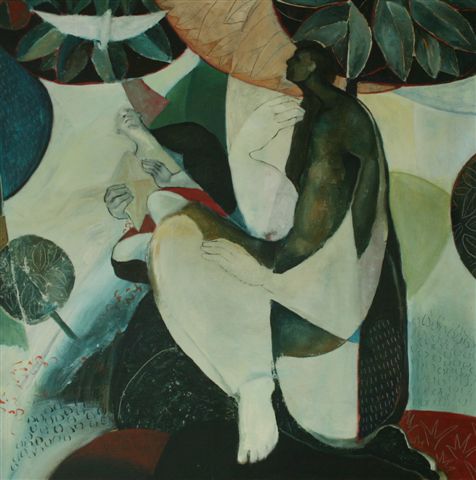
Canopy by David Robinson

Canopy by David Robinson

Catch A Glimpse

741. Join me in inspiring truly powerful people. Each day I will add a new thought, story or idea to support your quest and mine.

Deep in the alcove of the side entry to an old building lurked a man wearing a faux bear hat and a too big worn out raincoat. He was doing a slow dance, in invocation and I stopped to watch him. Our eyes met for a moment, just long enough for me to know that he did not mind my witness. His slow pushing and pulling of the air seemed out of joint with the pace of commuters racing to get somewhere. This man seemed to come from another era. He was not of the city; his dance was a nature dance. After a while I left him dancing in his alcove.

I passed a family hunkered down in a doorway. They were tourists. They were dressed for Florida and seemed surprised that it was cold in Seattle. They were confused by the rain; their map of the city was dissolving into mush. “What do you want to do now?” the father asked his kids, trying to buoy their wet spirits. There was no reply. They wanted to be warm. “How about finding that glass blowing place?” he asked.

As I crossed Pioneer Square I saw, laying near the memorial to firefighters, an empty jacket, pants, socks and shoes. It was as if someone had lain on the ground and disappeared, leaving their clothes behind. I wondered if this was the work of faux bear hat man. No one else seemed to notice so I walked on.

A man stepped in front of me and asked if I was up to doing a good deed today. Then, he asked me for a quarter. I imagined he must be a genius marketing executive gone destitute. As it turned out I was up for a good deed this day and thought his ask was too low so I gave him all of the change in my pocket. I had a lot of change in my pocket. He looked at me like I was a slot machine when I handed him a fist full of coins. He smiled when I said, “Great pitch!”

Worlds collide. I once saw Stephen Hawking talk about multiple universes, like bubbles that sometimes brush against each other. In those moments of bubbles touching, we catch a glimpse into the reality of the other universe. Today it seems that we are, each of us, a bubble universe. How else can I explain these strange and wondrous glimpses?

See The Elegance

659. Join me in inspiring truly powerful people. Each day I will add a new thought, story or idea to support your quest and mine.

Bryan and I talked tonight about the elegance of design. He told me that many years ago he became interested in the Golden Mean, which led him to research the Fibonacci sequence, which led to an interest in eclipses. He became fascinated by the simple elegance and paradox of astronomer’s capacity to precisely determine when an eclipse would happen and the impossibility (due to weather) of predicting if we would be able to see it. The Golden Mean and the Fibonacci sequence are simple equations that, when replicated, maintain the integrity of design throughout very complex structures and calculations. They are fractals. Much of classic architecture is based solely on the Golden Mean. Much of what you will learn in contemporary art school about composition is based on the Golden Mean.

Our physical bodies are complex structures based on a simple cell design. We are at the same time miracles of complexity and simplicity; more space than solid, more water than mineral, reducible to a small pile of dust and yet expansive beyond all imagining. We are elegant in our design, as nature only designs elegant forms from the same simple notion and very simple (yet complex) building blocks.

Our thoughts run according to the same principle. I once read a statistic that showed that we think mostly the same thoughts each day, day after day (don’t ask me how you measure such a thing….). We build our thought on a few replicable principles and then go holographic with them. A few simple assumptions will lock you in prison or set you free. Check out the pattern of the story you tell yourself each day. Are you locking yourself in or opening the cage? I realized years ago that the epicenter of my coaching work – or any other form my whacky work takes – was really about story change. I often say this to groups: change your story and you will change your world. They mostly respond, “It can’t be that easy!” or “Pie in the sky!” I didn’t say it would be easy – we are after all deeply invested in our stories; we are great fighters for our limitations. The wrong assumption is that it need be complex. We are elegant in our design, even down to our repetitive thoughts. Change the simplicity and you will some day be capable of manifesting an entirely new soaring cathedral of thought.

Ride The Goat

638. Join me in inspiring truly powerful people. Each day I will add a new thought, story or idea to support your quest and mine.

Judy was typing a quick email. She wanted to tell me which ferry she was taking into Seattle the next morning to meet me. Instead of typing “boat” she typed “goat.” Catching her mistake she deleted “goat” and tried again to type “boat” but instead she missed again and typed “boar.” She was so amused by her swimming menagerie that she told me of her mis-types so I could share in the fun. We decided she would take the early goat over and return on the late afternoon boar. Entire worlds change with alteration of a single letter.

Meaning making is a subtle yet powerful business.

Quinn was curious about perception and personality; he was a great studier of humankind. No experiment was too silly for him to try. Once, many years ago, he read an article in a magazine about personality traits and how character reveals itself in small children. It was a nature or nurture question. He had two daughters who in many ways were as different as night and day and decided he needed to create his own test and his daughters where the perfect subjects. At the time, Quinn was a banker so he wore nice suits and carried a briefcase. One evening when his oldest daughter was 5 years old and playing in the swimming pool, Quinn came home from work, tipped his hat to his daughter and walked into the deep end of the pool. His daughter laughed and laughed. Daddy went swimming with his clothes on. 4 years later, when his younger daughter was 5 years old, he repeated the experiment. This daughter cried and cried; something was dreadfully wrong with daddy.

I met his daughters when they were adults. The oldest is filled with laughter; the youngest feels deeply the world’s pain. Both smile and recount with great love the day their father came home and walked fully clothed into the pool. Both are dedicated to helping create a better world – they just do it in two entirely different ways.

Quinn served as my personal Viktor Frankel: he taught me that meaning is something we make, not something that we find. He also demonstrated, again and again, that some of us will cross the Sound riding a goat, others will take the boar, and still others will make the crossing on a boat. Some will see mischief and whimsy, some will see suffering and misery, and some will never see the magic beyond the ordinary filters that they’ve chosen to wear. And, that has nothing to do with the world and despite our natural orientation we have great choice in how to see it.
He also taught me that life is much more fun if you sacrifice the suit to the moment rather than try and protect it. He understood that we too often sacrifice the essential to maintain the superficial; it takes a wily trickster to alter a single letter and open our eyes to the amazing possibilities available in the small moments of life.

Sense The Season

537. Join me in inspiring truly powerful people. Each day I will add a new thought, story or idea to support your quest and mine.

A few days ago on my morning walk I sensed a hint of autumn in the air. There was the slightest breeze, cooler than the day before, and the subtle smell of leaves turning. I savored the moment as I do every year. I look forward with great relish to the day each year that I catch on the breeze the first hint of fall.

My grandfather lived his entire life in the same small area in Iowa. One day, as a boy, I was visiting, and we went to the park on a beautiful hot sunny day. He was looking for treasure with his metal detector and I followed with an old coffee can to hold the bounty and a screwdriver to poke into the dirt when treasure was detected. Suddenly he stopped, looked into the sky, closed his eyes – and “sensed” a change in the air. After a moment he said, “We better go home, it’s going to storm soon.” I was baffled. I could not sense anything. There wasn’t a cloud in the sky yet an hour later an intense storm blew through dumping buckets of rain. He had senses available to him that I did not; he had a specific relationship with a place and felt the rhythms and changes in his body. He was connected.

Brian McDonald opens his book, Invisible Ink, with this story: “An anthropologist was living among tribal people with little to no contact with the modern world. Wanting to share the marvels of technology with these isolated folks, the anthropologist took a photo of the chief and his wives. When the picture was processed and shown to the chief he was unable to recognize the blotches of black, white, and gray as an image of himself. He had never learned to translate two-dimensional images into recognizable three-dimensional shapes. That same chief, however, could look at a patch of grass and say what kind of animal had traversed it and how long ago with no more difficulty than you or I would have recognized ourselves in a photographic image.”

I look forward to that first hint of fall because I know it is a remnant of connection; it calls forward something in me, something deep and ancient. It is satisfying and evokes a kind of quiet affirmation that is rare in my urban indoor life. Catherine once told me that, “Nature yearns for us,” and I know that it is true. Often, when I am coaching or working with people and their creative blocks, deeply invested in their abstractions, I know that all they need do is go outside, recognize and reclaim their natural rhythm, and their capacity to sense the changes in the air. Just as nature yearns for us I know, like a long lost love, when we feel lost or blocked or void of meaning, we need only walk to shore, step into the woods, climb the ridge, close our eyes and receive the quiet touch that says, “Welcome home.”

Pop The Bubble

489. Join me in inspiring truly powerful people. Each day I will add a new thought, story or idea to support your quest and mine.

A few years ago I asked Carol what was the one thing I needed to know before going to Alaska. Her answer took me by surprise. She said, “Oh, that’s easy. When you go to Alaska you re-enter the food chain.” She was right. I had the same impression: a walk in the woods is never just a walk in the woods. Being lunch for a bear is not an abstraction. It is amazing how your priorities shift when you recognize that your position atop the food chain is an illusion. It is amazing how you come alive.

Sean told me that we are always in the food chain but society acts as a kind of bubble; it buffers us from the nature of things. Besides, within the bubble with our natures buffered we are highly efficient at killing each other and ourselves (with stress, cigarettes, etc.). A buffered nature spawns unnatural acts. A buffered nature – or a “culture of comfort” as Martín Prechtel would call it – distorts our story to the point that we forget we are part of and not on top of nature. The “on top” idea is lethal. It is the mother lode of comedy. It is not bears we need fear but the neighborhood watch, the rival gang, the other political team, the police, the banks, and those who are supposed to be governing and protecting our interests. I think I prefer the bears; they are upfront in their intentions.

I suspect the point of having a bubble is to feel safe within it. A city is nothing if not one big campfire. We are supposed to be safer together than alone so why does our bubble, our mega campfire, engender so much alienation and loneliness; all these individual bubbles walking around within the larger bubble? How many times have I met with groups in urban settings who want to “create community?” Too many – apparently proximity to millions of other humans does not a community make. Life within the bubble, buffered from nature, alienates us from…our nature and each other. Bubbles create smaller bubbles.

Outside the bubble, when I was aware that I looked like coleslaw to big furry animals, I wanted other people around. I wanted a lot of other people around. I like my big Seattle campfire – and I wonder what it might be like inside the bubble if we put down the ridiculous notion that we are separate from the natural order of things and stopped pretending that we were somehow above it all.