

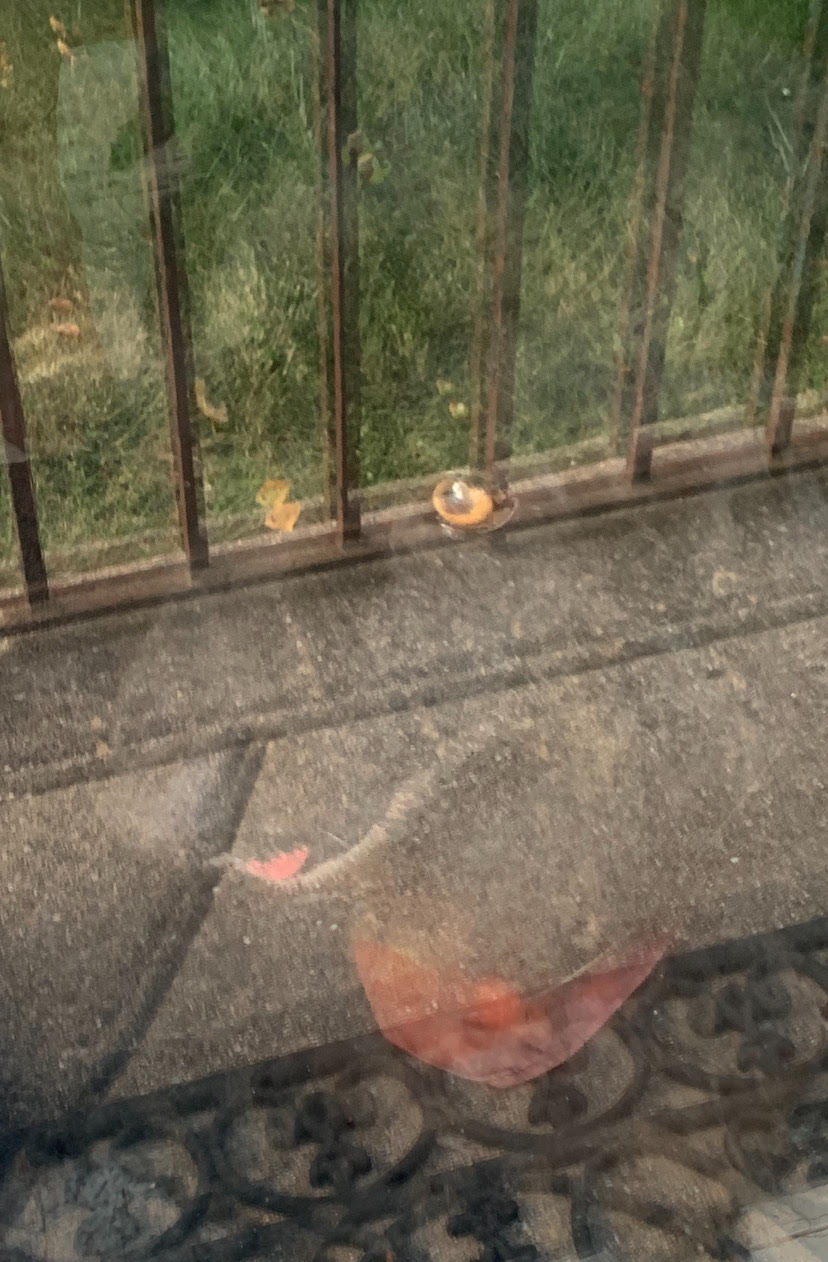
If you are like me, this image took a moment to grok. All the elements are apparent yet, at first, my brain couldn’t pull the pieces together. Kerri, standing outside the front door, took the photo of Dogga on the inside staring out. What is reflection? What is image-through-the glass? It reminds me of those famous drawings that can be seen in completely different ways, the old crone and the young woman. One drawing, two possible images. An optical illusion.
After the image of Dogga-in-the-glass came into focus for me, Kerri exclaimed, “I can’t believe it took you so long to see it!”
MC Escher made a career of creating optical illusions. Stairways to nowhere. Hands drawing hands. The mathematics of art and design. We are rarely aware that our brains assign rather than discover meaning, selecting and assembling pieces in order to sense-make. Like well-worn paths through the woods, our sense-making carves default channels: we see what we expect to see. We see it because we believe it, not the other way around. That is to say, we rarely see beyond what we think. Thinking paths-of-least-resistance render us blind.
The pursuit of truth is to see beyond our well-worn paths. Escher knew that. His images play with our expectations. His images, for a moment, shock us into seeing beyond our expectation.
Factors like age or cultural orientation create biases in the making of meaning, in the assembly of the illusion. For instance, in the drawing of the old/young woman, older people will more often see the old woman while younger people will almost always see the young woman. If you happen to come from a culture that is not inundated with images (there are a few remaining on the planet), it is likely that you would only see scribbles on a page. You would see neither the old or the young woman.
Your normal is not my normal. Your well-worn thought-paths are different than mine.
Given identical experiences, your sense-making will differ from mine. It is the genius behind our system of governance. That two opposing points of view might come together, discuss what they think-they-see and compromise on a best path forward, is the foundation-stone of our democratic system. The genius begins when allowing that one party sees an old woman while the other sees a woman who is young. Both can be valid. Both can exist on the same page.
Allowing for and valuing differences of perspective leads to common ground, shared action.
On the other hand, the same system collapses when what is immediately apparent to both parties is summarily denied by one side of the aisle. It’s another type of illusion altogether: the negation of the obvious. For instance, our last presidential election endured 65 challenges in court and all were summarily thrown out for lack of evidence. Both sides knew – and know – without doubt that the election was valid, free and fair yet the red-hat team continues to fearmonger, pounding the drum of corruption, wearing another kind of thought-path in the minds of their constituents, rendering them blind.
There is a clear distinction between sorting out differences and creating them to exploit fear.
Coming together, in an attempt to see beyond expectations, respecting differing perspectives, valuing the multiple perceptions of a diverse nation in order to stand on common ground is democracy at its best. Creating division, whipping up disunity, negating and devaluing the perspectives and values of others spells the end of democracy. It intentionally pulls the nation apart.
Democracies pursue truth. Autocracies thrive on falsehoods. The choice we face is abundantly clear and right before our eyes. As a nation, all we need do is step off our well-worn thought-paths and open our eyes.
read Kerri’s blog about ILLUSIONS

like. share. comment. subscribe. support…thank you.

Filed under: Perspective, Two Artists Tuesday | Tagged: artistry, autocracy, belief, common ground, culture, david robinson, davidrobinsoncreative.com, democracy, difference, division, expectation, illusion, image, Kerri Sherwood, kerri sherwood itunes, kerrianddavid.com, kerrisherwood.com, mc escher, optical illusion, perspective, story, studio melange, the melange, truth, value | 1 Comment »




 The Direction of Intention