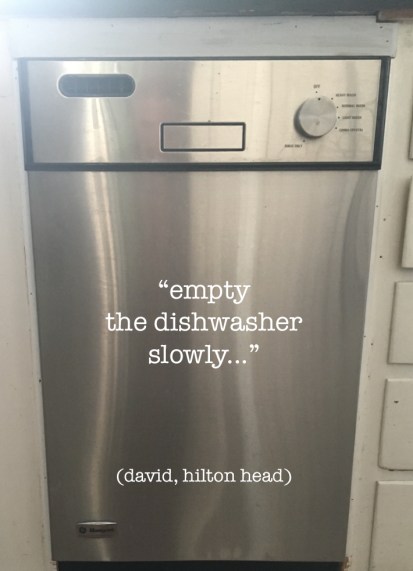
Empty The Dishwasher Slowly [on Merely A Thought Monday]

empty the dishwasher slowly box copy

In the dark ages, when I did my driver’s ed course, I remember reading an experiment in which two cars drove the same long distance route; the first car followed all of the speed limits. The second car drove as fast as possible. The second car, the speeder, arrived only a few minutes, 120 seconds, ahead of the rule follower. The illusion of speed is, well, an illusion.

We just drove a few thousand miles and along the way were passed by more than a few hurry-up-cowboys. In each case, their gain would be minimal. Often we’d catch them (and pass them) within a few minutes. It’s a game I can’t help playing: does the addiction to speed, the anxiety of I’m-late-I’m-late-I’m-late, or the anger of I-have-to-get-there-first actually produce significant gains?

An angel gave us a beach house to use for a week. My normal morning routine is predicated on the fantasy of efficiency. I can cook breakfast, clean and put away dishes while also sorting out and making lists of all the things I think I need to accomplish each day. At the beach I was always the first one awake. I’d start the coffee, wander around and open the blinds, and, after staring at the surf, I’d begin to empty the dishwasher. The waves lulled me into sanity. There was not an ounce of rush-and-get-it-done in my body. Efficiency was nothing more than a distant memory. I enjoyed my morning. Fully. I began wondering if I was just like those speedy drivers? Deluding myself with an idea that, in reality, gained nothing but a wee bit more stress.

What if the idea was more than to get the job done fast? What if the idea was to do the job well and well included the absence of manufactured, self-imposed stress? These are things I already know but have to remind myself to live. And, since all of life appears to me as an analogy, my latest reminder to live what I already know is now a simple dishwasher. Empty it slowly. It need not be at a beach house because, in fact, the beach house has very little to do with dropping delusions/illusions of achievement.

Will it matter if I empty the dishwasher 16 seconds sooner? So I can get through it to the next task that I will rush through so I can get to my next task? Is my efficiency real or in service to anything useful? Probably not. Actually, certainly, not.

Will it matter that I am present in my actions and mindful in my day? Will it matter that, instead of pushing myself to concocted efficiencies, that I arrive at an empty dishwasher 16 seconds later?  Will it matter if I carry that way of being throughout my day? So, that, instead of pressing myself to get it done faster, I allow myself to live my life well (and, yes, I use that word intentionally with a double meaning). To be in it rather than get through it.

Imagine what I might gain.


read kerri’s blog post about EMPTY THE DISHWASHER SLOWLY
 

beachfeet 1 website box copy


Put It On A Post [on Not-So-Flawed Wednesday]

littlefreelibraryBOX copy

Paul often told the young actors he taught: never underestimate your power to influence or impact another person’s life. Stepping onto a stage comes with a responsibility. I loved his advice and thought it was much more universal and should be heeded everyday. What you do matters and it matters in ways you probably will never understand. We are always and in all ways participants in the butterfly effect.

In a short walk around our neighborhood you’ll discover several Little Free Libraries, an idea that came from Todd Bol as a tribute to his mother. She was a lover of books and his idea to honor her caught on like wildfire. In 2009 he built a little schoolhouse shaped box, put books in it, and stuck it on a post outside his house. He invited his neighbors to borrow them. He had no intention of creating a worldwide movement yet in the 9 years that have elapsed since he built his box, Little Free Libraries have popped up in over 80 countries. It became a movement. An entity with a mission. People borrow books. People share books and ideas. Neighbors stop and check out what might be new. The boxes themselves are often little pieces of art that Joseph Cornell might have assembled. Little Free Libraries are community connective tissue.

Todd Bol died last week. It seems only right on this Not-So-Flawed Wednesday to stop and take note of the very big ripple one small box on a post set into motion.


read Kerri’s blog post about Todd Bol


buffalo adirondack chair website box copy

KS Friday

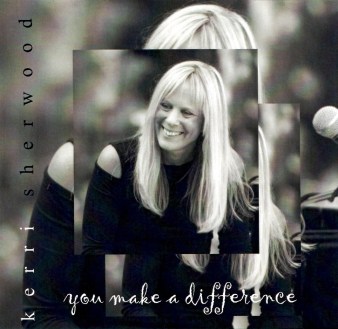
jacketymadjpegMany years ago, when I was riding around the country slaying dragons, thinking I might help save a troubled world, I wrote a post entitled You Make A Difference. A few days later, in my inbox, was an email with a link to a song from a musician I did not know. “I read your post,” she wrote, “and thought you might appreciate hearing my song with the same title.” I listened more than a few times. She was right! I loved her song. I jotted her a note thanking her. That was the first time Kerri and I communicated. It would be a few more years before our paths crossed again. Another post, another response, a surprising and casual email chain would lead me to this woman who would someday become my wife.

Over and over the lesson is the same: it’s the small stuff that matters. My life turned on an email. I never told her (until today because we are sitting together writing posts) that, on the day she sent her song to me, I was sitting in Seattle wondering if anything I did or had ever done in the world mattered. It was one of those days. And then I opened her email. She made a huge difference to me on that bleak day.

I have lived long enough to know that none of us truly understands the full impact our actions have on others. The smallest thing, opening a door, sharing song, ripples and ripples on.

Kerri was commissioned to write this song, originally for folks on the front line of the battle against cancer, though, like all great artists, she composed it from her very personal wellspring of experience; her brother died from cancer. Songs of inspiration can also be rallying cries and that is true of You Make A Difference. Kerri understands the profound difference between resisting the thing you don’t want (sickness) and moving toward what you desire (a cure). On this KS Friday, take in this blast of inspiration from the melange. You never know how one click might change the course of your day and life.

YOU MAKE A DIFFERENCE a single track available on itunes

read Kerri’s thoughts about YOU MAKE A DIFFERENCE

kerrianddavid.com

you make a difference ©️ 2003 kerri sherwood

Start Walking

photoTell Me. How can I be a learner?

My mind went absolutely blank, and I heard myself saying, Its simple. To be a learner youve got to be willing to be a fool. ~George Leonard, Mastery

I used to do a lot of work in education. My career in the theatre took a sharp left-hand turn when I started consulting with schools. The puzzles that plagued educators seemed to me easy to address. To be human is to be curious. Tickle the curiosity, begin the story and get out of the way.

Tom once told me that teaching is about relationship (not control). He also told me that the best teaching/learning needed to be directly applicable; it had to be immediate. It had to be real. It had to matter – to both the teacher and the learner. The trick is to extend the mattering into greater and deeper levels of abstraction.

An emphasis on testing is an emphasis on knowing. Great learning places the emphasis on not-knowing. It reinforces the pursuit and dispels the notion that knowledge is something achievable. Worthy questions always open more worthy questions. To be human is to be curious. To be alive is to wonder what is on the other side of the hill and then take a step toward it.

The fool George Leonard references isn’t “ the unthinking person,” it is “the carefree fool in the tarot deck who bears the awesome number zero, signifying the fertile void from which all creation springs, the state of emptiness that allows new things to come into being.”

Emptiness. Not knowing. Relationship. Mattering.

Step Into Unknown with SigThe question, “How do we/I do it?” is a great step-stopper. It is the leading edge of every personal and organizational stagnation excuse. We don’t know how. I’ve come to believe that it isn’t a natural question but is learned behavior. It is an emergency brake installed by a system that values right answers over great questions.

My wife and I have a short-hand phrase, Beaky’s Wheelchair, to remind us when we stall, that “how?” is something that can only be known after the fact. No one knows “How?” at the beginning. Beaky needed an electric wheelchair to be mobile and the world of insurance/medicare was standing still. After months of waiting, with no clue which direction to begin, we started making calls. We met every “no” with a “why not?.” We asked a multitude of foolish questions. We learned. And learned some more. Within a matter of weeks, Beaky had her wheelchair.

How do you play the guitar? Paint a picture? Bridge a conflict? Transcend a limit? Know one knows. Tickle the curiosity, let go of any notion that you need to know how, and start walking.

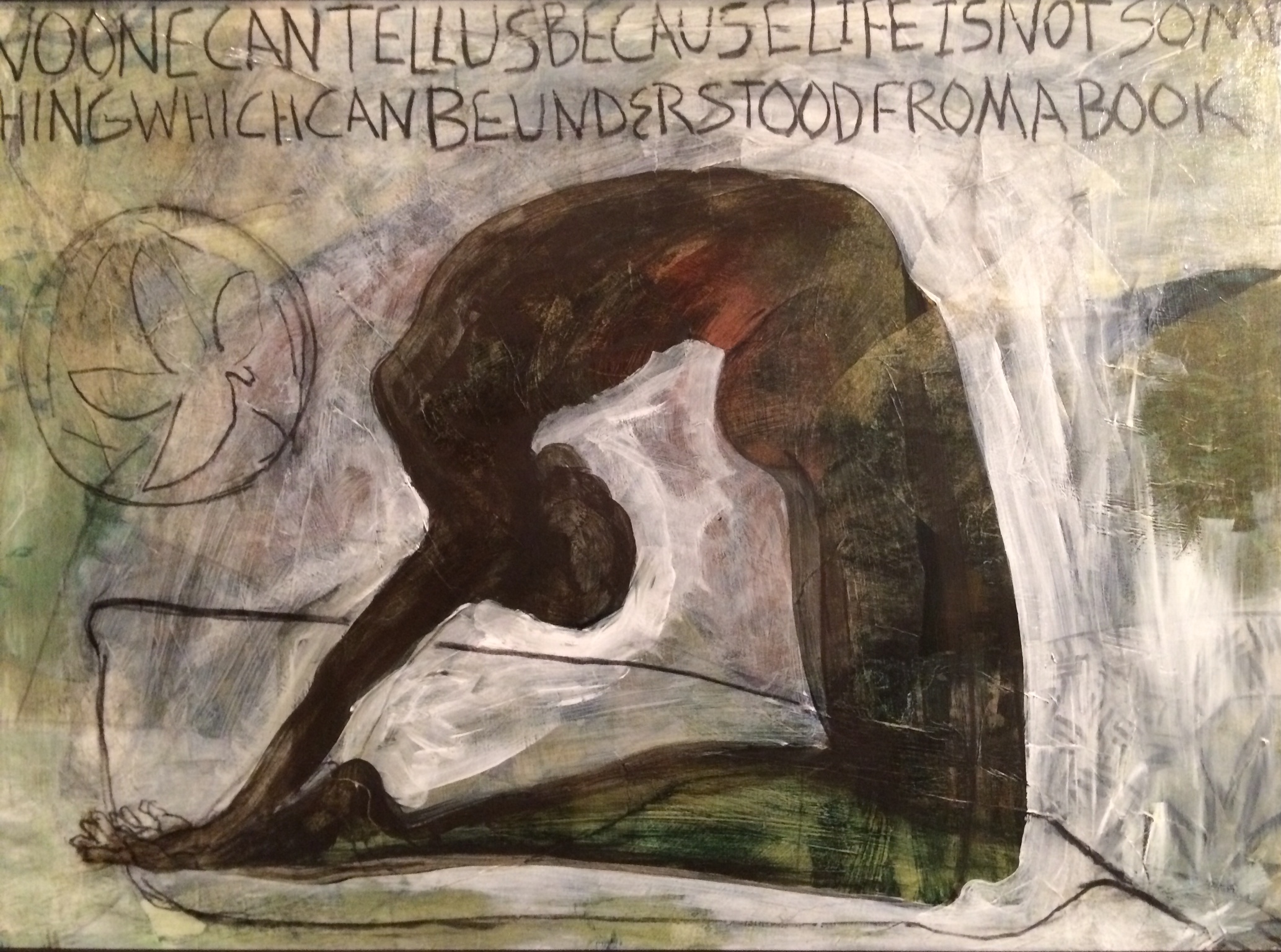
text from Krishnamurti as it appears in my painting

the text from Krishnamurti as it appears in my painting


Save

Save

Save

Save

Feel The Thunder

An untitled  watercolor I did years ago

an untitled watercolor from the archives

I am sitting alone in the back room of a coffeehouse. The room is dark because the day is dark with rain. It is hot and very humid. The building shakes with thunder and the voices in the front room drop to a whisper. I imagine the voice of the thunder inspires awe or at least a library-esque respect. After the rumble subsides, the volume is restored. People laugh again and talk in a tumble over each other until the next rumble quiets them.

I came to work. Good coffeehouses have always been productive places for me though today I’m distracted by the thunder. Like the other patrons, the angry sky has me on alert. It is nearly impossible to focus on my thoughts when the sky has so much to say. The truth is, I want to listen to it. I want it to stop all motion, to interrupt all the little things I deem important. I want to pay attention to what it has to say.

I remember listening to a recorded lecture of Joseph Campbell. He said that the voice of the thunder was probably humanity’s first experience of the godhead. In other words, when the sky talked, people listened. Long before the weather channel replaced the oracle, connectivity between human action and the elements was assumed. Our actions mattered. The gods communicated their pleasure or displeasure with us via sunshine or tsunami. Calm seas and good sailing were signs of approval. It is a marvel in the age of humanity blowing a hole in the ozone, pouring tons of carbon into the atmosphere, having created a Texas size floating trash site in the ocean, exhausting aquifers, etc., that we can in all seriousness debate whether or not we are having an impact. I wonder if in the age of the weather channel as oracle we have so disconnected from “our nature” (our connectivity) that the debate is less about impact and really about whether or not we matter at all. If we do not recognize that our actions have impact, that the smallest action ripples through the lives of others, how can we possibly expect our existence to matter? Mattering requires the understanding and experience of connectivity.

When was the last time that you felt connected to the bigger whole? In the end of the day, mattering (spirituality by another name) is a very practical thing. It is to feel connected. When was the last time you stopped and listened to the thunder? When was the last time you felt its rumble in your chest, or noticed how quiet you became when it spoke?

Matter.

From the archive: 'Angels At The Well.'

From the archive: ‘Angels At The Well.’

Paul used to tell the acting students at the conservatory that they should never underestimate their power to impact another person’s life. In other words, their work – how they brought themselves to the stage – mattered. Simply by doing their work they had the capacity to open a mind or challenge a story. The caveat, of course, was that, in all likelihood, they would never know the impact that they had.

His lesson applies as much or more in daily life as it does on the stage. What if we lived as if we understood our power to impact others? What if we recognized that the small stuff matters? What if we didn’t need to know – but simply brought ourselves to our days knowing that our actions and attitudes mattered?

Sitting outside at a Starbucks in Wesley Chapel, Florida, a young woman Skyped into a bridal shower happening in Pennsylvania. It was her bridal shower and, because she was starting a new job, she couldn’t get the time off to fly home. So, via Skype, she checked in on the party and giggled at the celebration. Kerri and I sat at the next table listening to the conversation, the love and festivities. I watched as Kerri, stricken with the grief of her mother’s passing, change. Her heart lightened. It changed her focus. The young woman, with no knowledge, eased Kerri’s grief. Kerri ran into the store and bought the woman a gift card. “Congratulations on your wedding,” she said as she gave the card to the young woman.

In coffee-desperation we pulled off the highway in Salem, Illinois. We bumbled into the M&M Coffeehouse on Main Street. Mike, the owner is a master chef. He told us the story of love that brought him to Salem, the story of his love for making food and how he became proprietor of a coffeehouse, the story of how the community was embracing his gift and returning the love; the coffeehouse was now also a catering business. He was teaching cooking classes and volunteering his time to the monthly Elks club hamburger dinner fundraiser. The Elks were raising tons of funds since he started making the meals. “You never know where life is going to take you,” he smiled. Mike never knew the gift he gave us; he was simply being chatty with strangers. We needed a good dose of hope and encouragement to carry us the final 6 hours of our long drive home. He filled our hope-tank to the top.

Whether we know it our not, it matters. Always.


Possess It

An untitled  watercolor I did years ago

An untitled watercolor I did years ago

Last night P-Tom said, “This is the time of year that everyone is telling us what we need and where we can go to buy it.”

Yesterday I worked on website language. After a year-long hiatus I’m re-visioning what was once a coaching practice. All day I was aware that words like “potential” and “purpose” are abstractions; they are marketing terms. Many years ago, when I was first establishing a coaching practice, I read articles and listened to recordings full of advice about “how to start a coaching business;” the recommendation was unanimous: host free calls, help people see their problem, and end the call. Leave them standing in the mud so they will need you. Create lack (isn’t that a great definition for marketing?).

What does it really mean to fulfill your potential? What does it mean to “find your purpose?” Look to the layer beneath. To fulfill, to find…, these are terms from the canon of outcome and result. No one willingly seeks his or her endpoint. If there is a universal problem it is that we see our existence as something with a bottom line and hire coaches and therapists to help us do the accounting.

(Insert mantra: nothing is broken. You do not need to be fixed).

Good coaches, teachers, mentors, and therapists get you out of the spreadsheet and into the moment. Looking for the fullness of life is usually a process that requires the cessation of looking so we might see what is right in front of us. Stop the search and you will be found. As the old saying goes, life is the thing that is happening while you are running around looking for it.

I’m a world-class note taker and always take notes when I work with people. For me it’s like mapping verbal terrain, capturing inner geography. Lately I’ve been reviewing the maps before I destroy them and I find not seekers of potential and purpose, but people overwhelmed by the experience of 1) feeling lost, 2) feeling that something is missing or they are missing something, 3) feeling that they are pushing on a door that won’t open, or 4) a yearning for a different way of being. These are questions of feeling. These are questions of orientation to life (experiences of life). “Potential” and “purpose” are words of doing. These are questions of being.

What if meaning, value, purpose,… in life was not something found or bought but something that is already possessed?

Go here to buy hard copies (and Kindle) of my latest book: The Seer: The Mind of the Entrepreneur, Artist, Visionary, Innovator, Seeker, Learner, Leader, Creator,…You.


Make An Appeal

Tom and me a long time ago.

Tom and me a long time ago.

Horatio wrote and said he hoped my kickstarter campaign picked up steam soon. Me, too. It looks like a long hill to climb with less than 10 days to go and less than a third of the way to our goal.

In his email, Horatio asked a great question and also gave me some good advice:

The question: why should anyone care?

The advice: make a direct appeal.

The question (why should anyone care?): To be honest, I’m not sure why anyone cares or does not care about anything. I have lots of cerebral reasons why I think this play should matter but to expound the list feels somewhat like one of the many times I’ve stood in front of a school board telling them why the arts matter. What I know in my bones will bounce off because it is not yet personal to my audience. I know it has to be personally relevant for people to engage or invest in any thing, not just the arts. For instance, the people raising money for breast cancer research and awareness are the same people who’ve had breast cancer or know someone who has. It’s personal. It matters.

This is personal for me. I spent hundreds of hours over several years listening to Tom’s stories, taking notes, recording him. We walked through graveyards. We drove through the fields and stopped at places where his ancestors lived and played out their lives. It’s where he played out his life. He took me those places and told me those stories because he feared they would die with him. He wanted to keep alive the family story and, at the time, no one in his family was present to listen. I was present. I wanted to listen. I wanted to spend time with my friend and mentor and that time was a great gift to me. Tom is chief among the patriarchs of my artistic family. I am his artistic descendent.

Last week as I travelled back to the San Joaquin Valley to work with The Chili Boys to integrate the new music into the play, it occurred to me that I’ve poured more energy and time into this play than any other artistic project in my life. It’s been a decade of development and attempts to get it to production. We let it sit fallow for a spell after Tom’s health collapsed. Oddly, it was Tom’s passing that made it ready, necessary.

One mistake I made in setting up the campaign: I thought people would join the kickstarter because of Tom. It has been somewhat of a mystery to me but also a great delight that the majority of people supporting the play never knew Tom. I thought the legion of Tom’s students, peers, and friends would be the primary donors. Instead, the folks throwing in their support are my peers, students, and friends. They know me. They are supporting me. So, the only answer I can come up with that may make this relevant for you: because I care, because I need to bring this play across the finish line. Because I am now on the front line of an artistic legacy: I carry the stories, the teaching, the value-set, the vision as I inherited it. Making art (performing this play) is the way I serve as conduit to the next generation. It’s how I (like all artists) pass it on. Kerri continues to remind me that there is more to it than that. It’s not just the passing of the legacy to me. It is the reminder we all need in this busy world – the reminder that family story needs to be told and needs to be heard. And everyone has a family story to pass on. Period.

As for Horatio’s advice: make a direct appeal. Here it is: I have 10 days and need your help. Pass on the link. Give $10.00..or $1,000.00. Mostly, I appreciate your correcting my mistake. Thank you for supporting me.

DSC_1196 copyGo here for The Lost Boy Kickstarter campaign

Go here to buy hard copies (and Kindle) of my latest book: The Seer: The Mind of the Entrepreneur, Artist, Visionary, Innovator, Seeker, Learner, Leader, Creator,…You.title_page

Know What Matters

A day with Beaky

A day with Beaky

When you leave Florida driving north there is a stretch of highway in Georgia that is littered with billboards advertising everything from the adult superstore to the second coming. The spectrum is as breathtaking as it is comical.

I’ve driven this stretch three times during the past several months and each time I wonder what an archeologist from some distant future might deduce about us if this stretch of highway was the only remaining fragment of evidence of our culture. A few years ago I spent a day in Herculaneum, the other city buried with Pompeii on the day that Vesuvius erupted. Like Pompeii, it was remarkably well preserved. We have so much writing from that time, we have eyewitness accounts, we have museums stuffed with artifacts and art. While I walked the streets of Herculaneum on that hot summer day, I read about the social norms, the exercise practices, food preparation, infrastructure, and what we assume a normal day was like. I also read, based on the placement of the bodies, what that most unusual day, the day the world ended, must have been like. There was a timeline of events. All the while I couldn’t help but wonder if our study of their culture could only reach the superficial, the top layer, the economics. We can sort through the garbage and garner much about daily practices. To study is not the same as knowing. What we know is minute when compared to what we do not know. The timeline told me little of the terror. It told me nothing of the love. The economic statistics told me less than the plaster cast of the old couple huddled together, arms wrapped around each other on their final day.

I recently watched a short TED talk by Ric Elias who was on the plane that a few years ago landed in the Hudson River. He talked about his thoughts as the plane went down, what he learned about life when he faced his death. He was surprised that there was no fear in dying but there was great sadness for all the things he would miss, all the relationships he would leave behind. He learned from that experience that the only thing in his life that mattered was being a good father. He also decided to clear all the toxic relationships and never again participate in negative energy. He said that he gave up being right. I thought of him as I drove the billboard gauntlet a few days ago. The archeologist from the distant future would glean much about our economics and ponder our obvious confusion. She would write studies useful for the tourists that would travel halfway around the world to visit the site of a once thriving community. The tourists would walk the stretch of ancient freeway, gape at the billboards and speculate about our addictions. But they would know nothing of the people who everyday drove that stretch of road with their families, or about people, like me, who drove more than a thousand miles to spend a day or two with a 93 year old woman named Beaky who can tell a story better than almost anyone I’ve ever known.

Go here to get my latest book, The Seer: The Mind of the Entrepreneur, Artist, Visionary, title_pageSeeker, Learner, Leader, Creator…You.

Go here for hard copies.


See The Color

857. Join me in inspiring truly powerful people. Each day I will add a new thought, story or idea to support your quest and mine.

Occasionally, for reasons I can’t explain, I become fixated on the words people use to describe their experiences. Language is powerful and we are rarely aware that in using specific language to describe particular experiences we are, in fact, defining ourselves.

Today I was struck by the predominance of phrase polarity I heard in my conversations and travels. People were “effective” or “ineffective.” Experiences were “good” or “bad.” We “liked” or “didn’t like” an idea. I heard, “Are you in or out?” A frustrated pedestrian shouted at a young woman who’d stopped to adjust her ear buds, “Walk or Don’t Walk!”
This or that. Up or Down. Black or white. More or less. Main Street or Wall Street.

It is comfortable to pretend that things are simple and easily defined. It is probably efficient to pretend that there are only two available options. We are, after all, a society of laws and in a legal preset there must always exist a clear line though we learn again and again that the line is never clear. Who honestly believes that Justice is blind? Context complicates even the smallest decision.

Dogma is not spirituality. Data is not knowledge and is miles from approaching wisdom. Wisdom is complex. Data sorts to the simple. There are an infinite number of points between those two poles. The question remains: how is your language defining you. Do you define yourself as data with two points or do you allow for more complexity? Listen to how you story yourself and your world.

The challenge with phrase polarity is that the points are often pitted against each other. It’s as if data and wisdom are two distinct paths so you can have one or the other but not both. The phrase “effective or ineffective” recognizes no middle ground. It eliminates any common ground. The same holds true if you define yourself as either good or bad. Do you have worth or are you worthless? Are you identified with a red state or a blue state? Can business have heart? Can data support wisdom? Can wisdom translate data?

Isn’t life sweet with only two choices! In such a paradigm it is easy to be the good guy and so by default the “others” are bad. In such a paradigm, when rushing to your very important meeting, all the “others” are in your way. My way or the highway is a bleak and immature paradigm.

The important questions do not live at the poles but are in constant movement in search of a balance point. Balance is available in the center and the center moves all of the time. Do you love your children? Do you want to make a better world? Do you want your life to have meaning? Is it possible that people in the other color states also want the same things?

Coloring outside of the lines requires crossing lines. It requires a desire to work with color, lots and lots of color, which opens the capacity to see a multitude of options. Everyday I work with people searching for the greater meaning in their lives. The first thing they come to realize is that they have choices. Not one or two but many, many choices. They have a full palette of choices. And they can only see the multitude of choices when they stop telling themselves that the world is black or white. They can only see the rainbow of possibilities when they get off the pole of rightness or wrongness and step toward the middle. Living a rich and varied story begins when you start telling a rich and varied story. Language is the building block of story. It matters.