Reach

photo-6In these few weeks post Lost Boy I’ve been writing thank you letters and sending Kickstarter rewards to the many people who donated to the campaign. I am humbled by the number of people who stepped forward to lend a hand, offer resources (financial and otherwise), and/or heap us with the moral support necessary to produce the play.

The Reminder: no one does anything alone. All creative acts, all things that are useful in this world, all triumphs that seem on the surface to be an individual achievement, are, in truth, a group effort. Life is a team sport. Quarterbacks are nothing without a front line, a coaching staff, a back office, a marketing machine spinning the tale. They also had mothers that for years drove them to practice, families that stood in the cold to watch them play little league, and a host of friends who told them that they could do it if the only kept going. Artists are no different. Even the loneliest painter has a rolling lifetime team whether they recognize it or not. Consider this simple basic: a painting is never complete until someone other than the artist engages with it. A play is never complete until an audience arrives. The whole point is to make or accept an offer to/from an other.

We, the people of these United States, place the accent of our existence on the achievement of the individual and that sometimes makes us blind to the obvious truth of our existence. We do nothing of worth on this earth without the support and participation of others; relationship is at the core of anything worth doing.

from the 2015 Racine snow carving contest. I'm sorry I did not capture the artists names!

from the 2015 Racine snow carving contest. I’m sorry I did not capture the artists names!

Once, many years ago, I lived in Los Angeles. I did not know my neighbors. I had no idea or desire to know who was living in the houses next to me. One night the earthquake came and our illusion of independence was stripped bare. With no power, no water, no heat, and compromised housing, the first thing we did was to reach to each other. When the illusions of comfort and security are stripped, our real need (each other) becomes glaringly apparent.

I wrote this play, The Lost Boy, because someone dear to me, over a decade ago, asked me for help. I was grateful that he asked – it meant I got to spend time with him and return some of the attention and love that he had invested in me. When the metaphoric earthquake hit – when Tom died – I had no recourse but to reach out to others; I produced this play when I realized that I was not alone and all I need do was ask for help. Legacy, like story or life, is an infinite loop of relationships.

End And Begin

photo-2My fascination with this play grows every day. It has had a hold on me for over a decade. I’ve told the story of The Lost Boy to everyone I know. And now, as we approach opening night, the story of the production, the timing of the production, the people coming out of the woodwork for the production, Tom’s relatives appearing with additions to the narrative that Tom originally relayed to me – is equal to or exceeding the marvel of the play itself. The story around the story is, in some ways better than the story itself. Or, perhaps it is an extension to the story, the next chapter. Roger once told me that he believed the most interesting aspect of the story was not the discovery of a trunk plastered into the walls, not the story Tom felt an imperative to pass on to me, but the story of my time with Tom. “I want you to tell that story,” he said.

I have a file of recordings that I made of some of my conversations with Tom. They were in a format that made them inaccessible to me. I kept them but have been unable to listen to them for several years. A few nights ago, on a whim, I searched for conversion programs and in less than an hour, I was listening to one of the recordings. It was like opening the trunk that had been plastered into the wall. I listened to one of our conversations. I listened to our laughter. I listened to the questions I asked and his thoughtful and generous responses. I listened as I told him that I believed the real story was not Johnny’s or Isabelle’s, but his. He considered it but could not see himself as anything other than a messenger. My suggestion to him was prophetic.

On a lovely August evening in 2013 I was on a pier in Wisconsin when I received the call that Tom had passed. I sat on a bench and talked with Marcia, Tom’s widow, for over an hour. After the call I walked with Kerri and as we watched the sun set I told her stories of Tom.

My attempts to produce the play while Tom was alive (though too ill to perform the piece) hit walls of brick and stone. If I wanted disaster to strike I only needed to attempt to mount a production of The Lost Boy. I’d all but shelved it and, although I’d rewritten it so I could perform the story, the script seemed incomplete, somehow awkward. When Tom passed, the end of the play became apparent – I saw the flaw. Tom needed to join the story, not tell it. I did a final rewrite and the play was ready.

I’ve been amused because, after so many obstacles, this attempt is almost producing itself. It is as if we couldn’t stop the transmission of the story if we tried. Jim said, “I think Tom is working his magic from the other side.” The other night, in rehearsal, just as I worked the section about Isabelle (Tom’s great grandmother) reaching through time, ringing a cow bell to summon Tom, the bells from the neighboring church began to toll.

It made me laugh and I recalled a question he often asked: where does a story end? Where does it begin?

title_pageGo here to buy hard copies (and Kindle) of my latest book: The Seer: The Mind of the Entrepreneur, Artist, Visionary, Innovator, Seeker, Learner, Leader, Creator,…You.

The PoetGo here for fine art prints of my paintings.


Light The Way

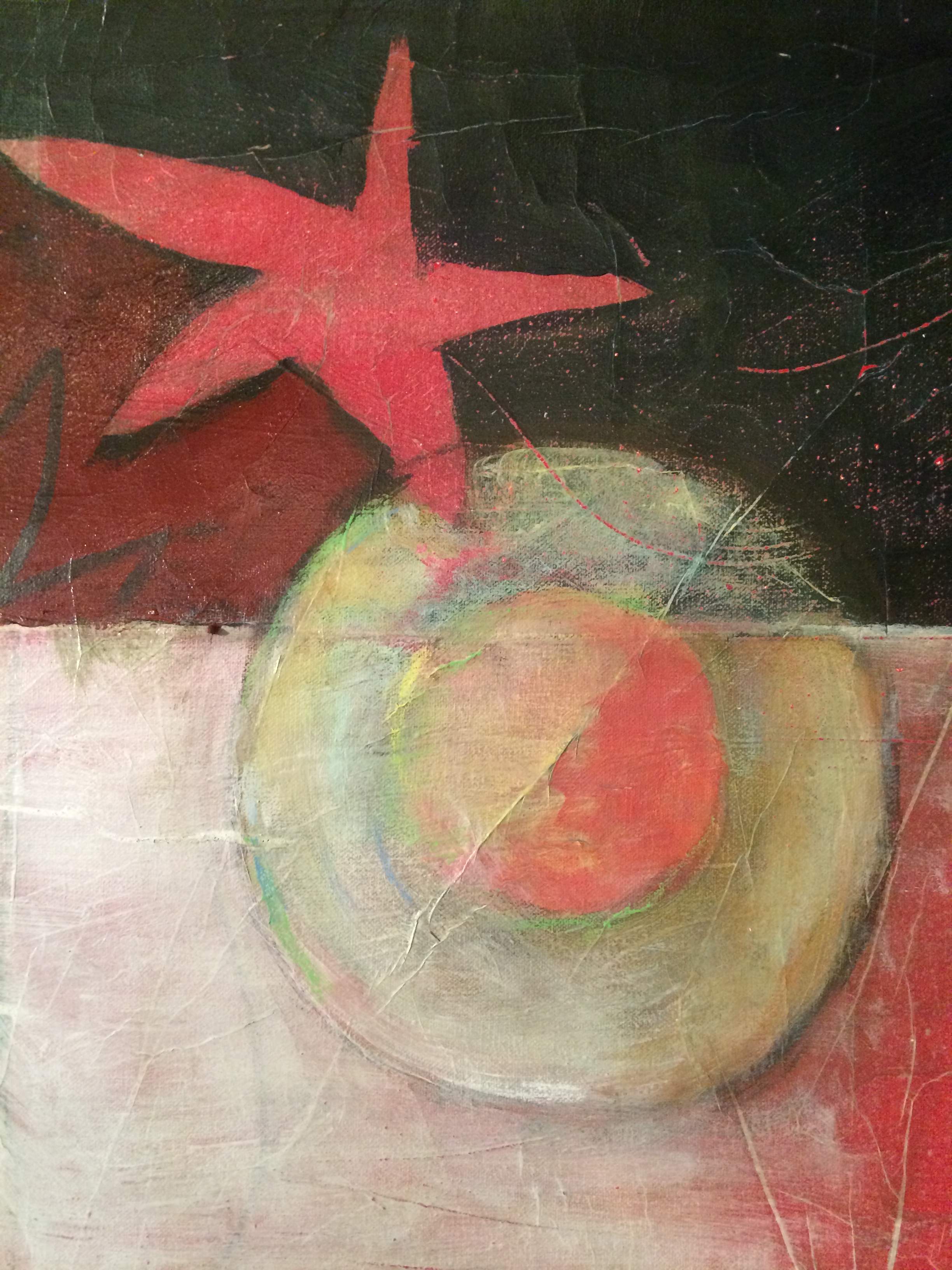
A detail from my painting, An Instrument of Peace

A detail from my painting, An Instrument of Peace

Yesterday was Ann’s funeral. She died too young but by all accounts lived out loud – she packed a lot of life into her short time. One of the speakers said that she was neither a glass-half-empty nor a glass-half-full kind of person; her glass was always overflowing. I sat in the choir loft and listened to the stories, the grief and the laughter, the music that a community makes when it says good-bye. I only know her through their stories, through their eyes, and I was overwhelmed with the beauty that they saw in her. She was rooted in a community and the community was rooted in her. I was moved by the story she inspired.

Just before the service I was working on my play, The Lost Boy. We open in a few short weeks. I was memorizing the last two pages. The language of the play, the moment in the script that I worked, is about Tom’s ancestors answering his call. He worried about what to do with the ranch and the legacy that he guarded. He didn’t know what to do. There was no one to receive what he had to tell. He summoned the ancestors and, when he needed them most, they came. They didn’t answer his question. Instead, they took his hand and helped him join the story.

Jean Houston called us – the living – the burning point of the ancestral ship. Each of us carry forward the story, we add a chapter to a longer epic whether we realize it or not. Once, many years ago, John was directing one of Shakespeare’s plays for my company. While talking with the young actors about the play, he was moved to tears telling them how he realized that he was a link in a long chain that led all the way back to a first production in the 17th century. This play did not exist isolated in time. It was a burning point. Their work mattered because they were the guardians of a tradition. They were the burning point. The play was remarkable because the actors understood their root; even the smallest action mattered because if fed something bigger.

A few weeks ago we watched the film, The Descendants, with Brad and Jen’s movie group. It is a story of legacy and mattering – a story of what happens to descendants when everything looks like a commodity. The root withers. The story dissipates. As Yeats wrote, “The center cannot hold.” Joseph Campbell said that our mythology was dead and all the proof we needed was in the news. It took me years to fully understand his statement. And, the question he asked was this: once lost can a community revive its mythology? Can it reconnect with the root? Can it look beyond the immediate and see the rich soil of the greater story? As the burning point, can we light the way forward or is our dilemma the same as Tom’s: what do you do when you carry a root-story and no one is interested or capable of hearing it?

title_pageGo here to buy hard copies (and Kindle) of my latest book: The Seer: The Mind of the Entrepreneur, Artist, Visionary, Innovator, Seeker, Learner, Leader, Creator,…You.

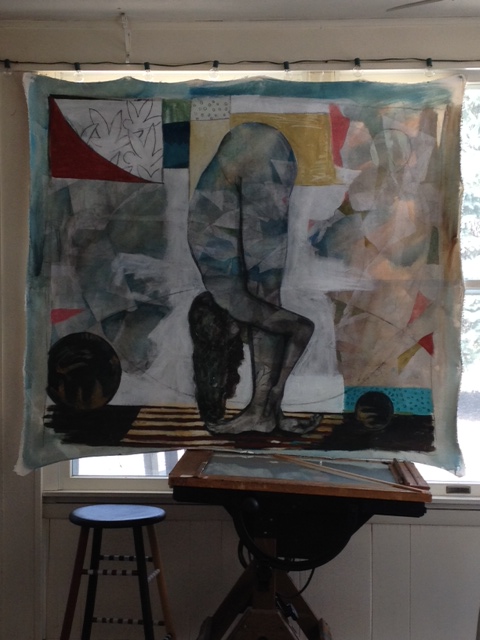
from my Yoga series

from my Yoga series

Go here to buy art prints, posters and such – of my paintings


Return To Center

Screen Shot 2014-12-26 at 5.16.04 PMMy sister posted some photos and a video of our father dressed as Santa Claus. He was playing the role for her grandchildren, his great-grandchildren. The photo made me smile and the moving images took my breath away. When he came in dressed as Santa he was mostly silent; his voice would have betrayed his true identity. His Santa was gentle and kind. Like every good Santa Claus, he took his cues from the children.

I did not have children, though, recently, there came into my life two amazing twenty-something adults, Kerri’s children, and I am learning the ins-and-outs of the role of parent. It is a complex and rich affair! On Christmas Eve, Kerri and I were up until 5am wrapping packages and hiding gifts for a treasure hunt (the wrapped boxes held clues and the gifts were hidden around the house). It was a riot of fun and gave me some small taste of what being a father must feel like. All night as I wrapped and concocted clues I thought of my dad: what must he feel in a room with his children’s children’s children? If my excitement for the giving of gifts on Christmas morning – also a new experience for me – is any measure, his heart must have been near to exploding as he pulled gifts from a red bag and handed them to his daughter’s daughter’s daughter.

During this season I’ve participated in many conversations about the loss of meaning in this holiday. As P-Tom said, this is the season that everyone seems to be telling us what we need and where we can go and buy it. And, there’s no denying that the commercial has generally overtaken the communal. Yet, when I watched the video of my dad, I knew that his great-grandchildren would someday tell the story of how once, long ago, their great-grandpa played Santa for them. On that day they would not remember what was in the presents he brought, only that he brought them. As I watched the video of my dad, I knew the essential thing was intact, the commerce had not touched the center: family.

title_pageGo here to buy hard copies (and Kindle) of my latest book: The Seer: The Mind of the Entrepreneur, Artist, Visionary, Innovator, Seeker, Learner, Leader, Creator,…You.

Yoga Series 7Go here to get Fine Art prints of my paintings.

Touch The Past

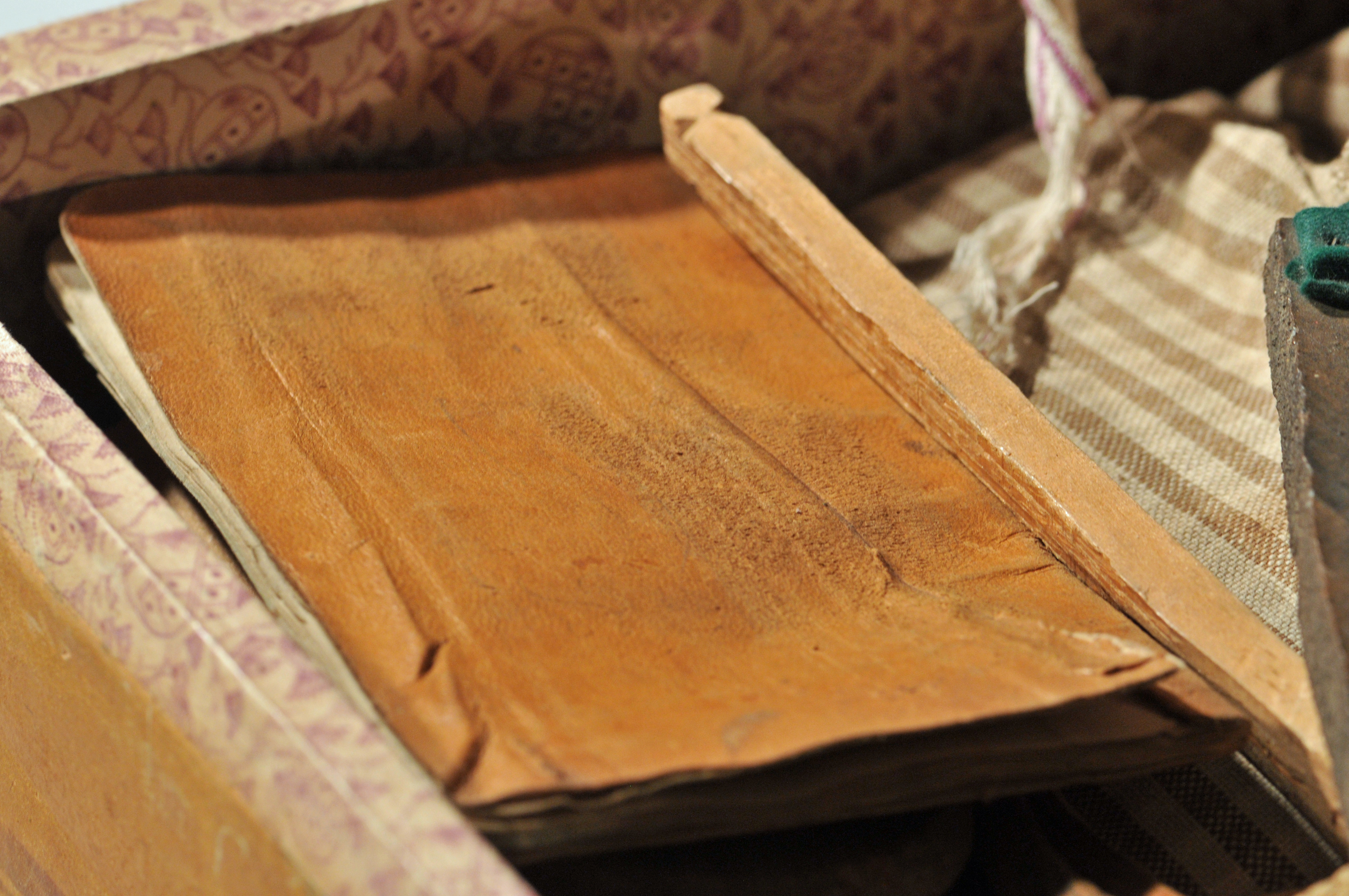
The journal/record Isabelle kept of the fever that killed Johnny.

The journal/record Isabelle kept of the fever that killed Johnny.

I’ve been posting updates to pledgers for my play, The Lost Boy, through the Kickstarter campaign. I’ve been using images of the artifacts – Johnny Quiggle’s possessions – found in the trunk. Jim, the chief Chili Boy, has been doing archival and art shots of the artifacts. The images have served to make a vital point about the play: this story happened. This little boy died. The story that unfolded for me moved both forward and backwards in time. And, while receiving it from Tom, I realized that it was also my story, and your story. It’s universal and, therefore, worthy to tell. My latest update generated much feedback so I’m sharing it here, too:

Jim has completed shooting archive and detail photos of the contents of Johnny’s trunk. This journal was the last thing Isabelle put in the trunk before she closed it in 1885 and secretly sealed it into the walls. Tom told me that this journal told him more about Isabelle than any other object in the trunk. In her record of the fever, he could read her worry, her despair, her fears, a few days of hope, and then the devastation at losing her son. This play is more than a good story well told; it is one of the ways Isabelle reached through time, through Tom, and into me to tell a story that is relevant to all of us.

Thank you for everything you have done to bring this play to life. It is your encouragement and support (financially and otherwise) that will open the trunk to larger audience and extend Isabelle’s intention beyond the walls of the ranch, beyond the Quiggle/McKenzie families, and into the greater conversation.

Johnny crop copySupport the kickstarter campaign for The Lost Boy


title_pageGo here to buy hard copies (and Kindle) of my latest book: The Seer: The Mind of the Entrepreneur, Artist, Visionary, Innovator, Seeker, Learner, Leader, Creator,…You.


Make An Appeal

Tom and me a long time ago.

Tom and me a long time ago.

Horatio wrote and said he hoped my kickstarter campaign picked up steam soon. Me, too. It looks like a long hill to climb with less than 10 days to go and less than a third of the way to our goal.

In his email, Horatio asked a great question and also gave me some good advice:

The question: why should anyone care?

The advice: make a direct appeal.

The question (why should anyone care?): To be honest, I’m not sure why anyone cares or does not care about anything. I have lots of cerebral reasons why I think this play should matter but to expound the list feels somewhat like one of the many times I’ve stood in front of a school board telling them why the arts matter. What I know in my bones will bounce off because it is not yet personal to my audience. I know it has to be personally relevant for people to engage or invest in any thing, not just the arts. For instance, the people raising money for breast cancer research and awareness are the same people who’ve had breast cancer or know someone who has. It’s personal. It matters.

This is personal for me. I spent hundreds of hours over several years listening to Tom’s stories, taking notes, recording him. We walked through graveyards. We drove through the fields and stopped at places where his ancestors lived and played out their lives. It’s where he played out his life. He took me those places and told me those stories because he feared they would die with him. He wanted to keep alive the family story and, at the time, no one in his family was present to listen. I was present. I wanted to listen. I wanted to spend time with my friend and mentor and that time was a great gift to me. Tom is chief among the patriarchs of my artistic family. I am his artistic descendent.

Last week as I travelled back to the San Joaquin Valley to work with The Chili Boys to integrate the new music into the play, it occurred to me that I’ve poured more energy and time into this play than any other artistic project in my life. It’s been a decade of development and attempts to get it to production. We let it sit fallow for a spell after Tom’s health collapsed. Oddly, it was Tom’s passing that made it ready, necessary.

One mistake I made in setting up the campaign: I thought people would join the kickstarter because of Tom. It has been somewhat of a mystery to me but also a great delight that the majority of people supporting the play never knew Tom. I thought the legion of Tom’s students, peers, and friends would be the primary donors. Instead, the folks throwing in their support are my peers, students, and friends. They know me. They are supporting me. So, the only answer I can come up with that may make this relevant for you: because I care, because I need to bring this play across the finish line. Because I am now on the front line of an artistic legacy: I carry the stories, the teaching, the value-set, the vision as I inherited it. Making art (performing this play) is the way I serve as conduit to the next generation. It’s how I (like all artists) pass it on. Kerri continues to remind me that there is more to it than that. It’s not just the passing of the legacy to me. It is the reminder we all need in this busy world – the reminder that family story needs to be told and needs to be heard. And everyone has a family story to pass on. Period.

As for Horatio’s advice: make a direct appeal. Here it is: I have 10 days and need your help. Pass on the link. Give $10.00..or $1,000.00. Mostly, I appreciate your correcting my mistake. Thank you for supporting me.

DSC_1196 copyGo here for The Lost Boy Kickstarter campaign

Go here to buy hard copies (and Kindle) of my latest book: The Seer: The Mind of the Entrepreneur, Artist, Visionary, Innovator, Seeker, Learner, Leader, Creator,…You.title_page

Carry Your Story

I call this painting, "Canopy"

I call this painting, “Canopy”

Since writing my post yesterday I’ve been rolling around in my mind the image from this quote from Deepak Chopra’s book, Life After Death: “Every former self you have left behind is a ghost. Your body is no longer the body of a child. Your thoughts, desires, fears, and hopes have changed. It would be terrible to walk around with all your dead selves holding on.”

All day I’ve been looking at people as if they are walking around with all of their dead selves hanging on. And, technically, we are. We define our present moment through the eyes of the past. I suppose the number of ghosts we carry depends upon the definition we carry about ourselves.

Definitions are stories. Thoughts, desires, fears and hopes are contained in the form of a story. Any thought you have is actually a form of storytelling. When we worry if this will happen or that, we are telling a story. When we tell our friends about being stuck in a traffic jam, we are telling a story. When we say, “This is who I am,” we are telling a story. When we say, “That is who they are,” we are telling a story. In a week, my family will gather to memorialize my grandfather; we will tell his story.

I’ve found in many parables and myths that an inner monologue (the story you tell yourself) acts like a fog. It obscures the present. For instance, in the Sisyphus tale, Sisyphus goes to the underworld and watches the souls of the newly departed cross the river Styx. Each soul thinks it is alone even though they are with many others; they cannot see the others through the curtain of their ego story. To enter the great “I am” they must first stop telling a story of separation.

Stories obscure.

We carry our stories forward. That is a legacy. Carrying a story forward is how we connect to our ancestry. Jean Houston once used an image that I like: we are the burning point of the ancestral line. We carry the story-torch forward. Like the Olympic flame our fire was ignited by a spark that stretches back eons. And through us, this flame will reach far into the future. We burn now. This story-torch, the family story, is the root story. It illuminates us.

Stories enlighten.

In both cases, obscuring and illuminating, stories can be heavy to carry. Or, they can be light. It may not be so terrible to walk around with your dead selves holding on if your dead selves tell a story love and connection, a story of hope and aspiration, a story of yearning and possibility. If illumination is the act of transcending your story, a step toward illumination certainly includes a story of love, and usefulness, and a deep appreciation of the ordinary moments that we story to fill our extraordinary days.

title_pageGo here for my latest book


Give Yourself Some Advice (2)

Finishing a painting is really about having a conversation with yourself. This one is talking!

Finishing a painting is really about having a conversation with yourself. This one is talking!

[continued from Give Yourself Some Advice]

Here’s the next bit of an email Horatio sent to me with his Advice To Myself. He wrote it following a question from a reporter about advice he’d give to emerging filmmakers. I am particularly fond of this section as many of my teachers, mentors, and guides are now passing away and I am revisiting what is mine to add to this “ancient conversation.” Here is the next section of Horatio’s advice to himself (for the full text, visit his blog at www.fidalgofilms.com):

Respect the boundaries of others; do not seek to control anyone else. You can only control your own choices.

Learn and honor with absolute integrity your own boundaries so that others may not try to control you or your work. Unfortunately, this is usually only learned through a certain amount of trial and error. 

Learning to trust is an art, and absolutely necessary. Learn to trust yourself first. Learn to trust others.

Always respect the tradition of your work, its ancient human conversation.

Connect to tradition, to all your teachers and your teachers’ teachers. Give yourself to it so that it can give to you and to your work. Honor it with rigor and doubt, with hours and hours of study and practice.

Then let your teachers go, follow the path that you understand as truth. You will know it when you see it. It will be your part of the ancient conversation. Likely, you will find that parts of one or two of your teachers have become part of you.

If you do not let your teachers go, your part of the ancient conversation will not be yours, but rather what you think other people want you to add to the conversation. That is not from you and only clogs up the conversation.

[to be continued]

Horatio asks great questions: What is the tradition that you carry forward? I follow the line of Tom and Marcia McKenzie, who learned from DeMarcus Brown, who learned from Eva Le Gallienne, who learned from…. What teachers/teaching do you need to let go?

Go here to get my latest book, The Seer: The Mind of the Entrepreneur, Artist, Visionary, title_pageSeeker, Learner, Leader, Creator…You.

Or, go here for hard copies (Amazon)


Know Your Root

879. Join me in inspiring truly powerful people. Each day I will add a new thought, story or idea to support your quest and mine.

With Tom’s death yesterday I’ve been thinking about legacy. So many people called me today to make sure that I knew of his passing. I’ve had many wonderful and brief conversations with people who knew what Tom meant to me. All of them said, “His passing has left a hole….”

Tom taught me more about the theatre and teaching and story than any other person. He was my great mentor and later my friend. The irony is that I never saw him direct a play (I caught a rehearsal or two) or teach a class. I did, however, spend hours and hours listening to him tell stories. Tom was an amazing storyteller. I spent hours asking him questions. I carry forward his philosophy of working. All of my work in education is sourced in Tom. Every time I stand in front of an audience and tell a story I carry him forward.

He liked to tell this story: When he was a little boy the 90-year old Countess Valencia would visit the ranch each Sunday to have a chat with his grandmother. The Countess was a local girl who’d married a count. They lived on a vast ranch nearby and the count was long dead. Because the Countess was too old to get out of the car, Tom’s grandmother would sit with her in the backseat. They’d have tea and talk. One Sunday, the Countess opened the car door and called Tom over. She asked him to sit in her lap. Tom said she was a little bird and brittle and he was afraid that she would break but he crawled into her lap never-the-less. She said to him, “I want you always to remember what I am about to tell you. This might not seem important to you now but it will later when you are old enough to understand.” She paused and said, “Thomas, you are sitting in the lap of someone who sat in the lap of Abraham Lincoln. He smelled of lilac water and saddle soap.”

He had a lifelong fascination for Abraham Lincoln. He read every book. He even looked a bit like Mr. Lincoln. Abraham Lincoln is not so far in the past. Two long lives stand between him and me.

Tom impacted more people than any other person I’ve since met. If I ever have or will tell you a story, I’ll be introducing you to Tom.