Two Sons and Two Fathers [on Merely A Thought Monday]

The original contractor arrived with heavy machinery and an army of men. It was November. Our waterline broke and water was bubbling up in our front lawn. He was the only contractor available and willing to do the job so late in the year. By the time he was finished, he’d busted out portions of the city sidewalk, trenched a 5-foot-deep moat from the street to our foundation, broke out a piece of our front walk, and drilled a sizable hole in our foundation. It was the equivalent of performing open heart surgery for a toothache. Look up “overkill” in the dictionary and you’ll find a picture of this man.

The wreckage that he left behind was prodigious, though he was obligated to return in the spring to fix or replace what he’d broken.

To say we had to fight is an understatement. The city forced him to replace the sidewalk. The burial mound that was our front yard, after weeks of wrangling, was finally leveled and the grass reseeded. He promised to return to complete the final bit of repair work, the last of the pieces: a single square of our front walkway. We knew we’d never see him again.

This story has an extraordinary ending. A series of companies were contacted. None wanted to do the job. It was too small. It was too complicated: the original walkway was scribed with lines and no one knew how to match it.

And then, one day, I looked out the window and saw Frank, hands on his hips, standing on our driveway, staring at our sidewalk. “I remember this job,” he said when I came out to greet him. “I was a kid. I was with my dad when he poured this.” He scrutinized the house. “I’m certain of it.” He smiled, adding, “I think I still have the tool he used to make those lines.”

We talked for several minutes. My dad worked in concrete so we swapped dad stories. He was excited to restore the walk that his father installed. Scribing the lines would not only be easy, but a way to connect his work with his father’s. His connection to his father provided a mainline connection to my father. I was suddenly extremely grateful for the disappearance of the original contractor. Into the void he created walked a heart-legacy, a special opportunity.

Now, the final steps you take approaching our house, will be the place two sons met with their lost fathers, a stone of remembrance and pride. What could possibly be a better welcome to our home.

read Kerri’s blogpost about CEMENT

Make Good Mistakes [on Not So Flawed Wednesday]

At the front desk, we answered a long series of questions about our recent health, had our temperatures scanned and recorded. A ritual of the COVID era. Name tags rolled from a printer and, with masks on, the door clicked open and we entered the memory care facility. It was the first time visiting my dad in his new home.

We found him in his room, number 110. His bed was sharply made, something he’d done all his life. He was sitting in a cranberry colored easy chair and was, in his mind, tending the store. He breathed an audible sigh of relief when we came in. “Finally!” he said, “I’ve been watching the store all day and haven’t had a single customer.”

I learned long ago to jump into his reality rather than try and pull him into mine so we talked about his business. He was especially excited about the television and radio spots promoting the shop. He pointed to the door to the bathroom and told us it was the library and confessed that he’d started to organize it but had been interrupted so it was a fantastic mess. He laughed and the old sparkle, for a moment, returned to his eyes.

I told him I was really good at making messes. He leaned in, adjusted his oxygen tube, and spoke a lovely wisdom, a lesson from the very old that, in my opinion, should be taught to the very young, “I can make as good a mistake as anybody.” We laughed.

He was always a good teacher. Making good mistakes was, and still is, even deep in his dementia journey, the epicenter of his good teaching. Make mistakes freely and learn from what you find in the mess. Remove failure from the equation.

He walked us to the door when it was time to go, and, for a moment, he knew who we were. He looked at Kerri and said of me, “I’m sorry you have to look at that all the time. Damn, is he ugly.” In my clan, to tease is to love. “I get my looks from my father,” I replied. More sparkle.

“Keep making those mistakes,” I said, hugging him goodbye.

“I don’t think I can avoid it,” he smiled and, he turned down the hall. “Guess it’s time to close up the shop.”

read Kerri’s blog post about GOOD MISTAKES

Catch His Hand [on DR Thursday]

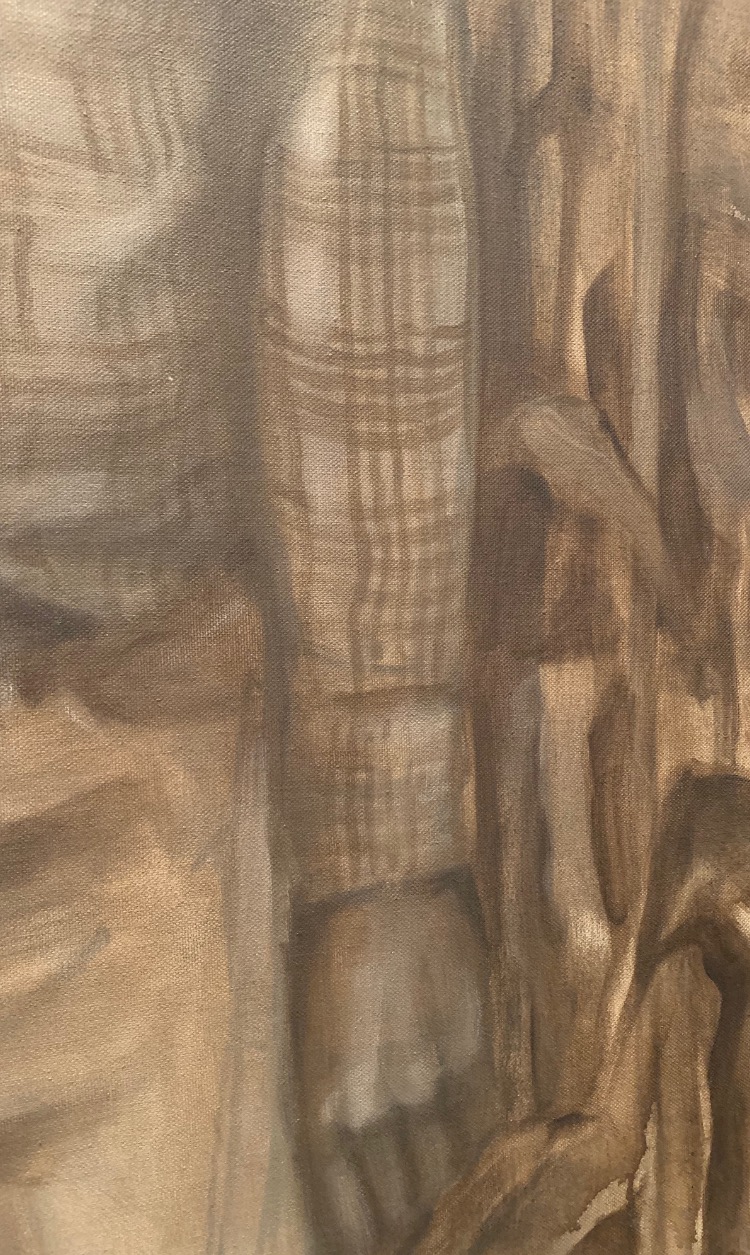
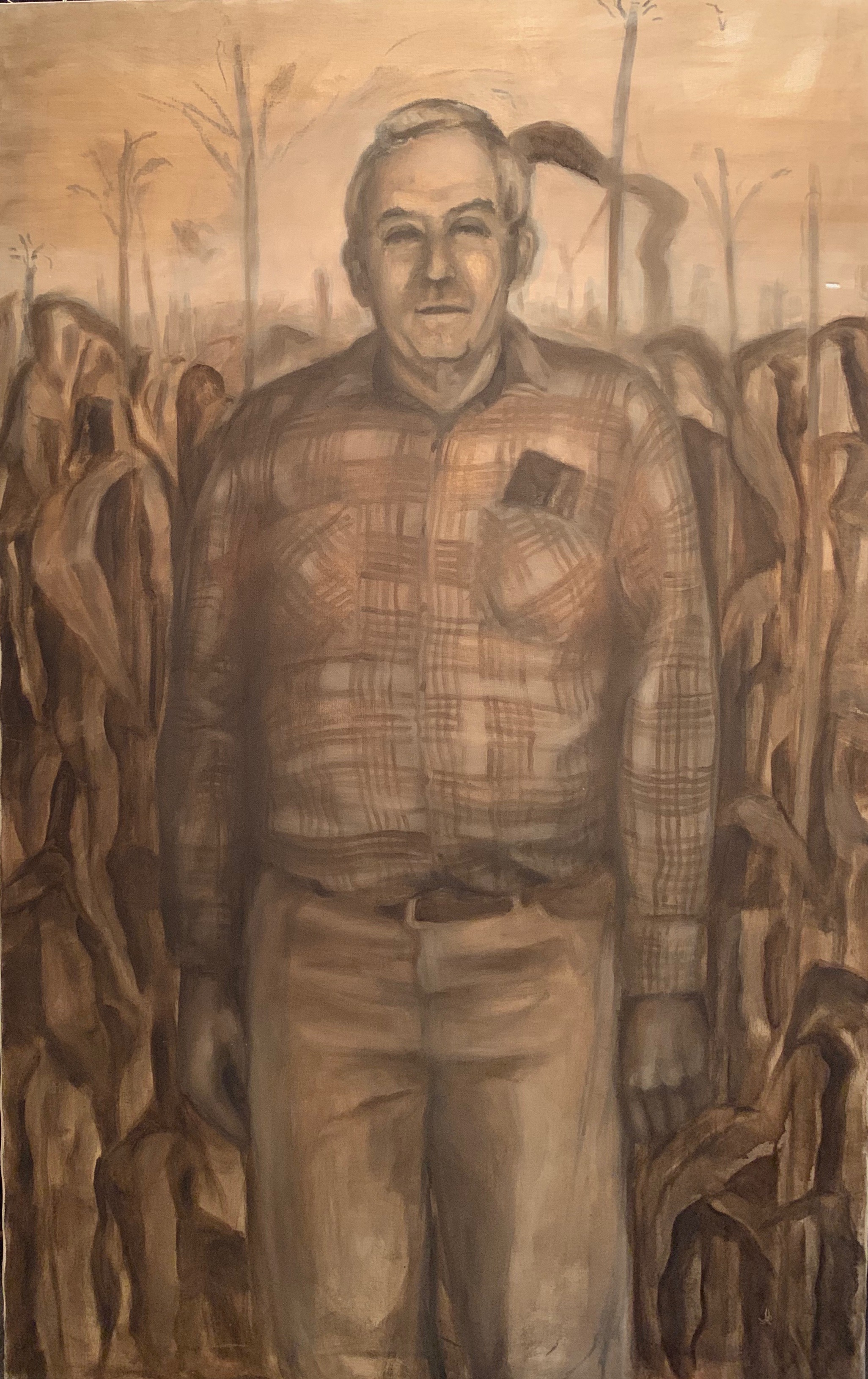
Many years ago, somewhere in the middle of the 1990’s, I painted a portrait of my dad. It is monochromatic and a fairly quick study. In the painting, he is either emerging or returning to the corn. Or both. I can’t remember why I painted him in the corn except that he was born in Iowa and wished his entire adult life to return to the small town where he grew up. Perhaps this is a painting about yearning. Perhaps it is a painting about returning home.

It occurred to me, when I found it while re-stacking paintings after the great studio flood, that I painted this when he was roughly the age I am now. For a fleeting moment I wanted to paint a monochrome self-portrait simply so I might place it across the room. We’d have a staring contest that reached beyond both of our lives.

I chucked the idea for many reasons but mostly because I had no idea what “field” I might emerge from or into? My symbolic return home would be…what? I am not connected to a single place, a tiny town in Iowa or, like Tom Mck, a ranch in California. I have been a wanderer.

I’ve always loved hands. They are, in many ways, more expressive than faces. They are not as guarded and rarely put on airs. My dad was a working man and has working man hands. He was proud of the work he did. It was hard and broke his body but he loved it. It was out of doors under the open sky. He started his career as a teacher and, although he never confessed as much, I think he hated teaching. The classroom was suffocating. He needed to get his hands in the dirt, feel the sun on his face. Even after he retired, as he aged, he sat on the porch in the mornings, he worked his garden or clipped his grass or cleaned his gutters; anything to be outside.

I had a dream many years ago that has stayed with me. My dad and I were free-falling through time. As we fell, he reached out his hand. I stretched out my arm, tried to grasp his hand, but in falling, we were just out of reach. In the dream I stared intently at his hand as I tried to extend my arm, tried to grasp his hand. I knew, if I was successful, if we could catch his hand, it might not stop our fall, but we, neither of us, would fall alone.

read Kerri’s blog post about COLUMBUS HANDS

Appreciate The Moment [on KS Friday]

The Final On-The-Road Haiku. A triple. Kerri’s chose this piece before we drove from home and it’s especially appropriate for this week.

We toured the basement.

“Look, this is my son,” he said.

Family picture.

He did not know me,

“He is his own man,” he said.

Dementia owns him.

The sweetest moment:

hearing tales of me, his son,

standing by his side.

Grateful on the album AS IT IS is available on iTunes

read Kerri’s blog post about GRATEFUL

grateful/as it is ©️ 2004 kerri sherwood