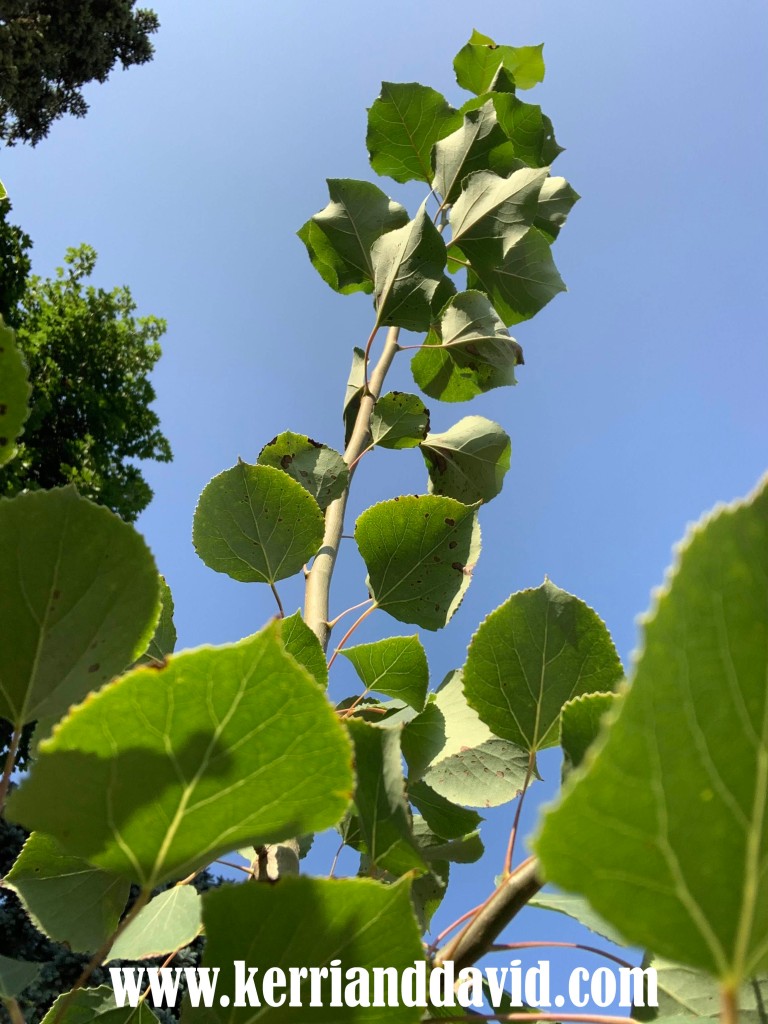
As you know, Breck-the-aspen-tree almost didn’t make it. Three years in a pot and one ill-conceived planting in the backyard left our poor Breck withered. A new spot in the yard restored Breck’s health but her growth was minimal. We removed dead branches. We assumed we’d stunted Breck’s growth so she would always be beloved and diminutive.
And then…It seems Breck is growing an inch every day. We began the summer looking down at her. Now, we crane our necks to see the new leaves sprouting at the top of her gangly reach. We joke that Breck is doing her Jack-In-The-Beanstalk imitation, though, at this rate of growth, it’s no joke. I confess to having a sit-down chat with her, cautioning her to not grow up too fast.
Last night I was awake most of the night. I thought about Breck and new growth. I thought about the cicadas, a surprising new form emerging from a discarded old body. I hoped against all hope that nature was talking to me, sending me a message. Be patient. All in good time. I’ve been sitting in the hallway for a very long time.
Perhaps, like Breck, I too am waiting for the optimal time, some intrinsic trigger and, suddenly and without warning or inhibition, I will reach to the sky. Perhaps, like the cicadas, in a moment of surprise, my new form will burst out of the old body, amazed at the sudden addition of wings.
In the meantime, I continue to do as I was taught: my job is to “put it out there”. The rest is out of my control [meantime: the intervening time. The hallway]. The operative word is “it”. It. I write and publish almost everyday. I paint and publish. We cartoon and publish. I toss resumes into the wind.
In the dark of night, thinking of aspen trees and cicadas, I ponder worthy questions. Breck needed assistance to move to new soil and then required recovery time. Storing energy for the right moment. The cicada lived underground until it felt an internal imperative to climb – an imperative that I imagine made no sense but had to be heeded just the right moment. For me, if nature is talking to me, it has me pondering what else – that I’ve not yet considered – might “it” be that I should “put out there”? Or better, does “it” matter at all? Perhaps all that I lack is the right moment. And there’s nothing to be done about that.
Although butterflies get all the headlines, the transformation of a cicada is equally astonishing. The cicada doesn’t emerge from a cocoon. It emerges from its own body. The outer shell, a crawling insect, splits and the new form, a miracle with wings, a flying insect, crawls out of its former self to greet the world.
It actually has two emergences. For most of its life it lives underground, feeding on the sap in tree roots. And then, one day, on a cue no scientist has yet discovered, all of the cicadas in the neighborhood crawl to the surface, climb into the air and light, ascend toward the sky, and attach to a tree or some other vertical surface. Once they are firmly attached, the second emergence begins. Like a snake shedding its skin, the cicada sheds its former…form, and enters the last chapter of life completely changed. Air-born.
I’ve never wondered if a butterfly turns and ponders the cocoon. A cocoon seems generic. An envelope. But each time I see the shell of a cicada I can’t help but wonder, as its new wings dry, before it is capable of flight, what it might think, perched atop the old form, staring at what it used to be. Did it know that wings were growing inside all along or is it a complete surprise? A reverse mummy, opening the lid of a body-shaped sarcophagus to venture into the upper regions.
I wonder if it knows the transformation to flight signals the end, only a few more weeks of life. The males begin to sing. The females click their wings. Partnering through an ancient call-and-response. The end of life. The fulfillment of purpose. The beginning of a new cycle of life.
It’s full, full, full of useful metaphors. The old shell appears as if it is hanging on for dear life when dear life was about to burst forth, unrecognizable. Transfigured. And, isn’t that usually the way of the scary new? The old, well-worn shape wants nothing more than to hang on for dear life to what it knows, what it has always been. It’s necessary for the new energy, the new form, to split the frightened shell, wrestle with itself to emerge, and discover life anew. Finally ready to fulfill its purpose, its reason for being.
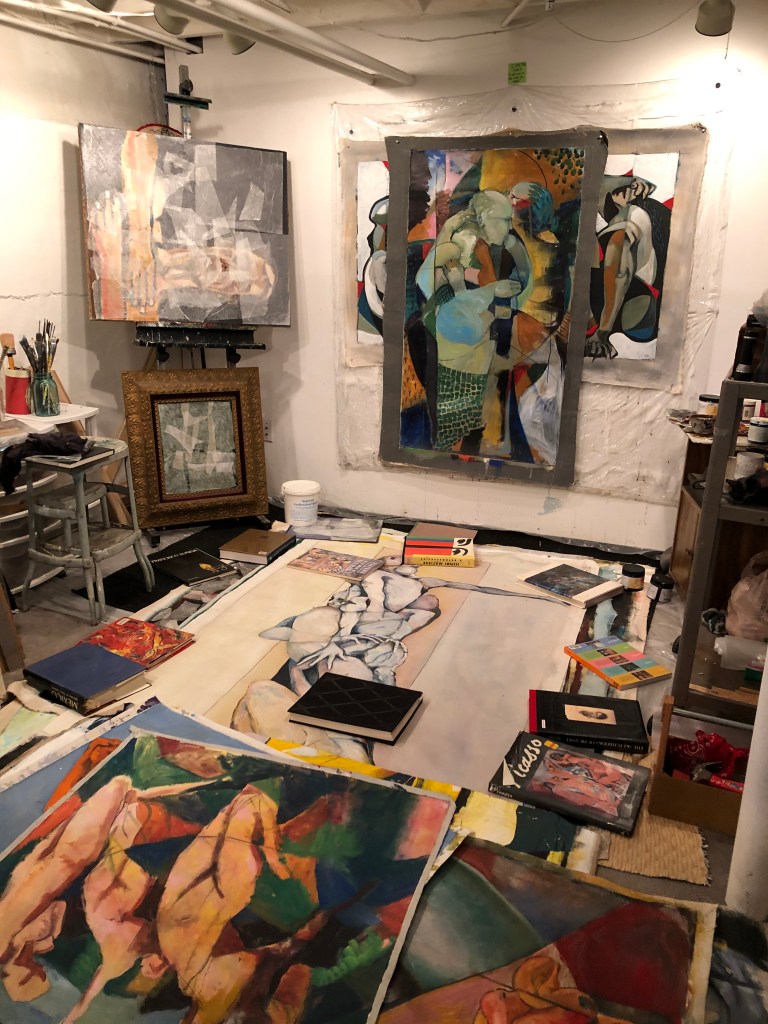
During the past weeks I have rectified a wrong that I did to myself. A few years ago, after several water disruptions in my basement studio, with the space in disarray and too full of stuff, I had a fit of “what-am-I-going-to-do-with-all-of-these-paintings. With no thought to the future, I rolled several of my canvases. There are many, many paintings so I made multiple heavy rolls. And then I stacked them. The stacking was my crime. The weight of the top rolls pressed those on the bottom. Left too long and the canvas warps; the paint cracks.
I feel as if I am emerging from a dream. The past. Dried flowers in springtime.
At breakfast on Monday, Liam asked if I had been painting. I blinked, not ashamed of my reply but mostly shocked at the truth of it. “I just finished a painting,” I said, “the first I’ve completed in three years.” Three years ago I rolled my paintings to keep them out of the water – to get them out of the way. Broken wrists, lost jobs, pandemic, an uncanny series of water issues…A pause. Or, I feared, a finish?
I carefully unrolled the paintings. Flattened the waves in the first canvas roll with books. I built successive layers of flat paintings, using the weight that caused the problem to my advantage. Opening the rolls was like taking a walk back through my life. Two of the rolls were paintings from the early 1990’s. A self portrait in orange on an Oregon beach. I recognized the paintings but had to reach to find the painter. Dried flowers. A dream. The past.
Kerri wrangled carpet tubes from a big box store. We cut them and carefully rerolled the paintings, now with a solid center so they cannot be smashed. We devised a strategy to stand the tubes, protected from any future water problem.
Emerging from the dream. Perfect timing. It is the season of renewal. Spring.
Posted on September 24, 2018 by davidrobinsoncreative
“Multiculturalism asserts that people with different roots can co-exist, that they can learn to read the image-banks of others, that they can and should look across frontiers of race, language, gender and age without prejudice or illusion, and learn to think against this background of a hybridized society. It proposed – modestly enough – that some of the most interesting things in history and culture happen at the interface between cultures. It wants to study border situations, not only because they are fascinating in themselves, but because understanding them may bring with it a little hope for the world.” ~ Robert Hughes
I read in my newspaper that tribalism is the new normal [insert eye roll here]. There’s nothing new in tribalism. Fear-full people lost in a very small Us-N-Them tale is as old as the old gods. It’s pulled out and paraded about when power structures are shifting.
I marveled at the utter absurdity of it. No one can deny that our airwaves and e-waves are choked with noisy proclamations of division and fear. However, it only takes a quick scan through the rest of my newspaper to grasp the undeniable reality of our situation: global markets, global economies, populations on the move, United Nations, NATO, WTO, multinational corporations, Bitcoin, international space stations, satellites, not to mention some of our greatest challenges like global warming, and invasive plant and insect species (made possible through global shipping and the necessity of sharing/exploiting resources). Take a stroll down the aisle of your local supermarket and educate yourself on the scope, depth and breadth of your food sources. Count the countries represented on the shelves.
Tribalism is not new. It was normal a few centuries ago. Nowadays it is a construct, an old dry log to toss on a fire to stoke divisions and create distractions. It’s a headline to sell newspapers. Division sells. Good theatre requires hot conflict. People are easier to control when divided. There’s nothing new there, either.
There is a truism in change processes: people hold on tightest to what they know just before releasing their fear and walking into the unknown future. They take a step back, temporarily entrench, before answering the call of growth and change. Call that tribalism if you must, or denial, or the conservative impulse. It’s a process step. “Age and stage,” as 20 likes to say.
What’s actually new? All the world is now a crossroads. People with different roots ARE coexisting – that, after all, IS the great experiment and central promise of these United States. Looking across the frontiers of race, language, gender and age – without prejudice or illusion – is the hope in our emergence. It is the cathedral we are building.
The other direction can only bring our decrease. And, as history has taught us again and again, that’s an ugly path. There’s nothing new in that, either.
Posted on January 14, 2017 by davidrobinsoncreative
“Our search for truth must be wide open, even when it takes us in directions we preferred not to go. This is the difference between propaganda and truth. Propaganda has a certain end in mind, and so it marshals and manipulates the ‘facts’ to support its conclusion. Truth weighs evidence, seeks proof, is appropriately skeptical of authoritarian claims, welcomes questions, and doesn’t fear dissent.”Philip Gulley, The Quaker Way of Living*
Kerri and I often read books aloud to each other. On cold winter days we sit beneath a blanket, Dog-Dog at our feet, BabyCat snoring by our side, sip coffee, and read. We like to discuss and compare perceptions, ask questions, and re-read passages for clarity or the simple poetry of the language. Sometimes we savor a book, moving through it slowly. Sometimes we devour a book and go back to reread especially potent sections.
“Propaganda resists close inspection and must continually be defended. Truth welcomes doubt and skepticism; indeed it is best served by questions, suggestions, and corrections.”
I am guilty of burying my head in the sand. My move to Wisconsin came with an intentional unplugging from the news. I was tired of pundits shouting each other down. I was weary and wary of conversations with family and friends that seemed to be territory-guarding regurgitations of our news-channel-of-choice. I was using the language given to me by my news sources and rolled my eyes at the predictable language leveled by the “other” side. One day as I raged at family members to pay attention to how they were being manipulated by their news source, I thought that it was probably a good idea for me to do the same. At the time, unplugging, stepping out of the toxic stream, seemed the only option to clear my mind.
“The search for truth begins within the seeker, for if we are not honest with and about ourselves, we will find it impossible to be honest with and about others.”
On a recent trip to Indiana, Bill and Linda suggested a book for us, The Quaker Way Of Living by Philip Gulley. They read it with their church group and found it compelling, especially given our corrosive political climate and collapse of civil discourse. We bought it when we returned home and a few days ago started reading it together. We couldn’t put it down. It asks some powerful questions. It doesn’t pretend to have answers [that, I’ve learned, would be the antithesis of the Quaker Way] but it does speak directly to the quandaries of personal and communal integrity in a climate of self-righteousness, blame, and distrust. It is hopeful and funny and places the onus of creating a better world squarely on the shoulders of each and every one of us. It reminded me that burying my head in the sand is not very useful while also affirming that their are options beyond planting a flag in the sand.
“To say a person has integrity means several things. Most commonly, we mean the person is honest, that his or her word can be trusted…. But there is another level of meaning that has to do with the integration of our values and lifestyle. In that sense, to say we have integrity is to say the separate parts of our lives combine to form a unified whole. What we believe is consistent with how we live. Our beliefs influence the work we choose, the way we use our time and spend our money, the relationships we form and the goals to which we aspire. This integration is critical for inward peace.”
While reading, I’ve been thinking a lot about a conversation I had a few years ago with Jim Marsh, one of the people I most admire in this world precisely because he walks his talk. He told me of an issue in his community that had deeply concerned him and that he’d been grousing about for long time. One day he’d had enough and to move forward he recognized that he had three options: First, to stop complaining (he said, “to just shut up.”). Second, to move away. Leave. Get away from the source of his irritation. That didn’t seem like a healthy option. The third was to strap on his boots and do something about it. To act instead of complain. But, (and here’s the reason why I adore him) not to act against, but to work to create what he wanted. His responsibility was not to fight or resist. It was to create.
“We preserve our integrity and wholeness when we are aware of what threatens it and then choose to act deliberately and prudently when tempted. When we fail to do this, we disintegrate, creating a chasm between who we are and who we wish to be.”
I practice tai chi and had the good fortune to have, for a few years, a master teacher, Saul, whose teaching transcended the specifics of tai chi. He was teaching me how better to live. One day, while I was in a fit of resistance, he quietly showed me the power of looking beyond my “opponent” and placing my focus, instead, in the field of possibility. I understood (intellectually) that the opponent was always of my own making and my dedication to having an opponent (inside or out) would always pull me off balance. In other words, as long as I invested in resistance I would always pull myself off balance.
“Integrity isn’t conditional…There is a seamless nature to integrity that transcends situations and relationships. Integrity does not present one face in public and another in private. It delights in transparency, having nothing to hide.”
Now, with my head freshly out of the sand, I understand Saul’s teaching beyond my thinking (I’ve had a lot of time to meditate on things with my head in the sand) and, taking my cue from Jim, I recognize that I have three options but only option-number-three holds the promise of integrity. The best news: no one creates alone…
*all quotes in this post are from the chapter on Integrity from The Quaker Way of Living by Philip Gulley










 The Direction of Intention