Update Your Model

InfinityI laughed when I read this phrase on Skip’s Power Point presentation:

“All models are false. However, some are useful.” Alan Kay

I spent years of my life reading books built upon the thought models of thinkers, consultants, physicists, mathematicians, artists, business people and spiritual thinkers. None of the models was true. Many contradicted other models. Models are only useful if they help us make sense of our days on this planet.

Culture is a thought model. Travel to another culture and you’ll spend some time being disoriented because you will have entered a different model for sense making. For instance, some cultures/models place the accent on the individual and others place it on the group. I come from a culture that celebrates the individual and my world was rocked in a culture that celebrates the group; the model was so different that I could not sense make anything and fell head long into “not knowing.” While stumbling about unable to make sense of the world, I saw my own cultural model for what it is: a useful model – not truth.

Art, in most of Western culture, is considered important if it breaks or disturbs the model. In most Eastern cultures art is considered important if it supports the model.  Neither is truth. Neither is right. Both are useful for sense making if you understand the model.

Language is a model. It is very useful model, wouldn’t you agree? Wade Davis is sounding an important alarm that is going mostly unnoticed: we are losing languages faster than species are going extinct. Each language lost is more than a lost collection of words; a language lost is an entire world lost. It is a mythology lost. A language lost is a way of seeing and engaging with the mystery that is lost. What is useful and unknowable (un-see-able) to other languages/models is lost forever.

Religion is a model. Science creates and constantly revises its models. Religion could learn a thing or two from science (and vice versa). Maps are models. For a terrific book on mind models, get Charles Hampden-Turner’s, Maps Of The Mind.

A study of history is a study of models that served as sense makers for a time but collapsed under the weight of updates. For instance, no explorer ever sailed off the edge of the world despite the unassailable model of the day. It turns out that the sun does not rotate around the earth though many people were hushed and crushed for going against the model of their day. Newton showed us that space and time were fixed and Einstein showed us that space and time are not only fluid but connected.

We get into trouble when we confuse our models with truth. No model is true. No model is right. This applies especially to the models that we carry within us: the mind models that lead us to believe that, “I can’t do it…” are false. My favorite model that is mistaken for truth shows up like this: “I’m not creative.” That is a model that is both false and not very useful. What might you need to do to reconsider your model and accept an update?

Go here to get my latest book, The Seer: The Mind of the Entrepreneur, Artist, Visionary, title_pageSeeker, Learner, Leader, Creator…You.

Go here for hard copies

Where’s Your Safety?

from my Yoga series

from my Yoga series

Bill said, “People must make time to smell the roses.”

We were talking about the stories, specifically the stories we tell that become self-made prisons. “It’s never made any sense to me!” he laughed, “I’ve never been able to work for anyone because the whole mindset seems like madness. For instance, I just talked to a man who believes he must work at his job for three more years so he might have a better retirement. He hates his job!”  He added, “I have a dear friend that sat down after a game of tennis and died of a brain aneurism. We never know, do we?” His question was actually a statement and I nodded my head in agreement. It’s never made any sense to me to give away this day of life for an idea of life in the future.

“Why do you think people do that?” he asked. Social norms. Expectations. Fear. Stability. There are many reasons. There are many good reasons. We have to feel safe. I used to tell groups that a child can’t play unless he or she feels safe. To the man holding on for retirement, trading today for a possible tomorrow makes him feel safe and a safety story is a necessity in a culture that has forgotten community. Without a tribe, people must fen for themselves and the sacrifice they make is their autonomy. It’s a paradox. It’s a story.

Bill and I tell a different story. I’m a terrible employee. I have too many ideas. I like to change things. I do my best work late at night or very early in the morning. The middle of the day, the normal working hours, are down time. Fog time. I feel safe by breaking patterns and changing rhythms. I feel safe when I don’t know what is coming. I value presence and feeling alive much more than retirement. I do not know what retirement means because my job has never been a thing that I do. To retire means to die. I’ll certainly do that someday but I see no reason to save up for it.

My story, my path is no better or worse than the man who gives up his today for tomorrow. We both create our idea of security and live from a set of assumptions that define a good life. We both make sense – we make it. Sense is not found like happiness is not found. Both ensue.

Bill looked at me and said, “Maybe asking why people give away today for tomorrow is not the right question. Maybe the right question is, ‘Do they know that they are making a choice?”

Go here to get my latest book, The Seer: The Mind of the Entrepreneur, Artist, Visionary, title_pageSeeker, Learner, Leader, Creator…You.

Go here for hard copies

Make Sense

'John's Secret' by David Robinson

‘John’s Secret’ by David Robinson

Several years ago, decades in fact, G was driving his car. A young boy sprinted into the street in front of his car and was killed. To this day, G holds himself responsible. Even though it was an accident, he cannot forgive himself for the death of the young boy. He blames himself. Forgiveness is beyond his reach.

This terrible accident has become the defining moment of his life. Rather, his search for understanding why it happened and his refusal of forgiveness has shaped his existence.

He is a kind man. He is generous. He is devout. He is very old, walks with a cane, moves slowly, cares for his ailing wife, always smiles, He is generous with his time and his resources even though his resources are very, very limited. He sings. He prays. He listens. He asks, “Why?”

“What if I had left the house a minute later? What if I had left minute sooner? What if I’d decided to stay home? How could I have been the instrument of that young boy’s death? What could I have done…?” He suffers because, for him, there can be no absolution.

What do you do when there is no answer to the question, “Why?” What do you understand about your life and the forces of the universe when there is no sense to be made? What do we do when the experiences of our lives betray the sense that we’ve already made?

We do what we always do. We do what is most human: we make sense. We create order so we might not have to experience the chaos. We make statements in the form of questions: “What kind of God would let this happen?” or, “Why me?” There are so many things that we cannot control so somewhere there must be a bigger picture, a greater intention, a man behind the curtain, a reason why. We say to ourselves, “There must be a right path, a rule, a law, a design that we must follow.” It is something to ponder: why is our greatest horror to be out-of-control? What if we danced with the mystery rather than tried to contain it?

“To understand” is a form of the control illusion. Do you believe you need to know how to do something before you do it? You don’t but without the control-illusion of “how” you’d come face to face with the reality that process is chaos. Chaos is uncomfortable. Things happen. Order is something that is made after the fact. “There must be a way!” “There must be a reason!” There is always a way but you won’t know it until you walk the path and turn around to see it. There is always a reason, but you create it. It is not given. Order feels good.

And, it is necessary. Giving order to our chaos, telling a story, is what makes us human. If you could boil my work in the world down to a single phrase, it would be this: we have experiences first and then we make meaning, not the other way around.

We make meaning, we contain to infinite, through the stories we tell. The choreography of the human dance happens between the poles of “no sense to be made of the mystery,” and “the need to understand why.” G is making sense of his life. I am making sense of my life. As are you and everyone you meet today.

[to be continued]

Go here to get my latest book, The Seer: The Mind of the Entrepreneur, Artist, Visionary, title_pageSeeker, Learner, Leader, Creator…You.

 Go here for hard copies

What Is Your Location?

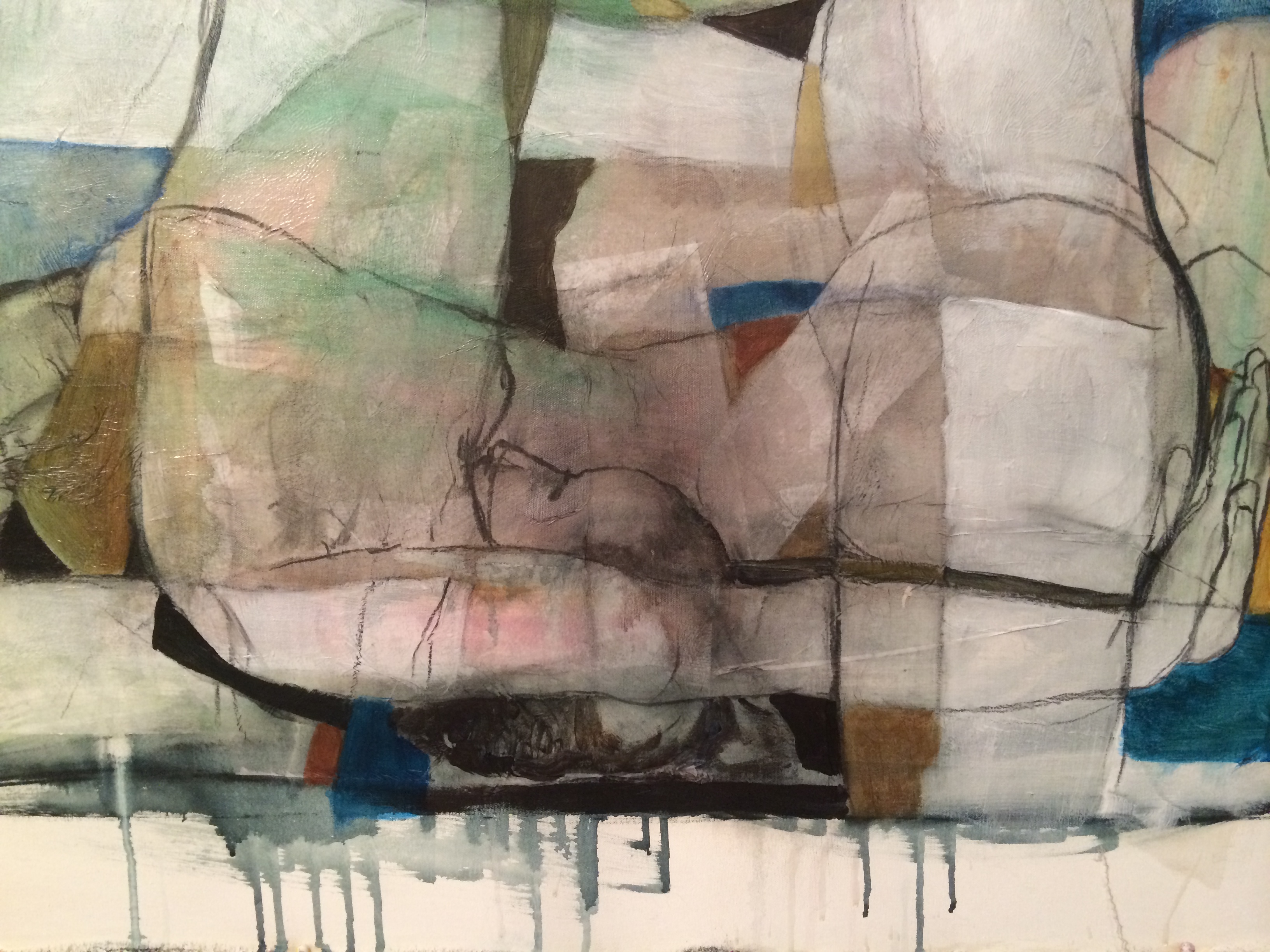
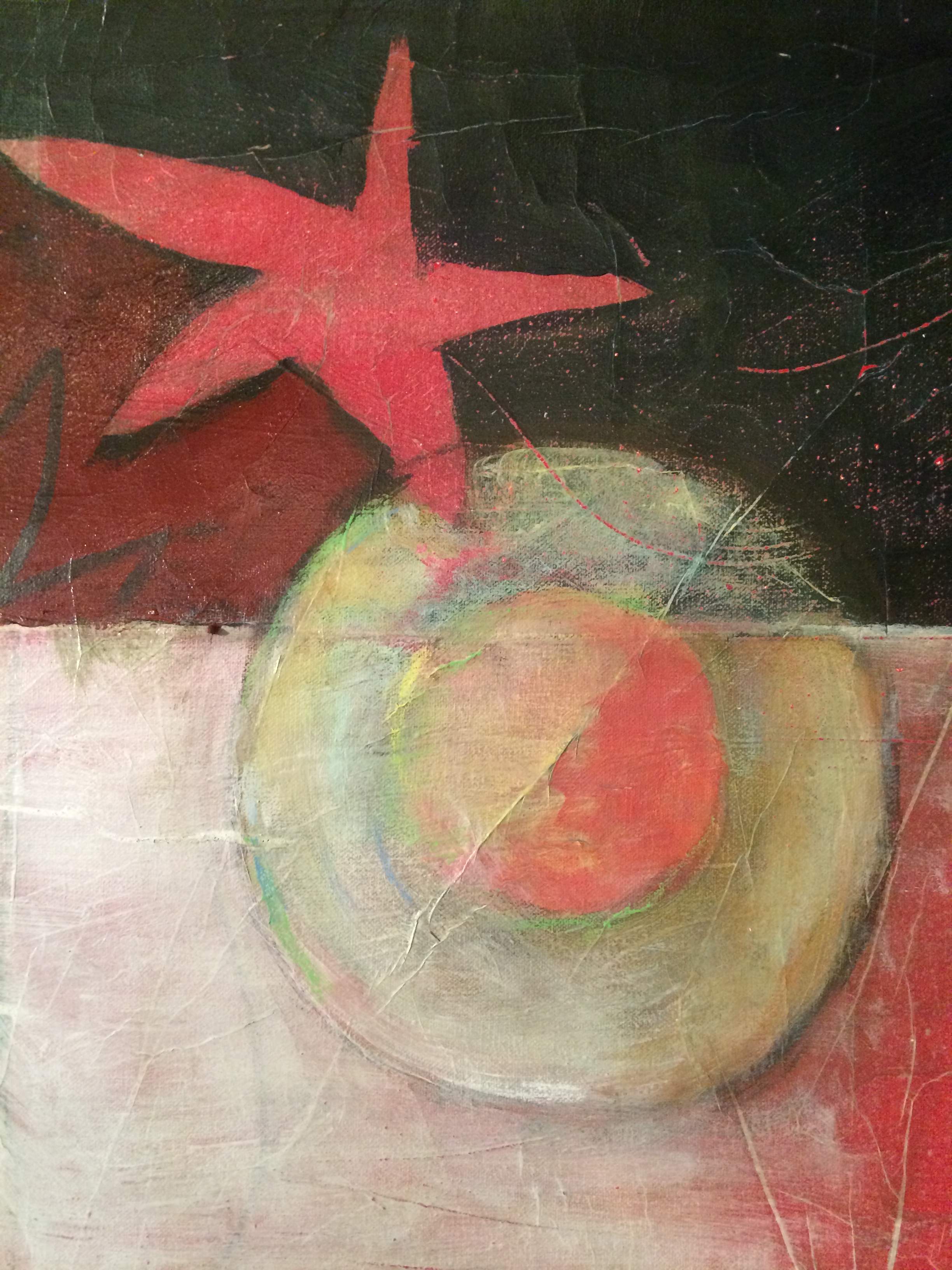
Yoga Series 7I painted this last year. For many months I’d been bored with my paintings – a sure sign of a coming growth phase – and was experimenting with new surfaces and techniques. This is the painting where all the experimentation came together. It landed and I was no longer wandering through an experimental geography but had found my new artistic location.

Just as I now locate myself within this arena, we are constantly locating ourselves in our lives. We physically locate ourselves in space (where do you like to sit when you go to the movies?) and we metaphorically locate ourselves, too. “Comfort zone” is a term of location, as is “preference,” as is “community.” “Safety” is a term of location. “Role” and “mine-to-do” are statements of location. What is yours to do? How do you know?

Some locations are given, others are chosen, and most are patterned. What we believe is possible to achieve is most often a pattern location. Children achieve according to how they are patterned; if you’ve never had an adult in your life attend college then you will most likely believe that college is out of your sphere. Economics are identity.

Once I led a group of students from the international center at their high school to the theatre where we were meant to rehearse a play. When we arrived at the theatre I walked through the front doors and the students stopped as if they’d hit a glass wall. They did! When I went back outside I asked what was wrong, a young woman from Cambodia said, “We don’t belong in there.” They’d learned that the theatre was for citizens; it was not for them. They could not imagine themselves there. I had to help them enter the building and locate themselves as “belonging.”

What you can or cannot imagine is a statement of location. Can you see yourself succeed? Can you see yourself painting a painting? Can you see yourself walking on the beach at sunset? How do you locate yourself? What do you imagine is possible?

Go here to get my latest book, The Seer: The Mind of the Entrepreneur, Artist, Visionary, Seeker, Learner, Leader, Creator…You.title_page


Listen To The Lake

I’m learning the many moods of Lake Michigan. It seems that each day it has an entirely different character. One day it is angry and steely grey with waves crashing against the shore like an ocean. One day it is as still as a Zen meditation. Regardless of the Lake’s mood, I am drawn to the shore to engage with it. Today I closed my eyes to feel the autumn sun radiate off the surface. “Don’t get used to this,” it whispered, gentle waves lapping the shore. “I know better,” I replied and smiled. The Lake is fickle. So am I.

With each new mood comes a dramatically different color palette that ranges through greens to turquoise to the deep purples. Sometimes the color is soothing, sometimes it is electrifying, and sometimes it is an assault. I’ve come to believe that the Lake’s color functions like a mask: it sometimes reveals the Lake’s mood and sometimes obscures it. Sometimes the Lake invites people to play and sometimes like the witch in a children’s book coerces people into a trap. The Lake teaches both faith and wariness.

Standing by the Lake I am reminded of something that I read many years ago. We are mostly monotheistic so we carry the expectation that we, like our god, have a single identity and are plagued by many moods. That is not true the world over. Cultures (like the ancient Greeks) that worship many gods have no such expectation. They allow that they have as many identities as the gods they worship. Their gods are forces of nature and they recognize that those forces are alive and expressing through them. The wind, the thunder, the quaking earth, the changing seasons, the rain, the fertile fields,…, are forces personified. Their moods, their emotions, are akin to being possessed by a god-spirit. Love is a possession. Inspiration is a visit with a Muse. They need to pay attention to their relationship with these forces (they have a relationship with these forces), to stay in the good graces of the fickle gods.

I’ve decided that the Lake is one of the old gods and I need to pay attention to my relationship with it. I like the notion that it has the power to inspire me, possess me, frustrate me, and fill me with laughter. I know its sister, the north wind, has the power to refresh me or chill me to the bone and, of course, the driver of the sun chariot graces me with warmth and music.

For a humorous look at the wonderful world of innovation and new ventures, check out my new comic strip Fl!p and the gang at Fl!p Comics.

Step Into The Dot

Kerri and I have a shorthand phrase for moving forward in life, carrying the lessons while leaving the yuck-story behind. We way, “Step into the dot.” Identity is a funny thing. People tote all of their past experiences with them, which means they tote their interpretations and patterns, too. “I can” or “I can’t” are statements of carrying past experiences forward into the future.

I used to guide an exercise called The Dream Police. The idea is that in five minutes your memory will be erased. On a piece of paper, capture the important stuff that you need to know about yourself. People most often write about their children or moments of epiphany. Some write names and phone numbers of loved ones with the idea that they will be able to make a call and re-learn who they are. We orient according to the past. In all the years I’ve led the exercise, only one person has written her dream life. She wrote about her triumphs and successes. She made it all up. In debriefing she said, “If my memory is going to be erased I get the chance to be anything I want to be. Why not tell myself that I am living a full and vibrant life. Why not be who I want to be instead of who I am.”

Too often we define our lives according to the yuck. We carry forward the reason “why I can’t” instead of standing in the field of possibility that is present in each moment. We can’t see the field of possibility through the lens of the past.

In his book, Aleph, Paulo Coehlo writes about a choice every person has the capacity to make: we can choose to orient our lives according to the past, according to what has been. Or, we can choose to orient our lives according to our soul. The past has little relevance when we orient according to our soul. The soul knows no past. It is like a puppy that is ready to play. The soul is in the present moment playing with possibility. Another word for “playing with possibility” is “creating.”

The opportunity is to orient to the present, not what has been. There is great power available when the past does not dictate the future. Rather, the present is ever-present, always new, always unknown, always learning itself. In the present moment, nothing is “known.” And, what specifically is unknown is…you. To orient to your soul is to step into the dot.

[to be continued]

For a humorous look at the wonderful world of innovation and new ventures, check out my new comic strip Fl!p and the gang at Fl!p Comics.

Join

It’s been 24 hours of ritual passage.

Last night, far off the beaten path in an old barn swept clean and decorated simply, Kerri, Kirsten and I attended a wedding. Well, truth be told, we attended the reception. Kerri played for a wedding and then we jumped in a car and drove several hours into rural Wisconsin. There was feasting and toasting and dancing. Old friends reconnected. New friendships were established. I’ve always thought that a good wedding was like a barn raising: a community comes together in support of the creation of something new, special, and useful. This was a good wedding. The ritual was filled with laughter (so I’m told). The barn was raised. Two became united into one. The elements of earth, water, air and fire are part of this union, nestled in a cornfield, a bonfire roaring, wine flowing, and the dancers breathing deeply.

With a few hours of sleep we were back in a church for services that included a baptism. A water ritual, a blessing of transformation; I’ve not attended many baptisms so I paid attention. I was delighted to realize that this water ritual is meant to welcome the new spirit into the community. The pastor kissed the baby on the head and said, “We have your back.” The congregation laughed and nodded.

Later, the congregation celebrated communion. I watched this ritual, too. “This is my body, take this and eat. This is my blood, drink….” This, too, is a ritual of joining. The community eats the god, they take the god into their bodies and in so doing become the god. They unify. They transcend. The bread is earth like the body is earth. It returns to dust. When alive, the body is fire. It eats, consumes, burns calories, and is constantly transforming. The air moves through the lungs, oxygen is carried through the body in the blood. The blood and body are water and fire and air and earth. “This is my body, take this and eat. This is my blood, drink….” The Makah literally consume their god, the whale. They hunt and eat their god. Actually, the god, the whale, chooses the worthy hunter to enact the ritual. The god feeds the people. The people resurrect the god. The indigenous people of the plains ate the buffalo in an agreement of death and resurrection. The god will feed you and, in exchange, you must perform the appropriate rituals to bring it back to vital life. It is a beautiful cycle.

Marriage. Baptism. Communion. Thresholds all. They lead to joining, belonging, and transcendence of the small self to participation with something much greater. Life honors life.

[910. Join me in inspiring truly powerful people. Each day I will add a new thought, story or idea to support your quest and mine.]

For a humorous look at the wonderful world of innovation and new ventures, check out my new comic strip Fl!p and the gang at Fl!p Comics.

Step Into Your Ordinary

Yesterday I had a moment that was truly surprising. It will not sound like much but to me it was profound. I was raking leaves and deeply appreciative of the fall and thinking of my life a year ago. The fall is a reflective time for me and the repetition of raking facilitates great mind wandering. Last year at this time my metaphoric house was ablaze from a fire that I’d lit. I was intentionally burning down everything that I knew. It was the second time in my life that I’d put a match to my life. One year ago the fire was burning hot and rather than run from it like I did the first time so many years ago, this time I stood in the flames. I’ve learned that the conflagration is total and to run only prolongs the burn. The fire will always catch the firestarter. It is better to embrace the path rather than choose it and then deny that it was a choice. So I stood still and burned.

I’ve already written too much about my months of wandering. It is enough to say that I had no map and was in a new geography. I drank deep from the cup of lost. I had great teachers, met some dragons, acted poorly, fought bravely and was blessed with an extraordinary guide and master who could only go so far with me. As is true in all great stories, the last mile I had to do alone. That’s the point of most transformational ritual: the community and guides can carry you only so far. Dying to the old form is necessarily a solo act. In the course of a single lifetime there are several cycles of dying and rebirth. The dying happens alone yet it always leads to rebirth, renewal, and a return to the community. The transformation of the community happens through the transformation of the members of the community and vice versa. It’s a cycle of renewal just as is the cycle of the seasons.

And this brings me to raking leaves. I was content. I was nowhere else and wanted to be nowhere else. I didn’t need to achieve anything or change anybody or facilitate a revelation for anyone – not even myself. There was no gap between me and my artistry or my work. I am my artistry. I am my work. My moment of profundity: I realized that I’ve stepped into my ordinary. I feel no need to defend or justify or explain or lie or glorify. I no longer need to be anything other than the raker of leaves, the painter of paintings. Peace. I understand that raking leaves and telling stories and painting paintings and dancing in the front yard and making dinner are all celebrations of life.

[906. Join me in inspiring truly powerful people. Each day I will add a new thought, story or idea to support your quest and mine].

For a humorous look at the wonderful world of innovation and new ventures, check out my new comic strip Fl!p and the gang at Fl!p Comics.

Meet At “We.”

Many years ago I was watching Johnny direct a play. It was one of Shakespeare’s though I can’t remember which play. Suddenly, in the middle of the rehearsal, he was overcome with the recognition that he and his actors where carrying forward a tradition. They were engaged in an artistic tradition that stretches back centuries. They were carrying the torch in this lifetime so that they might pass the flame to the next generation. Johnny’s passion and recognition was infectious and his cast dawned to the reality that they were in service to something greater than their small parts in a singular production of the play. They became priests and priestesses enacting the ritual story for all ages.

They found deeper meaning to their work. It mattered. They found connection to both the past (the tradition) and the future (the legacy). Their work rippled in time and came alive in the present moment because they suddenly understood who they were relative to the past and the future. They located themselves. This play was theirs to do. Their service to the play and the tradition defined their purpose. Their art was their gift to the community and the community the served transcended time: it reached into the past and stretched into the future.

This is the purpose of the arts: to locate us in time relative to our traditions and our legacy. The arts orient us to the question, “Who are we?” The arts do not answer the question, there is no single answer, but they facilitate an ongoing conversation and exploration of what it is to be alive as a member of a community.

Artists are the keepers of the communal narrative. When the artists no longer occupy the center, the narrative dissipates and so does the society. Rules and laws can hold the pieces together for a while but disparity and self-interest are inevitable. They are harbingers of communal collapse. A common narrative is the beating heart of a healthy community.

No plant can live without it root and neither can a community. No person can prosper alone. The purpose is never the “I.” Purpose requires a target so it is by definition the “We.” Greater purpose extends to the past and the future, just as the roots of a plant reach deep into the earth while the branches and leaves reach to meet the sun. This reaching, this connection to past and future that meets and grows in the present moment defines us. It is the two directions of mattering that meets in the moment of “We.”

(895. Join me in inspiring truly powerful people. Each day I will add a new thought, story or idea to support your quest and mine.)

For a humorous look at the wonderful world of innovation and new ventures, check out my new comic strip Fl!p and the gang at Fl!p Comics.

Live The Metaphor

884. Join me in inspiring truly powerful people. Each day I will add a new thought, story or idea to support your quest and mine.

It’s 3am and I am wide awake.

I have been goading Horatio for years to write a screenplay called 3am Man. It’s about a man who can’t sleep. He is troubled about the events of his life and his insomnia drives him to the streets and he makes a pass through the culture of the night. After months of walking through the underbelly of the world he finds peace and sleep. I think the story is Greek in scope. It’s Orpheus descending into the underworld. He’s torn to bits and resurrected (put back together again). It is Osiris, the same story from an earlier mythology. It’s a universal cycle of life.

Mythologies are not dusty old stories. They are metaphors of our personal stories, the stories of our lives. If you know how to read them they can be enormously helpful during times of being lost or alone. They can help orient you when life is spinning you around. In this lifetime we will all be torn to bits and put back together again, more aware, and usually with a new assignment. This is the story of the year past for me. I’m like the scarecrow in The Wizard of Oz. I lost my stuffing. Now, having been torn to bits and in the process of reassembly, I can help Horatio write his screenplay because I understand.

I used to work at this time of night. I found it peaceful to paint while the world slept. It’s almost as if the frenetic psychic energy of the daylight hours scrambled me. I found peace, clarity and an open channel in the quiet. Tonight, in this quiet, I am sitting in a house that is being pulled apart, the possessions of a lifetime pulled apart, put into boxes and divided among relatives. If I understand my mythology correctly, even this process of a life torn to bits will ultimately lead to reassembly somewhere down the road. New life will come of it. Energy will take another form.