“The heavier the burden, the closer our lives come to the earth, the more real and truthful they become. Conversely, the absolute absence of burden causes man to be lighter than air, to soar into heights, take leave of the earth and his earthly being, and become only half real, his movements as free as they are insignificant. What then shall we choose? Weight or lightness?” ~ MIlan Kundera, The Unbearable Lightness of Being
It’s too easy to boil life’s weighty decisions down into two easy choices. Go left or go right. Say it or don’t say it. Stop or go. It’s to imagine a kind of clarity that doesn’t really exist. Sink or swim.
I’ve been rolling the Japanese word, Mu, around in my head these past several months. Mu is a useful third choice, an escape from the imagined duality. It means, “Nothing.” Make no choice. When I berate myself, demanding an absolute answer to the question, “What do I do now?” I know to whisper, “Mu.” Decide not to decide. Stand still. Mu is a third way. The constant nest.
In Mu I’ve learned that frustration is a choice. And anger. When fear takes me by the throat, rather than choose to wrestle with it or attempt to control it (that which I cannot control), I ask myself to make a choice other than fight or flight. “Mu,” I whisper. Choose anything else.
I’ve learned that the weight of the burden is only a small part of what keeps a person’s feet on the ground. The greater part is how the burden is held – rather – when it is held. Future fear or past regret? Ah, there it is – another too easy choice, both crushingly heavy.
Mu. There is lightness in standing still, in choosing nothing. In nothing there is presence with what might seem a heavy burden. Instead of fearing what will be or grinding against what was, I am learning Mu. There is lightness of being in the midst of swirling turmoil, not unbearable, Mu, with feet both firmly planted on the ground, holding in my hands only what is…
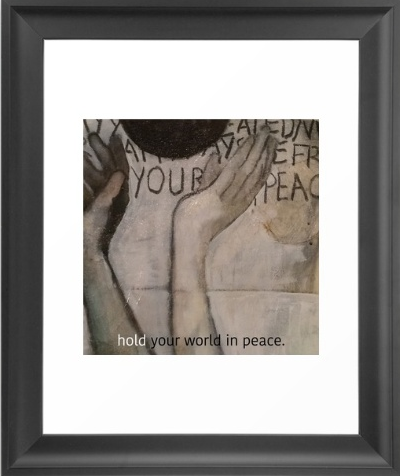
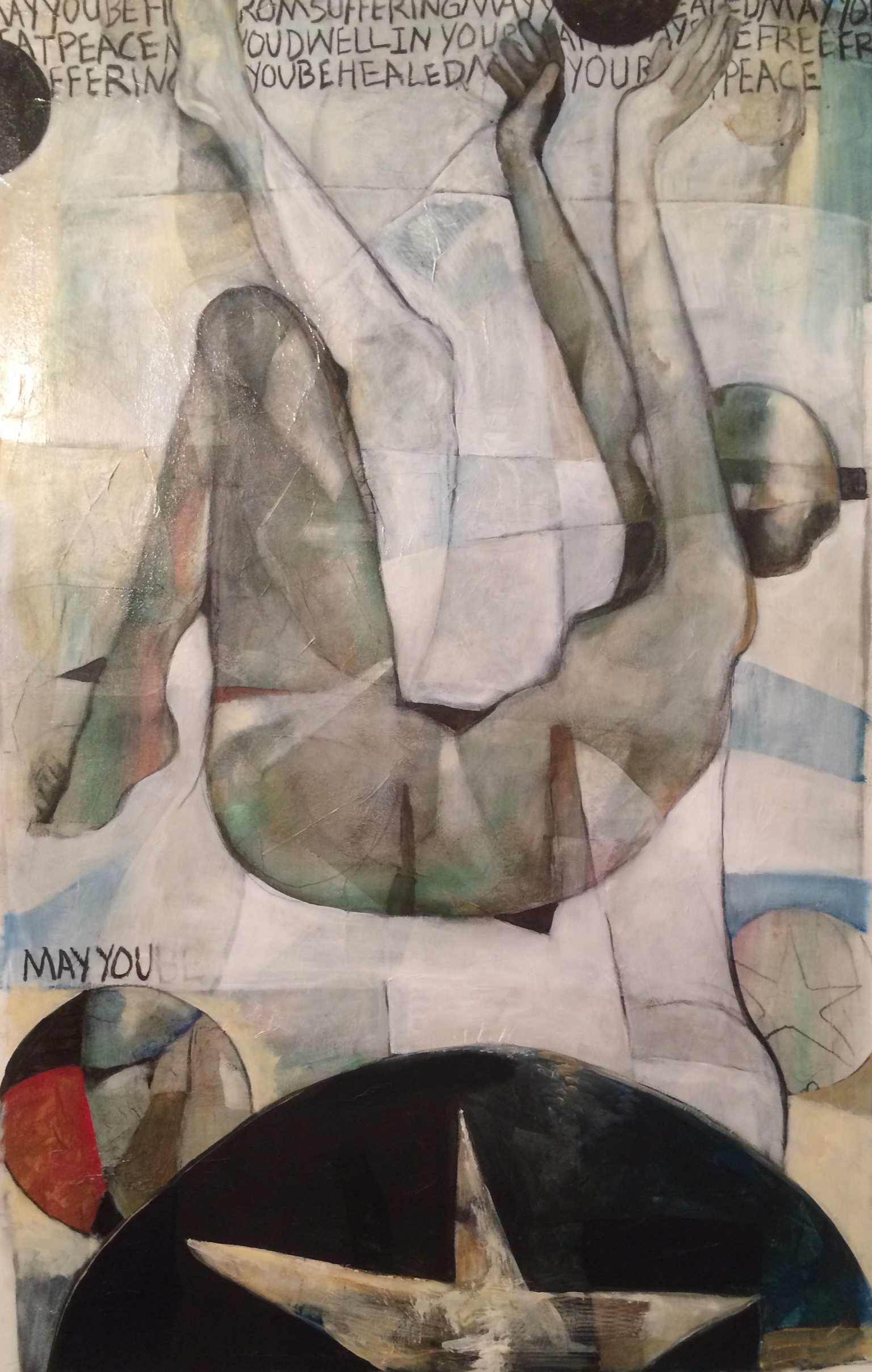
[this is one of my favorite of Kerri’s compositions]
Posted on January 14, 2017 by davidrobinsoncreative
“Our search for truth must be wide open, even when it takes us in directions we preferred not to go. This is the difference between propaganda and truth. Propaganda has a certain end in mind, and so it marshals and manipulates the ‘facts’ to support its conclusion. Truth weighs evidence, seeks proof, is appropriately skeptical of authoritarian claims, welcomes questions, and doesn’t fear dissent.”Philip Gulley, The Quaker Way of Living*
Kerri and I often read books aloud to each other. On cold winter days we sit beneath a blanket, Dog-Dog at our feet, BabyCat snoring by our side, sip coffee, and read. We like to discuss and compare perceptions, ask questions, and re-read passages for clarity or the simple poetry of the language. Sometimes we savor a book, moving through it slowly. Sometimes we devour a book and go back to reread especially potent sections.
“Propaganda resists close inspection and must continually be defended. Truth welcomes doubt and skepticism; indeed it is best served by questions, suggestions, and corrections.”
I am guilty of burying my head in the sand. My move to Wisconsin came with an intentional unplugging from the news. I was tired of pundits shouting each other down. I was weary and wary of conversations with family and friends that seemed to be territory-guarding regurgitations of our news-channel-of-choice. I was using the language given to me by my news sources and rolled my eyes at the predictable language leveled by the “other” side. One day as I raged at family members to pay attention to how they were being manipulated by their news source, I thought that it was probably a good idea for me to do the same. At the time, unplugging, stepping out of the toxic stream, seemed the only option to clear my mind.
“The search for truth begins within the seeker, for if we are not honest with and about ourselves, we will find it impossible to be honest with and about others.”
On a recent trip to Indiana, Bill and Linda suggested a book for us, The Quaker Way Of Living by Philip Gulley. They read it with their church group and found it compelling, especially given our corrosive political climate and collapse of civil discourse. We bought it when we returned home and a few days ago started reading it together. We couldn’t put it down. It asks some powerful questions. It doesn’t pretend to have answers [that, I’ve learned, would be the antithesis of the Quaker Way] but it does speak directly to the quandaries of personal and communal integrity in a climate of self-righteousness, blame, and distrust. It is hopeful and funny and places the onus of creating a better world squarely on the shoulders of each and every one of us. It reminded me that burying my head in the sand is not very useful while also affirming that their are options beyond planting a flag in the sand.
“To say a person has integrity means several things. Most commonly, we mean the person is honest, that his or her word can be trusted…. But there is another level of meaning that has to do with the integration of our values and lifestyle. In that sense, to say we have integrity is to say the separate parts of our lives combine to form a unified whole. What we believe is consistent with how we live. Our beliefs influence the work we choose, the way we use our time and spend our money, the relationships we form and the goals to which we aspire. This integration is critical for inward peace.”
While reading, I’ve been thinking a lot about a conversation I had a few years ago with Jim Marsh, one of the people I most admire in this world precisely because he walks his talk. He told me of an issue in his community that had deeply concerned him and that he’d been grousing about for long time. One day he’d had enough and to move forward he recognized that he had three options: First, to stop complaining (he said, “to just shut up.”). Second, to move away. Leave. Get away from the source of his irritation. That didn’t seem like a healthy option. The third was to strap on his boots and do something about it. To act instead of complain. But, (and here’s the reason why I adore him) not to act against, but to work to create what he wanted. His responsibility was not to fight or resist. It was to create.
“We preserve our integrity and wholeness when we are aware of what threatens it and then choose to act deliberately and prudently when tempted. When we fail to do this, we disintegrate, creating a chasm between who we are and who we wish to be.”
I practice tai chi and had the good fortune to have, for a few years, a master teacher, Saul, whose teaching transcended the specifics of tai chi. He was teaching me how better to live. One day, while I was in a fit of resistance, he quietly showed me the power of looking beyond my “opponent” and placing my focus, instead, in the field of possibility. I understood (intellectually) that the opponent was always of my own making and my dedication to having an opponent (inside or out) would always pull me off balance. In other words, as long as I invested in resistance I would always pull myself off balance.
“Integrity isn’t conditional…There is a seamless nature to integrity that transcends situations and relationships. Integrity does not present one face in public and another in private. It delights in transparency, having nothing to hide.”
Now, with my head freshly out of the sand, I understand Saul’s teaching beyond my thinking (I’ve had a lot of time to meditate on things with my head in the sand) and, taking my cue from Jim, I recognize that I have three options but only option-number-three holds the promise of integrity. The best news: no one creates alone…
*all quotes in this post are from the chapter on Integrity from The Quaker Way of Living by Philip Gulley








 The Direction of Intention