Let’s Dance

from my cartoon series, FLUB

from my cartoon series, FLUB

[This is a response to my dear friend who believes he will someday be worthy to call himself “artist.”]:

There is a trap that every artist must negotiate: the mistaken notion that “artist” is something you achieve. “Artist” is something that you are (and every child is an artist, wouldn’t you agree?). Art is an exploration of life. Some of the greatest artists in history had no training and no experience. They, like you, enjoy playing with various colors and never followed a textbook or a guideline because art doesn’t happen in textbooks and the only guideline that ultimately matters is in the heart of each individual artist. Art is an exploration. It is a relationship with the mystery.  It is not a prescription. There isn’t A WAY to do it. There is your way. And my way.

Art is an engagement with something intangible and if it is life giving to you, that is all that matters. It gives you life and you bring it to life and that dance of giving and bringing life is the work of the artist. The viewer will never see what you see because they do not have your eyes or your life experience or your heart. They will see what they see and interpret it according to their life-filters. Some people will love your work, some will hate it, most will be indifferent – and that has nothing to do with you. You can’t (nor should you) determine what they see. A painting or photograph is like a doorway: the viewer can step through or not. They can choose to engage or not to engage and you have no power over what they  do or see or feel or think. And, it is vital that you understand that because the notion that you can control what they think is the very thing that leads you to believe that you must pass some credibility test to be deemed and artist. When a viewer engages with a work of art they cease to be a viewer and themselves become an artist. Engagement with art is never passive; it is creative. They enter their own dance of creation. They become creators. Yours is to offer the doorway, not to push people through it.

In truth, the shadow side for the artist in trying to control what other people think is that they give away the essential thing: what they think. Why assign to other people the responsibility for your identity as “artist.” If they like your work then you are an artist? If they hate your work then you are not? You can either serve your heart (art) or please other people but you cannot do both.

I’ve coached a legion of people who set up great studio space for themselves and then never go into it. People are great at creating separation from what they want. They can get close to it (set up the studio) but fear stepping into it (picking up the paint brush) because the act of making art is the act of releasing control. It is to offer without condition. It can be a scary thing to give voice to what you see. It is vulnerable to show your heart to the world. It is only scary until you own it and get out of the trap of valuing other people’s point of view over your own.

Another form of separation is to say, “I will be an artist when I sell my work.” Selling your work does not make you an artist. Making art is what makes you an artist. Acceptance does not make you an artist. Making art is what makes you an artist. 10,000 hours in the studio will make you better and better (meaning freer and freer to express) but it will not make you an artist. You are an artist in the first hour and an artist in the 10,000th hour because you are exploring your relationship with life. You might have better mastery of the tools in the 10,000th hour but “master of tool” and “artist” are two distinctly different things. The  artist uses the tool, the tool does not define the artist.

You have the courage to go to your studio and get lost in an exploration of life through image and color. You lose all sense of time because your relationship with the mystery is pure. And, in the end of the day, who cares if anyone sees you as an “artist;” who cares if you see yourself as an “artist.” All that matters is that you enter that sacred studio place and open yourself to the mystery and say, “Let’s dance.”

Go here to get my latest book, The Seer: The Mind of the Entrepreneur, Artist, Visionary, title_pageSeeker, Learner, Leader, Creator…You.

Or, go here for hard copies and Kindle (Amazon)

Listen To The Window

'Dancing In The Front Yard' by David Robinson

‘Dancing In The Front Yard’ by David Robinson

I am having an ongoing conversation with a stained glass window. Perhaps it sounds odd but I sit in the choir loft, across the sanctuary from it, and I listen. Without fail a thought always jumps into my head. Sometimes it’s a feeling and if I continue to listen, if I ask questions, breathe and get quiet, great insight follows. My conversations may be the fodder for my next book.

Here’s what I heard today: Stories can be the heaviest thing on earth to carry.

“Tell me more,” I prompted, staring at the red robe that serves as the visual focal point of the window.

After a few moments I heard: So many stories are fear-based. Fear stories are the centerpiece of angst and depression. They are monumental. If you pay attention you can see the weight of the story that people carry. Closed hearts and furrowed brows, burdened shoulders and bad backs: these are bodies struggling under the weight of the story they carry. Stories of shame are heaviest of all.

There was silence but I know enough to sit still, breathe, and listen. After a few moments, the stained glass window continued: No one need carry the burden. Every story can be set down. A story can be left behind.

“Why do we choose to carry the weight?” I asked.

I heard almost immediately: Everyone has experiences that inform the arc of their lifetime. Sometimes it is a wound. Sometimes it is a loss. The story is often the account of “something happening to me.” It forms the great helplessness. It is the victim story. People confuse their life with the story they tell of their life. They think they need the story to know who they are. Without the story they would have to own their choices. Both feet in! They would have to start living. People are life, not the story they tell of life.

“People tell stories. It’s what they do!” I responded.

The light poured in through the window. The clouds must have shifted across the sky. I imagined the window was chuckling at me as I heard: Stories can be the lightest thing on earth to carry….

Go here to get my latest book, The Seer: The Mind of the Entrepreneur, Artist, Visionary, title_pageSeeker, Learner, Leader, Creator…You.

Go here for hard copies (it’s Amazon;-)

Step On The Stage

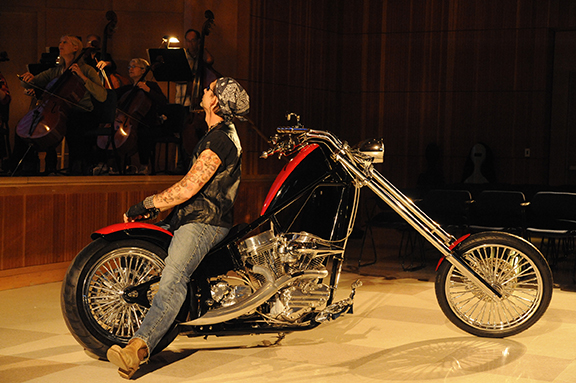
My performance with the Portland Chamber Orchestra of "The Creatures of Prometheus. I wrote and performed the piece for PCO.

My performance with the Portland Chamber Orchestra of “The Creatures of Prometheus.” I wrote and performed the piece for PCO.

Craig is laughing at me and with good reason. Through a post he asked a simple question about people building boxes around themselves. He issued a singular challenge: to apply what I found in his post to my writing. I’ve had more ideas and random ruminations than I know what to do with; he opened a big can. Before I let it go, I want to wade into the last part of his question: when did I know to create my stage?

Craig positioned a stage (showing up) as the polar opposite of a box (hiding) so I read his question as asking when I decided to show up. I’ve learned that a stage can be a strategy for hiding, too, so “showing up” means much more than just being visible.

Many actors get on the literal stage because they are seeking appreciation or approval from the audience. When anyone mounts a stage, either literal or metaphoric, to seek approval, they split themselves. By definition, they must hide their intention (to seek approval) and in so doing, give away their power and potential. Young teachers often pass through a growth phase in which they seek the approval of their students; they want to be liked and their need for appreciation neutralizes their capacity to teach. Ironically, in both cases (actors and teachers), the moment they cease splitting their intention they become great at what they do and their respective audiences can’t help but appreciate them. That’s the way power works.

Several years ago I was working with a corporate client who was upset because he felt uncomfortable with what he’d learned from my workshop. I told him that I could either serve him or please him but I could not do both. I understood that my job was to help him grow and that necessarily required discomfort. If he wanted to be pleased he needed to hire someone else.

I hid for years. I split myself for decades. My dear friend Roger once said that one day in his middle 30’s he realized that he was no longer becoming someone. He was someone. Everyone navigates the “becoming.” It is a necessary and vital growth phase and is often filled with fears of inauthenticity and split intentions; everyone wants to be appreciated and everyone sacrifices their primary intention in a mad dash for approval until one day, if they are lucky, they realize the only approval they need is their own. My revelation came when I was preparing to go on stage to perform. I realized that I was steeling myself against the audience (preparing to hide). I was assuming that they were going to judge me, which is a form of approval seeking. It was like a cold slap. I’d never had a bad experience with an audience. I’d only ever experienced appreciation and support and wondered why I was steeling myself against the very people I was there to serve. My need for approval dropped like a stone. I went on stage, perhaps for the first time in my life, present and powerful. I didn’t need anything from them. I was bringing life and my gifts to them and that was all that was required. My whole world flipped. No armor. No mask. No need other than to offer my gift on that day to that specific group. Whether or not they accepted my offer could no longer be my concern.

I’ve since learned that discomfort is a very valuable thing. It is present anytime learning and growing is happening. In fact, if there is no discomfort, there’s no learning. And that is the plaque nailed to my stage.

Go here to get my latest book, The Seer: The Mind of the Entrepreneur, Artist, Visionary, title_pageSeeker, Learner, Leader, Creator…You.

Go here for hard copies (Amazon;-)

Hear Your Words

[continued from EAT WELL]

Craig originally wrote a post about the boxes people construct around themselves and the alternative choice of creating a stage.  After his post he challenge me to enter the fray and muck about with boxes and stage and I’ve been pleasantly surprised at how much I have to say – I’ve followed the thread for a few days and will probably keep following it for a few more. It’s a rich exploration!

Yesterday I mentioned that I had the opportunity to work with Skip’s Human Centered Design class at the Illinois Institute of Technology in Chicago. I tossed the group into several exercises and experiences designed to help them understand how people story themselves. Specifically, we took a look at language as the building block of perception. We captured on video portions of my time with the students so rather than write about it, here’s clip from the day. [Note: the real riches start about 2:30 minutes in but I thought the students questions might be of use to set the stage so I left it in the cut. They’d just completed an exercise of misnaming things]. Let me know if you find some juicy bits about the boxes we build around ourselves and our attempts to “step outside of the box.”

[to be continued]

Go here to get my latest book, The Seer: The Mind of the Entrepreneur, Artist, Visionary, title_pageSeeker, Learner, Leader, Creator…You.

Go here for hard copies (it’s Amazon…)

Look Beyond The Box

one of my paintings (untitled) from the Yoga series

one of my paintings (untitled) from the Yoga series

[continued from SEE THE BOX]

Craig’s question is bigger than a single post can accommodate. He’s both reflecting and asking several questions about the boxes people construct around themselves, about building personal “stages” and what becomes visible to us when we open ourselves to life without editor or inhibition. He’s asking deep river questions about the assumptions we make when we look at others through the lens of our own experience. He asked about what I see from my stage and when did I know to create my stage. And, here’s the kicker question, “When was the last time you stepped up and saw something you didn’t know was there?”

I want to start with the last question first because I believe it colors all of the other questions. At this point in my life, there isn’t a day that passes that I don’t see something surprising or new. I know that sounds like a superficial dodge until you consider that it wasn’t always the case. Like everyone else, I was schooled in a long series of mistaken notions: 1) that people need to know where they are going before they go there, 2) people need to know what they are doing before they do it, 3) knowing is something that happens in the head, and 4) that truth is singular and knowable; believers in right/wrong paradigms are especially fond of this point.

It took a few years (okay, decades) to realize that “knowing” is a process and not an arrival platform and, therefore, no body knows. People build boxes around themselves because they think they must know what is unknowable. People build boxes around themselves because they think they must look a certain way or think what others want them to think. People build boxes around themselves in an attempt to control what they can never control. No one really knows where they are going (well, everyone knows where they are going but dying is an existential question – a topic for another post). No one knows what tomorrow will bring. As Marshall McLuhan wrote, people step into the future with their eyes in the rearview mirror. We make sense of today through yesterday’s eyes so we can only “know” what happened, not what will happen. The day before September 11, 2001 people walked into airports to greet their friends and relatives at the gate. And then, the very next day, like millions of people, I sat in front of a television and watched a plane fly into the World Trade Center. That day I understood that what I thought I knew was basically useless.

Each of us has, at one time or another, had a personal September 11th. People learn. They grow. They have experiences and then make meaning of their experiences. People change. Life is a moving target. At one point in my life I started my own school within a school. It was experiential and filled with filmmaking and theatre and performance art. At the beginning of that era of my life I thought I would run that school until I the day I died. Three years later, I was done with my exploration in education and I surrendered my cushy tenured position and ran for the air of uncertainty. People story themselves according to inner imperatives through lenses of past experiences. The idea that we are primarily rational and reasonable is…not rational or reasonable.

At some point, when you cease thinking you know stuff, your eyes open. You see beyond what you think. Everything is surprising beyond the dull-wit of thinking. Thinking (a language-based activity) will always be an abstraction. Put a word on something and you delude yourself into thinking that you “know” what it is. This is especially heinous when applied to other people. People build boxes around themselves because of the words placed on them or the words they place on themselves.

Mostly, people build stages for the exact same reason. Saying, “I’m not going to be influenced by others; I’m going to act independent of others” is also a delusion constructed from notions of “knowing” or trying to determine how others will see you. Most stages are constructed from the desire to control. Sometimes the biggest box looks like a stage.

When you no longer need to know anything, you see surprising things everywhere you look.

[to be continued]

Go here to get my latest book, The Seer: The Mind of the Entrepreneur, Artist, Visionary, title_pageSeeker, Learner, Leader, Creator…You.

Go here for hard copies (it’s Amazon, don’t be afraid;-)


See The Box

‘The Box’ by Kerri Sherwood from her album Blueprint for My Soul Craig sent me a link and a challenge. The link was to his recent blog post, Break Down The Box. It’s about how people build boxes around themselves. “Instead of building a box that may later require extra work to remove,” he writes, “I suggest building a stage.” What a great image! His challenge to me was to apply it to my writing. He texted, “It’s relevant to your general topics.”

My question back to Craig was about the word “apply.” Is he challenging me to write about boxes and stages? Is he challenging me to build a stage and stand on it? Both? His challenge came on a day that I said aloud to myself and the universe, “I’m feeling boxed!” His timing was impeccable.

Self Cut outWe’ve not finished our correspondence so I don’t yet know what he means by applying it to my writing. To stall I will write what I know about boxes:

1) Everyone has one. Don Miguel Ruiz writes that we come into this earth as free, uninhibited spirits and then the adults around us begin impressing rules and random philosophy upon us. They teach us constraint and we comply. We are a pack animal, after all, and must operate within the greater needs of the community. That’s why there are traffic lights and a proper fork to use when eating a salad. Our greatest need is to belong; The GAP, Old Navy, or Abercrombie & Fitch could not exist otherwise. The need to belong is the driver behind box building. It’s a paradox. Somewhere amidst all of the compliance we begin to assume that we are no good or start making comparisons to others or create standards of perfection that are impossible to inhabit. So, we build a box called, “should be”. The paradox is that, in order to belong, our action is to hide.

2) Growth comes from constraints. No box is built without the need to deconstruct it. That is the opportunity of the box. Joseph Campbell would call box deconstruction The Heroes Journey. In the great mythologies of the world there is a tension between The Right Hand path (what society expects you to do) and The Left Hand path (following your bliss). Both are necessary and, in the end, we all must find the middle way between the two paths. The middle way is known in mythological terms as The Holy Grail. Bliss always needs the participation of others. We are pack animals and need the pack to know where we fit.

3) Constraint is necessary for creative fulfillment. School boards around the nation have the misguided notion that art is the absence of rule and/or discipline. It must be a requirement of school board participation to attend the symphony without recognizing that the musicians on stage have given their lives to discipline and constraint. It might come as a surprise to most people but artists outstrip the military in rule adherence and rigid discipline. The disconcerting aspect for the school board is that the rules and discipline of the artist are self-imposed. They are inner imperatives. Artists do not need a drill sergeant. They need constraints to push against, boundaries to overcome, rules to challenge, and patterns to disrupt. Watch a kid on a skateboard try to learn a new skill (oh, yes – they are artists, too). They might break their arm in the process but the break will just fuel the need to improve.

4) No one sees clearly their box. To return to a Don Miguel Ruiz-ism, we are the stars of our own movie and can never know the movie of another person (and they can never know our movie). The paradox is, of course, as the star of your movie you never get to see your life from any meaningful perspective until lots of time affords you some distance. Even then, you’ll interpret your movie through the lens of having lived it. If you have an inner monologue, you are center stage of your movie and your movie is your box.  Here’s the beautiful thing about movies/boxes: they all come with flaws and the flaws are almost always the location of the opportunities. As I recently learned, the Amish intentionally place a small flaw in every quilt because they believe that the flaw is what lets the spirit in. The same might be said of boxes.

I’ve been privileged in my life to work with and direct a bevy of actors and most had to learn to stand on a stage. In fact, the stage frightens most of the really good ones. They understand the power of being seen, the responsibility that comes with visibility. It is simply this: be present without the need to control the thoughts or emotions of another. Be present with them. Offer them a story without the self-protection of trying to control what they see. All stories are maps out of boxes. Or, more to the point, stories are maps out of one layer of box to a lesser layer of box. So:

5) Boxes are like onions. A stage is merely a layer.

Go here to get my latest book, The Seer: The Mind of the Entrepreneur, Artist, Visionary, title_pageSeeker, Learner, Leader, Creator…You

Go here for hard copies or Kindle

Where’s Your Safety?

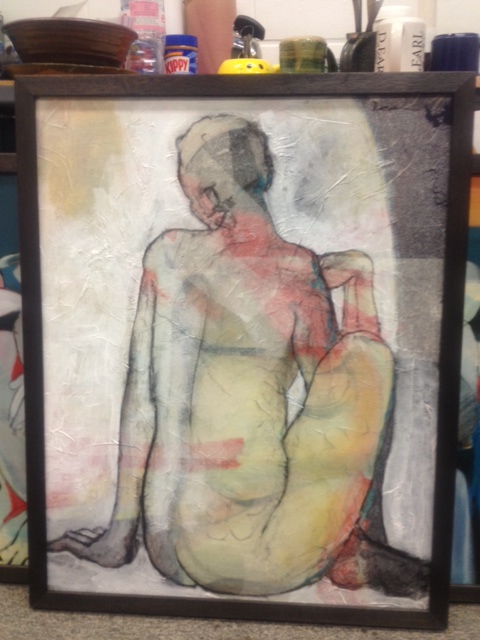
from my Yoga series

from my Yoga series

Bill said, “People must make time to smell the roses.”

We were talking about the stories, specifically the stories we tell that become self-made prisons. “It’s never made any sense to me!” he laughed, “I’ve never been able to work for anyone because the whole mindset seems like madness. For instance, I just talked to a man who believes he must work at his job for three more years so he might have a better retirement. He hates his job!”  He added, “I have a dear friend that sat down after a game of tennis and died of a brain aneurism. We never know, do we?” His question was actually a statement and I nodded my head in agreement. It’s never made any sense to me to give away this day of life for an idea of life in the future.

“Why do you think people do that?” he asked. Social norms. Expectations. Fear. Stability. There are many reasons. There are many good reasons. We have to feel safe. I used to tell groups that a child can’t play unless he or she feels safe. To the man holding on for retirement, trading today for a possible tomorrow makes him feel safe and a safety story is a necessity in a culture that has forgotten community. Without a tribe, people must fen for themselves and the sacrifice they make is their autonomy. It’s a paradox. It’s a story.

Bill and I tell a different story. I’m a terrible employee. I have too many ideas. I like to change things. I do my best work late at night or very early in the morning. The middle of the day, the normal working hours, are down time. Fog time. I feel safe by breaking patterns and changing rhythms. I feel safe when I don’t know what is coming. I value presence and feeling alive much more than retirement. I do not know what retirement means because my job has never been a thing that I do. To retire means to die. I’ll certainly do that someday but I see no reason to save up for it.

My story, my path is no better or worse than the man who gives up his today for tomorrow. We both create our idea of security and live from a set of assumptions that define a good life. We both make sense – we make it. Sense is not found like happiness is not found. Both ensue.

Bill looked at me and said, “Maybe asking why people give away today for tomorrow is not the right question. Maybe the right question is, ‘Do they know that they are making a choice?”

Go here to get my latest book, The Seer: The Mind of the Entrepreneur, Artist, Visionary, title_pageSeeker, Learner, Leader, Creator…You.

Go here for hard copies

Make Sense

'John's Secret' by David Robinson

‘John’s Secret’ by David Robinson

Several years ago, decades in fact, G was driving his car. A young boy sprinted into the street in front of his car and was killed. To this day, G holds himself responsible. Even though it was an accident, he cannot forgive himself for the death of the young boy. He blames himself. Forgiveness is beyond his reach.

This terrible accident has become the defining moment of his life. Rather, his search for understanding why it happened and his refusal of forgiveness has shaped his existence.

He is a kind man. He is generous. He is devout. He is very old, walks with a cane, moves slowly, cares for his ailing wife, always smiles, He is generous with his time and his resources even though his resources are very, very limited. He sings. He prays. He listens. He asks, “Why?”

“What if I had left the house a minute later? What if I had left minute sooner? What if I’d decided to stay home? How could I have been the instrument of that young boy’s death? What could I have done…?” He suffers because, for him, there can be no absolution.

What do you do when there is no answer to the question, “Why?” What do you understand about your life and the forces of the universe when there is no sense to be made? What do we do when the experiences of our lives betray the sense that we’ve already made?

We do what we always do. We do what is most human: we make sense. We create order so we might not have to experience the chaos. We make statements in the form of questions: “What kind of God would let this happen?” or, “Why me?” There are so many things that we cannot control so somewhere there must be a bigger picture, a greater intention, a man behind the curtain, a reason why. We say to ourselves, “There must be a right path, a rule, a law, a design that we must follow.” It is something to ponder: why is our greatest horror to be out-of-control? What if we danced with the mystery rather than tried to contain it?

“To understand” is a form of the control illusion. Do you believe you need to know how to do something before you do it? You don’t but without the control-illusion of “how” you’d come face to face with the reality that process is chaos. Chaos is uncomfortable. Things happen. Order is something that is made after the fact. “There must be a way!” “There must be a reason!” There is always a way but you won’t know it until you walk the path and turn around to see it. There is always a reason, but you create it. It is not given. Order feels good.

And, it is necessary. Giving order to our chaos, telling a story, is what makes us human. If you could boil my work in the world down to a single phrase, it would be this: we have experiences first and then we make meaning, not the other way around.

We make meaning, we contain to infinite, through the stories we tell. The choreography of the human dance happens between the poles of “no sense to be made of the mystery,” and “the need to understand why.” G is making sense of his life. I am making sense of my life. As are you and everyone you meet today.

[to be continued]

Go here to get my latest book, The Seer: The Mind of the Entrepreneur, Artist, Visionary, title_pageSeeker, Learner, Leader, Creator…You.

 Go here for hard copies

Leap Or Show Up

734. Join me in inspiring truly powerful people. Each day I will add a new thought, story or idea to support your quest and mine.

My inner sociologist shared his notes with me. He tugged on his sweater and pushed his glasses back onto the bridge of his nose before positing that personal edges only come in two varieties. Both varieties, he asserts, fall under the single category of “where the known meets the unknown.” Just as the sea meets the shore, the known meets the unknown in a convergence of elements. He told me that it makes no difference whether you are a sea or shore dweller, the other place, the unknown place, marks the line between comfort and discomfort. It also marks the line between stasis and growth. Stay in the known and stagnation is a certainty. Put your toes in the water or your fins on the shore and you will learn something new. I nodded my head. I agree with his assertion.

He tapped his pen on his yellow pad (my inner sociologist eschews technology) as he knit his brow and told me that stepping across the line into the unknown defines the first variety of edge. He labeled this first variety of edge, “The Leaping Point.” Apparently we visit the leaping point many times before actually leaping. We know what we need to do long before doing it – yet we pretend that we don’t know what we need to do. He explained that the most common mistake we make is to think that the discomfort comes from stepping across the edge; it doesn’t. The discomfort comes before the step. The discomfort is what drives us to finally do the thing we know we need to do. The discomfort comes from delaying the step. The step is liberating. The step transforms the discomfort.

He cleared his throat before telling me the second variety of edge comes from facing the thing we fear the most: being seen (note: fulfilling your potential is a subset of being seen). Being seen is a mirror-action to the first variety of edge. In this variety, the step is not from the known into the unknown; it is a step from the unknown into the known. He explained that the unknown in this case is the accumulated clutter of who we think we “should be;” we reject who we are. And then, one day, when we can no longer sustain the mask, we have to pull the mask off and reveal who we really are. We have to step into who we know ourselves to be. The transformation is from unknown to known.

He smiled, pulling his glasses from his face, and said, “It is really quite elegant if you think about it. Leap or Show Up. Those are our only two edges.”

Stop Pushing

633. Join me in inspiring truly powerful people. Each day I will add a new thought, story or idea to support your quest and mine.

I love when lessons come in clusters. Sometimes it seems the week has a theme that will keep coming until I pay attention.

This morning, Saul-The-Chi-Lantern gave us an article from a magazine about yoga injuries. “It’s never good to push too far, to try and be a super person,” he said. He asked us to face the mirrors in the room and guided us though a series of minimal movement exercises. “Find the edge of your movement and learn that edge.” As we moved through the exercises he told stories of dancers and martial artists that left their center, that strained their bodies beyond what was natural and sustained career ending injuries. He told us of a doctor he once knew that treated joint and spinal injuries with the minimal movement exercises we were doing in class. “The edge moves. You gain flexibility by finding the edge, working with it, and not by forcing yourself past it.”

“Power comes from relaxation, not through resistance,” he said as he demonstrated a martial arts move. “If someone punches, I am most effective with the least amount of energy,” he said, showing a simple twist of his arm to deflect a blow. To meet the force with force will knock me off center. It will hurt!” he laughed. Power is not resistance. Power is relaxation.

Earlier this week I worked with a class of entrepreneur’s preparing for their investor pitches; they were working really hard to be memorable. They were tense, pushing. I told them that in a past life I used to audition actors, sometimes I’d see dozens of people in a single day. I told the class that I’d never remember the actors who worked hard, who tried to get me to remember them; the actors I remembered where simple, honest, centered, and clear. The actors I remembered were relaxed. Minimal effort. Easy. Powerful. The actors I remembered were honest.

Yesterday, Judy-Who-I-Revere, after listening to my tale of woe said, “You don’t need to work so hard. You already have everything you need. Relax; you can stop pushing.”

When Saul started his lesson this morning I smiled, thinking, “Alright already! I hear it! I’ll stop pushing. I will relax.” I am a slow study and sometimes it tickles me that I make the universe work so hard to teach me….