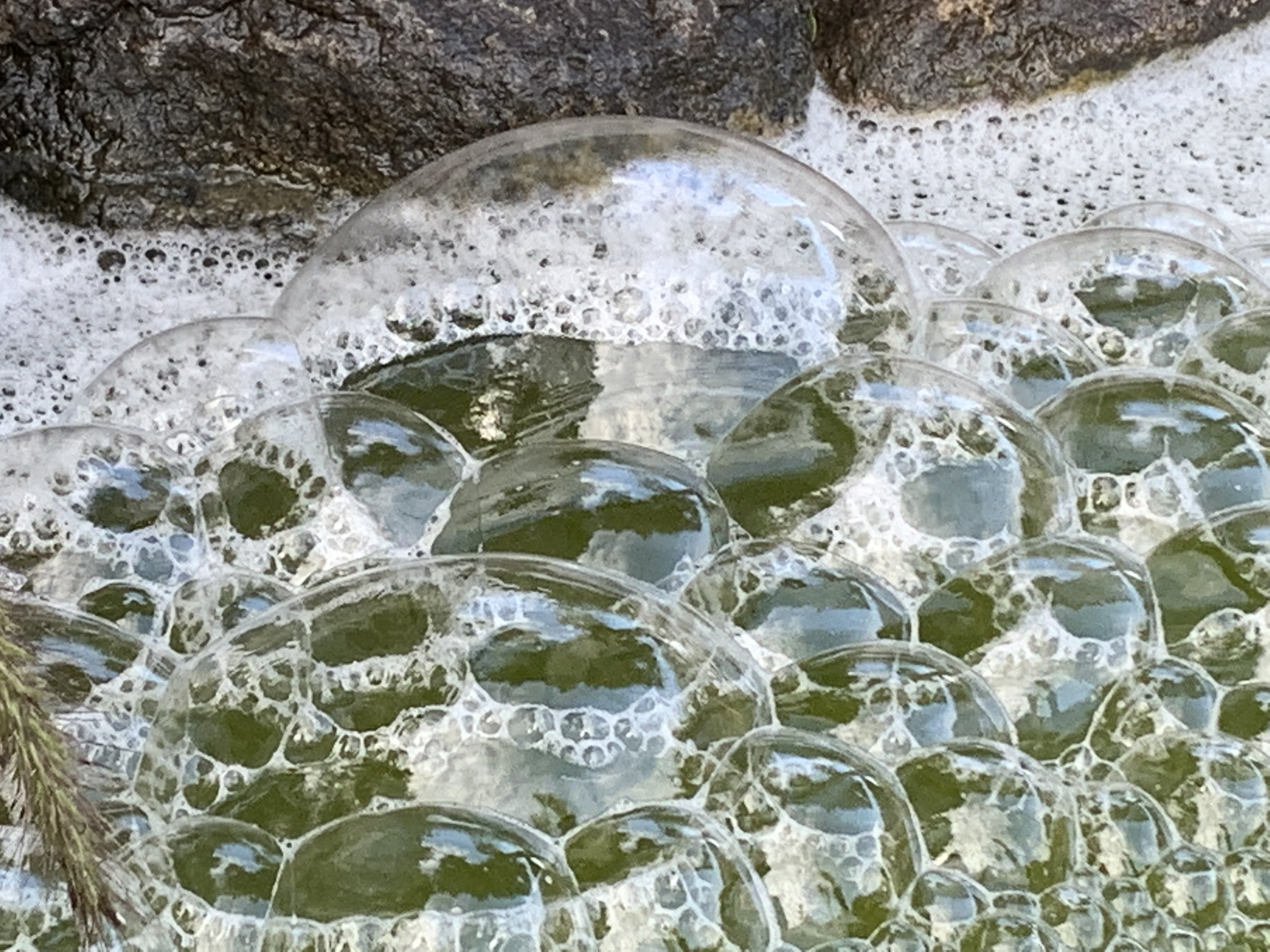
Tend The Pond [David’s blog on Two Artists Tuesday]

She called it The Big Dig. She always wanted a pond in her back yard so she threw a party, invited friends to bring shovels, and the pond was born. I flew in for The Big Dig since we’d only just met. Early in the day we went to a local landscaper and collected a trailer load of stone. Ted ran power from the garage to the dig site.

A mass of people arrived with shovels. Mudslides were served. People laughed. And, in less than 15 minutes the hole was dug, the liner installed, the pump secured, the stones placed and the hose was busy with the inaugural filling. We cheered when the pump was plugged in and the fountain began to bubble.

The Big Dig was a ceremonial so-long to the past and a hearty welcome to the future. It was the next day, sitting in the sun, that Kerri let the “m” word slip (marriage); she blushed and back-peddled so hard I fell out of my chair laughing. When I could breathe again I confessed that, at that very moment, I too, was thinking about the “m” word. It was the day after the Big Dig that I understood I was about to uproot my life from Seattle and move east.

Each spring when I clean the pond, repair it, and ready it for the summer, I revisit the ceremony. In fact, caring for the pond has become for me a ceremonial revisit to that line between past and future.

Each fall, when the pond begins to ice-over and I am forced to pull the pump, filters and fountain, tucking it in for the winter, I have a rush of quiet thanksgiving. A new life. A second chance.

A decade of seasons has rolled by since The Big Dig. There have been plenty of changes since that day. Dogga arrived and ran deep velodrome paths around the pond, forcing us to lay stone to prevent him from carving a full moat with his racing circles. We put up a fence. We’ve planted grasses. Breck-the-aspen tree found a forever spot and is entering her teenage years. The Covid epoch made us focus on our backyard. We made it our sanctuary.

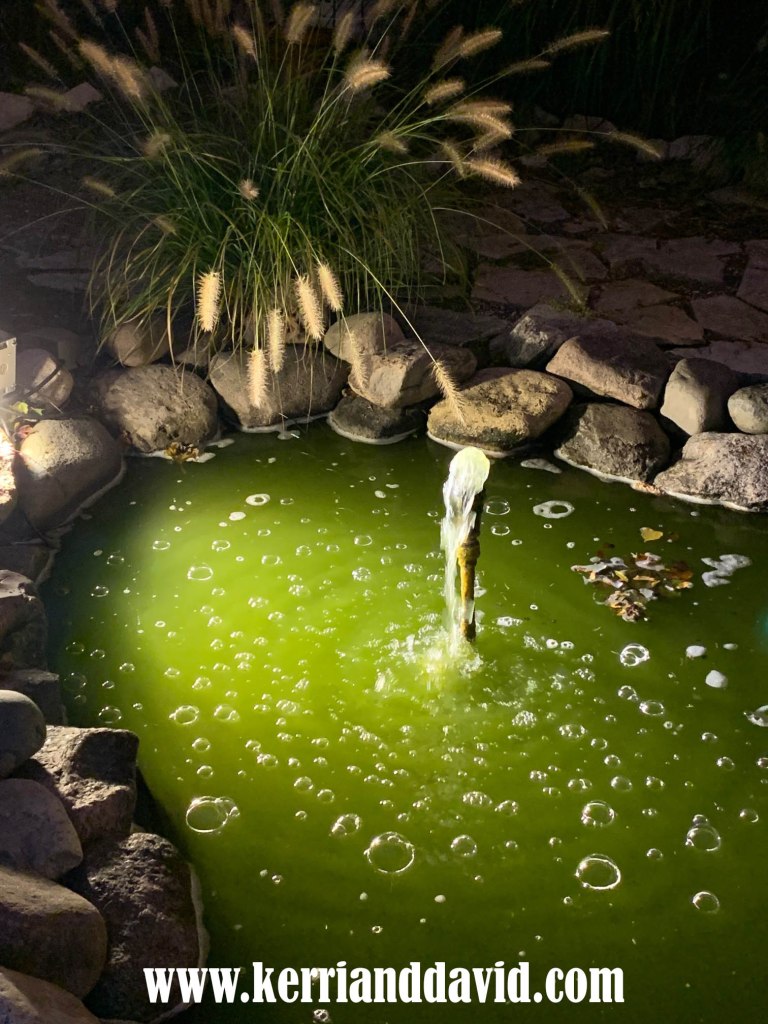
And, at the heart of our peaceful place, a monument to the beginning of our story, a reminder of our good fortune, a refuge for the birds and chippies that we adore watching, bubbles the pond. Every day. A simple source of nourishment for our souls.

read Kerri’s blogpost about THE POND

like it. support it. share it. comment on it. we thank you for it.
buymeacoffee has nothing to do with coffee and everything to do with supporting the continued work of the artists you appreciate. Even if that work is cleaning the pond…

Scratch The Soil [David’s blog on DR Thursday]

For some reason this photograph reminds me of Andrew Wyeth’s great painting, Christina’s World. The landscapes are not remotely the same. His Christina pulls herself through dry grasses on the coast of Maine. Kerri’s photo is of a cornfield in Wisconsin. But there’s something similar about the spirit. Maybe it’s the starkness? I feel it in my belly, an inner quality to the outer image.

There is something willful about corn. In the cliff houses of the Anasazi, archeologists found corn. We take it for granted. Since we can purchase butter lettuce grown hydroponically we forget that there was a time when cultivating food was a new experience. A new relationship with the mystery. It’s the reason people worshipped the corn. It’s like an old joke: it’s not the corn, stupid, the worship was with the relationship to the mystery. It’s never about the form. It’s always about the relationship. A lesson we moderns have yet to learn. The joke continues to be on us.

It’s the same lesson that every artist learns and relearns. It’s not about the painting, the final image. Andrew Wyeth’s painting was not about Christina. It is his reach into the mystery. He must have touched something because his painting opens the mystery to us.

Standing before a blank canvas is like the Anasazi scratching open the soil, the wonder of the seed. The planting of the corn. The promise of nourishment.

read Kerri’s blogpost about CORN

like. share. support. comment. it’s like scratching the soil. we appreciate it

buymeacoffee is an online tip-jar where corn-ideas are seeded, new work is planted and watered, and the creative growth of the artists you value are supported.

Find The Riches

an illustration from Beaky's book, SHAYNE.

one of my illustrations from Beaky’s book, SHAYNE.

During my call with Jim I told him that my projects this year have been the most satisfying of my life. Certainly they have been the most important. And, they have also been, as I laughingly used the term, “negatively lucrative.” He didn’t yet know of Beaky’s books, of her website, of her book signing, so I sent him a few of my favorite photos from the event. Later, he sent me this text:

It is wonderful to be able to eat and pay the bills but there are for a fact things money can never buy. That famous authors obvious joy being one.

Isn’t that the truth? What price could we possibly place on joy? What price would we pay for true love? What price do we place on personal truth? What is the price tag on fulfillment?

I suspect that the great disease of our time – something future history professors and archaeologists will investigate – is that we’ve managed to place a value on our values; morality has somehow enmeshed with money, the purpose of education has somehow become the achievement of a bigger paycheck. In this never-ending political season, count the number of times and ways our candidates tell us that we must weigh our interests against our values.

What is the price of a value? What is the purpose of a value if it has a price?

All my life I’ve been told by people who love me, that, as an artist, I need to make a distinction between the work I do for food and the work I do for love. Most artists, myself included, feel their work is a kind of call. It is an imperative, a necessity. It is food. It is love. Most artists, myself included, do their work-for-love whether they are paid for it or not. They have to. I have to. It is a call. It is nourishment. There is no way in a culture that has placed a value on its values to recognize the real value of food-for-the-soul and food-from-the soul (the purpose of artists in a culture); a market cannot make sense of soul nourishment. This line of distinction, work-for-food or work-for-love, is at best a wonky value statement. It is a line that only makes sense to a people versed and rehearsed in trading their soul-requirements for a better retirement.

what is the price of joy?

what is the price of joy?

Last night I finished reading aloud to Kerri Tuesdays With Morrie. Jim’s text and Morrie’s messages are in beautiful alignment: there are, for a fact, things that money can never buy. And, those things are where the riches of this life can be found.

Stand In The Cornfield

647. Join me in inspiring truly powerful people. Each day I will add a new thought, story or idea to support your quest and mine.

Many years ago I painted a portrait of my father standing in a cornfield. It was an odd painting for me to do at the time as I’d stopped doing portraits years before. I just had to do it. I wasn’t working from a photograph; I just knew he had to be standing in a cornfield. It is a painting I never show. It is a painting of yearning fulfilled.

My father was born in a small farming town in Iowa and spent his adult life yearning to live in the place of his birth. He moved for work and then for love and although he knew where he wanted to be, he could not find a way to return. I put him in the cornfield because symbolically that was where he most wanted to be: in a small community, contained, where life made sense, where people knew where they fit and where people were not in so much of a hurry that they would stop and talk.

Yearning is a funny thing. Yearning is a necessary thing. Yearning is not what is missing; it is the space between where you are and where you want to be. Yearning can be fuel. It can help clarify what you want and energize your actions toward manifesting your desire. Or, it can twist your guts and make you bitter: unspent energy needs to do something and if it is not moving toward your fulfillment it will knot your belly and make your neck tense. Once in a class, I watched several people give speeches. Many put their energy into the speech and where poised, present. Many others were ungrounded and unconsciously pounded the podium or wiggled their legs; energy must have someplace to go.

Yearning can be proof of separation (“I don’t have what I want”) or proof of connectivity (“this is what I will create”). The difference lives in how you define yourself: if you are in this life looking for what you can get, your yearning will probably feel a lot like separation. If you are in this life living according to what you bring to it, your yearning will be an umbilical cord to what you will create and will nourish you in the creating.