Know Your Stuff

my latest and the first of a new series. Held In Grace: Rest Now

my latest: Held In Grace: Rest Now

This a note of gratitude. Unashamed and unabashed.

Yesterday was our third annual trip to Cedarburg for Winterfest. It is one of my favorite adventures of the year with some of my favorite people. The temperatures were unseasonably warm, in the 50’s, so there was no snow and the river ran freely. The ice sculptors lining the streets tried to carve but soon abandoned their too-rapidly-melting blocks of ice. I stood with my back to a brick wall and drank in the sun.

Like the rest of the crowd, we wandered in and out of the many boutiques and shops, ate brats, sipped coffee, watched the sweet -small-town-parade and cheered at the bed races, an event that usually takes place on the frozen river but this day was held on a side street. The team with the best wheels won.

The shops, like shops in every town dependent on tourism, are chocked full of trinkets, greeting cards, clothes, and tchotchkes galore. Some of the shops are so stuffed with stuff that shoppers routinely flee to the streets to avoid imminent suffocation. I am generally crowd-averse so I hovered near the door and watched the games that emerged when the rules of personal space also fled to the streets. I delighted in the dance of strangers-in-too-tight-aisles bumping bellies, stepping on toes, laughing and blushing at unintentional nose touches and unfortunate hand placements.

In one of the shops I found displayed among the stuff a book entitled, Less Stuff, More Life by Amy Maryon. Ironies abound! I laughed heartily and was surprised when I found the same book in the very next shop we entered. So, I made a game of finding how many shops stuffed with stuff carried the book about collecting less stuff. The count: I found it in every shop we entered with the single exception of the antique store. It’s okay to load up on old stuff.

Each time I found the book I assigned it as a trigger for me to turn and appreciate the amazing people sharing the day with me: Dan and Gay, Sandy, Noelle, Daena, Jay and Charlie. Kerri above all. I also made it a game of giving gratitude for the riches of my life: 20, Linda and Jim, Russ and Mary Kay, Marilyn, Arnie, my Jims, …I could go on and on. I am the recipient of infinite kindness and support, love and friendship. This is the stuff of my life – as it is the stuff of life for us all. I suspect (the author) message is that the stuff in our closets obscures the real stuff of life. The shoes and houses and dish towels are not in themselves negative, they are, in fact, nothing at all. They are stuff. And, in the midst of the stuff, if we can see the forest through the trees, is our family and friends and community. There are people in our lives that we will never meet who make it all richer, better (for instance, I’d like to hug the human that first made a cup of coffee). They are the people we read about in the newspaper who donate time to make playgrounds, volunteer at the library or to man the local firehouse. There is the woman in the shop in Cedarburg that prays that we will buy something so she can pay her mortgage and feed her children.


Be Clumsy

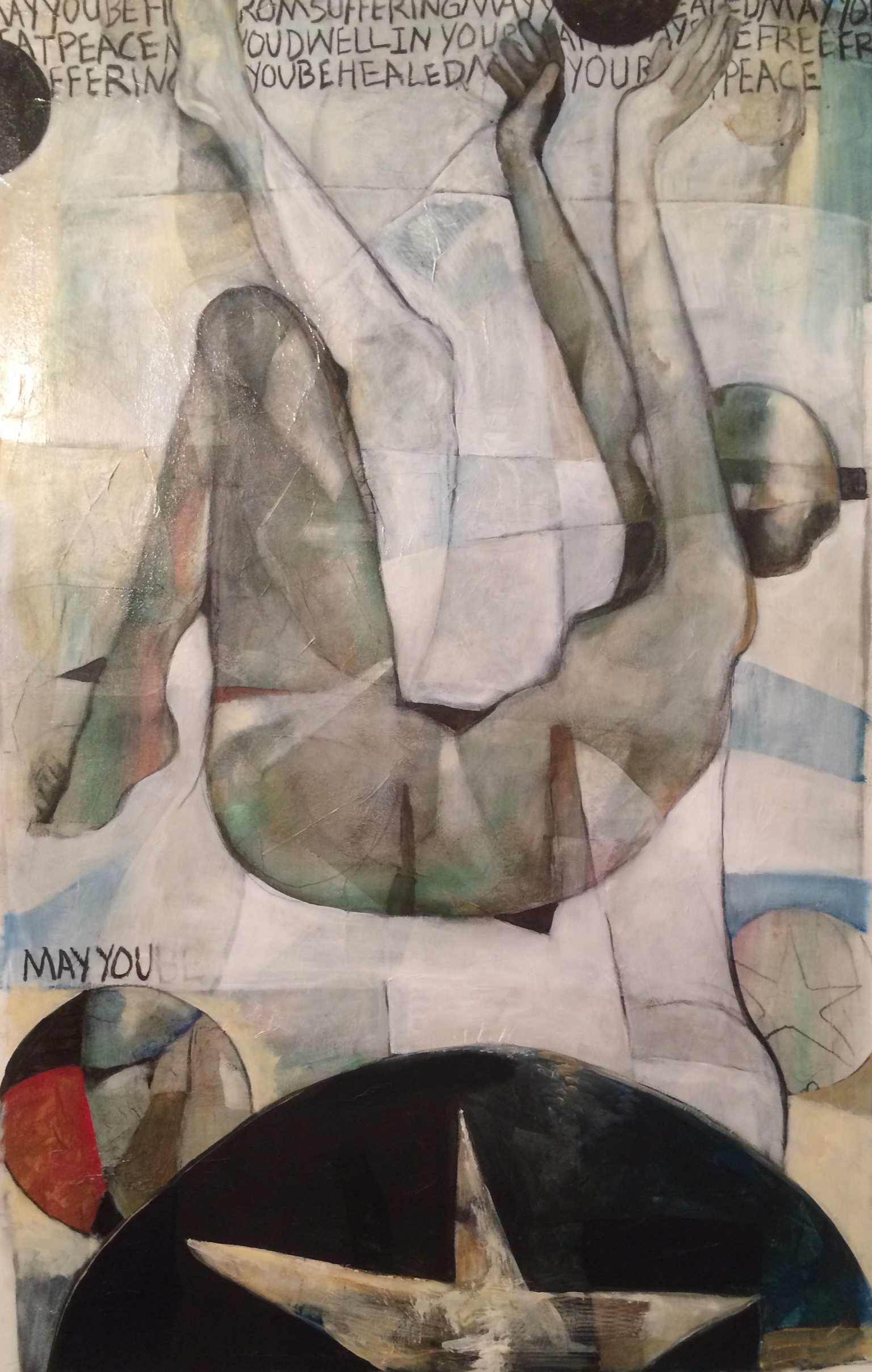
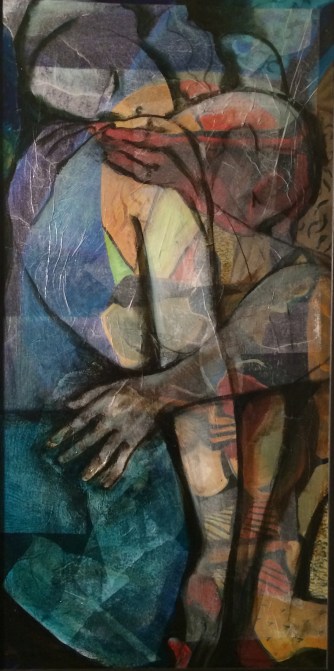
a detail of my painting, May You Be.

a detail of my painting, May You Be.

Clumsy (klum’ ze) adj. 1. lacking dexterity, grace or skill; awkward. 2. ungracefully shaped or made; unwieldy. 3. awkwardly or unskillfully said or done, ill-contrived.

“We don’t allow ourselves to be clumsy,” Kerri said. “Life is clumsy.”

Many years ago I read a commentary that suggested we moderns have a harder time of feeling good about ourselves than people of ages past. The argument went something like this: we have an impossibly high standard to meet and it is mostly illusory. For instance, our predecessors compared themselves and their successes against a relatively small village populace. We are swimming in pool that stretches around the earth. The athletes in our ancestral villages ran against their neighbors, the artists created for a specific purpose that served a tangible need in their community. Our young runners know to the hundreth-of-a-second what greatness requires. They run against the world. Our artists rarely know outside of their own inner imperative why they are creating. With no outer limit they spend a great deal of time wondering if their work has any impact or greater significance. With no outer limit it has no defined audience or community. Stephen, a gifted and prolific artist, used to ask, “Why don’t people recognize the value of art?”

The argument is largely a question of access. Our predecessors had limited and very abstract access to the news of the day, to the happenings beyond their region. We have a 24-hour global news cycle that comes to us on multiple devices that are designed to grab and keep our attention. It is not passive. On our multiple devices we are bombarded with images and messages of what we should look and feel like. Yet, almost all of the images populating our personal measuring stick are constructed. They are manipulated, retouched, powdered and Photoshopped. Legs are stretched. Wrinkles are removed. Sunsets are filtered. We measure ourselves against illusions.

Thus, intermediaries are everywhere. Interpreters abound. I rarely go into a gallery without a curator telling me why the work on the walls is important. The news of the day makes us the rope in a tug-of-war of interpretation.

Art, like life, like deep spirituality, requires direct engagement. It is made rich in the rough draft and the mistake. The broken road is interesting, vital. Learning is a process that takes time. It is messy. It is clumsy. It is not straight, paved, and has no road signs. And, it cannot be walked alone.

There is no forgiveness (of self or other) on the path of perfection; forgiveness is in short supply when the standard is both impossible to attain and an illusion. On the clumsy path, on the messy and muddy road, lives grace, generosity of spirit and deep forgiveness.

Clumsy (klum’ ze) adj. 1. Human

May You Be

May You Be


Laugh More

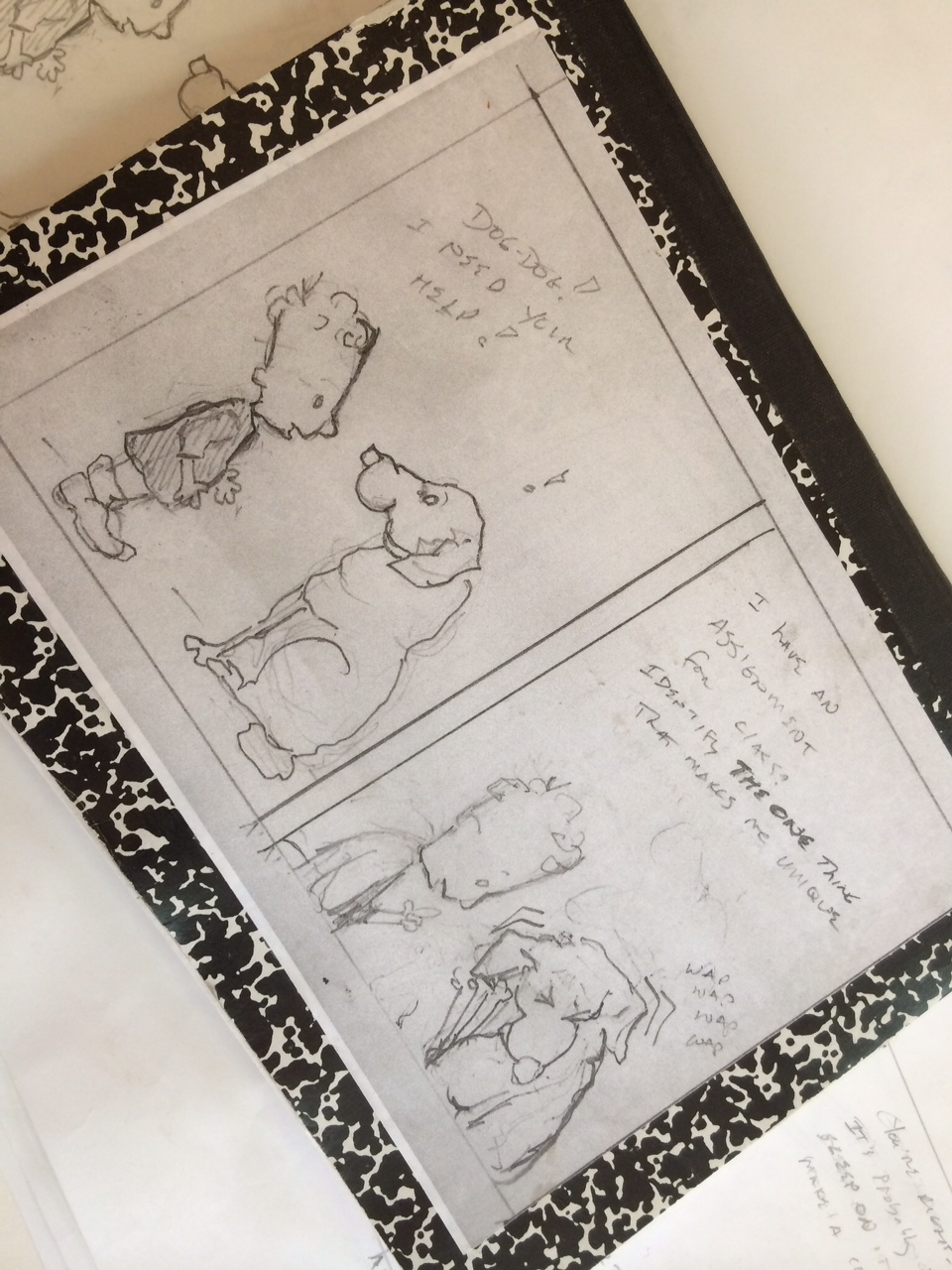
my idea book for our coming-soon cartoon, Chicken Marsala

my idea book for our coming-soon cartoon, Chicken Marsala

There is laughter coming from the next room. Across the way, a woman bursts into tears and a man with a ponytail leads her away from a group. They whisper. He tries to calm her. He makes her laugh. She wipes her eyes and they walk back to the group and all act as if nothing had happened. And, maybe nothing did happen. I am too far away to know the circumstances of her tears. I know the circumstances of her laughter.

Today it rained. I sat at my drafting table and worked on a cartoon strip. Tripper Dog-Dog-Dog sat at my feet. For the first time in over two years I streamed NPR and listened to the day’s news and some other stories. There was a story of a hunger strike in Chicago over the closure of a school. There was a story on public figures and apologies. There was an age-old story of the division in congress. I felt the same way listening to the news as I just felt watching the woman in tears. I am too far away to know the circumstances. I am too far away to know with certainty the truth of any of it. I’ve developed a healthy distrust of news reports. All I know with certainty is that truth is relative, truth is a point of view. I inked my drawings and listened as I might listen to a book-on-tape.

There is more laughter. It is coming from a meeting. I find comfort knowing that a committee in charge of anything can laugh. I hope that they are laughing at themselves.

Ann once told me that they key to success was to find a need and fill it. This world seems to have no shortage of needs. It does seem to have a shortage of laughter.

Recently, David shared with me his thoughts of Plato’s analogy of the cave. Perception as projection. It’s all shadows. Once I watched a Balinese shadow puppet master perform. The performances always take place in the outer ring of the temple and are meant to remind people that what they see in this life is a shadow, a projection merely. One of the messages: we are too far away to know Truth. Another message: our projections are worthy of our laughter and not much else. The puppet master had us rolling on the ground. His characters were mostly tricksters, stooges, and in their over-serious pursuits they were hysterical in their folly. Another message, perhaps the most important: the quickest route to the divine, to the connective tissue, is through laughter.


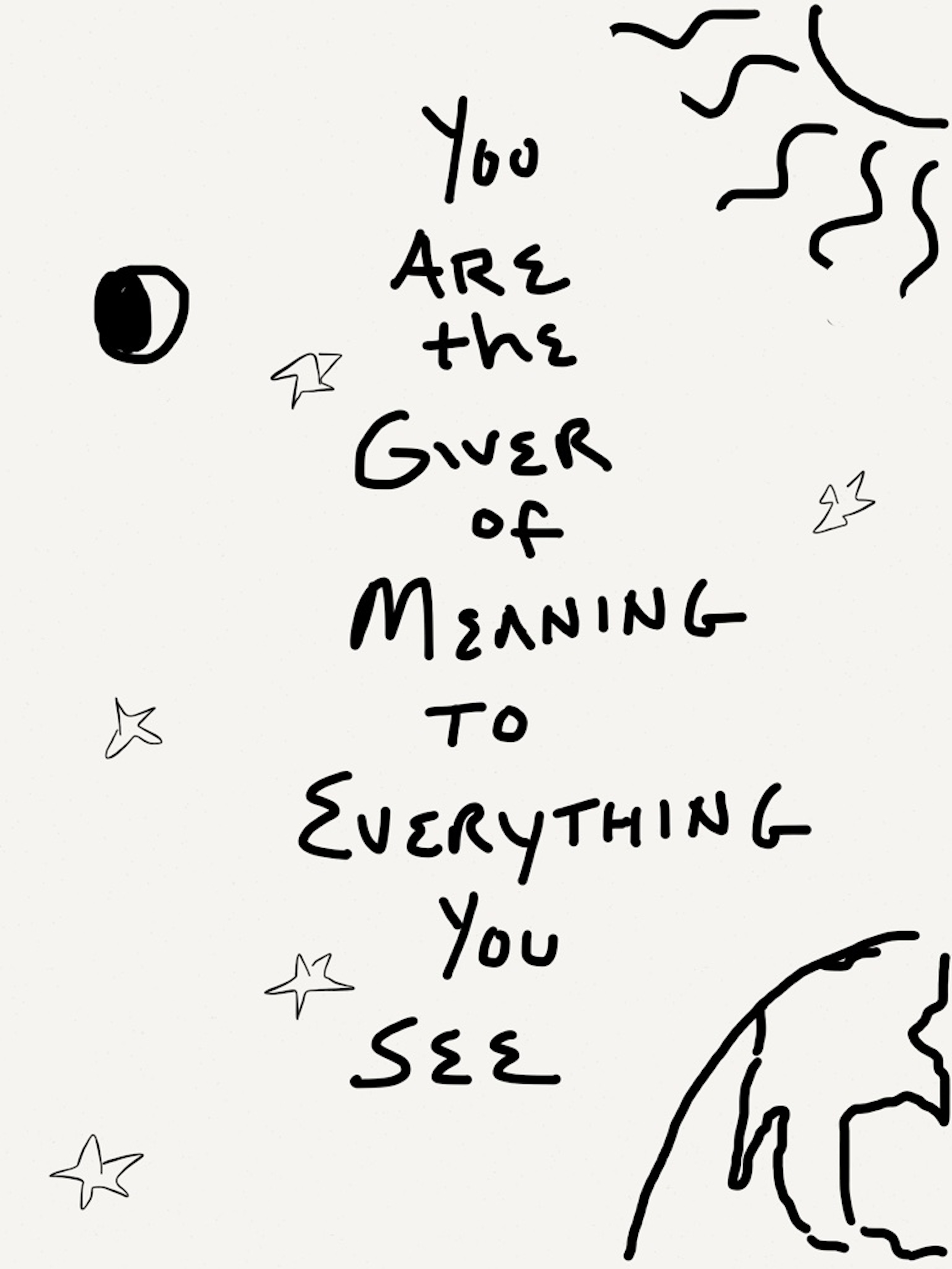
You Are The Giver Of Meaning

TODAY’S FEATURED PRINT FOR HUMANS

You Are The Giver of Meaning

FOR TODAY’S FEATURED PRINT FOR HUMANS, GO HERE

Place No Blame

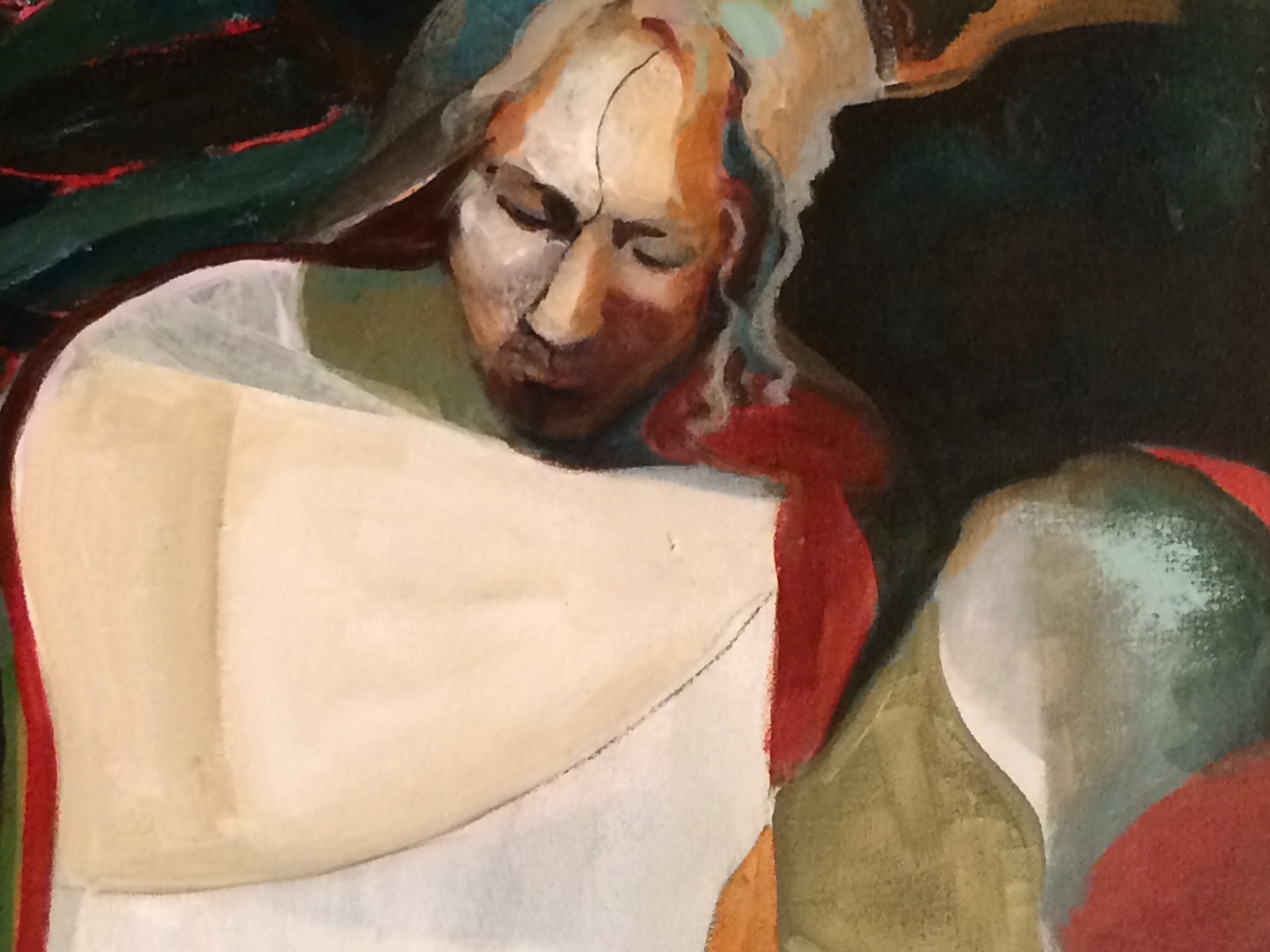
a detail of my painting, "John's Secret."

a detail of my painting, “John’s Secret.”

I’ve been thinking a lot about forgiveness. Earlier today, Kerri read an article to me and the author, someone with terminal cancer, wrote that blame is a waste of energy. Life is too precious to waste on blaming. Forgive and move on.

My meditation on forgiveness has inadvertently become a meditation on blame. As it turns out, forgiveness and blame are often dance partners.

My favorite phrase of this week: Blame, no matter where you place it, does no good. To me, the crucial concept within the phrase is this: blame requires placement. Although it might feel otherwise, blame is not a passive act. We place it. We aim it. It is a way of making meaning of things that don’t feel good. I’ve written that blame is like sugar; it is addictive. It is choice wearing the mask of it-happened-to-me. Oddly, as an active choice, blame actually inhibits action and as an inhibitor it does no good either for the placer-of-the–blame or the recipient. It stops motion. It is an energy eddy. It is destructive both ways.

Forgiveness is also not a passive act. Forgiveness takes more effort because forgiveness is an unmasked choice. It, too, requires placement and aim. It is also a way of making meaning of something that doesn’t feel good. But, unlike blame, forgiveness does great good for both the giver-of-forgiveness and the recipient. It creates motion. It is generative both ways.

Possess It

An untitled  watercolor I did years ago

An untitled watercolor I did years ago

Last night P-Tom said, “This is the time of year that everyone is telling us what we need and where we can go to buy it.”

Yesterday I worked on website language. After a year-long hiatus I’m re-visioning what was once a coaching practice. All day I was aware that words like “potential” and “purpose” are abstractions; they are marketing terms. Many years ago, when I was first establishing a coaching practice, I read articles and listened to recordings full of advice about “how to start a coaching business;” the recommendation was unanimous: host free calls, help people see their problem, and end the call. Leave them standing in the mud so they will need you. Create lack (isn’t that a great definition for marketing?).

What does it really mean to fulfill your potential? What does it mean to “find your purpose?” Look to the layer beneath. To fulfill, to find…, these are terms from the canon of outcome and result. No one willingly seeks his or her endpoint. If there is a universal problem it is that we see our existence as something with a bottom line and hire coaches and therapists to help us do the accounting.

(Insert mantra: nothing is broken. You do not need to be fixed).

Good coaches, teachers, mentors, and therapists get you out of the spreadsheet and into the moment. Looking for the fullness of life is usually a process that requires the cessation of looking so we might see what is right in front of us. Stop the search and you will be found. As the old saying goes, life is the thing that is happening while you are running around looking for it.

I’m a world-class note taker and always take notes when I work with people. For me it’s like mapping verbal terrain, capturing inner geography. Lately I’ve been reviewing the maps before I destroy them and I find not seekers of potential and purpose, but people overwhelmed by the experience of 1) feeling lost, 2) feeling that something is missing or they are missing something, 3) feeling that they are pushing on a door that won’t open, or 4) a yearning for a different way of being. These are questions of feeling. These are questions of orientation to life (experiences of life). “Potential” and “purpose” are words of doing. These are questions of being.

What if meaning, value, purpose,… in life was not something found or bought but something that is already possessed?

Go here to buy hard copies (and Kindle) of my latest book: The Seer: The Mind of the Entrepreneur, Artist, Visionary, Innovator, Seeker, Learner, Leader, Creator,…You.


Find The Purpose

Despite warnings, Icarus reached for the sun.

Despite warnings, Icarus reached for the sun. Why do I paint? Why does anyone do anything?

The question of the day is, “What is the purpose?”

Mike is 85 years old and she said, “Never in my entire life did I think I would live in a world where beheading was a reality. We’ve gone backwards, it seems to me. My god! It’s like we’re living in the Middle Ages.”

Is history a sandwich with madness in the middle or perhaps a Mobius strip? What is the purpose?

Arnie just returned from Israel. He was profoundly moved by his experiences there. He was also angered by the discrepancy between what American media reports about Israel and what he found there. “I’ll never again believe another thing I hear on the news.”

Belief meets disbelief. The fields of the profound exist beyond anything called purpose. What changes in our hearts and minds when our experiences touch the profound? Our sight changes; our eyes open.

Horatio recently wrote and told me that he’d dumped his Facebook and Linked In accounts. He wrote, “I dislike them and the fallacies we suffer because of it. Mostly, I wonder what took me so long. I mainly feel like a man with a simpler life.”

Simplicity arises when complexity falls away. The extraordinary is always found in the ordinary, something as common as holding hands.

Kerri and I sat in the autumn sun to eat our lunch. She gazed at our house. She asked, “Do you think our house will be here in 100 years?” Before I could respond she answered her own question, “If it is, we’ll never know.” And then she asked the question beneath the question, “What is everyone racing to achieve?”

Moments of fulfillment. Presence. Both require a move beyond achievement to something more connected.

It is passing. Life. Purpose. Who assigns purpose to a life? Who assigns purpose to all of life? Is it achievable? What happens when we get there? Mirages.

“Purpose” is a word like “Outcome”; it exudes permanence but don’t be fooled. An outcome is a snapshot. Just as bottom lines are temporal, data is interpretation, and endings are beginnings.

Purpose wants to feel important. Profound simply wants to feel.

title_pageGo here to buy hard copies (and Kindle) of my latest book: The Seer: The Mind of the Entrepreneur, Artist, Visionary, Innovator, Seeker, Learner, Leader, Creator,…You.

Go here to support my play The Lost Boy.DSC_1196 copy


Covet The Right Stuff

I did this drawing for my book, The Seer

I did this drawing for my book, The Seer

This morning Kerri shared a nice definition of the word “covet:” insufficient gratitude for what you already possess. It made me laugh because the definition exposes the ethical double bind of being human.

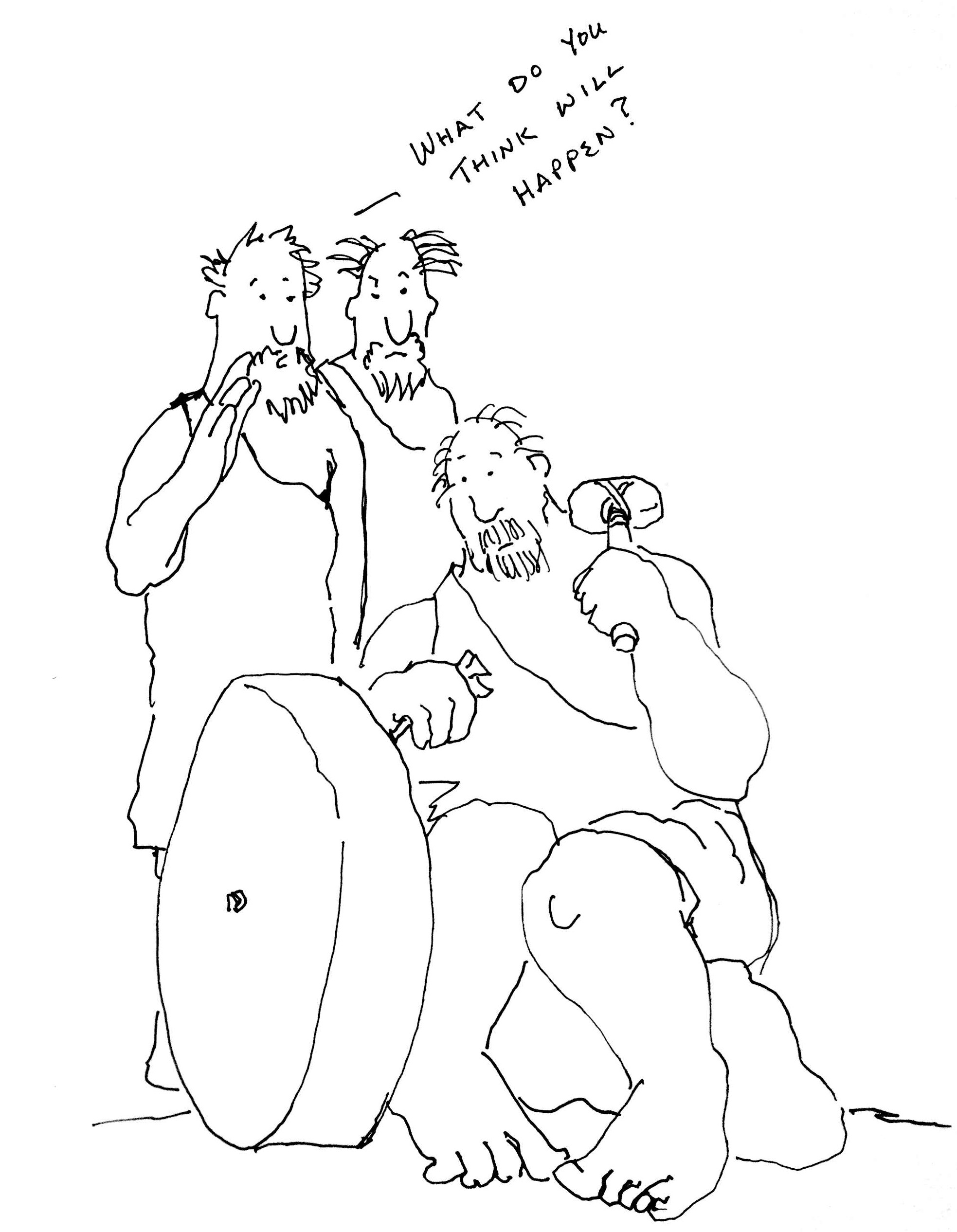
I imagine that in some distant past, a hairy guy stepped out of his cave and was startled to find that his neighbor had a new thing called fire. Being cold and also tired of eating sushi for every meal, he coveted his neighbor’s fire. He wanted some of that. A healthy lack of gratitude for what you already possess is often how good ideas spread (a random anthropological note: I read this morning that the average life span of a cave man was 18 years. I suspect coveting warmth-by-fire increased the average by a couple of years).

So, to covet is sometimes useful, especially where essentials like food, fire, and stories are concerned. It is only human to want enough food, a roof over your head, and a life-story that has meaning and purpose.

To desire is human. To want a better life is universal. What is the line between desire and coveting? To want what others have, to a certain extent, is pack behavior and we are, like it or not, creatures of the pack. Product marketers around the world count on our capacity to want what other people have and so our covet-muscle is exercised daily. The creation of imaginary need is a super trick for selling stuff and coveting what others have is key to lack creation. It’s hard to sell things if people are fulfilled.

So, to covet may be a warning signal that you are building your tower of meaning on sandy soil.

And that loops back to gratitude. All day, Kerri and I have been talking about being conscious in the moments of your life. None of us have unlimited time on this earth. The only thing we actually possess is our moments and our choices within our moments. The other stuff is really on loan and generally passing. Spiritual teachers and artists throughout history are unanimous on this point: the path to a rich life is built upon presence. Paying attention, exercising deep gratitude for the moments of your life, will always illuminate the extraordinary in the ordinary. Cultivating the capacity to see your extraordinary life will help you will covet the right stuff. Feeling grateful for your moment is always easier when you are warm and your brontosaurus burger is cooked just right.

title_pageGo here to buy hard copies (and Kindle) of my latest book: The Seer: The Mind of the Entrepreneur, Artist, Visionary, Innovator, Seeker, Learner, Leader, Creator,…You.

Check out the kickstarter campaign for my play The Lost Boy. DSC_1196 copy

Make Sense

'John's Secret' by David Robinson

‘John’s Secret’ by David Robinson

Several years ago, decades in fact, G was driving his car. A young boy sprinted into the street in front of his car and was killed. To this day, G holds himself responsible. Even though it was an accident, he cannot forgive himself for the death of the young boy. He blames himself. Forgiveness is beyond his reach.

This terrible accident has become the defining moment of his life. Rather, his search for understanding why it happened and his refusal of forgiveness has shaped his existence.

He is a kind man. He is generous. He is devout. He is very old, walks with a cane, moves slowly, cares for his ailing wife, always smiles, He is generous with his time and his resources even though his resources are very, very limited. He sings. He prays. He listens. He asks, “Why?”

“What if I had left the house a minute later? What if I had left minute sooner? What if I’d decided to stay home? How could I have been the instrument of that young boy’s death? What could I have done…?” He suffers because, for him, there can be no absolution.

What do you do when there is no answer to the question, “Why?” What do you understand about your life and the forces of the universe when there is no sense to be made? What do we do when the experiences of our lives betray the sense that we’ve already made?

We do what we always do. We do what is most human: we make sense. We create order so we might not have to experience the chaos. We make statements in the form of questions: “What kind of God would let this happen?” or, “Why me?” There are so many things that we cannot control so somewhere there must be a bigger picture, a greater intention, a man behind the curtain, a reason why. We say to ourselves, “There must be a right path, a rule, a law, a design that we must follow.” It is something to ponder: why is our greatest horror to be out-of-control? What if we danced with the mystery rather than tried to contain it?

“To understand” is a form of the control illusion. Do you believe you need to know how to do something before you do it? You don’t but without the control-illusion of “how” you’d come face to face with the reality that process is chaos. Chaos is uncomfortable. Things happen. Order is something that is made after the fact. “There must be a way!” “There must be a reason!” There is always a way but you won’t know it until you walk the path and turn around to see it. There is always a reason, but you create it. It is not given. Order feels good.

And, it is necessary. Giving order to our chaos, telling a story, is what makes us human. If you could boil my work in the world down to a single phrase, it would be this: we have experiences first and then we make meaning, not the other way around.

We make meaning, we contain to infinite, through the stories we tell. The choreography of the human dance happens between the poles of “no sense to be made of the mystery,” and “the need to understand why.” G is making sense of his life. I am making sense of my life. As are you and everyone you meet today.

[to be continued]

Go here to get my latest book, The Seer: The Mind of the Entrepreneur, Artist, Visionary, title_pageSeeker, Learner, Leader, Creator…You.

 Go here for hard copies

Play For Meaning

705. Join me in inspiring truly powerful people. Each day I will add a new thought, story or idea to support your quest and mine.

Horatio took me on a whirlwind tour today. We met his art teacher, Jo, and I listened as they discussed artists like Sylvia Plath and Diane Arbus, artists whose work explores the darker shades of life. Both women killed themselves. Horatio posits that their artistry in some ways chronicled their march toward an inevitable conclusion. Like a raft caught in the current, hurtling toward a waterfall, they determined that there was nothing to be done, no greater meaning to be found, and went over the falls.

Horatio and I often stray into the topic of meaning making. What’s it all about? What is the greater purpose and meaning of this experience of life? I’ve decided that meaning is something we make and not something we find. Meaning is something we bring to the dance. However, we come to the dance with great expectations. We look for someone to dance with, we look for an experience that might lift us from the ordinary routine, we yearn for someone to notice us, we want food to eat, a future to create; we seek experiences. We want more. Life is made sweet in the yearning.

We get lost when we think someone else has what we need or that someone else can fulfill our yearning. Our job is to engage life; no one can do that for us. Our job is to bring our selves to life (I intend the double meaning of that phrase). Our job is not to fulfill another person’s need just as their job is not to fulfill ours. The meaning is in what we bring to the dance; if we bring joy there will be joy. If we bring blame there will be blame.

Tonight Horatio and Teru made a lovely dinner and had a cake for my birthday (coming soon!). Their daughter Nina and her beau Keith came along with Nina’s 4 year-old daughter, Jordan. I spent much of the evening learning from Jordan how to play Chutes and Ladders and a cupcake game. The first rule is that there are no rules. The second rule is that because there are no rules things like winning and losing are ridiculous. The only thing that mattered was that we played. She showed up and I showed up and the rest was imagination and wonder. You’ll be surprised to know that in a single evening I played the role of Santa Claus AND was placed forever on the naughty list (my name is written on the list in magenta crayon). It is an existential dilemma of massive proportion that required the creation of a third rule: naughty and nice are relative terms and who needs lists anyway? Meaning is never found in the list and always found in the play. So, as Jordan taught me tonight: play and the meaning will soon follow.