A Sculpture Worth Making [David’s blog on Two Artists Tuesday]

The question floated across my screen, something I’d asked a group many years ago. I don’t remember the moment so it was a blast from the past of a former me: apparently I asked, “What if no one else has your answers?”

The timing was interesting since I am currently without answers. Well, more accurately – more honestly – I’m standing still surveying the wreckage.

I appreciated my blast from the past because now, at this point in my life-journey, were I working with a group, I’d flip the equation and ask, “What if no one else has your questions?” I’m no longer a big believer in answers.

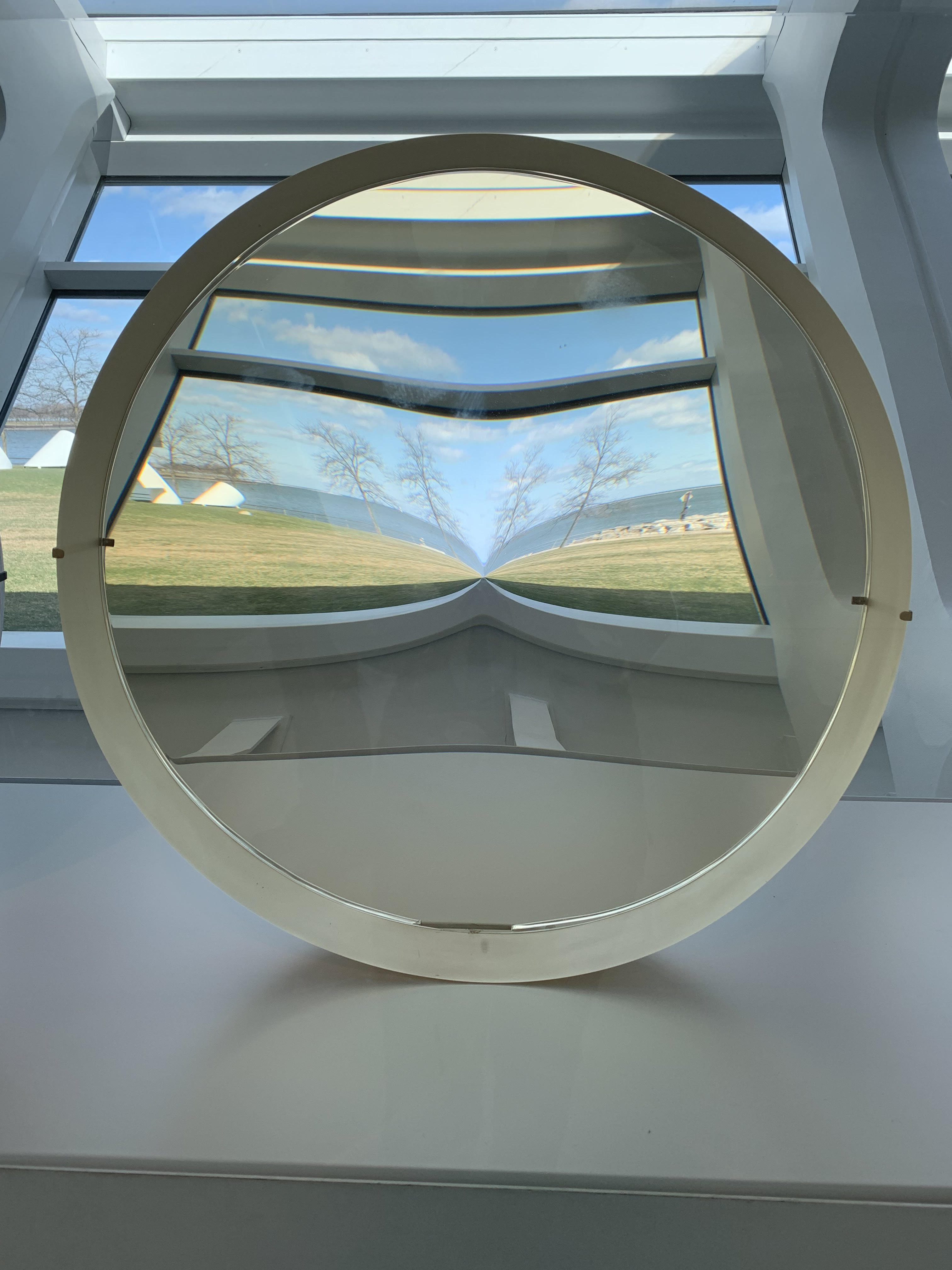
We stopped in the long hallway leading to the contemporary art collection to admire the lens. I didn’t note the title or the name of the artist so I cannot give credit where credit is due. I’ve looked at the piece before but never with the same appreciation. Never from this moment in time. It was suddenly, intensely relevant. All points bend toward a common center. A point of view that generates circles. A single intersection.

“It’s an ego,” I thought. It believes it’s the center of everything that’s happening. It made me laugh. It brought to mind the ubiquitous lesson from Quinn: “There are six billion people on this planet and you are the only one that cares what you think.” Or feel. Or see.

No one else has your questions. No one else has your answers.

Standing before the sculpture I imagined flipping the script and reversing the circle: what would it look like to genuinely care what other people think. Or feel. Or see. With no need to understand it or change it or control it. Only care about it. About them. There’s a common center available in that paradigm, too.

Now, how do I make that lens? That’s a question worth asking, a sculpture worth making.

read Kerri’s blogpost about THE LENS
subscribe. support. share. like. comment. many thanks.

See The Exact Center [on Two Artists Tuesday]

Kerri took this photograph a week ago. We’d set up our pop-up table in the middle of the woods. We had a small cooler with cheese and crackers, tabouli and chips and wine. It was cold. We needed to take off our gloves to eat a bit of our snack and then put them on again, fingertips stinging. Since she is a photography maven, I knew to stand back after setting up so she might take shots of our snack-laden table. She finished, sat, and then pointed her camera to the sky.

Despite what you see in the photo, the trees did not reach to a common center. That is an illusion. Perspective as taught in art school. The point of view of a lens. “Lookit!” she said, red fingertips holding the camera so I could see the image. “We must have found the exact center of the forest,” I thought and smiled.

I often feel like that these days. We must have found the center.

Last night, on an all-too-rare warm evening, we sat with friends on their deck. The Up North Gang. We ate dinner. We laughed. I had my first ever sip of salted caramel whiskey. Dessert as a drink. Time stood still for me and I studied the moment. I wondered if anyone on earth was as fortunate as Kerri and me.

Perspective as taught in art school. Points converge creating the illusion of distance. At one time in history, a crossroads of art and mathematics, this simple recognition was a revolution. Linear perspective. A unique point of view. The accurate portrayal of three dimensions on a two-dimensional surface was powerful – the creation of illusion, shape and distance, produced new intentions and mathematical rules.

It also changed forever the viewer. To see the illusion one must occupy the illusion of a unique center. A new psychology. It’s possible to draw a direct line of descendancy from the hard perspective of the Renaissance to our abstract expressionism. The artist’s point of view, unconscious expression without limit or rule, is all that matters. Two ends of the same pole.

I told Horatio that I am, at long last, learning to keep quiet. To share what I see when asked, and not before (he says as he writes a blogpost about what he sees). I have made a career out of too adamantly trying to get people to see what I see. My adamancy might be traced to the Renaissance and the notion that I occupy a unique center, a specific point of view that makes my illusion of shape and distance somehow privileged and necessary.

Age is helping me challenge and release my investments. It is also a grand teacher of movement and moments. Nothing stands still, especially time. The best we can do is savor the spaces between, always shifting and moving. Children become parents become grandparents. A warm night. A cold day on the trail. It matters less and less what I see and sense-make with my unique hard lines and more and more that I taste the tastes and see the colors, my lens aimed at a common center, sharing the passing moments with others.

read Kerri’s blogpost about THE WOODS

Learn to Look [on KS Friday]

part of the wind dandelion fluff copy

“At the heart of beauty must be a huge care and affection for creation, for nowhere is beauty an accidental presence.” John O’Dononue, Beauty, The Invisible Embrace

I read yesterday in my Brain Pickings that Georgia O’Keeffe believed her close-up paintings were “a magnifying lens for paying attention.” I read and appreciated this phrase: Painting these close-ups was a way of learning to look, a way of removing the blinders with which we gallop through the world, slowing down, shedding our notions and concepts of things, and taking things in as they really are.

It is the astonishing miracle of a human being: we can choose to see or choose to not see. Also, we can choose what we see or we can choose to deny what is right in front of us. In any case, seeing is predicated on slowing down, on taking the time to “shed our notions and concepts of things.”

Seeing is an intentional act or perhaps it is a creation-in-the-moment – which implies it is an intentional relationship. In this way, as I understand it, seeing the beauty of this life is a decision, it is a lens. It is a dance.

I’ve never been in a hot-air balloon. Kerri had the experience once, it is the source of this composition. Hovering in a basket above the earth, moving with the wind, very few controls. It was, I imagine, an exercise of giving over, of letting go. I think seeing is like the experience she describes of hanging in the basket of a hot-air balloon. All concepts of hurry-up or getting-things-done drop away. Hard time dissolves. There is nowhere else to be. And, in that space, beauty makes known her presence. She opens your eyes.


PART OF THE WIND is on the album BLUEPRINT FOR MY SOUL


read Kerri’s blog post about PART OF THE WIND


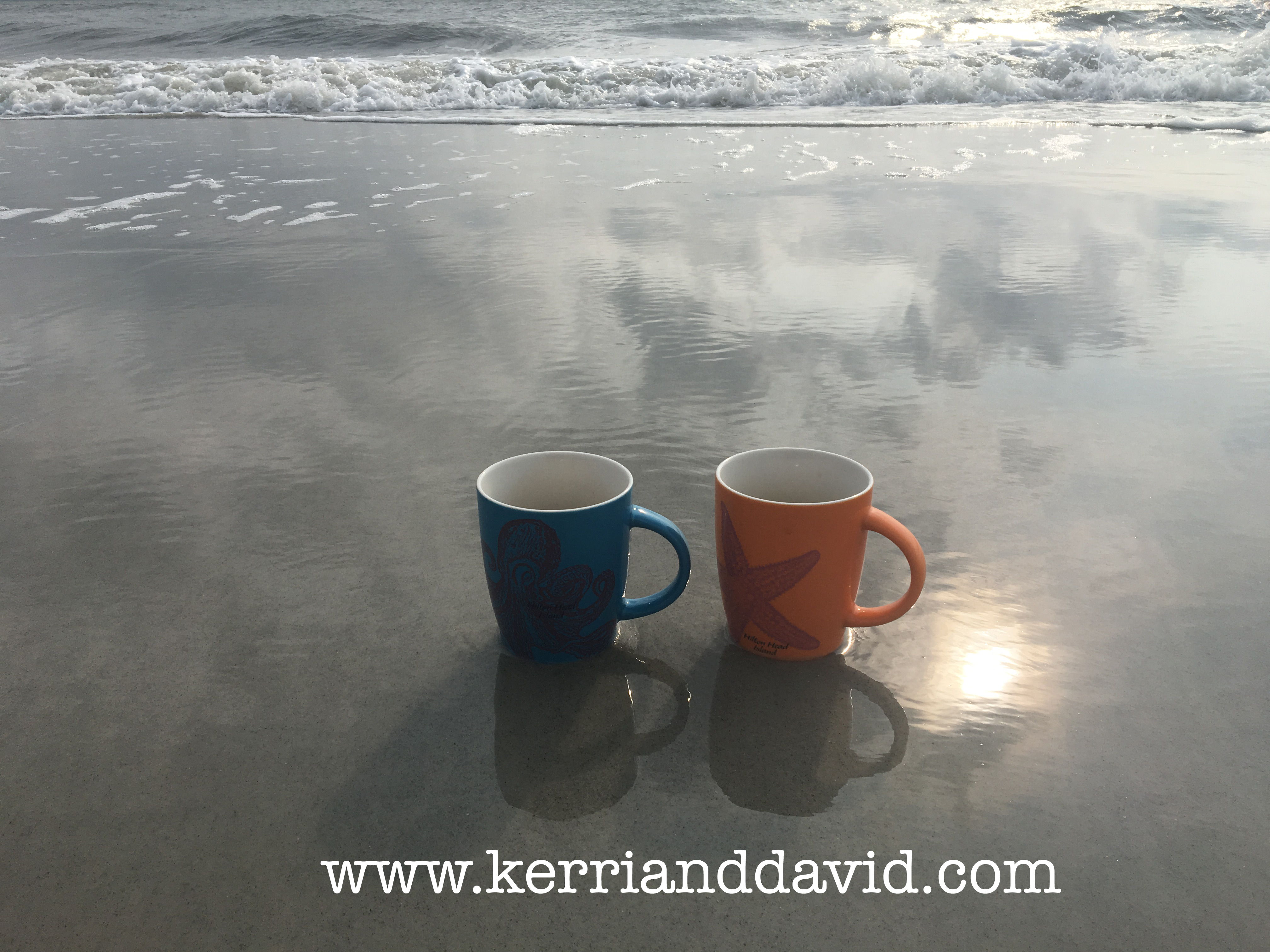
HH coffee cups website box copy


part of the wind/blueprint for my soul ©️ 1996 kerri sherwood

  blanket of blue sky ©️ 2004 david robinson

Live According To Your Necessity

a detail of a painting I did in honor of Dawson's arrival on earth

a detail of a painting I did in honor of Dawson’s arrival on earth

“Depending upon the lens you look through, I have been a miserable failure at everything I’ve ever done,” I said. Arnie protested but we both knew it was, to a certain extent, true. And, since our conversation I have been gazing through that certain lens and feeling my failure acutely.

This lens is not new to me. I visit it each year as my birthday rolls around. It is a lens that most artists visit from time to time. To their peril. Recently, Chris, one of the most talented and hardworking actors I know, told me that now that he is far down the road of his career, no longer a beginner, he has surrendered the idea, imperative or illusion of economic success. “I work because I have to,” he said. It makes no sense and is impossible to explain to someone who does not have “that” impossible intrinsic driver. The incentives are internal. The rewards are internal. The achievements are mastery landmarks and not monetary rewards. It looks like insanity through the lens of a profit/loss, money=morality society.

When I look through the failure lens I’ve learned I need to visit Rainier Maria Rilke. I need to seek the advice of a master. “Nobody can counsel you or help you. There is only one single way. Go into yourself. Search for the reason that bids you write; find out whether it is spreading out its roots in the deepest places of your heart, acknowledge to yourself whether you would die if it were denied you to write. This above all – ask yourself in the stillest hour of your night: must I write? Delve into yourself for a deep answer. And, if this should be affirmative, if you may meet this earnest question with a strong and simple “I must,” then build your life according to this necessity;….”

...closer in

…closer in

My life is built upon this necessity. No amount of comparing it to others is useful. No other lens is healthy. Since moving to Kenosha from Seattle, I am fond of telling people that in my move I committed economic suicide. That is a statement made looking through the wrong lens. Here is the truth: Since my move I have published my book, The Seer. I produced and performed in what I thought was the greatest heart-project of my life, The Lost Boy. It played to sold out houses and fulfilled a decade long journey and commitment to Tom. Two months later I did what I now think was the the greatest heart-project of my life when I illustrated and Kerri and I published Beaky’s books, The Shayne Trilogy. Beaky had an author’s reading a mere two weeks before her passing. Last year I authored drew and submitted with Kerri over 25 cartoon proposals to syndicates. We are completing work on our next play, The Road Trip. And, in the middle of it all, I’ve done arguably the best paintings of my life. I am meeting my question with a simple and strong “I must.”

What is failure? What is success? They are lenses and they matter not.

I am living and building my life “according to this necessity.”

The whole painting.

The whole painting.


Be The Detail

I took photo and used this image in The Seer.

I took photo and used this image in The Seer.

When I shared the early chapters of The Seer with friends, their feedback was universal: I was trying to say too much. They asked me to break it down into smaller bites. At first I resisted because I couldn’t see the path to smaller bites! In time I was able to step back and see what they were telling me. All of the necessary connective tissue was in my mind; I was filling in the thought-gaps. My wise-eyed readers had no access to my mental filler and saw a story riddled with gaps.

It was a valuable lesson for me. What I see is never what others see. Even when we share an experience, it is false to suppose that we had the same experience. We share. That is a much different thing than assuming sameness. When I think I am being clear, when I think that my point of view is right, I remember the gaps. I am projecting content and context filler onto every experience and so are all the other people in the room.

Perception is at best a moving target. This simple principle is what makes art so necessary and science so exciting. Newton thought he was dealing in absolutes. He was describing a universe based on uncontestable fixed principles. And then came Einstein. We see from and through a context that we like to call “truth” but, it is at best relative. Is it a particle or a wave? Well, it depends…

I used to facilitate an exercise called Mask Mingle. It is a powerful way to open eyes and hearts to the grace that we grant ourselves but rarely grant to others: specificity of story. We cannot walk through our days without carrying the specificity of our experiences and the rolling, roiling interpretations and re-interpretations of those experiences that we call ‘memory.’ No one can see what we’ve done and where we’ve been. No one sees the joy, the hurt, the dreams, the losses, the fears, the perseverance. They cannot see the detail. The best they can do is interpret us through their lens. We will always be a generality in the eyes of others.

I find that central to much of what I write about and coach about is the surrender of what other people might think. It is a fallacy to think that you can determine what others think of you. You will never see through their eyes. You will never know their lens. It is a powerful moment when an artist (or anyone) realizes that they have no control over the perception of others. The best they can do is offer their gift from their unique, unknowable, rich, point of view. That moment is called artistic freedom.

title_pageGo here to buy hard copies (and Kindle) of my latest book: The Seer: The Mind of the Entrepreneur, Artist, Visionary, Innovator, Seeker, Learner, Leader, Creator,…You.