

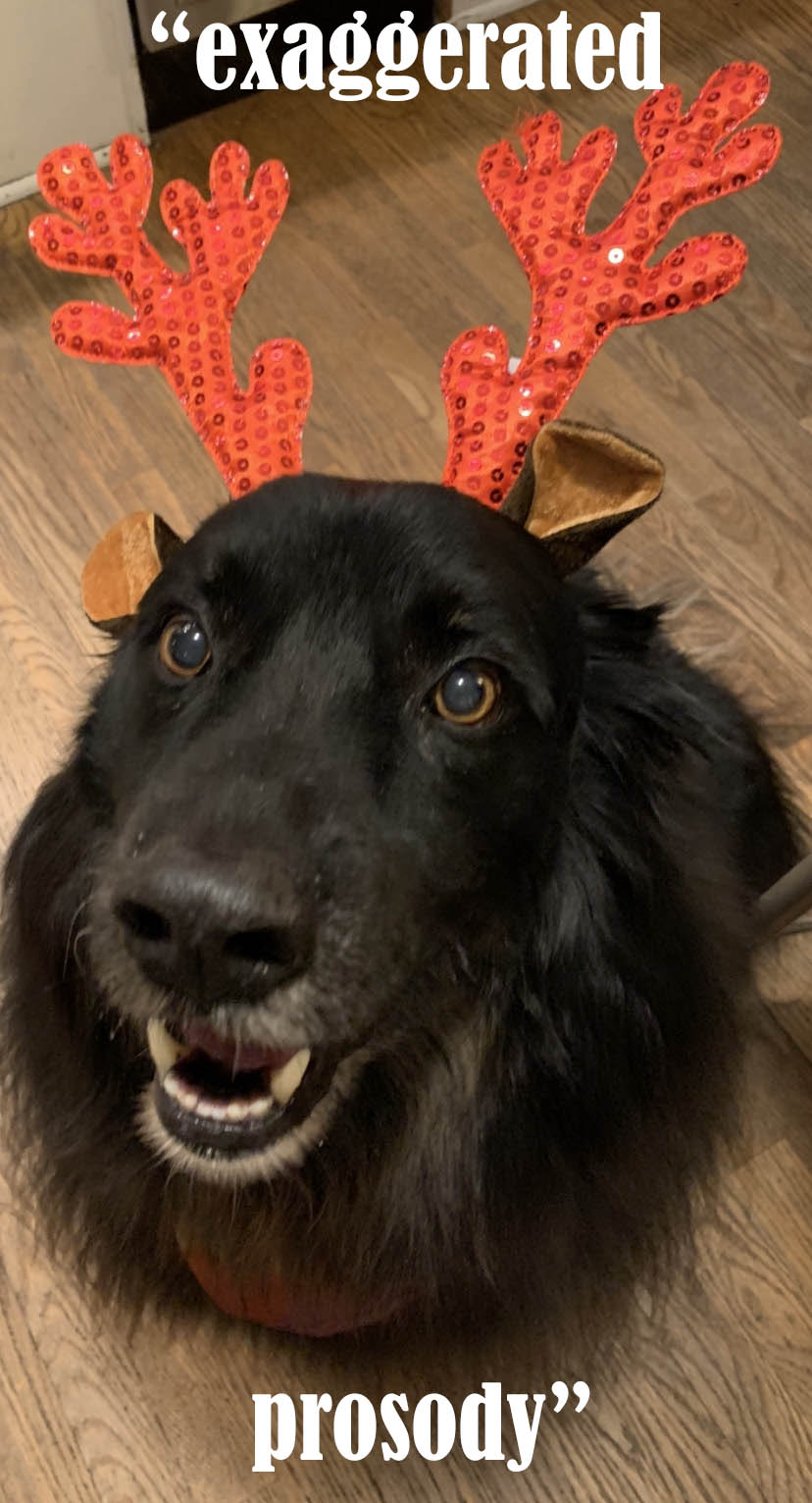
The sound, rhythm and pattern of language. Listen to the sing-song of a mother talking to her infant child. Exaggerated prosody. Love carried through time and space on a warm carpet of sweetly over-elaborated sound waves. The words carry less meaning than the prosody. The shape of the sound, exaggerated to invoke a giggle. A bright face. A smile.
In our house, the exaggerated prosody is reserved for Dogga. “It’s time for sleepy-night-night!” Kerri sings to a tired-faced-Dogga. There is a distinct rhythm to “sleepy-night-night” that has become a comforting ritual chant. Our day would not be complete without it. He wags his tail and lopes toward the bedroom. Or, “We’re going to the living room!” she says in response to his constant anticipation of our next move. The words “living room” elongated and embued with excitement. He dashes to beat us there and, in my mind, to convince us that he’s been waiting all along.
When Unka John arrives, his ritual Dogga sing-song goes like this: “Hey! Hey! Give me that bone!” The game is explicit, the sound of the words as exacting as a line from Sondheim. After Unka John pretends to eat Dogga’s bone and returns it to the awaiting Dogga mouth, signaling the end of the arrival game, he chants two consecutive times, “Do you want a treat!” with the hard accent and lift on the word “treat.” It sets-off a full body wag and race to the treat jar. “Gentle! Gentle!” is the incantation that signals Dogga to sit and tenderly accept the treat. Of course, the whole sequence of Unka-John love-fest is ignited when we say to Dogga, “Guess who’s coming?” in a melodic line that we know will provoke a bouncing-dog-rush to the front door as we await the imminent arrival.
The meaning is not carried in the words, rather, it’s in the poetry of the tones. The generosity of the sound.
It’s the poetry of everyday life. The ritual sounds we use to shape our day, to create our comfort-home. To fill our hearts with gratitude. To clearly say, “I love you” in sound and tone when our words are merely, “Do you want some lunch?”
read Kerri’s blogpost about EXAGGERATED PROSODY
like. support. share. comment. all carry forward the meaning and are appreciated with or without sound.


Filed under: Family, Language, Love, Merely A Thought Monday | Tagged: artistry, david robinson, davidrobinsoncreative.com, dogga, Gratitude, incantation, Kerri Sherwood, kerri sherwood itunes, kerrianddavid.com, kerrisherwood.com, language, love, meaning, meaning making, melody, music, musicality, pattern, poetry, prosody, rhythm, ritual, ritual sounds, sing-song, sound, story, studio melange, the melange | 2 Comments »






 The Direction of Intention