Our Moment [David’s blog on Merely A Thought Monday]

At the top of the stairs on the second floor of our house is a bulletin board of photographs. We assembled it in 2019 when we took a job on Washington Island. We would be far away from family and friends and hoped the photo-board would help us stay connected to home. It’s funny to me now, I rarely looked at the bulletin board when we were on the island but five years later, firmly ensconced back at home, I pause on the stairs every single day and study it.

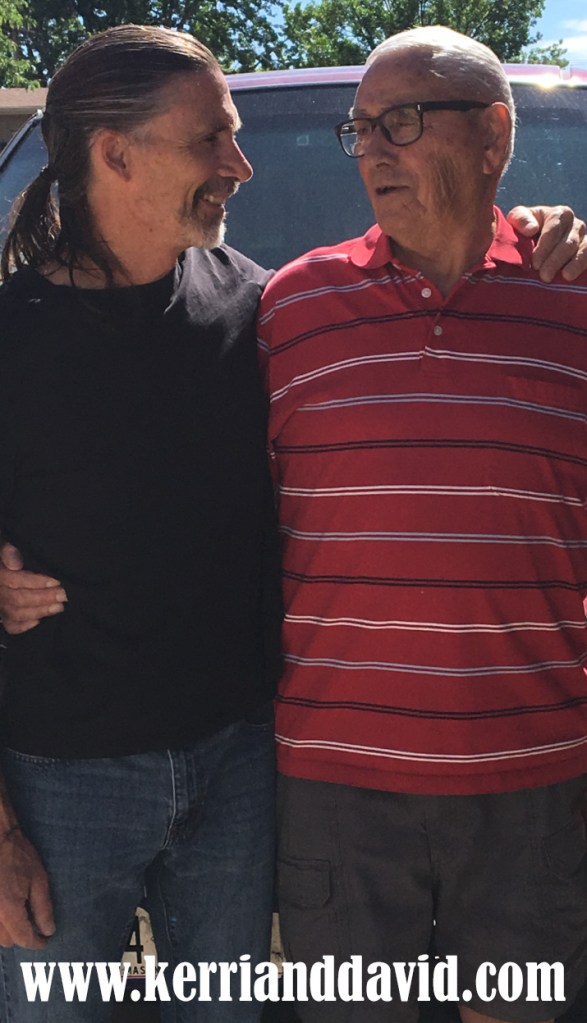
It’s the photos of my dad that stop me. In order to function on island we needed a second vehicle. My dad was no longer able to drive so he gave us his truck. The photos were taken when we flew to Colorado to get the truck. We call it Big Red. It was a blue-blue-sky day. Kerri and I were just about to begin the long drive back to Wisconsin. Kerri took some pictures of my dad and me standing next to Big Red.

He died in 2021. Those few photos are among the last I have of him. They are certainly among the last taken when he knew who I was; he was far down the road of dementia on that blue-sky Colorado day.

I stop on the stairs and study the photographs because I knew on that day that I might never see him again. I knew that his time on earth was short. I was fully and completely present with him when Kerri took the photographs. It was sublime and painful. And, I can access the fullness of his presence the moment I look at the photograph. It never fades.

I stop at the top of the stairs to hang out a few minutes with my dad but there is a greater gift in that blue-blue-sky photograph: it is a reminder that those moments happen every day. It is a reminder not to miss it, that these moments are also fleeting. Cooking meals together. The way the Dogga parading with his candy-cane-toy every time we dial the phone. Our slow cleaning out of the basement, playing Rummikube with 20, sitting under the quilt writing blog posts on a cold Wisconsin day, the chimes calling us back to this, our moment. It’s what we have. It’s precious. It’s all we have.

read Kerri’s blogpost about THE NOW
likesharecommentsupportsubscribe…thank you.

Say “Good Morning” [on DR Thursday]

My dad always kept a garden. He grew up in a farm community. I watched as he attended to his fruits and vegetables and it seemed innate, second nature. Without thought, he knew what to do. His garden knowledge did not find its way to me so I am grateful that Kerri’s thumb is green. Her potting bench is alive with tomatoes and basil.

This is the first summer of my life without my dad and I am finding in the tomatoes a deep sense of reassurance. Connectivity to my dad that transcends time. He loved his garden as Kerri loves hers. In her garden, he stands.

Kerri’s mom and dad watched birds and cardinals were special to them. In the past few years, cardinals have taken up residence in our neighborhood. Brilliant red, salmon, antique pink…Gorgeous. When one stops to visit, I say, “Beaky’s saying ‘hello.'”

I suspect connectivity is what we experience when we slow down. It’s hard not to realize how deeply interconnected we are when stopping all motion to watch the sunset. It’s impossible not to realize how small and passing we are when taking the time to gaze through a telescope at the night sky.

I am taken by surprise by the tomatoes, though I should have seen it coming. I love that each day, I take a break and go to Kerri’s bench. I stop all motion, feel the sun, look for the new growth, and whisper, “Good morning, Columbus.”

read Kerri’s blogpost about NEW GROWTH

Become More [on Merely A Thought Monday]

what now bcat copy

“Whoever cannot seek the unforeseen sees nothing, for the known way is an impasse.” ~ Heraclitus

It’s funny how the smallest thing can set a mind off in a different direction entirely. For instance, it seems the entire nation is asking “What now?” Some are asking the question filled with hope. Some are asking it filled with fear. I had some thoughts to share about what now and before I began to write, I checked my email. There was a note from my mother.

She found him this morning standing on the patio weeping. He couldn’t see the water coming from the sprinkler. He wanted to help her take care of the yard but simply could not see. My father has the double challenge of going blind while also slipping into dementia. He’s pretty far along in both. She wrote that “she is amazed that he is not perpetually angry.” Instead of being angry, he is unbearably kind. He just wants to help. He cries, not because he cannot see, he cries because he cannot see the water. He can’t remember what to do. He cannot help and, somewhere in his increasing darkness, he knows my mother needs his help .

Kerri believes that people don’t change over time, they simply become more of who they’ve been all along. Age reveals our character. I can only hope, as I age, that the character revealed as my control drops away, is as beautiful as my father’s. He is kind. He is kind. He is kind. Each day he steps further into the darkness and he is kind.

What now?


read Kerri’s blog post about WHAT NOW?


? website box copy


Touch The Arc

A painting I did twenty years ago of my dad.

Years ago I started a portrait of my dad (we call him Columbus) emerging from – or returning to – a cornfield. At the time it seemed an odd painting, something more elemental than intellectual. Something I had to paint though I didn’t really know why. I thought I’d left portrait painting far behind. Columbus is from a very small town in Iowa so the necessity of the cornfield made some small sense. He yearned to live in the town of his birth and although life took him other places he maintained a deep heart-root to Monticello. For Columbus, Monticello, Iowa was and always will be home.

After laying it out, after applying the under painting, the portrait felt complete – or I felt complete. So, I stopped. I have carried it with me all of these years.

These days, dementia has its slippery tentacles around Columbus. He is a mighty combatant in this tug of war, a war that he cannot win, and feeling his strength waning, his single wish was to one last time visit Monticello. So, this past week, Kerri, my mother, and I – as Kerri likes to say – followed Columbus’ heart around Monticello.

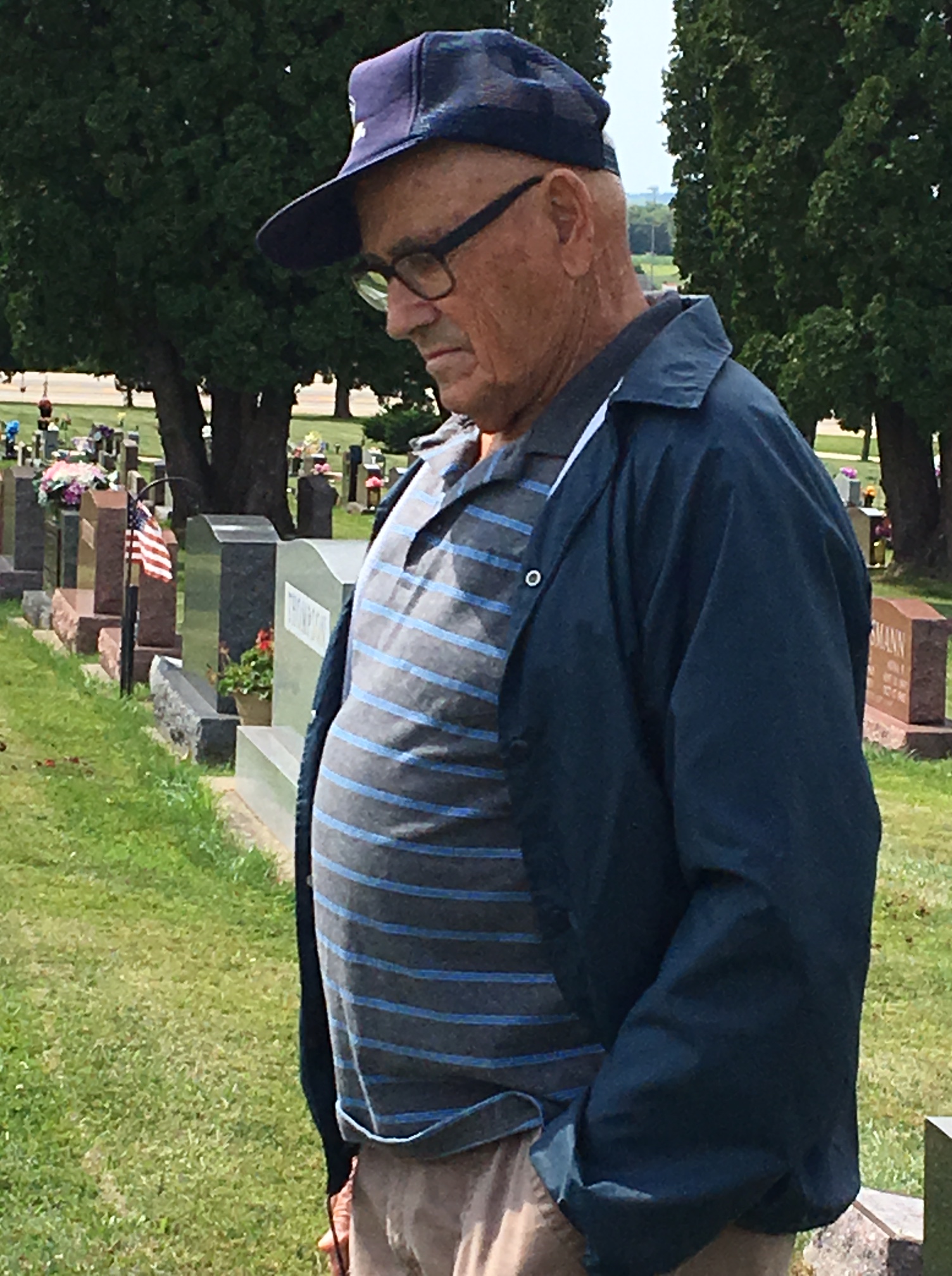
His heart took him three places. The first was to the cemetery. It is the place he will finally rest with his brother, parents, grandparents, aunts and uncles and friends. He wanted to wander. We followed him as he touched stones and told stories – stories he told to us but for himself: a friend who died too young in a car crash, a kind scoutmaster and mentor, an old girlfriend, a high school pal who flew an airplane and their adventures landing in cornfields. We followed, listening, renewed to the deeper truth that the stories we tell of others, the stories of shared time and experiences, both comic and tragic, when combined, scribe the arc of our own lives. Columbus needed to go to the end place to scribe his arc, to touch the depth and arc of his experiences.

The second place was the house that his grandpa Charlie built. It was the place of his childhood, the place of his greatest freedom, the place where all his stories begin and, now I know, where they return. This house is the cornfield. It is, for Columbus, the font of family and the source of his ideals. It is the symbol of his pride. This small house, with no electricity or running water, no indoor plumbing, this house that was pieced together with found material, smacked together with a handsaw and a hammer, an evolution, this house is Columbus’ holy ground. It still stands, just barely. And although now a storage shed for someone, it holds riches beyond words or measure. Columbus needed to stand in the source of his belief.

Finally, we followed his heart to visit his aunt JoAnne. She is only two years his senior but his aunt never-the-less. She is the last living person to know him through the entire passage of his life. She is his connective tissue, the one capable of affirming that it all happened, that the house and the people in it were exactly as he remembers, that this life, although only a minute long, is bottomless in the love that they share. They are the burning point of family, the front line. When we left her, Columbus and JoAnne hugged and cried, saying to each other but not for a moment believing it, “I’ll see you again.”

Stories told at the end place. Stories told from the beginning place. Stories told that connect the places. Columbus counts himself a lucky man. He knows with absolute certainty the trinity of places that hold his life/story. Sitting on the porch he (once again) taught me that stories – lives – are like a river and the flow transcends a single life. He just taught me that the story, a good life, like the painting, is never really complete.