The Stuff Of Life [David’s blog on Two Artists Tuesday]

It’s been awhile since we updated our website. Although Kerri disagrees with me, it feels a bit outdated. This morning, while poking around, I was struck by the “welcome” language on our Melange page: a place where we gather together to share writings, paintings, music, performances, workshops and the stuff of life. And then a statement of intention: we offer a daily blend of goodness, thought, laughter and beauty.

Recently a reader of John Pavlovitz commented that they missed John’s positive messages. John responded that he missed them, too. With the nation under attack by an authoritarian and mad-hatter oligarch, it seemed reckless to ignore the reality of our dire situation. Kerri and I feel the same way. We miss writing our positive posts but right now this is the stuff of life. It is impossible to ignore.

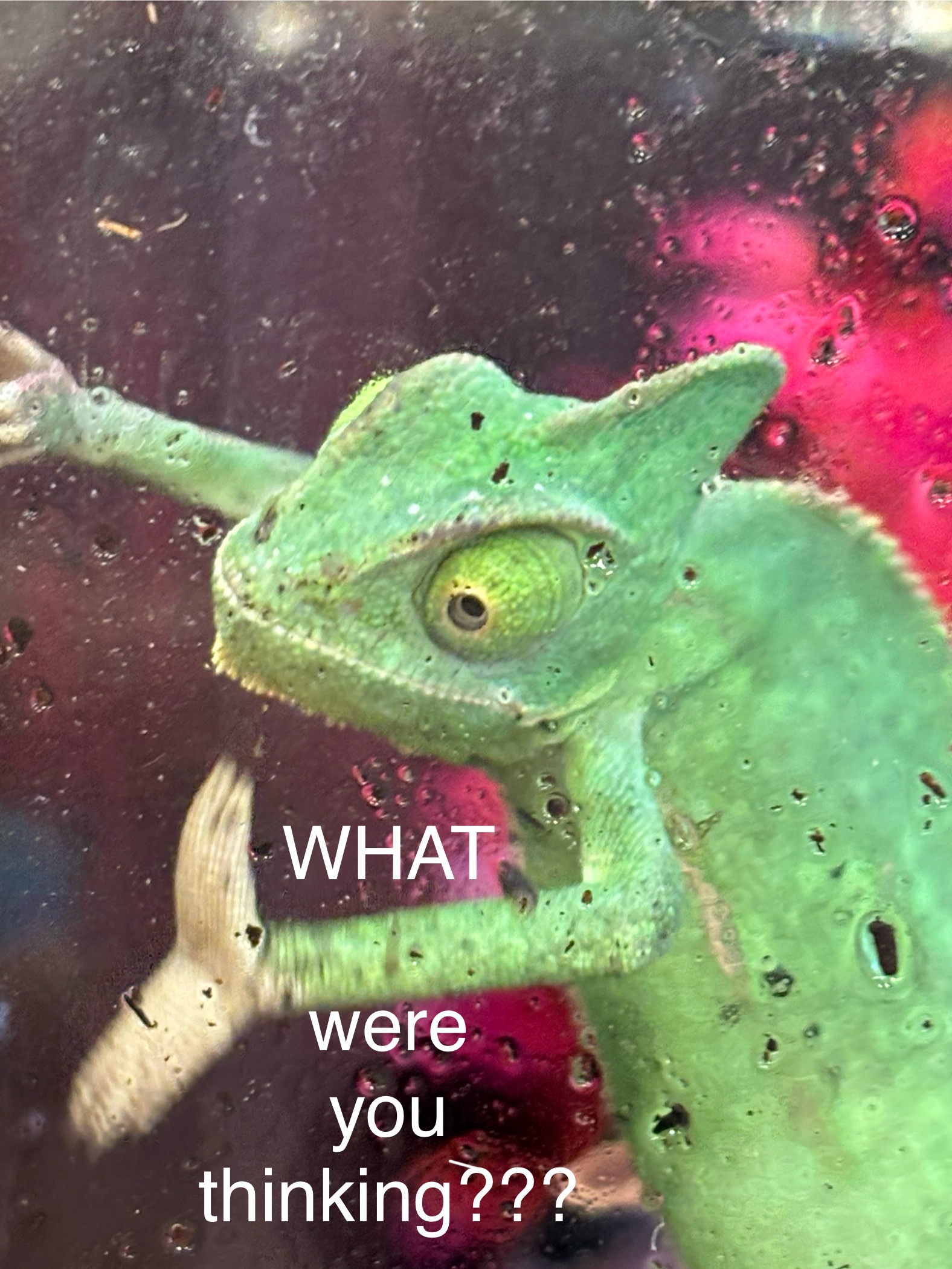
We were killing some time before an appointment and wandered into a pet store to visit the puppies and kitties. To our surprise there were no furry critters to pet so we wandered the store and were immediately captivated by a Veiled Chameleon. As is true of all things that capture our attention, the camera came out; a full-fledged reptile photo-shoot commenced and I have to admit, this tiny creature-from-the-black-lagoon knew how to model. It worked the camera.

Later, Kerri showed me the series and chose her favorite four from the reptile-photo-shoot. She gave each photo a name based on the animated pose of the chameleon, “Doesn’t it look like he’s saying, ‘OMG’?” It did. Body language is 55% of communication.

It made me laugh. Her four photo series captured perfectly the themes of our blogs since the election. 1) OMG!!! 2) WTF!!! 3) What were you thinking??? 4) NOW what??? I think this little critter may have solved my website design questions. He just might find himself featured as an animation on the Melange.

Someday we might return to a daily blend of goodness. Someday, if we are all fortunate, our focus will once again lean toward laughter and beauty. For now, this is the stuff of life. It is impossible to pretend otherwise.

read Kerri’s blogpost about THE CHAMELEON
likesharecommentsupportsubscribe…thankyou.

Cranky, Earnest, Docile [David’s blog on KS Friday]

I can’t help it. I see animated characters in these spiky thistle-balls. Three spiny stooges who are sharp, sharp, sharp on the outside with nary a thought on the inside. Bullies all.

Look closely and you’ll see that each has a different character. There’s a leader who has no idea where he’s going. There is the faithful number 2 who follows the leader without question. This thistle has no idea that he’s lost. And then there’s the character I love the most: the butt of every joke, the low-man-on-the-totem-pole. The follower. This thistle is just happy to belong. He doesn’t care where he goes as long as he’s with the pack. A directionless devotee.

What I adore about my budding animated-thistle-story is that each character is defined by their relationship with the other two. Leaders cannot lead without willing followers. Likewise, the role of faithful servant, blind follower, the second in command, only knows himself relative to number one. Number two puffs up on hot air borrowed from of the boss. And the low man, the thistle picked last for the team, will take any bone thrown his way. The other two are careful not to throw too many bones. Status games are like that: high status leaders need grovelers on the bottom rung. Mo, Larry, Curly.

Cranky, Earnest, Docile.

Cranky, the thistle leader, is ego-driven. He can do no wrong so, being directionless, he is constantly proclaiming himself a victim. “The forest is out to get me!” Earnest works hard to validate Cranky’s reality. If Cranky says it is true, it must be true! “The forest has it in for Cranky!” Docile, in turn, will perform any task without question. Docile will march in the streets, break windows, lie, hide documents…all to be one of the gang and, by association, feel one-rung-above. Docile is dutiful. The noticeable absence of question or thought is what makes Docile such a rich character. He is a lemming in thistle-clothes.

The absence of direction or thought or moral compass is what makes these three spiky stooges so utterly comical. So utterly frightening. So utterly close to home out here in the real world. Animation. Our poor thoughtless cartoon nation.

Boundaries/Right Now © 2010 Kerri Sherwood

Kerri’s albums are available on iTunes and streaming on Pandora and iHeart Radio

read Kerri’s blog about THISTLES

comment? share? like? support? thank you.

buymeacoffee is a thumbs-up for thinking, a nod of approval for curiosity and questions.

Look At You Look At Me [on Merely A Thought Monday]

It’s taken me this long to discover the source of all cartoon characters: orchids. I’m not kidding. At a recent field trip to the Chicago Botanical Garden’s Orchid Exhibit, I was surrounded by brightly colored fantastic faces, playful and chuckling. “Look at this one!” Kerri exclaimed. “It’s the Imperial Margarine guy!” I thought it was a whacky Pope or funny Cardinal, but the idea was the same.

“The earth laughs in flowers.” Emerson’s quote was stenciled on the wall as we exited the exhibit. And the laughing flowers made me laugh. Truly. I felt like a little kid at Christmas. Surrounded by color and delight and whimsy, I found myself more than once pointing, “Look at this one! Oh My God!” And, I felt like the colorful faces were staring back at me, thrilled to tears by the odd looking human standing before them. I-look-at-you-look-at-me. “Look at that face!” they snickered.

The thought stopped me in my tracks and filled me with wonder. We personify everything, projecting our humanness into everything. The art of animation, the world of Disney, is rooted in our desire to project ourselves onto and into the world. Talking mice. Dancing candlesticks. Humpty Dumpty. Wise old trees. Wouldn’t it be lovely, and isn’t it hopeful, to think the world projects itself into us? I want the orchids to fill me with color and awe. To project themselves into me. I know the forests I walk through infuse me with quiet. I know Dogga pulls love from my deepest soul.

Participants. Relationship, rather than controllers. Dancers rather than dominators. Would we be so invested in killing each other for imagined supremacy if we allowed ourselves to laugh the laugh of the flowers? If we actually understood that nothing is forever, that our warmongering was at best delusional? That the single trait that makes us human is to turn and help someone in need? The very capacity that allows us to project ourselves into the orchids is the same capacity that makes it possible to stand in the shoes of the other. Empathy is a two-way street.

If the earth laughs in flowers, these days it certainly cries in humans. Yet, standing amidst the orchids, I looked at all the human faces, hundreds of people wide-eyed with wonder and alive with astonishment. The laughing orchids looking back at the astonished faces, open and vulnerable, and they were evoking those qualities from the crowd. Earth’s tears. So hopeful, these faces, drinking in each other’s beauty.

read Kerri’s blog post about FACES

Make Art So.

at one time even this was considered a new technology

at one time even this was considered new technology. numbers, too!

Chet said, “But where’s the human in all of it?” His question took me by surprise. It is a question that often puzzles me. I was telling him about my recent inner earthquake, the moment that the train of technology jumped the tracks and collided with my art engine. Both exploded.

For weeks I’d been looking forward to a full day of exploration at the Chicago Art Expo. Hundreds of contemporary galleries from around the world assembled in one place, each showing their premiere work. As an artist these events have always fed my soul. This time, with the exception of a few older masters (a Chagall, a Picasso), a Hockney that made me smile, and few pieces from The San Francisco Figurative painters, I was unmoved. Worse, I was uninterested. As I wandered through the exhibits I listened to curators over and over again working hard to give context to the art. The viewers had no immediate access to it. They (like me) needed an explanation to access its relevance. I felt as if I was watching art-priests interpreting god for parishioners who had no expectation of direct access to the divine. The art needed a middleman. It required an explanation.

Just before going to the Expo, Skip shared a link with me. It was a video of animator Glen Keane drawing in virtual space. He was literally drawing from within the image. It took my breath away. Glen Keane called the technology a new tool but, like many new tools – so many new technologies, this one has the capacity to change our relationship with life and, therefore, with art because it could change our relationship with time and space. At one point in time, electric light was a new technology. The automobile, the airplane, the telephone, the camera and the phonograph were once new technologies. Each changed our relationship with sound, light, distance, the planet…each other. They changed how we see and experience possibilities. And, at the time of their invention, the community, at first, did not understand the power being introduced into their lives. They, like we, were stepping into the future with their eyes in the rearview mirror. What we know as art changed with the introduction of each of these technologies.

I couldn’t help but see the work at the Expo through the lens of this most contemporary tool. My eyes, for a moment, were wrenched from the rearview mirror and forced to look straight ahead through the windshield. Relative to the tool, the work at the Expo seemed abstract to the point of inaccessibility. It felt academic and I felt distant from it (lots of head, little heart). The tool although incomprehensible, was exhilarating, approachable, and inspiring. It made me want to play. It made me want to create. With this tool, Jackson Pollock would have danced and splashed in 3-D space. Picasso would have explored Cubism from within the cube. And, with this tool, I could see them doing it; I could sit in the same space and get paint on my face. In the video, Glen Keane says, “When an artist makes a line, it is a seismograph to their soul.” This tool, this technology, is a 4 dimensional seismograph.

Eve Ensler wrote, “Art has the power to explode the heart and open up other energetic capacities to re-perceive it. It defies boundaries and leaps tall buildings. It transports, it translates, it transcends. Transcendence is so important right now because our lives are so mechanized, controlled, and commodified; art has the capacity to open our souls and could be our revolutionary, evolutionary salvation.”

Yes. And, yes again. I can draw in the dirt with a stick. I can draw in virtual space. The verb remains the same. The access to others – the reach of the art – changes.

To Chet I wanted to say that humans create technology. And, in turn, technology informs humans and, therefore, art. Our very short attention spans are the result of our relationship with technology –  800 word blog posts are now too long, and 140 character tweets are desirable. Much of the Expo was digital photography or digitally altered images. It was mental and cold and abstract – certainly expressions of our time – expediency allows for little depth of experience. The technology did not make it cold; the way it is wielded by human beings makes it so.