


FOR TODAY’S FEATURED PRINT FOR HUMANS, GO HERE
(greeting cards also available)
Filed under: Art, Prints for Humans | Tagged: art prints, imagination, inspiration, prints | Leave a comment »
 I’m sitting on the deck sipping red wine. It is twilight. Jim is playing the mandolin (he is an extraordinary musician) and Kerri is playing her keyboard. They are rehearsing outside because it is too hot in the house. The breeze off the lake is a godsend. Dog-Dog does not know what to do with all the activity. He is running around and around; there is no sense to his crazy figure-eight patterns. I’ve learned his looping is actually Dog-Dog glee. He likes their music, too.
The fireflies are sparking. Kerri and Jim are working through a series of slow tunes for a performance this weekend and I am falling into their playing. I routinely tell them that they need to make an album together and they routinely smile and laugh at me. It is their laughter that comes through their playing and I love it. This world, I believe, like me, needs more laughter.
There is magic in a mandolin and I am suddenly reminded of my conversation with Arnie earlier today. We had a much needed phone conversation. Over the many years of our friendship Arnie has walked me through multiple mazes of my own construction. He has listened to more than one of my epic rants. He has a gentle way of asking just the right question to stop my rant in its tracks. I seek his counsel when I am lost. He somehow knows when I need an ear to bend or just a walk with a friend. His superhero name might be The Velvet Dope-Slap. I am grateful to be the dope to his slap.
During our conversation we bumbled into the topic of wisdom. I am now old enough to understand that bumbling is the only path to wisdom. No one seeking wisdom will ever find it. Seekers are notoriously serious. I have always been suspect of the dour saints that pock western sacred spaces. The Buddha laughs. Shiva dances amidst the destruction. There is wisdom in dancing, too.
Arnie and I agreed that wisdom only comes from repeated and dedicated folly. Sooner or later, if we are lucky, the mask of comedy breaks through the sad mask of tragedy; we learn to laugh at ourselves and our dedication to drama. It is through the laughter that wisdom finally reveals itself.
Kerri just gasped and stopped playing, “Oh my god! Look at the moon!”
Jim laughed at the interruption, and, pulling his glasses off his forehead, said, “Wait, I have to put my far-eyes on.”
Filed under: Awakening, Gratitude, Seeing, Truly Powerful People | Tagged: comedy and tragedy, firefly, friendship, laughter, music, seekers, wisdom | Leave a comment »
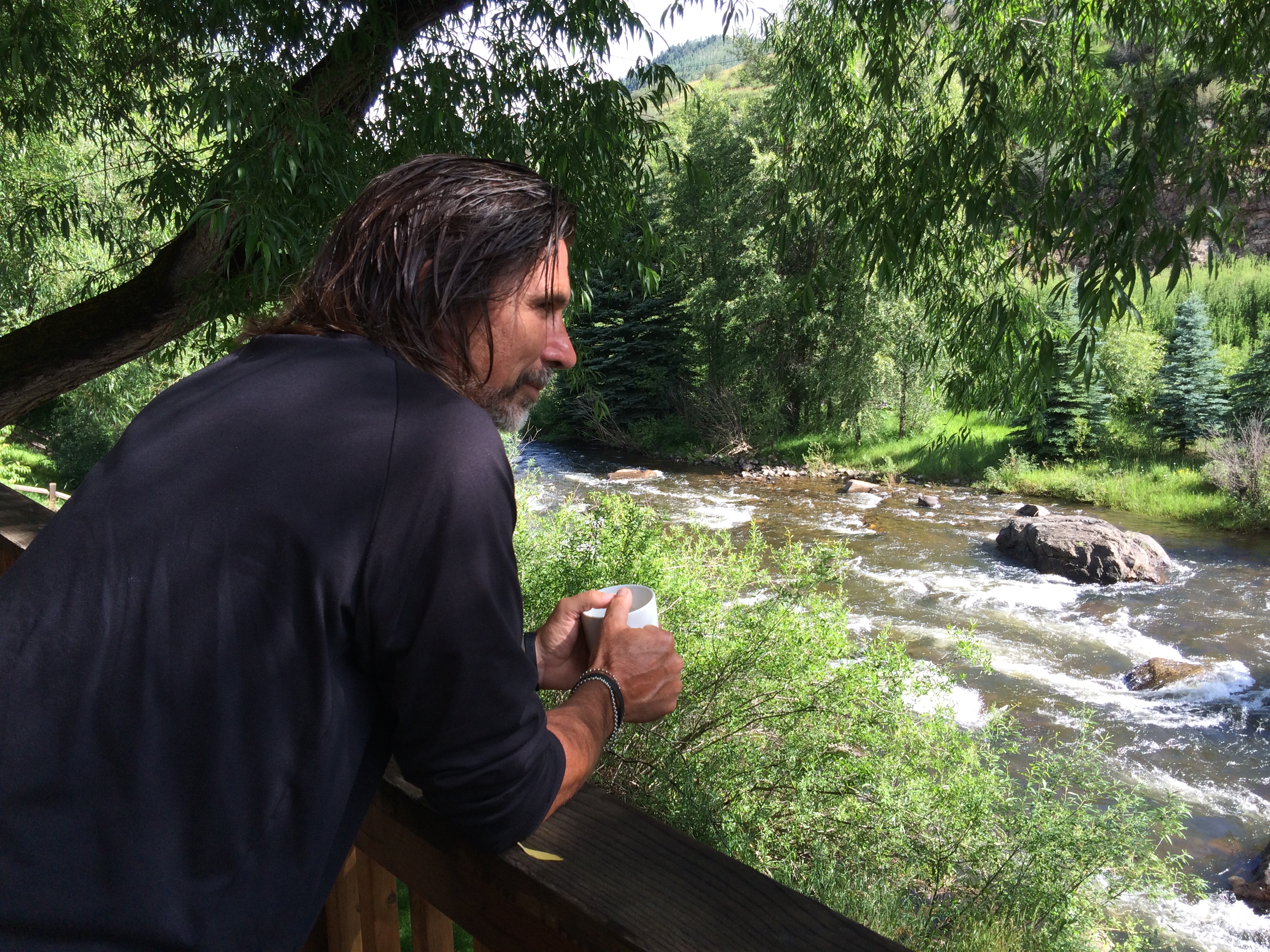 The back deck of the Minturn Inn overlooks the Eagle River. We sit in the sun and are mesmerized by the sound of the rushing water. It is liquid peace. In this moment I believe that people seeking to develop a meditation practice should begin sitting by a river. The water easily carries away all thought and worry.
The river is a great giver of perspective, a great deliverer of presence.
I am struck by this power of the river – and it is a power. We easily grasp nature’s power when a tornado levels a town or an earthquake devastates a city but forget that there is a flip side, a quieter side to nature’s ominous power. There is a vast quiet. In our world peace seems nearly impossible to achieve yet in less than a minute, sitting by the river, I am steeped in peace. That is an awesome power!
I once read (somewhere) that we have a vibrant internal compass capable of ringing true from false, right from wrong. If we make a choice that is out of our integrity, the compass spins wildly out of control, setting off an unstoppable inner monologue, a great inner debate. If the choice is in alignment, the moment passes unnoticed. True north is known by the absence of spinning. Inner quiet is an affirmation. Nature – including our inner nature – doesn’t lie.
Sitting on the deck, breathing in the mist and peace of the rushing water, I know that what’s most important in this life, the real art, happens in the quiet spaces, the moments that thought cannot penetrate, the spaces that require no definition or justification. They are the moments ripe with gratitude. They are the moments dripping with appreciation. I know that all the debates and disagreements and defenses are paper tigers. I also know that this peace is not the province of the river. It is, in fact, available all the time. The river simply reminds me to hush up and listen.
Filed under: Art, Awakening, Gratitude, Power, Seeing, Truly Powerful People | Tagged: alignment, artist, awakening, awareness, beauty, center, consciousness, death, meditation, perspective, power, river | 2 Comments »
 We’d been out in the canoe for more than an hour. The morning was warm and the water was still. We hugged the shore, cruising the lily pads. Dan told us some of the lily pads were over 150 years old. I was amazed at their capacity to reach through time but also reach through long stems to the water’s surface to drink the sun.
The turtle emerged from nowhere. It appeared from the depths, through the lily pad stem forest, and rose to within inches of the surface. It was big for a lake turtle, perhaps the size of a dinner plate. I let my paddle trail in the water. It was so close I could have reached into the water and touched it. We glided forward and turned the canoe so Kerri might see it but the turtle had already disappeared.

the view from the canoe
Turtle is perhaps the oldest known symbol for the earth. In many traditions, turtle carries the world on her back; the earth is her shell. She is a great reminder to go slow and persevere, to live grounded amidst the chaos of life. She symbolizes patience and ease. I was struck by how similar are the symbols of turtle and lily pad. Peace. Ease. Both are extraordinary symbols of grounding or rooting. Both cross the boundary of elements: the turtle lives in water and land. The lily pad reaches through the water to find air and sun. Both inhabit the depths and reach to the surface.
It feels as if I came into this world with art already in me. From an early age I drew pictures, not because I wanted to but because I had to. Like the lily pad, I was reaching for something unknown. I drew the same images over and over again: a cabin in the woods, eyes, clowns. I wasn’t drawing to master the image, I was drawing and painting in order to reach beyond the image. There was something there, beyond, deep in the depths, a root, rich soil, the void. There was a force behind the image that pulled me. My artistry felt like a descent into the caves of the ancients, a search for sources mythological.
Sometime during these past few years, the direction of the pull reversed itself. Like Orpheus in the underworld, I turned around. I walked toward the surface. In essence, the pull to the depths became a reach to the light. The sun called. Balance, in this life, at long last necessitated light and warmth.
Tom once told me that inheriting his family’s ranch and subsequently finding a trunk hidden in the wall of the house containing his ancestors possessions served as an affirmation that he had finally come home. Sitting in the canoe, the turtle rising by my side, I felt the affirmation. I am now only inches from breaking the surface. I drink the light because I know the depths and am adept at walking in the dark unknown.

the first layer of under-painting for my next piece
I am working much slower now. I am in no hurry to get anywhere. And my art, my life, is the better for it.
Filed under: Art, Awakening, Creativity, Emergence, Energy, Metaphor, Truly Powerful People | Tagged: art, artistry, balance, darkness, ease, grounded, light, myth, peace, rooted, sun | 1 Comment »

the latest painting in the Yoga series
David is among my chief muses. He was the first person I met in my spontaneous-no-plan-move-to-Seattle over 15 years ago. We sat next to each other at a conference and he asked me if I wanted to be in a play. When I said yes he said, “Great. Can you be at rehearsal tonight?” Like me, he is a painter as well as a theatre artist. He steps through life with his eyes firmly focused on the possibilities. He reminds me that obstacles are nothing more than interesting process steps. When I wander through museums or galleries David goes with me whether he is there or not. When I see a play that inspires me, I wish that he might see it, too, so we might talk about it.
Recently, he sent this quote: “My intention has been, often, to say what I had to say in a way that would exemplify it; that would, conceivably, permit the listener to experience what I had to say rather than just hear about it.” – John Cage, Where the Heart Beats: John Cage, Zen Buddhism, and the Inner Life of Artists.
When I was in college studying acting I had a professor who would say, “You will always know a good play from a bad play because a bad play wants to tell you what happens. A good play wants to include you in what happens.” He also used this rule to define good acting from bad acting. His shorthand phrase was, “Show me, don’t tell me.” It is the artistic equivalent of, “Give a man a fish and he will have a meal; teach a man to fish and he will eat forever.” Art, regardless of the form it takes, is meant to teach people to fish.
Art is not a “thing,” it is a relationship. It is a dynamic orientation to life. It is an experience (not a possession). My interpretation of my professor’s rule goes something like this: a good play/performance/painting includes; a bad play/performance/painting excludes. Vital art reaches for others. Empty art rejects or attempts to elevate itself above others.
The best artists I know have learned to get out of their own way. They have essentially, let go of all investment in self-importance. They serve the art and, so, are not terribly invested in whether a critic or a friend likes or dislikes their work. They have grown beyond attempting to control the perceptions of others (control is an act of exclusion); they are attempting to reach the soul of the matter, touch the soul of the other.
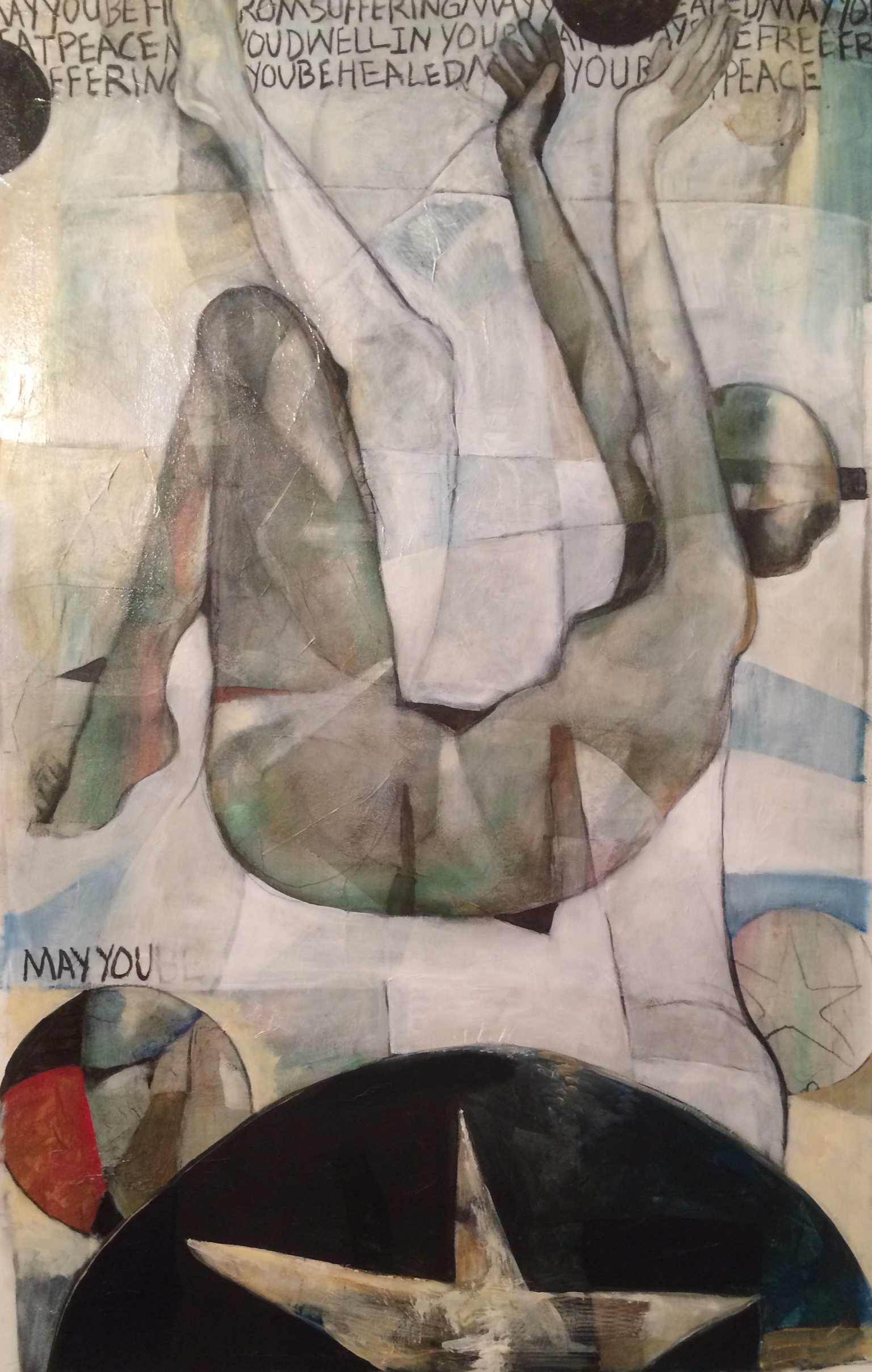
finally finished: May You Be
It is also true that great artists are constantly learning. And, since growth is always in the direction of the unknown, it is terribly important to have allies to walk with you. Stepping into the unknown is best done in the company of others, those special few wanderers who you can turn to and say, “Whoa! Did you just see that?” David, who is always there with me, laughs in response to my awe, and says, “Tell me! What did you see?”
Filed under: Art, Creativity, Gratitude, Heroes, Seeing, Truly Powerful People | Tagged: ally, art, creativity, friendship, muse, painting, plays, theatre | Leave a comment »

I had to use this painting from the archive for this post. I call it Eve
Notes at the crossroads of The New World Order:
1. B was disappointed in the low attendance at church. She told us that everything had changed in the last decade. Churches that were once thriving were now struggling. It is a trend. It is happening everywhere. It’s true. A few months ago I saw the statistics of church membership in America and the numbers are plummeting.
“What changed,” I asked.
Without hesitation she said, “People don’t need God anymore. They think they know everything.”
I quipped, “Who needs God when you have Google?”
She laughed and said, “Right! JFGI!”
“What does that mean?”
She smiled, “Just f*cking Google it.”
It is probably true for believers and non-believers alike that God is slower than Google, especially if the notion of God is uncannily human, (i.e., a rule-maker, judgmental, angry one minute and loving the next, assigns ‘chosen’ status to one team but not the other, etc.). Such a god might easily be confused with a search engine or a legal system.
I thought, but did not say, perhaps people are looking for something that neither technology nor a search-engine-god can deliver. Perhaps they are looking for something less volatile. Information is readily available. So is judgment. Wisdom is a bit harder to come by.
2. After band rehearsal we went to a bar. Jim grew up Catholic and we were talking about the revolution of thought that Pope Francis is inspiring. Jim said, “I really like that guy!” Suddenly, he pulled out his phone. “I wonder if The Pope is on Facebook?” We laughed when he found and “liked” The Pope. Facebook showed us a gallery of others who’d “liked” The Pope. The top of the list was The Dali Llama. “I’m going to like him, too!” Jim cheered and added, “I wonder if he’ll like me back?” We laughed.
I remember when a photograph was absolute proof that something happened. I remember the day that a photographer showed me a new “software” (at the time I had to ask what that meant) that could alter a photograph. He showed me and erased someone from a shot. I remember wondering what would be the new standard of proof? Sitting at the bar the other night with Jim, nearly 30 years later, I finally received my answer: it doesn’t exist if it isn’t on Facebook.
This brought me to what will be my next late night bar conversation topic with Jim: When did all of life become marketing and data collection? Have you checked your “likes” lately?
This inspired a glance at the fast moving river that is Facebook. I read:
Religion is for people who are afraid of going to hell. Spirituality is for people who have already been there.
That raises an obvious question: Is hell an experience or a place? JFGI!
Filed under: Random, Truly Powerful People | Tagged: Facebook, faith, God, perception, religion, seeking, spirituality, technology | Leave a comment »
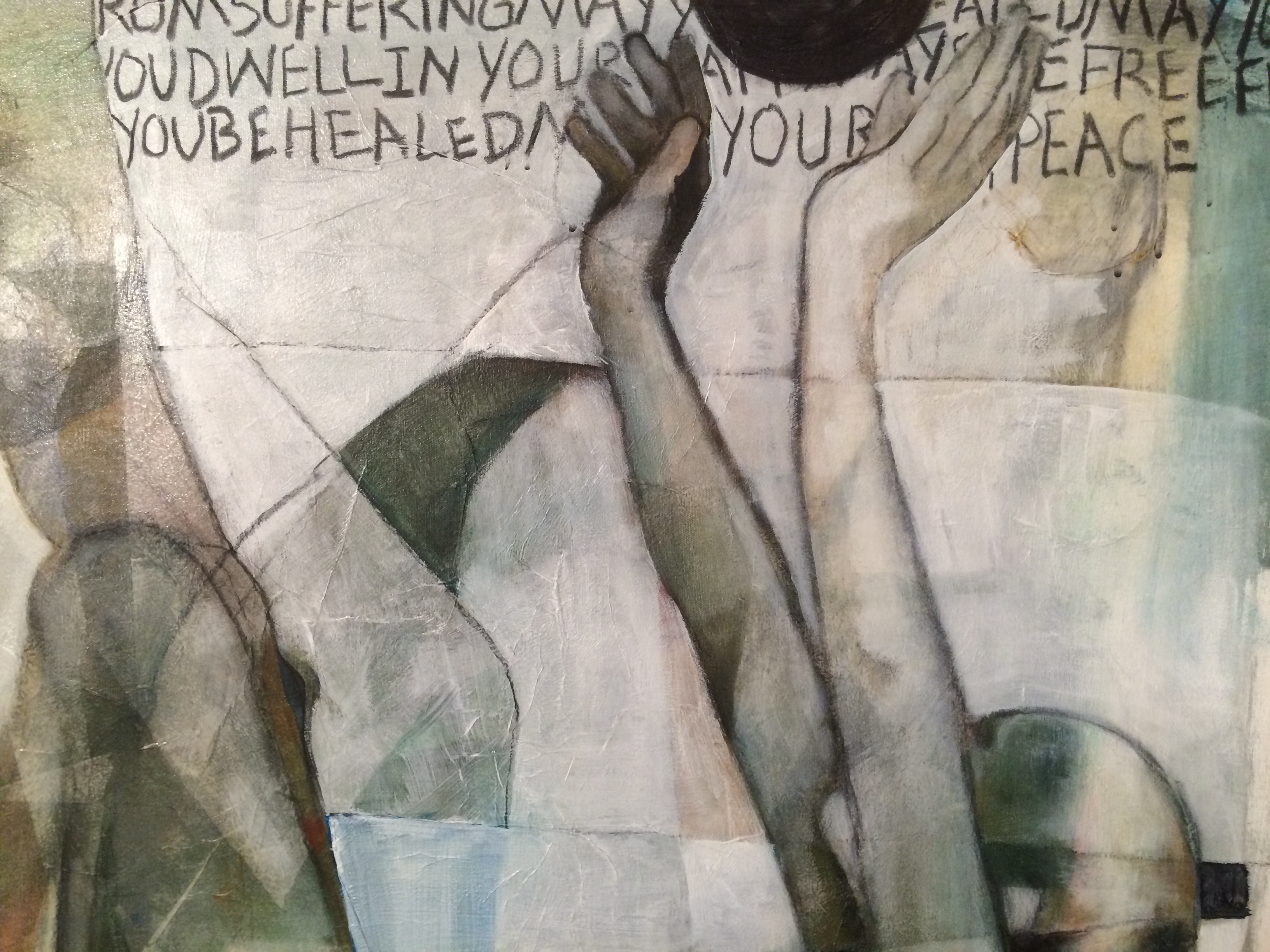
a detail of my latest painting
Oscar said, “I’m way too busy. I have too much to do.” He’s a junk guy, a scrapper and we’d just pulled a piano out of the back of his old truck.
“”That’s better than the reverse problem,” I said. “Too much time and nothing to do.”
Oscar smiled. “My grandfather always told me that sleepers wind up with nothing but dreams.” He added, “I’m trying to teach that to my son.” His son, a strapping young man, rolled his eyes.
It was a nice sentiment, a worthy lesson, and like all sticky-note wisdom, the flip side is usually also relevant. Sleepers wind up with nothing but dreams. People without dreams wind up walking through life asleep.
Once long ago I walked through a house with a realtor named Hans. The place was crammed with piles of stuff, stacks of books and mountains of magazines. I felt claustrophobic and couldn’t wait to get outside. Standing in front yard, having escaped, I said, “I don’t know how people live like that.” Hans replied, “Everyone has their heaven. What looks like hell to you is heaven to them.”
Everyone has their heaven. Everyone has their hell. Isn’t it a good bit of sticky-note wisdom to remember that heaven does not look the same to all people? And, to some people, depending upon how present they are, heaven is here and now. The same sticky-note applies to hell in the here-and-now.
Flipping to the weather channel I found, instead of the weather, an episode of Why Planes Crash (answer: the weather!). A flight attendant who’d survived a crash said, “When the plane is going down, people get religion really fast.” I thought, I bet the opposite sticky-note is also true. Religion is rule bound and usually comes with an in-crowd, a right way, or a chosen people. When the plane is going down I’ll bet all the rules go out the window (so to speak), the divisions become meaningless, and what people get is how precious, unique, and vast is their life – and all of life, for that matter. They don’t get religion, they “get” life. Ric Elias was in the plane that landed on the Hudson River. For him, going down in the plane served as instant clarity. He left the plane knowing without doubt what mattered. He no longer needed to be right. He no longer had time for negative energy. He no longer had time to be too busy. He woke up to his dream.
Filed under: Awakening, Emergence, Truly Powerful People | Tagged: awakening, awareness, dream, dreams, heaven, hell, presence, wisdom | Leave a comment »
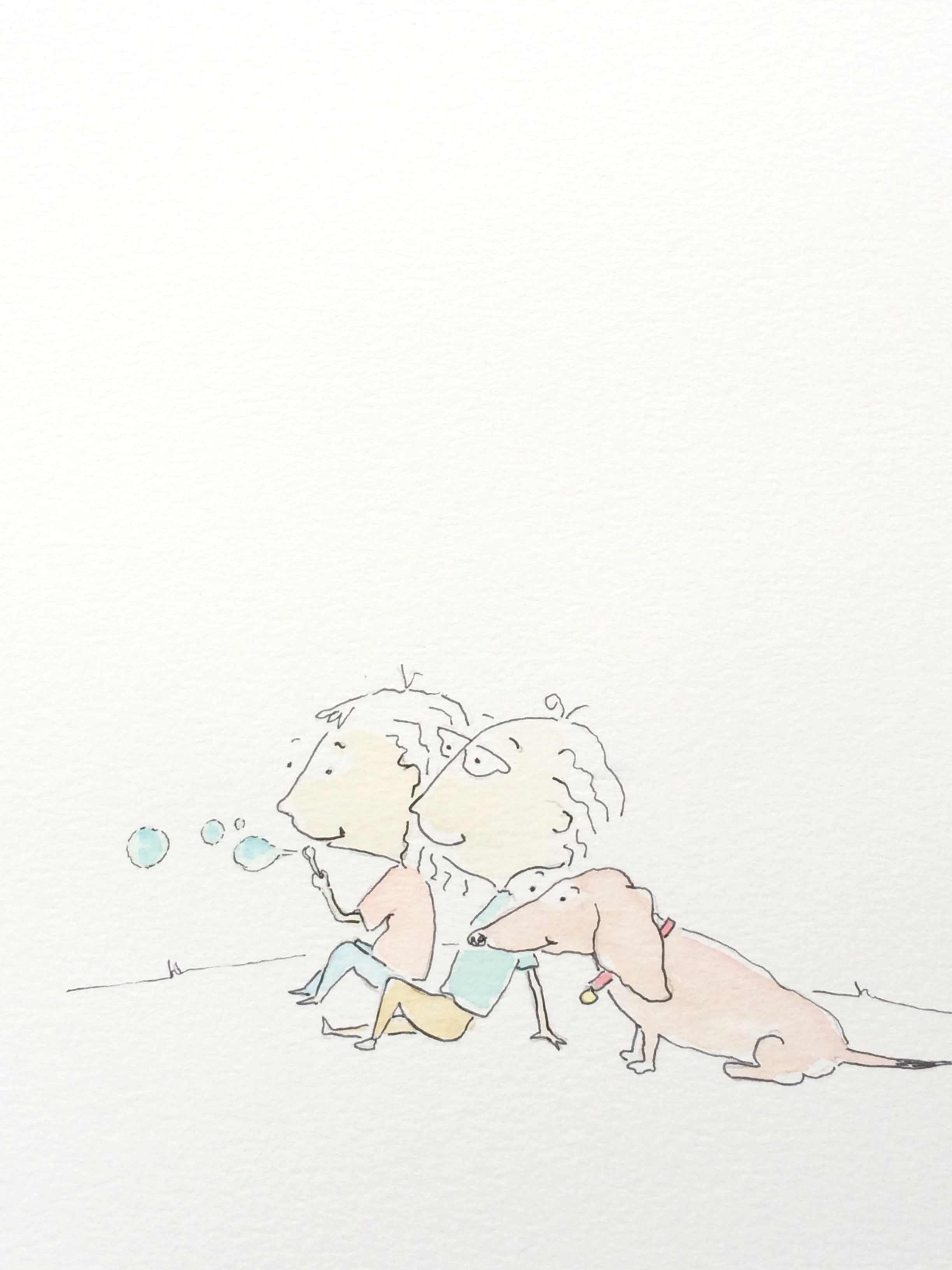
an illustration for Shayne And The New Baby
The lake is very still today. Usually the lake, Lake Michigan, behaves more like an ocean than a lake. The breakers roll onto the beach. It is famously fickle and can change moods in a heartbeat. It regularly swallows tankers. This winter it swallowed more than a little bit of the shore. The Coast Guard routinely practices search and rescue missions off the coast; we’ve stood on the rocks many evenings and watched the helicopter go through its paces. Today there is calm. Today there is peace.
This afternoon I completed the 65th and final illustration in the Shayne Trilogy. Like the lake, when I cleaned my brush and put it aside, I was quiet inside. In the middle of March, after a call with Beaky, we decided there was nothing more important than illustrating and publishing the manuscripts that she’d written. And, there was no time to waste. We illustrated, designed, and published the first book of the series in record time. Beaky had her very first-ever book reading and author signing on April 11th. It was a triumph. That day I knew I that I would never do anything more meaningful or important in my life.
When Beaky passed away at the end of April, the second book was midway through the design phase. The illustrations were complete and Kerri was working furiously to publish it by May 1st. Beaky’s passing, of course, derailed all progress and I wondered if we would be capable of bringing all of her books to the finish. We were still for many weeks. We were breathless.
And then, last week, out of nowhere, a strong wind caught our sail and we were back at it with the same fervor as before. It was as if someone threw a switch; we did not get out of bed that day intending to resume the work, but by noon I was drawing the next batch of illustrations and Kerri was layering words over images. The second book, Shayne And The Yellow Dragon is, at this moment, a single click away from publication. Yesterday Kerri began laying out the final book in the trilogy, Shayne And The New Baby. At this pace, we are a few short weeks away from finishing what we started a lifetime ago in March.

the creative team
The illustrations are simple. They came easily – as do all labors of love. They are just what Beaky wanted. “You two did all the work!” Beaky protested as we wheeled her toward the over 70 people that gathered for her reading. I teased her that she must have forgotten that she wrote the books. “We make a good team, Beaky,” I said, and she smiled.
Filed under: Art, Family, Gratitude, Love, Truly Powerful People | Tagged: Beaky, books, calm, children's books, illustration, love, peace | Leave a comment »

It was after 2am and, at first, I thought the screams were human. I was writing at the kitchen table and the screams brought me to the front door. My neighbor’s light came on. Faces peeked out of the window. They thought the screams were human, too. Kerri was suddenly standing behind me. “It’s a rabbit,” she whispered. “They scream like that when they are being killed.” She was quiet for a moment and added, “It’s awful. It’s the sound they make when they are trying to hold onto life.” The screams stopped. The neighbor’s light flicked off. They recognized the sound, too, and went back to sleep.
Kerri returned to her call. She was on the phone with a friend in distress. I remained at the door and stared into the dark night. It was silent. It was as if all of nature had stopped to listen to the screaming. Even the wind was still.
The fox pranced from the darkness into the center of the street. It was vibrant, sated. It stopped and was immediately still when it realized it was being watched. It stared at me and I stared at it. I’ve rarely looked for so long into the eyes of something so wild. Neither of us moved for several seconds. And then, as quickly as it had emerged from the darkness, it bolted and vanished.
My only thought came like a mantra: it knows that it is mortal and I do not.
Earlier in the day I’d read a passage from Tales of Power by Carlos Castaneda. I’m completing my once-a-decade rereading of his first three books. I’m reading them very slowly this time, bit-by-bit, and sitting with what I read. The passage that rang my bell this day was this [I’m made some cuts for brevity]:
“Your reason is telling you again that you are immortal,” he said.
“What do you mean by that, Don Juan?”
“An immortal being has all the time in the world for doubts and bewilderments and fears. A warrior…knows for a fact that the totality of himself has but a little time on this earth.”
…”But, Don Juan, my point is that I’m always under the impression that I’m doing my best, and obviously I’m not.”
“It’s not as complicated as you make it appear. The key to all these matters of impeccability is the sense of having or not having time. As a rule of thumb, when you feel and act like an immortal being that has all the time in the world you are not impeccable; at those times you should turn, look around, and then you will realize that your feeling of having time is an idiocy. There are no survivors on this earth!”
Staring into the eyes of the fox I was shocked out of my immortality. Acting like an immortal being, having all the time in the world to indulge my doubts and fears or dream of greener pastures knocks me out of presence. Staring into the eyes of the fox I, for a brief moment, understood that being fully present in my life had nothing to do with achievement. Presence is not something to strive for and attain like a new car. It is not a study and the path to it cannot be found in a book. Presence is what we are. It is something we forget when we think we have all the time in the world.
The fox does not know time. The fox does not know judgment or indulge in doubt or entitlement. It literally has no time for that. It does not need to story its actions. It lives with what is, not with what it imagines.
Filed under: Awakening, Edges, Truly Powerful People | Tagged: awareness, entitlement, immortal, judgment, mortality, presence, time, timeless, wild | 2 Comments »

Illustration from Play-to-Play
It’s very late. I was deep asleep and am suddenly wide awake. That is happening often these days. My inner light switch is tripped and there is no going back to sleep.
I woke up thinking about something Judy told me yesterday during our phone call. Judy is wise. She told me that she believes the real work in a life is never achieving a goal or arriving at a destination. It is not something with a direction. The real work is to learn to stay open. Stay open to possibility. Stay open to choices. Stay open to feeling. Stay open to changes. Stay open to experiences. Stay open to surprises.
It is not the kind of advice that children generally get in school but it is exactly the kind of advice an elder might impart if asked – and only if asked. Learn to stay open. Life has a way of making us want to close, to armor up, to dull our selves, to turn our backs and whisper, “There’s nothing I can do.”
It sounds too simple, “Stay open to life.” It’s not. What is simple is sinking into the easy chair and falling asleep in front of the television. Simple seems like a good idea until you realize you’ve been doing it for years. That is, of course, the point of the easy chair. The easy chair is a destination. It is a direction.
Staying open is a practice. Turning toward life and facing it with all of its force, heat, and pressure is not simple. Opening to the grief as well as the joy, feeling the pain as well as the pleasure, requires intention. Opening to the full spectrum of living engenders liveliness. Life begets life.
In a recent post I included a quote from Carlos Castaneda that just popped to mind:
“Oppressors and oppressed meet at the end, and the only thing that prevails is that life was altogether too short for both.” Carlos Castaneda, A Separate Reality
Filed under: Awakening, Edges, Identity, Possibility, Truly Powerful People | Tagged: alive, awakening, choice, feeling, open heart, open mind | 1 Comment »





