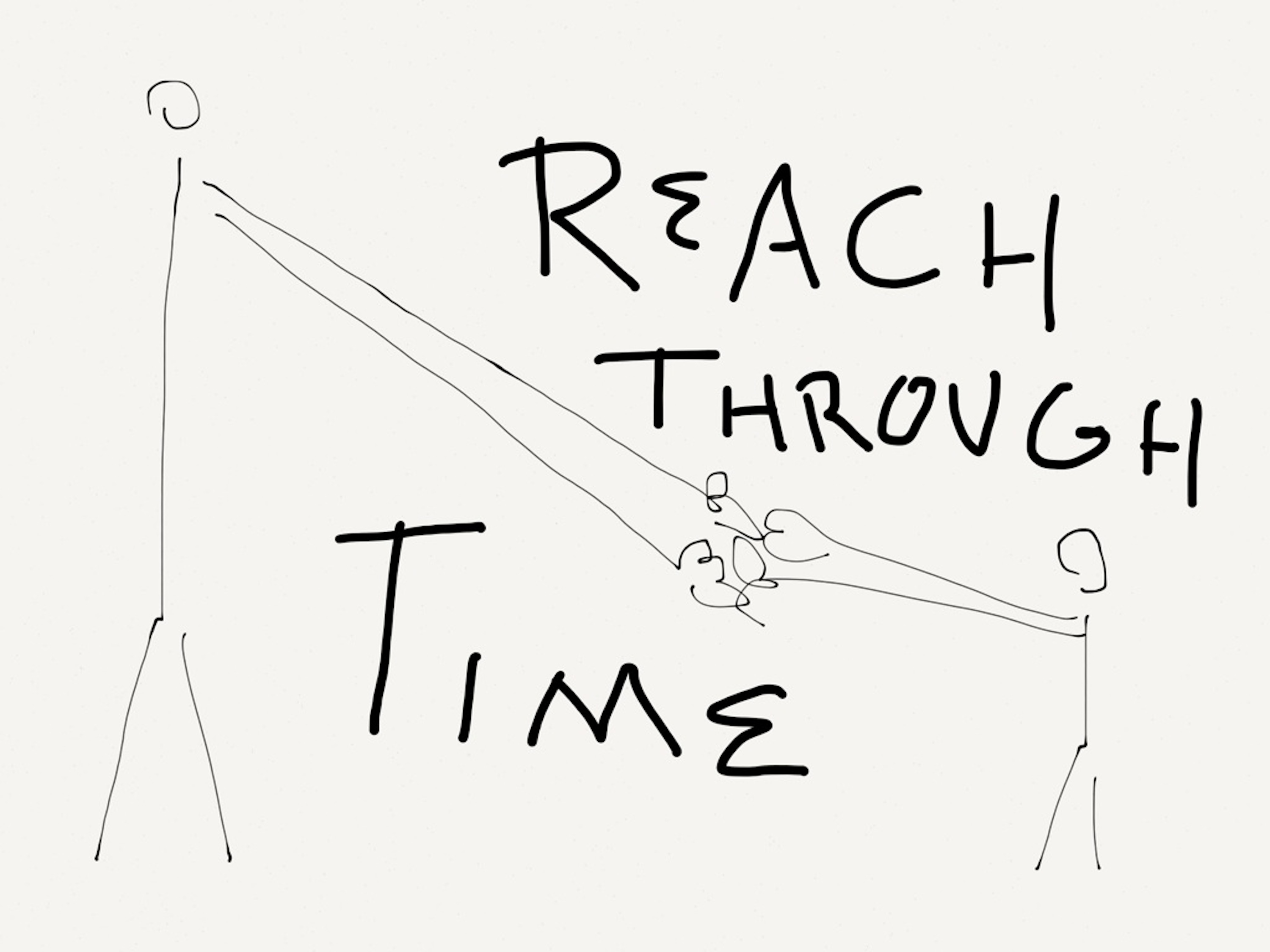
Reach Out. Peer In.

I've yet to title this painting but it seemed right for this post.

I’ve yet to title this painting but it seemed right for this post.

It’s a mid August morning with a hint of fall in the air. The breeze carries that “something” that is indescribable, more of a feeling than a chill or the changing of leaves. Never-the-less it is present. It is the signal and my body knows even as my mind debates. It is too soon for this – but even as I think the thought, I wonder what that means. Too soon based on what? Compared to what? This is my first summer in my new home. Last year I was an occasional visitor. I had glimpses into the cycle of the season so I have little with which to compare.

It has been a surprising summer all the way around. We’ve been traveling almost constantly since early June. The first few weeks of travel was planned, the rest was not. I’m not sure what the summer was like here because I was not present for it. The neighbors tell me it was a wet and cool summer. “Summer never came,” is a phrase I’ve heard more than once. After this summer of travel I will move into autumn with mere glimpses of the season.

I just had a call with Skip. He inspires me and makes me think things I would not ordinarily think. We’ve not talked for many months and our call was about catching up. Since I am writing about glimpses I was aware during our call that the best we can do is offer small windows into our lives. I said, “These past few years have been extraordinary in the changes and transformation I’ve experienced.” I was fundamentally incapable of articulating how profound my experiences have been. “It’s been like peeling off layers,” I said. A simile is the best I can do. Like or as. Glimpses. Events. Metaphor. No one can ever know the full scope of my walk just as I can never know the fullness of another person’s life.

During our call Skip told a story of walking through the woods with his wife when his cell phone rang. It was his daughter and infant granddaughter calling on Facetime. Skip’s granddaughter was taking her first steps. He and his wife peered into their phone and watched the miracle of first steps as their granddaughter, taking her first steps, looked into her mother’s phone at the excited faces of her grandma and grandpa. Glimpses into spaces.

We peer for a moment into a space. We stand in a space for just a moment. We try to share what we see. We try to share the fullness of our experience but can only approximate. Reaching out and peering in. Standing on the deck feeling that indescribable something that my body knows. My mind debates. This is life. Reaching out and peering in. What else?

title_pageGo here for my latest book, The Seer

Go here for fine art prints of my paintings.Yoga.ForwardFold


Know Your Meditation

photo-1Some random thoughts on consciousness:

Last night I read that, according to some traditions, all forms of separation are an illusion. Only the whole is real but to experience the whole, one must experience him or her self as separate from it. What a conundrum!

Or, is it a gift? Tonight we witnessed the most extraordinary sunset. It’s been stormy these past few days and this evening the storms finally broke. The colors of the sunset were subtle, muted, otherworldly. Breathtaking.

We witness all of creation. All of it. And, as witnesses, we experience ourselves as separate from it. A sunset stops us in our tracks because we glimpse the glory of it all. Once, I stood on top of a mountain at sunrise and cried for the sheer beauty of what I was witnessing. Or, perhaps I cried for the feeling; I was, for a brief moment, not separate.

Consciousness is like a flashlight. We point its beam. We see what we illuminate. And, we illuminate what we see. We assign meaning and value where we point our beam. Some experiences – like sunsets – we define as glorious. Some, we define as lacking. Both are forms of meditation. Every choice to aim the beam is a meditation. All assignment of what is found in the light of the beam is a meditation.

What is your meditation?

As Joe said, the entire universe tends toward wholeness. Every time I recall his words I realize a deeper truth in what he said. We tend toward wholeness because we are already whole; the illusion of separation makes us think otherwise. In fact, thinking makes us think otherwise.

The Balinese have an art form, the shadow puppet, called Wayan Kulit. The audience sees the story as shadows cast on a screen. The performance is meant to remind the community that what they see is illusion. It is meant to remind them that they (we) are all casters of shadows. Our minds are screens upon which we play our dramas. Behind the screen, when all the characters are put away, when all the conflict is resolved, when all the separate pieces unified, there is only one artist, and we are….all.

title_pageGo here for my latest book, The Seer

For hard copies, go here.

The latest in the series. This piece is almost 5ft x 5ft

For fine art prints of my paintings, go here.

Feel The Ripple

Baby Cat settles in

Baby Cat settles in

“The fabric of creation ripples when people love each other,” the leader prayed. I opened my ipad to capture the phrase. I liked the image of creation as a dynamic living fabric, a weave responsive to the heart.

Yesterday, Jim said with gratitude and love in his eyes, “Life can change in an instant.” His wife was in a brutal head-on collision a few days ago. She survived and will eventually recover. “The crash was 900 feet from our driveway,” he said, adding, “You never know.”

You never know.

Tripper Dog-Dog-Dog jumped onto the bed. He brought his bone and settled at our feet. We were having the first cup of coffee of the day and talking about things to come. Baby Cat leaped up to the window sill and settled in.

Creation ripples.

title_pageGo here for my latest book, The Seer

Or, go here for fine art prints of my paintings

Eve, by David Robinson

Eve, by David Robinson

Ask Them To Be Kind

A black cloud moving in.

A black cloud moving in.

While driving across South Dakota, the darkest cloud I’ve ever seen rolled across the sky and consumed the light. The cloud was dense and black. It was heavy, its belly hung over the car and seemed to press us to the earth. It seemed more than cloud. It was ominous, a presence.

When we started the day we’d intended to drive through the Badlands but a prodigious rain had slowed our progress. We saw the rains marching toward us across the open land. It was both beautiful and daunting and hit us with a wave of authority. This storm meant business. We crawled through Wyoming with other back road drivers, watching the barely visible white lines to keep on the road. Motorcyclists pulled off the road and stood next to their bikes; there was no shelter to be found.

Although we lost a few hours to the storm we thought we might still make it through the Badlands before nightfall. And then the black cloud appeared and ate the last light of the day. Once many years ago I did a night dive through the wreck of a sunken ship. In the dark of night, deep in the ocean, while swimming through the bowels of the ship, it’s decks between me and the surface, I felt as if I couldn’t breathe. This blackest of clouds enveloped us like the ocean at night and I felt that same sense of pressing suffocation.

The gods of nature are not to be ignored. Once, I sat with a Balinese man who told me that, according to their belief, it was with the dark forces of nature that people need alliance. There is no hell in their paradigm so dark and evil are not bedfellows. There are forces: creation and destruction in an eternal cycle of rejuvenation. Their rituals are about making peace with the black clouds, the gods of lightning and rain. “The forces of light are already with us,” he said. “We ask the dark forces to be kind.”

Looking through the windshield at the ominous pressing cloud I whispered, “Be kind.” It was. It let us go. We heeded the warnings and left the Badlands for another day. Later that night, sipping wine from plastic hotel cups, safe in our room, we sighed and laughed at how utterly small we felt on the open plain amidst the power of the storms. With that smallness came the gift of alertness. We were fully awake, alive with moment, stripped of the illusion that humans have dominion over anything. We savored our moment, temporary, passing, and perfect.

title_pageGo here for my latest book, The Seer.

Or here for all digital downloads of The Seer.


And, here you will find fine art prints of my paintings

Canopy by David Robinson

Canopy by David Robinson

Revisit And Revise

Pidgeon Pier (Alan and David on the Sound) by David Robinson

I used this painting as the cover image for The Ground Truth. I call this painting Pigeon Pier.

With the success of my book, The Seer, I’ve been revisiting some previous manuscripts and ebooks. I have a lot of them, mostly unpublished and unseen. One of my favorites, and one that I am considering revising and releasing, is called the Ground Truth. The ground truth is a military term and denotes the difference between the truth as seen by the generals in the war room (an abstraction) and those actually doing the fighting on the ground (actuality). I gave the book the subtitle: Six Dynamic Relationships That Will Change Your Life. Marketing claims are usually brazen. The book is really about how to orient to personal truth.

As I’ve been revisiting the book, I’ve also been revisiting several of the concepts in it. One concept that has been much on my mind lately is the Hero and the Anti Hero. Here’s an excerpt from The Ground Truth defining the concept:

In a small notebook with a red cover I found a drawing. The image is horizontal on the page. On the far left I wrote the word “Hero” and scribbled a circle around it. On the far right I wrote, “Anti-Hero” and also scribbled a circle around it. The circle with the Hero and the other with the Anti-Hero are connected with a line. The drawing looks like a cartoon barbell. I must have been explaining this to someone; I can tell by how emphatically I scribbled the circles.

The Hero and The Anti Hero was a revelation that Harald shared with me a few years ago. Harald’s first language is German so he used the term Anti-Hero instead of villain or devil or “big dog yapping in my brain.” I like Anti-Hero because it is actually more appropriate than any term I might have used.

He told me that he’d spent much of his life trying to rid himself of his inner Anti-Hero. It had consumed much of his life, this powerful inner voice of self-criticism and judgment. It plagued him and the more he resisted the Anti-Hero the stronger it became. One day, exhausted by his inner turmoil he had an epiphany. He realized that the way to rid himself of this Anti-Hero was to stop expecting to be a Hero. In fact, his expectation of being a savior, being perfect, being everything to everybody was the very thing that fueled the Anti-Hero. Letting go of the Hero dissipated the power of the Anti-Hero and what was left was…human. Beautiful, flawed, funny and messy, Harald was a human no longer at war with himself.

Internal warfare causes split intentions, split intentions create internal warfare. It’s a feedback loop. As Harald discovered, trying to be the Hero in the eyes of everyone else split him into two pieces: the unreal expectation (Hero) and an ever-vigilant judge (Anti-Hero). Harald was attempting to control what he could not control: the expectations and responses of other people. His happiness was contingent upon the responses of others so he was constantly measuring his worth against others responses: The actor (Hero) and the measurer (Anti-Hero). The internal warfare was inevitable.

In the next few days I’ll write more on The Hero and the Anti Hero, and what a few years and new eyes have brought.

title_pageGo here for my latest book

Yoga Series 7Go here for fine art prints of my paintings

Welcome The Bump

With Kerri on the top of a mountain

With Kerri on the top of a mountain in Colorado.

Just beyond Vail, Colorado there is a tiny two street town called Minturn. It began as a mining town when people were rushing for gold but these days it survives as a place for tourists. It is radically different than its founding fathers intended. We stayed there for a few days of rest and recuperation after our two-week double loop through Middle America.

The double loop through America was nowhere in the plan a month ago. Things just seemed to pop up. A death. Kerri’s daughter stumbled into a new job that necessitated an immediate move. Plans changed. Our intentions for the month went out the window. All of the artistry went on hold. We quickly packed the car and hit the road.

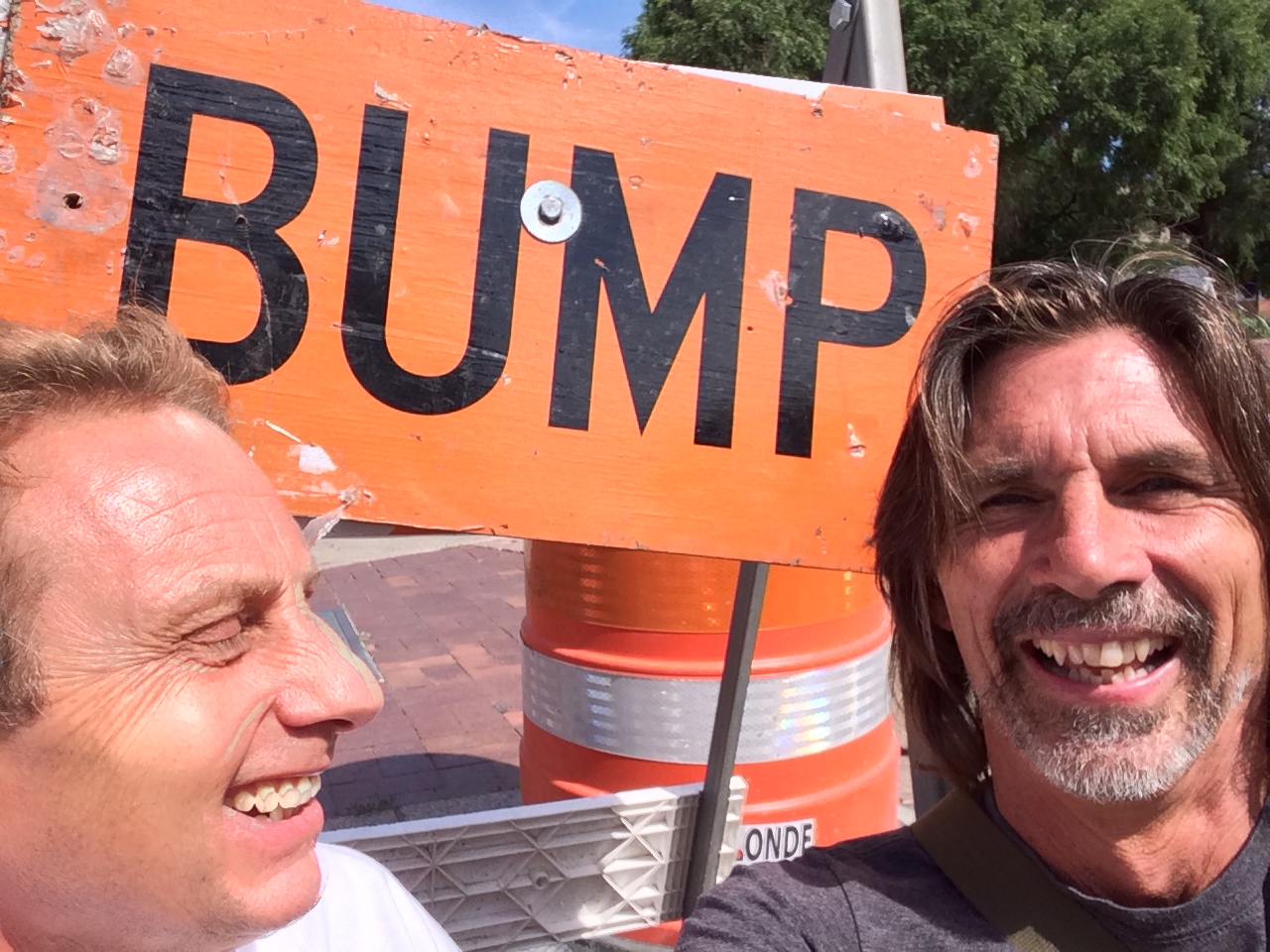
Just as plans change it is also true that change is rarely planned. I’ve yet to meet a person who doesn’t resist change (despite their rhetoric). Change requires a step into the unknown and that’s precisely the point: real change comes when we simply don’t know. Most of us like to know where we are going before we step. Change finds its way through the cracks that happen when patterns are disrupted, when things just seem to pop up, when we have no idea what the next step is. Change happens when we are making it up as we go. Change is a creative act, a tap dance on the event horizon.

Last week we drove to Colorado from Wisconsin through Iowa and Nebraska to attend my grandfather’s funeral. After the service we drove to Columbia, Missouri, crossing the full expanse of Kansas, to deliver some treasures from Beaky (Kerri’s mom) to Wendy (Kerri’s niece). Since we were driving to Denver, why not go home via Missouri? We returned home long enough to wash our clothes, pet the dog, and repack the car and head to Minneapolis. We packed up Kerri’s daughter and moved her to Vail via South Dakota with a sharp turn through Nebraska before arriving again in Colorado. After a rest in Minturn, a few hikes, some time with wine sitting on a porch, and a few precious nights with my parents, yesterday we returned to Wisconsin through Wyoming, South Dakota, and Minnesota.

It was a tap dance. Change found its way in as our patterns disappeared in the spontaneity of the double loop. We arrived home exhausted and exhilarated, with renewed eyes, a riches of profound and varied experiences, and much clearer intentions. What seemed initially like an interruption in our path was, in fact, a crack in the pattern, a necessary bump into the unknown.

title_pageGo here for my latest book

Look At All The Stories

My Stuff

My stuff.

It is ironic to me that I spent the previous two years divesting myself of stuff. When I moved to Kenosha last October, the truck was filled mostly with paintings, art supplies, and books. If I excluded those things, I could carry my worldly possessions on my back. And, I did for months. I now know without doubt what is essential and what is luxury. Mostly, my story is no longer entangled with my stuff. Well, in truth, there are still a few things that are sacred: the box that held DeMarcus’ brushes, a treasure or two from Bali, grandpa’s nutcracker, Bob’s tools. I gave away many useful things because of the story they held!

Since moving I’ve been helping Kerri clean out her house. Each week we take stuff to the Goodwill or place bags on the curb. She has been twenty-five years in her house and raised two children. The things we sort through have layers and layers of story. Children’s toys and books, sporting equipment, old electronics, and clothes; everything comes with a memory. More than once Kerri has held tightly to a box or shirt, saying, “I can’t get rid of this! Craig used this when….” We’ve saved many things, not for usefulness, but for story.

Several times we’ve made the trip to Florida to sort, box and store the contents of her mother’s house. Kerri spends hours each week on the phone with her mom, Beaky, as she pours over an enormous list of her possessions. Beaky is now in assisted living and will never return to her home. She wants to make sure that each item goes to the right person and that the story held in the item goes with it. In fact, the designation of recipient often has more to do with the story than the item. She is reaching into the future attempting to build a story link with the past.

A few weeks ago we walked by an open house. It was an estate sale. People were lined up out the door to go in and buy stuff cheap. The people in line were anxious and jockeying for position; they wanted to get in before all the good stuff was gone. The stories associated with the stuff died with the homeowner. The new story begins with a bargain found at an estate sale.

Last week while in Denver for my grandfather’s funeral, I crawled under Ruby’s house to pull out the boxes that Bob had stored there, mostly things they hadn’t used in years. Ruby said, “I didn’t even know that was down there!” Forgotten stories resurface.

My parents’ house is filled with the accumulated possessions of a lifetime. Their sedimentary layer of stories includes children, grandchildren, and great grandchildren. They’ve added no small amount of my grandfather’s possessions now that he has passed. The layers of story sediment compounded. “What are we going to do with all this stuff?” my dad asked. “Someone must have use for it!” He might just as well have asked, “What are we going to do with all of these stories. Someone must have use for them?”

It’s the question Tom asked when he found a trunk plastered into the walls of the family’s ranch house. The trunk contained the worldly possessions of an ancestor, a young boy named Johnny who died a century earlier. Little slips of paper written by his mother accompanied the layers of clothes and toys. “She wanted to keep his story alive,” Tom said. “What am I going to do with it?” he asked when he knew his life was on the glide path to the finish.

Someone once said to me, “You are not your stuff.” No. But we are people of commerce. We are people who identify ourselves through our stuff. We place great value in what we accumulate and what we accumulate becomes the vessel for passing on our value and our story. Look around you. Look at all the stories that surround you! Stand in your home, close your eyes, and spin around. Open your eyes and look at any object, any thing. What’s the story? What is essential? What is luxury?

title_pageGo here for my latest book

Canopy by David Robinson

Canopy by David Robinson

Go here for fine art prints of my paintings

Chase Your Lion

This is from the long ago archives. A sketch I call Persephone

This is from the long ago archives. A sketch I call Persephone

We were talking about fear. I’d suggested that some fears were actual and some imagined. For instance, if a lion were chasing me, fear would be my ally. It would be actual and useful. My fear would possibly save my life. It would make me run faster. On the other hand, if I feared pursuing my dream, of doing what I wanted to do in the world because of what others might think, my fear would be imagined. It would not be useful.

He said, “You don’t understand how afraid I am.”

“How afraid are you?” I asked.

He wrinkled his brow, “How can I answer that? No one can answer that.”

“Well, tell me how big is your fear?” I said. “Give it a size.”

“I can’t do that!”

“Sure you can,” I said.

“How do you quantify fear? How does anyone quantify fear?”

“Oh, quantifying fear is easy.” I said. “You simply count all the things you don’t do because of your fear. Those things are quantifiable. Count all the life experiences that you are willing to lose by holding onto your fear.”

He was silent for a moment. Then asked, “Like what?”

“Most people lose access to their lives. They let go of their dreams. They tell themselves that they don’t know how or that they were not meant to do what they want to do. How much life are you willing to miss by telling yourself the story that you are afraid? Count the days, the moments, that you stop yourself. Those moments are actual. Those days are quantifiable.”

He was angry, so I added, “Dreams are not lions.”


title_pageGo here for my latest book


Or, go here for fine art prints of my paintingsThe Poet

Hold It In Your Hands

photoBob could fix anything from airplanes to autos to plumbing. He had the accumulated tools of a man whose life was about keeping things well tuned. So, when his wife Ruby asked me to go into the garage and choose some tools to take home with me, I had to work hard not to weep. “Bob would have wanted you to have them,” she said.

Many years ago when my grandpa Robinson passed, after his funeral, we gathered at his home for what amounted to a love-fest. “Grandpa would have wanted you to have this,” his sons and grandchildren said as they gifted each other with grandpa’s worldly possessions. The decisions were made according to history and need. “He knew you loved this and would want it to go to you.” My dad looked at me and asked me to choose something. The only thing I wanted was an old nutcracker. It was falling apart because he used it so often. He’d held it in his hand. It was ordinary and useful and in one of the few precious times I sat with him, we cracked nuts, laughed, and talked about nothing important. I wanted something he touched. Sometimes when I need some simple wisdom or some laughter in a dark time, I hold the nutcracker and wonder what he would tell me. It never fails. I always hear a whisper of advice or something that makes me smile.

Going through the garage I chose tools that Bob used often. I wanted the tools that were worn and fit his hand.

I am, for the first time in my life, responsible for the upkeep of a home, my home. I’m new to repairing faucets and fixing gutters. It is my hope that when I have no idea how to fix something, I can choose a tool that Bob held, hold it in my hand, and ask Bob what I should do. It’s my bet that without fail, I’ll hear his saucy whisper of guidance. More than likely I’ll hear a joke (off-color, as my mother might say) and the laugh that made his shoulders rise. He’ll take the toothpick out of his mouth before saying something like, “Ah hell, just start. You got the right tool what else do you need?”


title_pageGo here for my latest book

Yoga Series 7Go here for fine art prints of my paintings


Flow With Your Constraints

a rough draft from my soon to be released children's book, Play to Play

a rough draft from my soon to be released children’s book, Play to Play

Margie said, “You two need to learn how to be cool and calm.” We repeated her words as if in a trance, “Cool and calm,” I muttered. “Cool and calm,” Kerri said and then looked at me and asked, “Can we do that?” I shook my head. We smiled. The previous day we jumped out of bed at 1:30am and drove 4 hours to Indianapolis to help Craig move out of his apartment. We made it back home by 10pm.Tomorrow we drive to Colorado and then on to Columbia, Missouri. Next week we drive to Minneapolis and on to Colorado again. “You have to learn to sit still!” Margie chirped.

Many years ago Makaela told me that I was like a feral cat. “There’s a part of you that flees from any form of containment,” she said. I was at first surprised by her comment. From the inside, my life seems ordinary. I go to the grocery store. I pay bills. Makaela has a Cheshire Cat grin and it flashed across her face. In truth, I can’t wear lace-up shoes. Neckties are deadly to me. I am brilliant at starting things: programs, theatres, companies,.., just don’t ask me to maintain them once started. Neckties, cubicles, and commutes suffocate me. “See? Feral,” she said.

Cool and calm? Feral?

Neckties and lace up shoes restrict movement. To me, they are improper constraints. Improper constraints are akin to knots in a muscle: they impede flow. Toxins collect around the knots. Disease in a body is the result of an improper constraint. An improper constraint can be literal, a knot in a muscle, or a thought pattern, like the expectation of being perfect. “Perfect” is a mental knot. It stops flow. It stresses unnecessarily. It blocks the movement of free self-expression and engenders judgment. It becomes toxic to the system. Gossip is an improper constraint.

The flip side an improper constraint is a proper constraint. Proper constraints facilitate movement in a direction. They focus energy. Proper constraints define clear and open channels of movement. In a healthy body, air and blood and lymph move unimpeded through channels of proper constraint. Proper constraint is necessary to feed the body. Proper constraint is necessary for vital artistic expression. Healthy communication works just like a healthy body. A choice is a proper constraint. Proper constraint frees the movement of self-expression and engenders connectivity. It clears toxins from a system.

“Wait a minute,” Kerri said as Margie retreated down the stairs, “I think we’re always cool and calm.” I agreed. Our proper constraints look a bit different than most peoples. More than once Craig has looked as us and said, “You two are not normal.” Too true. What is normal, after all? A proper constraint for me is improper for others and vice versa. Kerri and I know for ourselves what engenders flow and what interrupts it. Jay Griffiths wrote that a society has to be tame to need the concept of wild. If there is no break in the natural world, if there isn’t a need for dams and fences, there is no need to distinguish between wild and tame. I am not feral after all. Kerri and I work at having no internal dams or unnatural fences. Our business is to create our own version of flow. Isn’t that what everyone wants?

title_pageGo here for my latest book

The PoetGo here for fine art prints of my paintings