Sit In The First Seat


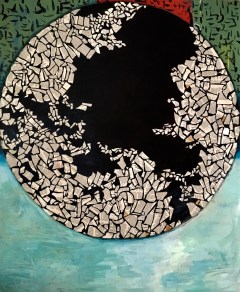
a detail from my latest painting

a detail from my latest painting

I am living this story, as are we all. I am a lover of story so I count myself fortunate enough to know that I am living it. It’s one of the grail stories. Here’s the section of the story that I am now living:

The knight who cannot be beaten (he has a magic sword) is knocked from his warhorse. A warrior, a man with no armor or shield, no protection, emerges from the woods, challenges the knight, and in a single blow, unseats him. That’s not the worst of it: the knight’s magic sword shatters. And, that’s not the worst of it. His armor, his trusty protection through the many wars in the wasteland, pins him down. Like a turtle on its back, he is defenseless. His magic sword, his trusted armor, all that he has relied on, all that he’s built his identity and purpose upon, betray him. He is stunned. He is lost. He closes his eyes and awaits his death.

Death does not come. Well…

another detail

another detail

The warrior, the man with no armor, does not finish the job. He disappears without a trace leaving the knight stranded but alive. The knight opens his eyes and somehow manages to sit up. He weeps because his endless efforts to save the world have come to naught. In fact, fighting ogres seemed to produce more ogres! He removes his armor. He is no longer a knight. He is no longer capable of saving the world. He is, for the first time since his childhood, unprotected. He is, at last, purpose-free.

Nothing is more frightening – or useful – than to drop the armor of purpose and take a good hard look at what lives beneath all that forged metal.

...and another

…and another

At first his lack of identity drives him crazy. He has no answer to the cocktail party question, “So, what do you do?” He feels naked and exposed. Fortunately, a teacher, a hermit, emerges from the woods to help him navigate the crazies. Namely, the hermit helps him by not answering his endless questions. The hermit helps him understand that the world never really needed him because the world was never really broken. The hermit helps him relax and see beyond all of his thinking. He realizes that the wasteland came, not because the world was broken, but because he believed himself to be broken, somehow lacking.

In a life of chopping wood and carrying water he sees that his purpose has nothing at all to do with doing – or roles or achievements. He sees that the road to the grail castle is blocked so long as he believes he is defined by a role or a bank account or lost in a made-up purpose. When he drops his need for importance the grail castle appears.

...and another

…and another

Satori, in all the stories, knocks seekers from their ponies. It stops all pursuits. It pops the illusion of a purpose-driven life. It necessarily strips the seeker naked.

We are all seekers at some point.

When you are required in the workshop to write your epitaph or are somehow forced to articulate what was most important in this life, the doing, the list of achievements, the purpose-drive will always take second seat. HOW you did what you did, the relationships you tended or ignored, the moments you appreciated or missed, will sit squarely in the first spot.


as yet unnamed

as yet unnamed


Save

Save

Let Go

Dog-Dog three years ago

Dog-Dog three years ago

Tripper Dog-Dog-Dog is now three years old. His birthday is July 4th so he believes all the ruckus and fireworks are for him. Of course, we do not dissuade him from his delusion. Country-wide festivities seem appropriate for the birth of any creature. It is a miracle no matter how you story it and ought to be outrageously celebrated.

Marilyn invited us to her family picnic. It was a riot of volleyball and bag toss, not to mention the best cheeseburger I’ve ever eaten. It was a great time! We sat at the table for elders. In the midst of feeling honored to be included at the grown-up table (I feel like I ought to be seated with the kids at the card table), I was shocked to realize that I was sitting with my peers. I am now of a certain age…. Some delusions pop themselves.

On Sunday at the holiday carnival as we watched the Pier Pups distance jump into a pool, Brad and I had one of those broad and deep conversations that keep me thinking for days. Among many things, we rolled around the idea of what it means to achieve, what it means to be successful. I’ve discovered, as my teachers told me I would, that ideas of success and fulfillment are different at each stage of life. Now, I’m successful if I’m quiet inside, if I do not let one of these too-fast-days slip by unappreciated. Some delusions are shed like too-much armor.

There is the moment that the unbeatable knight is knocked off his horse, the moment when Sisyphus, so strong, knowing and independent, doesn’t know what to do and his only recourse is to ask for help. His life depends upon it. To gain all, so the stories remind me, we must first lose it all. Like them, each time I think I have control of my destiny, I am summarily reminded of my delusion. Control is nothing more than just another story. Let go.

My greatest teachers in one pix

My greatest teachers in one pix

This morning, talking about all that has happened in three years, my wife looked at me through the steam of her coffee and said, “Time just keeps moving. You’d think it would slow down or take a vacation every once in a while.”

Dog-Dog now-a-days

Dog-Dog now-a-days

Pass It Forward

option2compilationartwork jpeg

david robinson at zatista.com

Picture It

blogblast5 jpeg

david robinson at zatista.com

Bookmark It

blogblast4 jpeg

painters never sleep. there’s always more to come.

david robinson at zatista.com

Walk The Gallery

blogblast3 jpeg

david robinson at zatista.com

Come See

blogblast2 jpeg

david robinson at zatista.com

Curate With Us

blogblast1unframed jpeg

david robinson at zatista.com

Save

Save

Start Walking

photoTell Me. How can I be a learner?

My mind went absolutely blank, and I heard myself saying, Its simple. To be a learner youve got to be willing to be a fool. ~George Leonard, Mastery

I used to do a lot of work in education. My career in the theatre took a sharp left-hand turn when I started consulting with schools. The puzzles that plagued educators seemed to me easy to address. To be human is to be curious. Tickle the curiosity, begin the story and get out of the way.

Tom once told me that teaching is about relationship (not control). He also told me that the best teaching/learning needed to be directly applicable; it had to be immediate. It had to be real. It had to matter – to both the teacher and the learner. The trick is to extend the mattering into greater and deeper levels of abstraction.

An emphasis on testing is an emphasis on knowing. Great learning places the emphasis on not-knowing. It reinforces the pursuit and dispels the notion that knowledge is something achievable. Worthy questions always open more worthy questions. To be human is to be curious. To be alive is to wonder what is on the other side of the hill and then take a step toward it.

The fool George Leonard references isn’t “ the unthinking person,” it is “the carefree fool in the tarot deck who bears the awesome number zero, signifying the fertile void from which all creation springs, the state of emptiness that allows new things to come into being.”

Emptiness. Not knowing. Relationship. Mattering.

Step Into Unknown with SigThe question, “How do we/I do it?” is a great step-stopper. It is the leading edge of every personal and organizational stagnation excuse. We don’t know how. I’ve come to believe that it isn’t a natural question but is learned behavior. It is an emergency brake installed by a system that values right answers over great questions.

My wife and I have a short-hand phrase, Beaky’s Wheelchair, to remind us when we stall, that “how?” is something that can only be known after the fact. No one knows “How?” at the beginning. Beaky needed an electric wheelchair to be mobile and the world of insurance/medicare was standing still. After months of waiting, with no clue which direction to begin, we started making calls. We met every “no” with a “why not?.” We asked a multitude of foolish questions. We learned. And learned some more. Within a matter of weeks, Beaky had her wheelchair.

How do you play the guitar? Paint a picture? Bridge a conflict? Transcend a limit? Know one knows. Tickle the curiosity, let go of any notion that you need to know how, and start walking.

text from Krishnamurti as it appears in my painting

the text from Krishnamurti as it appears in my painting


Save

Save

Save

Save

Unify

a watercolor from 2003, House On Fire

a watercolor from 2003, House On Fire

Stay with me. I actually have a point.

If ever I teach actors again, or coach people in any endeavor, or communities/businesses seeking betterment, I will only have two things to teach: 1) Grounded-ness and 2) Focus placement on the unifiers. These two concepts are really  one looping concept but for ease and the sake of being understood, I will offer them independent of one another.

As focus placement goes, an actor on the stage has two options and depending on the focus placement they choose, they will either create the play or destroy it. A focus on how they look or sound or feel destroys the play. It is a self-focus in an art form of relationship (all art forms are made vital in relationship). A self-focus breaks the relationships and effectively locks the audience out of participating in the story. It makes the actor giddy with fear, easily distracted, alone. Conversely, the actor can focus outside of themselves, on the other actors on the stage, on the energy between, on their pursuit. An outer-focus creates relationships and serves as a magnet that pulls audiences into the story. It facilitates participation, creates relationship, and shared experiences. It unifies. Literally.

The actor who listens to him/herself pulls up their root. They unground themselves. The actor whose focus is outward, who is actively pursuing relationship, creates grounding. In fact, they must be grounded to create vital relationships. It is a first principle. Grounded-ness begets grounded-ness; it unifies. It strengthens. It invites. It clarifies truth.

The same principles apply off the stage or out of the studio. It is, however, more complex off the stage. It is much, much, more sticky.

And here’s the point: It has been said that nothing is better at uniting a community than having an enemy. It’s true. A common enemy provides an outer focus. It provides another team to defeat. It works so well that leaders across the ages, leaders who would otherwise look insipid, leaders who, like a bad actor, have a self-focus, a control need, have concocted all manner of enemies. It is a deflection. It works for a short while but what starts as false unity strips a community of its true binder. It separates and splits. It diminishes. It destroys.

Here’s the sticky part. One of the oldest tricks in the book for controlling a community is to split them, to locate the enemy within the community. And then, for good measure, magnify the split. In the early colonies – that ultimately became The United States of America – it was a strategy known as The Giddy Masses (see Ronald Takaki’s excellent book A Different Mirror). Make the people giddy with a false enemy. Uproot them. Deflect them so they cannot join in relationship and be strong as a community. Self-focused leaders cannot survive a unified, healthy populace. It is a strategy: separate the people so they cannot see the movement of power.

Today I started to read the news but stopped after only a minute. Building walls. Expelling Muslims. Enemy creation everywhere! Fox news and MSNBC are great giddy creators. It’s a bad story poorly told. It weakens all players. The primary actors do harm to their audience. Grounded-ness, a first principle, can only come to all when the actors choose to focus on the relationships, see the unifiers, to create rather than destroy. Groundedness comes when the audience engages, questions what they are being told and open (rather than close) their minds.

Grounded-ness. Focus placement on the unity. The principles that make great art also make great society. Fear, the province of the bad actor, the lot of a passive audience, although temporarily effective, can only destroy the play.

Save

Save