Step Into The Pool

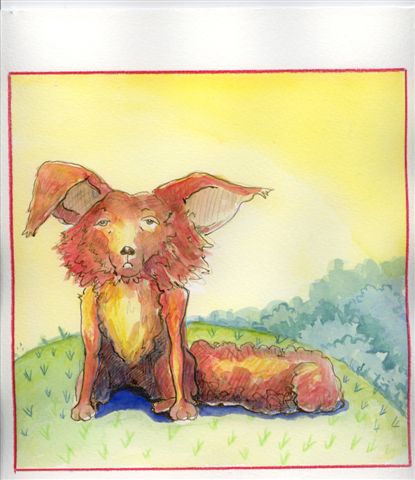
From my children’s book, “Lucy & The Waterfox.” This is what Lucy looks like when she gives up her dream.

Do you remember this phrase from Richard Bach: Argue for your limitations, and sure enough they are yours. I am a notorious eavesdropper and today, listening to the conversations, I think all of life is one long argument for limitations.

The wicked thing about arguing for limitations (I think to myself while eavesdropping) is that we rarely recognize that we are doing it. For instance, blaming others for our misery is actually an argument for limitation. Blaming is an abdication of responsibility, an investment in the notion that, “I can do nothing about that which bothers me.” Blame is an assignment of potency to everyone but your self.

I think all things worth knowing are paradoxical. Arguments for limitation are double-edged because they often also mark the boundary between safe and not safe. An argument for a limitation often looks on the surface to be a defense of the perimeter or an argument for safety. The fulfillment of a dream usually requires a step or two beyond the perimeter and who hasn’t dipped their toe into the pool of their big dream only to pull it back and refuse to wade into it. The shore is safe and known. Stepping into the dream pool never feels safe because the depth of the water is always unknown – and no one ever knows how to swim in the dream pool until they jump in. Staying safely ensconced in Plan B is a great disguised argument for limitation. It is a disguise that will always make sense; self-imposed limitations always make rational sense.

Go here to get my latest book, The Seer: The Mind of the Entrepreneur, Artist, Visionary, title_pageSeeker, Learner, Leader, Creator…You.

Go here for hard copies

Run With It

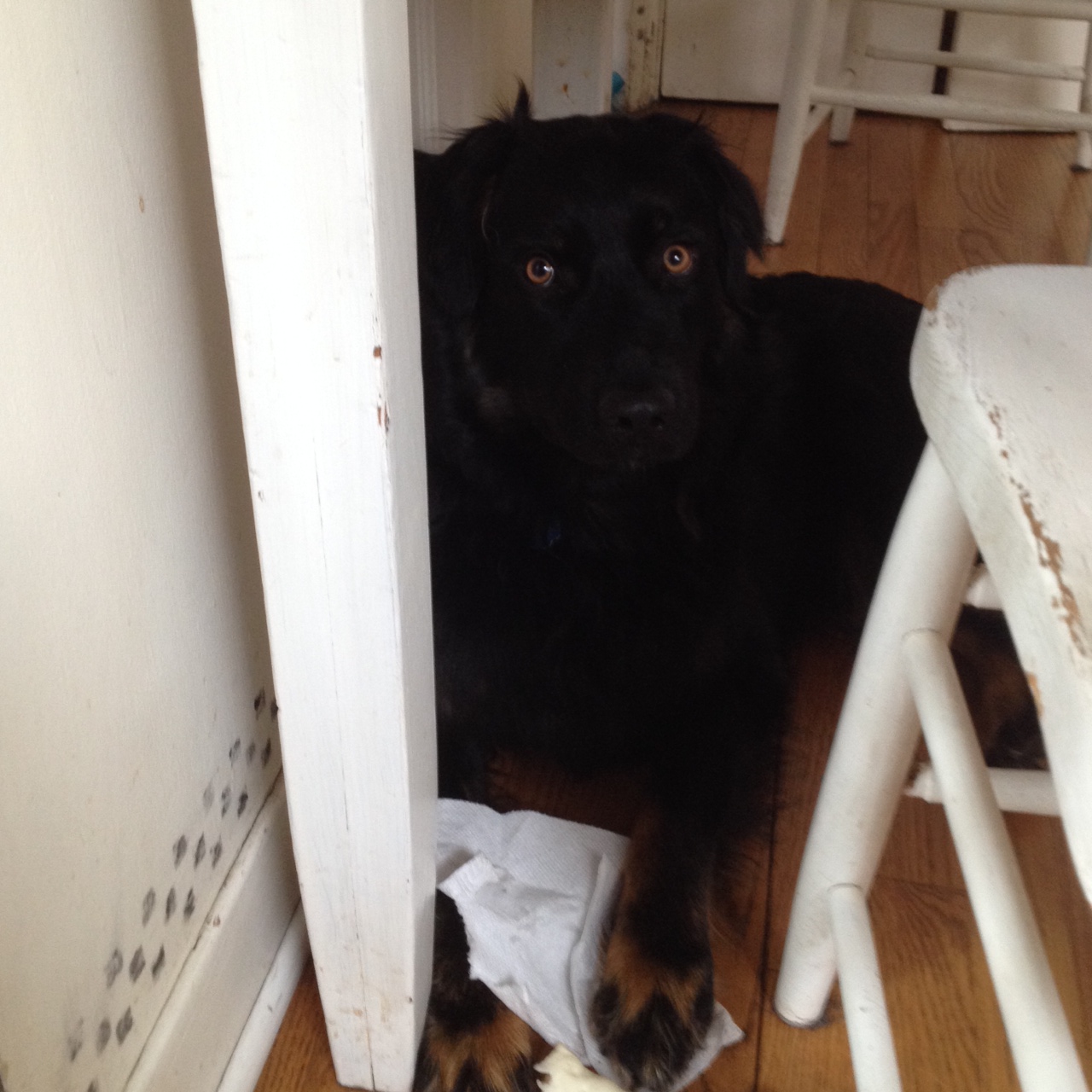
The criminal with the evidence. Tripper with Kleenex.

The criminal with the evidence. Tripper with plundered Kleenex.

Tennessee Tripper Dog-Dog-Dog is a fantastic pick pocket. I’m certain he is kin with the Artful Dodger and the other sticky-finger street boys who lift wallets and jewelry without detection. Dog-Dog’s preferred target is Kleenex. With his snout he can reach into the deepest pocket and disappear into a crowd, Kleenex in mouth, and his poor victim is none the wiser. Lately I have had a nasty cold so my pockets are prime targets for his crimes. More than once I’ve reached into my pocket, alarmed by the rising tide of an inevitable sneeze, and found that my pocket has been picked. “Dog-Dog!!” I scream (and then sneeze). He always appears with tiny bits of evidence in his whiskers.

I first noticed his pilfering when he was still more puppy than dog. He was adept at undetected napkin snatching. I knew it was a crime scene when dinner guests started looking on the floor for missing napkins and came up empty. Although publically I’d hang my head and make Tripper confess his misdeed and return his plunder, secretly I was impressed by his stealth and wondered if he would grow up to become a Ninja.

Tripper Dog-Dog does not suffer guilt. He does not question his choices. He rarely debates whether he should or should not do something. He does not mask his confusion or blunt his awe. He races across the yard in full celebration of his speed and how good it feels to run. He does not run to win, he runs to run. Were I still working with actors I’d have them study the pure intentionality of their pets. I’d have them study what undiluted commitment to action really looks like.

One of my favorite themes running through the books of Paulo Coehlo is to find your enthusiasm and follow it; there lives your treasure. Joseph Campbell famously said, “Follow your bliss.” One of the post-it notes on our Be A Ray plan wall reads: Dream big dreams. The sub note adds: Run At It. The other day we heard a man say, “At least when I die, I’ll know I took my shot and gave it my all.” I sat up and wrote his thought as two questions: What is your shot? What would it look like to give it your all?

And then, finding my pocket empty of Kleenex, I added a third question: If “it” was a Kleenex and I was Tripper, what would I do? I’d take “it” with great enthusiasm, no apology, and without doubt or question. And then I’d run with “it” just because I liked the way it feels.

Go here to get my latest book, The Seer: The Mind of the Entrepreneur, Artist, Visionary, title_pageSeeker, Learner, Leader, Creator…You.

Or, go here for hard copies.

Give Yourself Some Advice (2)

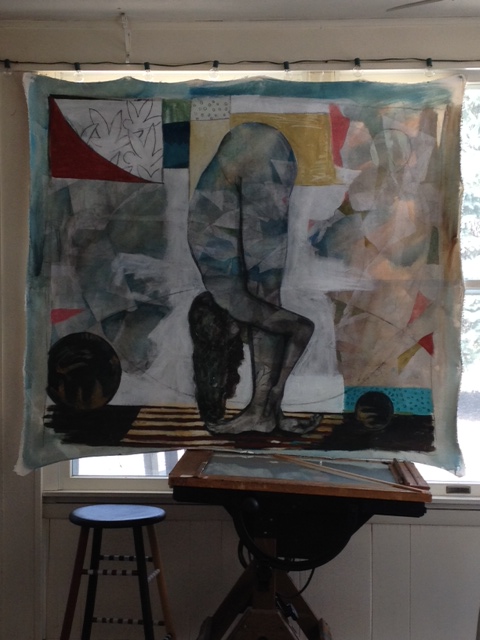
Finishing a painting is really about having a conversation with yourself. This one is talking!

Finishing a painting is really about having a conversation with yourself. This one is talking!

[continued from Give Yourself Some Advice]

Here’s the next bit of an email Horatio sent to me with his Advice To Myself. He wrote it following a question from a reporter about advice he’d give to emerging filmmakers. I am particularly fond of this section as many of my teachers, mentors, and guides are now passing away and I am revisiting what is mine to add to this “ancient conversation.” Here is the next section of Horatio’s advice to himself (for the full text, visit his blog at www.fidalgofilms.com):

Respect the boundaries of others; do not seek to control anyone else. You can only control your own choices.

Learn and honor with absolute integrity your own boundaries so that others may not try to control you or your work. Unfortunately, this is usually only learned through a certain amount of trial and error. 

Learning to trust is an art, and absolutely necessary. Learn to trust yourself first. Learn to trust others.

Always respect the tradition of your work, its ancient human conversation.

Connect to tradition, to all your teachers and your teachers’ teachers. Give yourself to it so that it can give to you and to your work. Honor it with rigor and doubt, with hours and hours of study and practice.

Then let your teachers go, follow the path that you understand as truth. You will know it when you see it. It will be your part of the ancient conversation. Likely, you will find that parts of one or two of your teachers have become part of you.

If you do not let your teachers go, your part of the ancient conversation will not be yours, but rather what you think other people want you to add to the conversation. That is not from you and only clogs up the conversation.

[to be continued]

Horatio asks great questions: What is the tradition that you carry forward? I follow the line of Tom and Marcia McKenzie, who learned from DeMarcus Brown, who learned from Eva Le Gallienne, who learned from…. What teachers/teaching do you need to let go?

Go here to get my latest book, The Seer: The Mind of the Entrepreneur, Artist, Visionary, title_pageSeeker, Learner, Leader, Creator…You.

Or, go here for hard copies (Amazon)


Let Owl Guide You

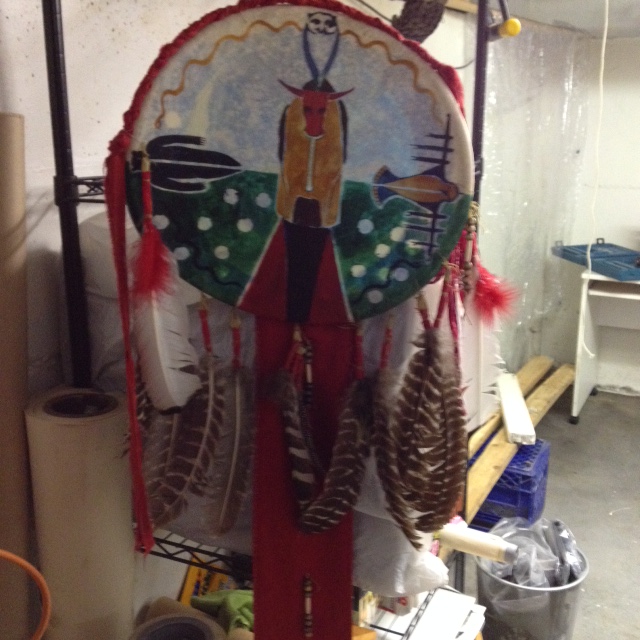
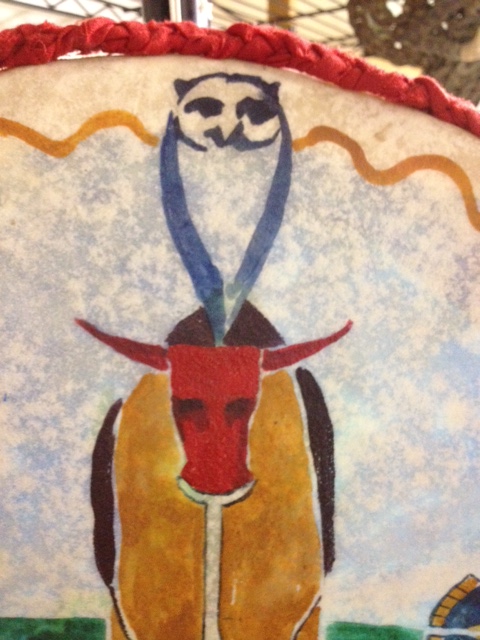
With the guidance of an elder, I made this medicine shield years ago.

With the guidance of an elder, I made this medicine shield years ago.

“Your vision will become clear only when you can look into your own heart. . . . Who looks outside, dreams; who looks inside, awakes.” Carl Jung

For a few disconcerting moments, I thought the crows had followed me across the country. You will remember that while living in Seattle, I was plagued by crows. They swooped me on a daily basis, picking me out of crowds for a sneak attack. I came to the conclusion that they were trying to wake me up. According to Crow Medicine, crows are an omen of change. When crows are around, something special is about to happen, consciousness is about to change and dis-ease will be dispelled. Since we can only connect the dots backward I can now say with great confidence that I took the medicine and it worked. They hammered me on the head for months before I stepped into the void and allowed new forms to emerge. Needless to say, I have a love-hate relationship with crows.

Yesterday afternoon our backyard was a festival of crows frantically barking. It brought back visceral memories and I went on high alert. As it turns out, the crows were focused on our owl and not me. I haven’t heard the owl since autumn and had forgotten that we have an owl in the backyard. I was happy that the owl was back. The crows were not happy as owls are great nest robbers and also, if hassled excessively, will make a dinner of an adult crow.

A detail from my shield. Owls have been with me for a long time. The owl is the top symbol.

A detail from my shield. Owls have been with me for a long time. The owl is the top symbol.

Last fall I googled Owl Medicine when the owl hooted above my head almost every night. I learned that, as a totem, Owls have great intuition. They follow their instincts. They see clearly (meaning they cannot be deceived). Owls see what others cannot. For instance, Owls see into the inner life of others; generally, they know more about a person’s inner life than that person knows about him or her self. This is why people do not sit next to me at parties! Also, owls are fierce warriors if something dear to it is threatened.

What a fantastic collision of bird archetypes for the crows and the owl to return to my world at the same moment. The owl was mostly indifferent to the incessant crow barking and attacks. There was no contest. In the evening the owl flew away to hunt and I wondered if there might be one less crow barking in the morning.

Both owl and crow are harbingers of change. They both speak to a comfortable relationship with the unknown and an attraction to the mysteries of life. I laughed when I re-read the symbols as I’ve lately been preaching through my book, The Seer (owls and crows are both seers) to cultivate “not knowing” as a necessary step on the path to health and creative vibrancy. In the practice of “not knowing,” one learns to see.

Later in the night, while driving back from Chicago, Kerri and I were talking about the extraordinary and meteoric changes in our lives this past year. She encapsulated my crow and owl commentary when she said, “We make plans according to what we know. It’s what we don’t know that changes us.” Her thought reminded me of another Carl Jung quote. He famously wrote that, “Religion is a defense against a religious experience.” Just so, a life plan is often a defense against a vital life. Adventure and discovery are never in the direction of the known. When you pay attention to the symbolic crow hitting you on the head you can also rest assured that when you step into the void there will always be an owl waiting to guide you.

title_pageGo here to get my latest book, The Seer: The Mind of the Entrepreneur, Artist, Visionary, Seeker, Learner, Leader, Creator…You.

Or, go here for hard copies (Amazon…Kindle version available here, too)


Return To Life

Tripper-dog-dog-dog listens to birds

Tripper-dog-dog-dog listens to birds

I’m writing this from the choir loft. It’s gorgeous outside and I wonder what I’m doing inside on such a beautiful morning. Kerri is playing the organ for an early morning service. I’ve decided – just this moment – that the organ is an instrument for the dark days of winter. It is heavy and fills your belly like good hearty stew. Birdsong is the music of spring.

Before coming here this morning I was hanging out in the back yard with Tripper-dog-dog-dog. We were watching birds. We were listening to their worship service. He is mystified by them. They are a relatively recent discovery for him. He cocks his head sideways as he stares at them as if to say, “What the heck!” Then he looks to me to see if I’m having the same revelation. I say, “Pretty incredible, huh!” He nods in agreement (no exaggeration. really. no really).

My conversation with the stained glass window continues. The three panels of the window are, of course, the nativity on the left, the crucifixion on the right, and the resurrection in the center panel. It is the largest image. The focal point. The return to life is the center and perhaps this is the meta-point of my window conversation. Many years ago in a class on ritual and life cycles, the instructor said that each one of us would die and be reborn 12 times in the course of our lives. These mini deaths and rebirths were preparation for the main event. Energy does not die, it changes form.

The window is a perfect cycle of the seasons. Throughout the winter the window and I have been talking about the return to life. We’ve talked about birth and rebirth. We’ve talked about pilgrimages. Every life is a pilgrimage. There are long stretches of walking, rich with discovery, sometimes with achy legs and exhaustion. There are days of rest. There are arrivals and departures. Sometimes the weather is fair and sometimes not. The bad weather days make better stories; protagonists need obstacles to move things forward. Flow rarely requires lengthy recounting. Sunrise and sunset are, of course, our daily birth and death cycle, a solar pilgrimage!

Birth and rebirth is the mirror image of death and resurrection and, of course, this is the season of things coming back to life. Both are progressions, movement through the cycle of life. This cycle, punctuated by my first Wisconsin winter, is especially pronounced for me. Three weeks ago we were knee deep in snow. I can see and feel the return of life, the warmth of the sun’s return.

One year ago I was wandering, in the exhaustion phase of my pilgrimage, dropping the old knapsack; it was too heavy to carry any longer. I enacted and presided over one of my mini deaths. This morning I breathed in the cool air and watched the worship of birds. Nests are being built and I am enjoying the sweetness of life’s return.

Go here to get my latest book, The Seer: The Mind of the Entrepreneur, Artist, Visionary, title_pageSeeker, Learner, Leader, Creator…You.

Or, go here for hard copies.

Love Yourself Better

this one is from the archives. I painted this 10 years ago.

this one is from the archives. I painted this 10 years ago.

He said, “The current goal is to love myself better.” And then he added, “Not so much a goal but something that needs teaching from our own mind.” His statement begs a great question, an ages old question: Can the mind teach itself? Really, the question is can the mind see itself clearly enough to teach itself?  Or, the question within the question: Can the mind teach itself to love itself? I scribbled the questions in my notebook and beneath them I wrote, “Is love teachable? Is love reachable through the mind, especially self-love?

We’d been chatting for a while and had covered a lot of territory, from Monte Blanc pens to typewriters to soap use around the world, clean water, the difference between good and bad scotch, the shapes of the 50 states and how they might influence personal identity and we’d somehow wandered into the epicenter: self-love.

His statement nailed the universal dilemma perfectly. It was a declaration of separation. The self watching and wanting more for the self. The separation is in the language: to love myself better. I don’t know anyone who hasn’t made this statement. Which part of the self will better love the other part of the self? Which part of the mind will teach the other to love?

It is where myth meets the everyday. Every human being who has walked the earth has wrangled with separation and the yearning for self-love (re-connection to self, unity). The human journey is a walk from separation (birth, if you want to take it literally) to reunification (death). The story lives in mythologies the world round. If we were still willing to read our mythologies (religions) metaphorically, we’d see it. For instance, being expelled from the Garden of Eden for eating from the tree of knowledge is the story the ancients told of the experience of separation. The inevitable bite of apple from the tree of knowledge brought duality consciousness: male/female, us/them, mine/yours, haves/have-nots, me/you. Separation. The rest of the story, not often told, is how, through out the rest of our lives, we seek the Garden where there lives a second tree: the tree of everlasting life (unity). We journey from knowledge (separation) to everlasting life (reconnection). The death need not be literal. To die to the self is necessary to experience the SELF.

Here’s the great paradox: loving another person is an act of self-love. The path to self-love is found when we serve something bigger than our selves. Think about it: the movement is always from separation to joining, from isolation to connectivity. The obvious question is, “Connectivity to what?”

Self-love is not found when the mind teaches the mind but when the mind gets out of the way of the heart. The love is always there. Love is never missing. Self-love reveals itself when the definition of self grows beyond our own skin. According to our latest neurological science, we experience ourselves as separate because we dull ourselves to our fundamental connectedness to others. In other words, we cultivate a story of isolation and then set about the real work of our lives: to see beyond what we think.

And then he said, “You know what else I just realized?”

“What’s that?” I asked.

“I just landed myself in a blog post.”

Yep.

Go here to get my latest book, The Seer: The Mind of the Entrepreneur, Artist, Visionary, title_pageSeeker, Learner, Leader, Creator…You.

Or, go here for hard copies.

Spin A Web

from the Yoga series by David Robinson

from the Yoga series by David Robinson

Quinn’s study smelled of cigarettes and books. There was always a red felt tip pen and a yellow pad for note taking or for his latest composition. Quinn didn’t type and I doubt that he ever touched a computer. He had to feel the pen move across the paper. He was a sports writer though, in truth, he was more a poet philosopher. For Quinn, sports were a path to illumination. He filled his articles with haiku, analogies to chaos theory, Michael Murphy, and George Leonard.

One day while sitting in his study, talking about athletic achievement and success, he said, “You have to cultivate your serendipity.” What a terrific phrase! Serendipity is one of those paradoxical words that imply both coincidence and destiny. So, according to Quinn’s coupling of “cultivate” with “serendipity,” we must either promote coincidences or encourage destiny. Or both.

I responded, “So, in other words, the harder you work, the luckier you get.”

“It’s more than that,” he said. “It’s much more than that. Of course you have to do your work. But you also have to share your work. You have to show up, be visible, ask lots of questions, and seek the masters in your field. You have to show what you don’t know. In fact, you have to operate from what you don’t know. There’s always a better way to make a shot or shoot a basket. To cultivate your serendipity is to never stop learning, never stop improving, never assume that you’ve got it.” He paused and then said, “What you don’t know can be an obstacle or it can be connective tissue.”

Quinn watched me take it in. I knew we were talking about more than athletic achievement. He was trying to help me. At the time, I was an accomplished introvert and was wrestling mightily with sharing my work. I had no problem painting the paintings but telling galleries about my work seemed an utter impossibility. Sharing meant I would have to talk to people. It meant I’d have to say, “This is my work and it is good work.” It meant claiming my gift beyond the thoughts and opinions of others. Quinn was teeming with blarney and always seemed at ease in a crowd though I knew even then that we shared a similar demon. He doubted his gift. He recognized my struggle because it was his struggle.

After a moment he lit a cigarette, blew the smoke and continued, “It’s like spinning a web – and the silk, the connectivity, is spun from seeking what you have yet to learn. The more you share your gift, the more you ask others what they see, the more people know about your gift, the higher the odds that a path to success will open. You have to spin the web.” I nodded my head, taking it in. I remember being daunted by what he was telling me. He leaned back in his chair, his eyes filled with mirth, and said, “Success is really about letting yourself learn; always learn.”

I nodded and stared at the floor. He took a drag on his cigarette and as he blew the smoke he added, “No one does this alone.”

Go here to get my latest book, The Seer: The Mind of the Entrepreneur, Artist, Visionary, title_pageSeeker, Learner, Leader, Creator…You.

Go here for hard copies

Step On The Stage

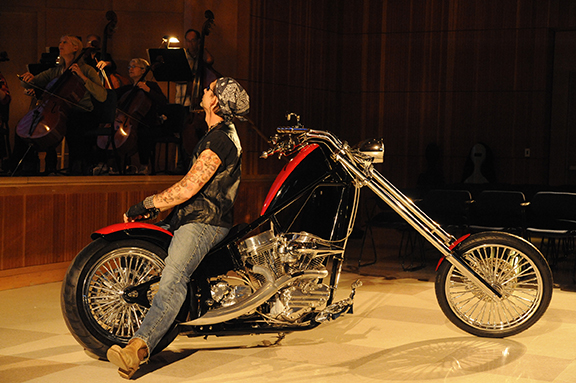
My performance with the Portland Chamber Orchestra of "The Creatures of Prometheus. I wrote and performed the piece for PCO.

My performance with the Portland Chamber Orchestra of “The Creatures of Prometheus.” I wrote and performed the piece for PCO.

Craig is laughing at me and with good reason. Through a post he asked a simple question about people building boxes around themselves. He issued a singular challenge: to apply what I found in his post to my writing. I’ve had more ideas and random ruminations than I know what to do with; he opened a big can. Before I let it go, I want to wade into the last part of his question: when did I know to create my stage?

Craig positioned a stage (showing up) as the polar opposite of a box (hiding) so I read his question as asking when I decided to show up. I’ve learned that a stage can be a strategy for hiding, too, so “showing up” means much more than just being visible.

Many actors get on the literal stage because they are seeking appreciation or approval from the audience. When anyone mounts a stage, either literal or metaphoric, to seek approval, they split themselves. By definition, they must hide their intention (to seek approval) and in so doing, give away their power and potential. Young teachers often pass through a growth phase in which they seek the approval of their students; they want to be liked and their need for appreciation neutralizes their capacity to teach. Ironically, in both cases (actors and teachers), the moment they cease splitting their intention they become great at what they do and their respective audiences can’t help but appreciate them. That’s the way power works.

Several years ago I was working with a corporate client who was upset because he felt uncomfortable with what he’d learned from my workshop. I told him that I could either serve him or please him but I could not do both. I understood that my job was to help him grow and that necessarily required discomfort. If he wanted to be pleased he needed to hire someone else.

I hid for years. I split myself for decades. My dear friend Roger once said that one day in his middle 30’s he realized that he was no longer becoming someone. He was someone. Everyone navigates the “becoming.” It is a necessary and vital growth phase and is often filled with fears of inauthenticity and split intentions; everyone wants to be appreciated and everyone sacrifices their primary intention in a mad dash for approval until one day, if they are lucky, they realize the only approval they need is their own. My revelation came when I was preparing to go on stage to perform. I realized that I was steeling myself against the audience (preparing to hide). I was assuming that they were going to judge me, which is a form of approval seeking. It was like a cold slap. I’d never had a bad experience with an audience. I’d only ever experienced appreciation and support and wondered why I was steeling myself against the very people I was there to serve. My need for approval dropped like a stone. I went on stage, perhaps for the first time in my life, present and powerful. I didn’t need anything from them. I was bringing life and my gifts to them and that was all that was required. My whole world flipped. No armor. No mask. No need other than to offer my gift on that day to that specific group. Whether or not they accepted my offer could no longer be my concern.

I’ve since learned that discomfort is a very valuable thing. It is present anytime learning and growing is happening. In fact, if there is no discomfort, there’s no learning. And that is the plaque nailed to my stage.

Go here to get my latest book, The Seer: The Mind of the Entrepreneur, Artist, Visionary, title_pageSeeker, Learner, Leader, Creator…You.

Go here for hard copies (Amazon;-)

Update Your Model

InfinityI laughed when I read this phrase on Skip’s Power Point presentation:

“All models are false. However, some are useful.” Alan Kay

I spent years of my life reading books built upon the thought models of thinkers, consultants, physicists, mathematicians, artists, business people and spiritual thinkers. None of the models was true. Many contradicted other models. Models are only useful if they help us make sense of our days on this planet.

Culture is a thought model. Travel to another culture and you’ll spend some time being disoriented because you will have entered a different model for sense making. For instance, some cultures/models place the accent on the individual and others place it on the group. I come from a culture that celebrates the individual and my world was rocked in a culture that celebrates the group; the model was so different that I could not sense make anything and fell head long into “not knowing.” While stumbling about unable to make sense of the world, I saw my own cultural model for what it is: a useful model – not truth.

Art, in most of Western culture, is considered important if it breaks or disturbs the model. In most Eastern cultures art is considered important if it supports the model.  Neither is truth. Neither is right. Both are useful for sense making if you understand the model.

Language is a model. It is very useful model, wouldn’t you agree? Wade Davis is sounding an important alarm that is going mostly unnoticed: we are losing languages faster than species are going extinct. Each language lost is more than a lost collection of words; a language lost is an entire world lost. It is a mythology lost. A language lost is a way of seeing and engaging with the mystery that is lost. What is useful and unknowable (un-see-able) to other languages/models is lost forever.

Religion is a model. Science creates and constantly revises its models. Religion could learn a thing or two from science (and vice versa). Maps are models. For a terrific book on mind models, get Charles Hampden-Turner’s, Maps Of The Mind.

A study of history is a study of models that served as sense makers for a time but collapsed under the weight of updates. For instance, no explorer ever sailed off the edge of the world despite the unassailable model of the day. It turns out that the sun does not rotate around the earth though many people were hushed and crushed for going against the model of their day. Newton showed us that space and time were fixed and Einstein showed us that space and time are not only fluid but connected.

We get into trouble when we confuse our models with truth. No model is true. No model is right. This applies especially to the models that we carry within us: the mind models that lead us to believe that, “I can’t do it…” are false. My favorite model that is mistaken for truth shows up like this: “I’m not creative.” That is a model that is both false and not very useful. What might you need to do to reconsider your model and accept an update?

Go here to get my latest book, The Seer: The Mind of the Entrepreneur, Artist, Visionary, title_pageSeeker, Learner, Leader, Creator…You.

Go here for hard copies

Exit The Circle

Mind Chatter

Mind Chatter

Jen came over today. She is taking a photography class and her assignment this week is to take pictures of people. She is working on mastering depth of field and introduced me to my favorite new term: circle of confusion (note: depth of field is also a great term but is less ominous!). I spent several minutes reading definitions for circle of confusion. This is the kind of stuff I encountered:

A lens cannot resolve a point exactly. Instead it creates a small circle of light called the ‘Circle of Confusion’ (from photoconnexion.com)

What does that mean? In my search for definitions of ‘circle of confusion’ I entered a circle of confusion! I kept digging and I learned that the term predates photography and originated in the study of optics. So, this is my stab at defining a circle of confusion for myself: my eye (or a camera lens) breaks an image into dots and the dots can never be completely focused. So, each dot is rimmed with a circle of light. In an image that appears to be completely focused, the light circle is very, very small so the dots are closer together and make a sharp image. In an image that appears unfocused, the light circle is large so the dots are farther apart, making a fuzzy image. This circle of light is called a circle of confusion, a blur circle, or a blur spot.

The greater the circle of light around the dot, the greater the potential for confusion. What a fantastic metaphor! The same concept applies to the imagination. I have friends who’ve always known what they wanted to become when they grew up. They had a sharp, clear picture of what they wanted to do with their lives. They imagined a clear, focused target-life. For instance, when I was in college, my best friend Roger knew that he wanted to direct plays and, more specifically, he wanted to direct plays at The Pacific Conservatory for the Performing Arts. Thirty years later, Roger has spent his career at PCPA directing plays. His actions were distinctly aimed at a very clear image-target. He did not spend much time wondering what he wanted to do with his life. Roger has lived with a smaller circle of confusion than most of us.

The metaphor could also be applied this way: If people were dots, the circle of light surrounding them would be their mind chatter. The greater the mind-chatter the greater the circle of light, the greater is the potential for confusion. Buck Busfield used to say of people with loud mind-chatter, “That guy has a big dog barking in his head.” The Buddhists call mind-chatter, “monkey mind.” A person with monkey mind is a person with a large circle of confusion; their dots can’t focus through the noise. Victim stories come with lots of mind chatter. So do blame stories or a fix-it mentality.

When we see and own our choices, we reduce the size of our circle of confusion. That’s how choice works. When we invest in stories like, “I have to…,” or “I should…,” stories that lead us to believe that we have no choice, we amplify our circle of confusion. Embracing our choices makes intentions clear. Embracing our choices clarifies our life-target. The noise in our minds quiets. It’s an equation: own your choices and your mind quiets. There’s less division in a mind that says, “I choose,” so there is less need for inner debate. If you want to exit your circle of confusion, start by seeing how vast is your capacity for choice.

Go here to get my latest book, The Seer: The Mind of the Entrepreneur, Artist, Visionary, title_pageSeeker, Learner, Leader, Creator…You.

Or, go here for hard copies