Spin A Web

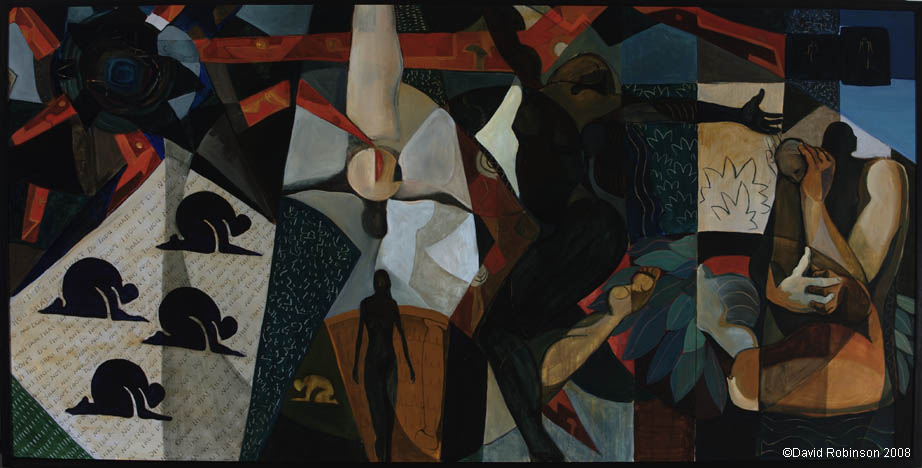
from the Yoga series by David Robinson

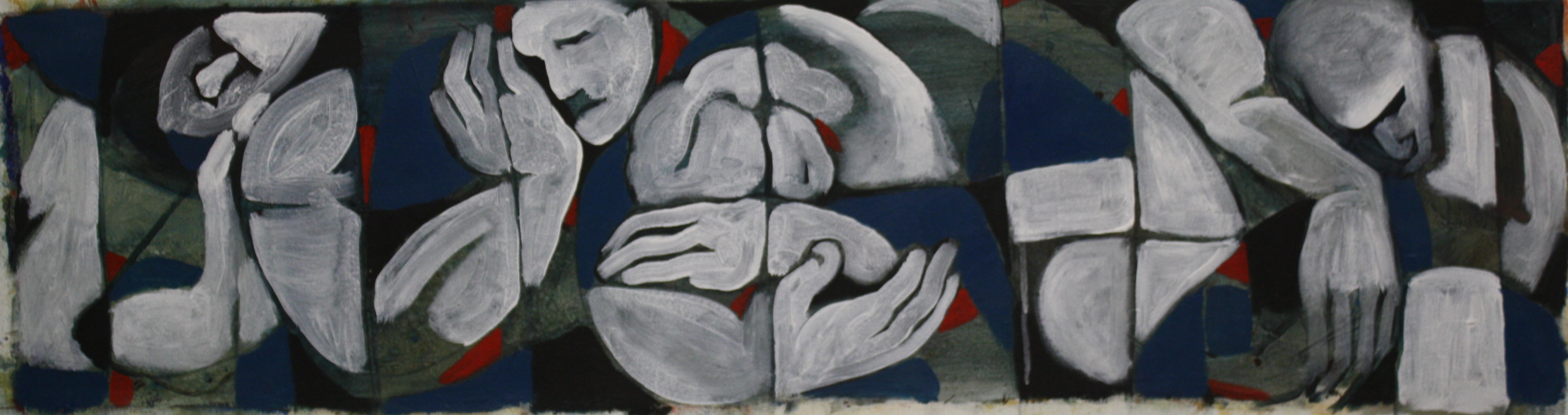
from the Yoga series by David Robinson

Quinn’s study smelled of cigarettes and books. There was always a red felt tip pen and a yellow pad for note taking or for his latest composition. Quinn didn’t type and I doubt that he ever touched a computer. He had to feel the pen move across the paper. He was a sports writer though, in truth, he was more a poet philosopher. For Quinn, sports were a path to illumination. He filled his articles with haiku, analogies to chaos theory, Michael Murphy, and George Leonard.

One day while sitting in his study, talking about athletic achievement and success, he said, “You have to cultivate your serendipity.” What a terrific phrase! Serendipity is one of those paradoxical words that imply both coincidence and destiny. So, according to Quinn’s coupling of “cultivate” with “serendipity,” we must either promote coincidences or encourage destiny. Or both.

I responded, “So, in other words, the harder you work, the luckier you get.”

“It’s more than that,” he said. “It’s much more than that. Of course you have to do your work. But you also have to share your work. You have to show up, be visible, ask lots of questions, and seek the masters in your field. You have to show what you don’t know. In fact, you have to operate from what you don’t know. There’s always a better way to make a shot or shoot a basket. To cultivate your serendipity is to never stop learning, never stop improving, never assume that you’ve got it.” He paused and then said, “What you don’t know can be an obstacle or it can be connective tissue.”

Quinn watched me take it in. I knew we were talking about more than athletic achievement. He was trying to help me. At the time, I was an accomplished introvert and was wrestling mightily with sharing my work. I had no problem painting the paintings but telling galleries about my work seemed an utter impossibility. Sharing meant I would have to talk to people. It meant I’d have to say, “This is my work and it is good work.” It meant claiming my gift beyond the thoughts and opinions of others. Quinn was teeming with blarney and always seemed at ease in a crowd though I knew even then that we shared a similar demon. He doubted his gift. He recognized my struggle because it was his struggle.

After a moment he lit a cigarette, blew the smoke and continued, “It’s like spinning a web – and the silk, the connectivity, is spun from seeking what you have yet to learn. The more you share your gift, the more you ask others what they see, the more people know about your gift, the higher the odds that a path to success will open. You have to spin the web.” I nodded my head, taking it in. I remember being daunted by what he was telling me. He leaned back in his chair, his eyes filled with mirth, and said, “Success is really about letting yourself learn; always learn.”

I nodded and stared at the floor. He took a drag on his cigarette and as he blew the smoke he added, “No one does this alone.”

Go here to get my latest book, The Seer: The Mind of the Entrepreneur, Artist, Visionary, title_pageSeeker, Learner, Leader, Creator…You.

Go here for hard copies

Step On The Stage

My performance with the Portland Chamber Orchestra of "The Creatures of Prometheus. I wrote and performed the piece for PCO.

My performance with the Portland Chamber Orchestra of “The Creatures of Prometheus.” I wrote and performed the piece for PCO.

Craig is laughing at me and with good reason. Through a post he asked a simple question about people building boxes around themselves. He issued a singular challenge: to apply what I found in his post to my writing. I’ve had more ideas and random ruminations than I know what to do with; he opened a big can. Before I let it go, I want to wade into the last part of his question: when did I know to create my stage?

Craig positioned a stage (showing up) as the polar opposite of a box (hiding) so I read his question as asking when I decided to show up. I’ve learned that a stage can be a strategy for hiding, too, so “showing up” means much more than just being visible.

Many actors get on the literal stage because they are seeking appreciation or approval from the audience. When anyone mounts a stage, either literal or metaphoric, to seek approval, they split themselves. By definition, they must hide their intention (to seek approval) and in so doing, give away their power and potential. Young teachers often pass through a growth phase in which they seek the approval of their students; they want to be liked and their need for appreciation neutralizes their capacity to teach. Ironically, in both cases (actors and teachers), the moment they cease splitting their intention they become great at what they do and their respective audiences can’t help but appreciate them. That’s the way power works.

Several years ago I was working with a corporate client who was upset because he felt uncomfortable with what he’d learned from my workshop. I told him that I could either serve him or please him but I could not do both. I understood that my job was to help him grow and that necessarily required discomfort. If he wanted to be pleased he needed to hire someone else.

I hid for years. I split myself for decades. My dear friend Roger once said that one day in his middle 30’s he realized that he was no longer becoming someone. He was someone. Everyone navigates the “becoming.” It is a necessary and vital growth phase and is often filled with fears of inauthenticity and split intentions; everyone wants to be appreciated and everyone sacrifices their primary intention in a mad dash for approval until one day, if they are lucky, they realize the only approval they need is their own. My revelation came when I was preparing to go on stage to perform. I realized that I was steeling myself against the audience (preparing to hide). I was assuming that they were going to judge me, which is a form of approval seeking. It was like a cold slap. I’d never had a bad experience with an audience. I’d only ever experienced appreciation and support and wondered why I was steeling myself against the very people I was there to serve. My need for approval dropped like a stone. I went on stage, perhaps for the first time in my life, present and powerful. I didn’t need anything from them. I was bringing life and my gifts to them and that was all that was required. My whole world flipped. No armor. No mask. No need other than to offer my gift on that day to that specific group. Whether or not they accepted my offer could no longer be my concern.

I’ve since learned that discomfort is a very valuable thing. It is present anytime learning and growing is happening. In fact, if there is no discomfort, there’s no learning. And that is the plaque nailed to my stage.

Go here to get my latest book, The Seer: The Mind of the Entrepreneur, Artist, Visionary, title_pageSeeker, Learner, Leader, Creator…You.

Go here for hard copies (Amazon;-)

Update Your Model

InfinityI laughed when I read this phrase on Skip’s Power Point presentation:

“All models are false. However, some are useful.” Alan Kay

I spent years of my life reading books built upon the thought models of thinkers, consultants, physicists, mathematicians, artists, business people and spiritual thinkers. None of the models was true. Many contradicted other models. Models are only useful if they help us make sense of our days on this planet.

Culture is a thought model. Travel to another culture and you’ll spend some time being disoriented because you will have entered a different model for sense making. For instance, some cultures/models place the accent on the individual and others place it on the group. I come from a culture that celebrates the individual and my world was rocked in a culture that celebrates the group; the model was so different that I could not sense make anything and fell head long into “not knowing.” While stumbling about unable to make sense of the world, I saw my own cultural model for what it is: a useful model – not truth.

Art, in most of Western culture, is considered important if it breaks or disturbs the model. In most Eastern cultures art is considered important if it supports the model.  Neither is truth. Neither is right. Both are useful for sense making if you understand the model.

Language is a model. It is very useful model, wouldn’t you agree? Wade Davis is sounding an important alarm that is going mostly unnoticed: we are losing languages faster than species are going extinct. Each language lost is more than a lost collection of words; a language lost is an entire world lost. It is a mythology lost. A language lost is a way of seeing and engaging with the mystery that is lost. What is useful and unknowable (un-see-able) to other languages/models is lost forever.

Religion is a model. Science creates and constantly revises its models. Religion could learn a thing or two from science (and vice versa). Maps are models. For a terrific book on mind models, get Charles Hampden-Turner’s, Maps Of The Mind.

A study of history is a study of models that served as sense makers for a time but collapsed under the weight of updates. For instance, no explorer ever sailed off the edge of the world despite the unassailable model of the day. It turns out that the sun does not rotate around the earth though many people were hushed and crushed for going against the model of their day. Newton showed us that space and time were fixed and Einstein showed us that space and time are not only fluid but connected.

We get into trouble when we confuse our models with truth. No model is true. No model is right. This applies especially to the models that we carry within us: the mind models that lead us to believe that, “I can’t do it…” are false. My favorite model that is mistaken for truth shows up like this: “I’m not creative.” That is a model that is both false and not very useful. What might you need to do to reconsider your model and accept an update?

Go here to get my latest book, The Seer: The Mind of the Entrepreneur, Artist, Visionary, title_pageSeeker, Learner, Leader, Creator…You.

Go here for hard copies

Exit The Circle

Mind Chatter

Mind Chatter

Jen came over today. She is taking a photography class and her assignment this week is to take pictures of people. She is working on mastering depth of field and introduced me to my favorite new term: circle of confusion (note: depth of field is also a great term but is less ominous!). I spent several minutes reading definitions for circle of confusion. This is the kind of stuff I encountered:

A lens cannot resolve a point exactly. Instead it creates a small circle of light called the ‘Circle of Confusion’ (from photoconnexion.com)

What does that mean? In my search for definitions of ‘circle of confusion’ I entered a circle of confusion! I kept digging and I learned that the term predates photography and originated in the study of optics. So, this is my stab at defining a circle of confusion for myself: my eye (or a camera lens) breaks an image into dots and the dots can never be completely focused. So, each dot is rimmed with a circle of light. In an image that appears to be completely focused, the light circle is very, very small so the dots are closer together and make a sharp image. In an image that appears unfocused, the light circle is large so the dots are farther apart, making a fuzzy image. This circle of light is called a circle of confusion, a blur circle, or a blur spot.

The greater the circle of light around the dot, the greater the potential for confusion. What a fantastic metaphor! The same concept applies to the imagination. I have friends who’ve always known what they wanted to become when they grew up. They had a sharp, clear picture of what they wanted to do with their lives. They imagined a clear, focused target-life. For instance, when I was in college, my best friend Roger knew that he wanted to direct plays and, more specifically, he wanted to direct plays at The Pacific Conservatory for the Performing Arts. Thirty years later, Roger has spent his career at PCPA directing plays. His actions were distinctly aimed at a very clear image-target. He did not spend much time wondering what he wanted to do with his life. Roger has lived with a smaller circle of confusion than most of us.

The metaphor could also be applied this way: If people were dots, the circle of light surrounding them would be their mind chatter. The greater the mind-chatter the greater the circle of light, the greater is the potential for confusion. Buck Busfield used to say of people with loud mind-chatter, “That guy has a big dog barking in his head.” The Buddhists call mind-chatter, “monkey mind.” A person with monkey mind is a person with a large circle of confusion; their dots can’t focus through the noise. Victim stories come with lots of mind chatter. So do blame stories or a fix-it mentality.

When we see and own our choices, we reduce the size of our circle of confusion. That’s how choice works. When we invest in stories like, “I have to…,” or “I should…,” stories that lead us to believe that we have no choice, we amplify our circle of confusion. Embracing our choices makes intentions clear. Embracing our choices clarifies our life-target. The noise in our minds quiets. It’s an equation: own your choices and your mind quiets. There’s less division in a mind that says, “I choose,” so there is less need for inner debate. If you want to exit your circle of confusion, start by seeing how vast is your capacity for choice.

Go here to get my latest book, The Seer: The Mind of the Entrepreneur, Artist, Visionary, title_pageSeeker, Learner, Leader, Creator…You.

Or, go here for hard copies


Step

'Hope and Prayer' by David Robinson

‘Hope and Prayer’ by David Robinson

I’m in a “life is funny” phase. It is as if the universe is hammering me with this theme: you do not need to see the big picture. You do not need to see the plan or even have a plan. You simply need to take the next step that you see. The next step need not make sense.

Do you remember the scene in one of the Indiana Jones films when Indiana has to take a step that looks as if he was going to step off a cliff and fall into the abyss? What he sees is in direct opposition to what he knows he needs to do. How often does life send us that conundrum! He saw an abyss but knew he needed to take a step anyway. He stepped and an invisible path became visible.

Take the step BECAUSE it does not make sense.

On Sunday, Pastor Tom asked his congregation, “Is your faith by default or by choice?” He told the story of the Roman nobleman whose son was dying. None of the doctors of the day could help the boy so in an act of desperation, the man walked two days to find the magician/healer named Jesus. As Pastor Tom said, this Roman nobleman had the best healthcare plan available and nothing was working; in the absence of science he turned to faith. Of course, we know the rest of the story: the magician/healer told the nobleman to go home. He told him that his son would live. Remember, it was a two-day walk so the question is this: during those two days walking home, did the man have faith or did he want to have faith? In other words, did he need proof to have faith? Did he rush home to see if the magic worked? When he arrived home and found his son alive and well, did he cancel his healthcare policy? What would you do in a similar situation?

Take the step BECAUSE sense-making has nothing to do with it.

Last week Diane wrote a great comment about “knowing” from my previous post, Stand With Hope. She wrote, “…it makes me think about the definition of knowing. I am seeing that, for me, it is not about knowing an answer (like I know that 4 x 4 = 16), but knowing my self and being present with what is happening, and trusting the inner impulse to respond and act. I think this is standing in hope, but for me hope is uncertain faith. But then, when I’m short on faith, I guess I can hope to have hope.”

Take the next step BECAUSE you trust your inner impulse to guide you.

In other words, step because if feels right. Sense-making is a function of the brain. Stepping while uncertain is a matter for the heart. Sense-making is something that always happens after the fact. The next step need never make sense. It does need to make heart.

Take the next step BECAUSE it is what you must do.

Go here to get my latest book, The Seer: The Mind of the Entrepreneur, Artist, Visionary, title_pageSeeker, Learner, Leader, Creator…You.

For hard copies, go here

Break Out The Crayons

John's Secret by David Robinson

John’s Secret by David Robinson

It is very cold and the entire community is hunkering down. I love these days of bright sun and super cold air. It’s like a sweet tart, a collision of opposites that pop the taste buds into awareness. I want to go outside – and do – for short periods of time; soaking up the sun, while the cold air bites, is life giving. The paper warned that, “frost bite is possible in less than 10 minutes! Stay inside!” Clearly, the good folks at the Kenosha News like their sweet without the tart.

Three times this morning I’ve crossed paths with a metaphor: Life is a blank page. It is a metaphor that is like the sun-cold of this day: it has two edges. The first refers to life as wide open to infinite possibility. There is nothing like a blank page to bring out the crayons. The other edge refers to emptiness: life as a void. Once, I was diving at night and we turned out our flashlights. It was the darkest dark I’ve ever experienced. It was darker than a cave because the water gave the darkness substance. There was no visible form. No boundary. No way of knowing up from down (unless you relaxed). A void is like a party invitation to the monsters in the mind. Peering into the blank page allows the shadow to peer back at you.

The first path crossing of the blank page metaphor came as a question, “How do I stay an open, blank page?” The second and third came as expressions of discomfort: my life is a blank page. Help! Both the sweet and the tart variations are invitations to life. The path may look and feel different but both lead to the same place. Pulling out the crayons and scribbling invites play. Standing in void, filled with fear, invites awe, silence, and the recognition that there is no path: it is all made up so what do you want to make up now? The terror is in the infinity of choices. There’s nothing to be done but to start scribbling.

As I was writing the last sentence the phone rang and it was Skip calling. He’s writing a book and is having a few folks read the early drafts. I laughed when he told me some of the feedback and insights his book evoked. Skip works with entrepreneurs and this is the phrase that made me laugh out loud:  ‘Being lost is the new normal.’ The world is moving too fast for us to really know where we are or where we are going. So, the metaphor comes a fourth time. There’s nothing to be done but break out the crayons.

Go here to get my latest book, The Seer: The Mind of the Entrepreneur, Artist, Visionary, title_pageSeeker, Learner, Leader, Creator…You.

For hard copies, go here.

Water The Seed

Illustration 07 Illustration 08In 2004 I wrote and illustrated a children’s book, Lucy and the Waterfox. I could have sworn that Lucy was only 5 years old and was taken aback to realize that she’d been around for a decade. Time flies! I recently bought a copy of Lucy since I had nothing in the archives and I will soon release her in versions for ipad and kindle. She’s an old fox and is not available in digital form. It felt funny to buy my own book. I was delighted when she came in the mail! It was as if she was coming home.

It had been a few years since I’d read Lucy so I was taken aback (again) by the parallels in Lucy to the book I just released, The Seer. I’ve been chewing on these ideas for a long time! In The Seer there is a mysterious guide named Virgil who challenges the assumptions of the main character and helps him reorient to a healthier more powerful way of being. In Lucy, a mysterious storyteller emerges from the forest one night; his story stirs deep yearning in Lucy to own and fulfill her extraordinary capacity. Lucy, I recognized, was a seed for The Seer.

Ten years ago I was hired to tell a story in several installments at a conference of health care providers. The conference lasted 3 days and the story served as a thread that tied all the conference segments together. The story also provided a central metaphor for the participants; it served – as stories always do – as the force that forged the individuals into a community. The participants had deep, meaningful conversations because they didn’t get stuck in the superficial, literal levels of their topics. They went into the well through their metaphor and, instead of trying to fix problems they explored their choices and opened to new opportunities.

On the second night of the conference there was a talent show and the organizers approached me and asked if I would tell a simple short story. I had nothing prepared but knew I had a little ditty in my journal about a fox named Lucy. She had a gift and was hiding it because it made other foxes uncomfortable. I told her story and Lucy was such a big hit that night, I received such enthusiastic feedback, that I returned home, illustrated, and published her. The experience of publishing Lucy inspired me: I’d never before thought of myself as a writer. Publishing ideas and stories was nowhere on my personal radar.

A decade later, publishing ideas and stories is the only thing on my radar. I have so many ideas! I have so many stories to tell and more show themselves to me everyday.

I’m delighted that Lucy came home to remind me that in the decade since she was born that I have grown, too, and have a much expanded personal radar. I look forward to the day, a decade from now, that a copy of The Seer comes in the mail and I say, “Whoa. Look at that! I’ve been chewing on these ideas for a long, long time.”

Go here to get my latest book, The Seer: The Mind of the Entrepreneur, Artist, Visionary, title_pageSeeker, Learner, Leader, Creator…You.


Know Your Metaphor

Canopy by David Robinson

Canopy by David Robinson

Metaphors matter far more than we know. In fact, it is not an exaggeration to say that we build our realities on the metaphors we entertain. The stories we tell about ourselves and are lives are built upon metaphor. For instance, is your god a hairy old thunder hurler, a pervasive energy, a spirit with intention, an abstract concept, science, or a force of nature? How you build your reality will have much to do with the metaphor you choose. Do you step into the future or does the future step toward you? Are you part of nature or the steward of it? Metaphors are not just for literature!

For instance: Don’t put all of your eggs in one basket. It’s a well-worn metaphor warning us to keep our options open. When Kerri and I first met she asked me to never forget that she’d placed all of her eggs in my basket. “Organic, free-range,” she said in response to my laughter at her reference. “I won’t forget,” I replied. Putting all of the eggs in a single basket is a great statement of commitment yet it’s not the best metaphor to build a relationship upon. Eggs are, after all, fragile. They break. While the metaphor for our relationship was eggs in a basket we necessarily treaded lightly. We’ve been much happier and healthier since we populated our basket with twelve organic free-range rocks.

The Holy Grail is a metaphor. When Arthur’s knights roamed the realm seeking the grail, they were establishing a lovely metaphor for personal fulfillment. The knight who finds the grail is the knight who finds the middle way between the armor of social obligation (self sacrifice) and the nakedness of an uncontrollable wild-child (self indulgence). Parcival must fail to find himself. And, isn’t that a lovely metaphor for living and learning? It is impossible to find the middle way until you’ve cracked some eggs or shifted your metaphor to something unbreakable and capable of sitting in the fire.

Go here to get my latest book, The Seer: The Mind of the Entrepreneur, Artist, Visionary, title_pageSeeker, Learner, Leader, Creator…You.


Feel The Peace

Last night I went to the Taize service. It is a meditation service with lots of candlelight, repetition of music and lyric, and great opportunities for silence. It is hypnotic and peace-full. It was crackling with energy though I recognize that sounds paradoxical. Lately in me peace is vibrant.

Two days ago I talked with Heather who is starting a coaching business. The focus of her practice is based on the premise that outer space reflects inner space. Inner clarity often comes when outer clutter is cleaned and sorted. Inner space opens when outer space is organized. As I move into my new home, Kerri and I are cleaning and sorting. We’ve cleaned our space of multiple bags of old clothes, ancient files, furniture, and equipment. We are opening space and will work on it all winter. This week I will close my business to open space for the next possibility. To me, Heather’s premise is right on. I feel the space opening inside me.

Many years ago Ana challenged me “to make all the world my studio.” That challenge has been my North Star. She asked me to erase the boundaries between art and not art. Erase the boundaries between sacred and not sacred. I’ve learned since Ana issued the challenge that, like my house, I needed to cleanse myself of several trash bags of old stories (bad patterns). The trash stories concern what is mine to do and what is not. I’ve tossed out notions of who I think I need to please. I’ve dumped loads of obligations and expectations. As the space opens I’m more able to clarify my gift. I routinely ask myself these days, “What is my service (how do I bring my gift to the world)?” The cleaning now reaches deep. I have much more space than trash. I now understand that for the world to be my studio the space inside me must be vast so the space outside can be infinite with possibility.

Saul recently taught me to address myself to my concern and no one else’s. He told me I was all the time orienting myself to others concerns. He said, “Look beyond the opponent and place a soft focus on the horizon in the field of possibility. In this way, you will have no obstacle. You will offer no resistance.” Saul was teaching me to clean house. He was teaching me to seize the great opportunities that become available when the tug of war ceases and all that remains is vibrant crackling peace.

For a humorous look at the wonderful world of innovation and new ventures, check out my new comic strip Fl!p and the gang at Fl!p Comics.

Listen To The Lake

I’m learning the many moods of Lake Michigan. It seems that each day it has an entirely different character. One day it is angry and steely grey with waves crashing against the shore like an ocean. One day it is as still as a Zen meditation. Regardless of the Lake’s mood, I am drawn to the shore to engage with it. Today I closed my eyes to feel the autumn sun radiate off the surface. “Don’t get used to this,” it whispered, gentle waves lapping the shore. “I know better,” I replied and smiled. The Lake is fickle. So am I.

With each new mood comes a dramatically different color palette that ranges through greens to turquoise to the deep purples. Sometimes the color is soothing, sometimes it is electrifying, and sometimes it is an assault. I’ve come to believe that the Lake’s color functions like a mask: it sometimes reveals the Lake’s mood and sometimes obscures it. Sometimes the Lake invites people to play and sometimes like the witch in a children’s book coerces people into a trap. The Lake teaches both faith and wariness.

Standing by the Lake I am reminded of something that I read many years ago. We are mostly monotheistic so we carry the expectation that we, like our god, have a single identity and are plagued by many moods. That is not true the world over. Cultures (like the ancient Greeks) that worship many gods have no such expectation. They allow that they have as many identities as the gods they worship. Their gods are forces of nature and they recognize that those forces are alive and expressing through them. The wind, the thunder, the quaking earth, the changing seasons, the rain, the fertile fields,…, are forces personified. Their moods, their emotions, are akin to being possessed by a god-spirit. Love is a possession. Inspiration is a visit with a Muse. They need to pay attention to their relationship with these forces (they have a relationship with these forces), to stay in the good graces of the fickle gods.

I’ve decided that the Lake is one of the old gods and I need to pay attention to my relationship with it. I like the notion that it has the power to inspire me, possess me, frustrate me, and fill me with laughter. I know its sister, the north wind, has the power to refresh me or chill me to the bone and, of course, the driver of the sun chariot graces me with warmth and music.

For a humorous look at the wonderful world of innovation and new ventures, check out my new comic strip Fl!p and the gang at Fl!p Comics.