Begin Here

photo-6

Begin Anywhere

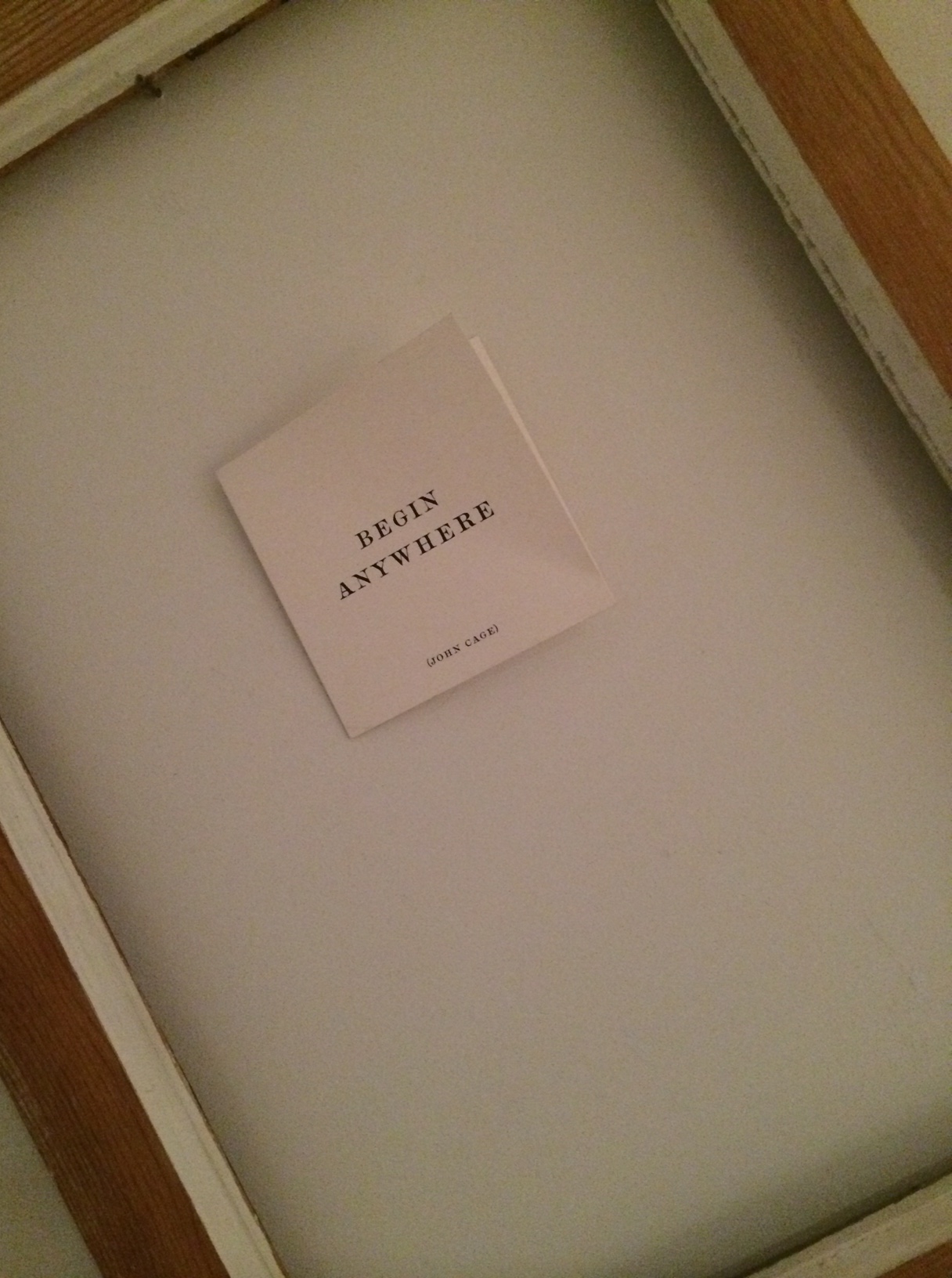
In our house, hanging on the wall like a painting, is an old window frame. In the top pane is a card that reads, “Begin Anywhere.”

Earlier this week I had a great conversation with Diane. She laughed and said, “In my meditations I was whining to God because I wanted to see the plan of my life. I got the clear message that I was never going to see the plan but I could always see the next step. The next step is always right in front of me.” Dancing with what’s right in front of you is sometimes called faith. Sometimes it is called play. Sometimes it is called art.

Diane and I are good reflectors for each other; we are usually on parallel paths. For both of us, the past year or two has been a process of letting things go and stripping things back: paths, patterns, and presuppositions. It has been the mother of all house-cleanings (she had a literal flood!) and, like all good house cleaning it took some elbow grease and few hard decisions about what to keep and what to throw. After the job is done, nothing feels better than a clean house and along with the good feeling, new space, and wide-open possibilities, comes the question, “What’s next?”

Diane told me her story because my next step is so clear that I can focus on nothing else. With such a myopic focus I can see nothing else and that’s why I called her. I must do this play. I must. I cannot see beyond this dance. It is my first thought in the morning. It is my last thought falling into sleep. This step, my dance with The Lost Boy, makes no sense and Diane’s point was well taken: the next step rarely makes sense. Sense-making requires context. Sense-making is a skill of relativity – and since we can never know the plan (if, indeed, there is one), we can only make sense based on old information. That is good news for plumbers but is dubious at best for leaders, explorers, seekers, and artists.

After our call I realized that dancing with what’s right in front of me is how I paint. It’s also the key to a good conversation – and painting, for me, is a good conversation. After my good conversation with Diane, she sent me an email of affirmation and concluded her thoughts with this: “Stay focused on what is before you now and let the creations show you how and when they are ready to play.”

title_pageGo here to buy hard copies (and Kindle) of my latest book: The Seer: The Mind of the Entrepreneur, Artist, Visionary, Innovator, Seeker, Learner, Leader, Creator,…You.

For all digital forms of The Seer, go here

Yoga.ForwardFoldFor posters and prints of my paintings, go here


Hear The Voices

photo-2This is the most unusual rehearsal process I’ve ever navigated.

First, I wrote the play and in preparing to perform it, I’m discovering it anew as if someone else wrote it. There have been brilliant and funny moments when I ask myself, I wonder why he wrote that? The good news is that I remember whom to ask.

Second, the play was originally meant for Tom to perform and since the story is Tom’s family narrative, I wanted the language and syntax to be Tom’s. In development, I recorded hours of conversation with him. Much of the first draft was a transcription so that I might capture word-for-word his language choices and speech patterns. Those structures survived the several rewrites that happened after Tom’s death. In preparing to perform the play I’m wrestling with the language. I’m wrestling with his language. It is almost as if I am discovering my own speech patterns and syntax – in telling Tom’s story I’m finding it necessary to tell it my way, not his. Essentially, as is true in all good storytelling, I am finding myself, my voice, through his story.

Tom and me a long time ago.

Tom and me a long time ago.

Finally, the music is a character in the play and the musicians, Mom’s Chili Boys, are madly rehearsing in California while the actors (Kerri and I) are rehearsing in Wisconsin. The internet is a beautiful thing as, each day, we pass notes, record voices, email questions; we will only be together in the same room 3 days before the first performance. We’re essentially workshopping the play from two locations. It is akin to rehearsing a symphony in parts and the parts only come together in the final day. They get to experience the whole symphony, the fullness of their music as played through all of the voices, only in the final hour. And that will be true of this play.

Each day I rehearse and I hear Tom’s voice in my head, telling me the stories that comprise the play. I am reminded that, whether artist or audience, art is a living thing. It is a relationship and ultimately that relationship is with your self.

title_pageGo here to buy hard copies (and Kindle) of my latest book: The Seer: The Mind of the Entrepreneur, Artist, Visionary, Innovator, Seeker, Learner, Leader, Creator,…You.

For all digital versions, go here (Leanpub)

Untitled by David Robinson

Untitled by David Robinson

Go here for fine art prints of my paintings.

Look Up

Eve, by David Robinson

Eve, by David Robinson

The nights have been bitter cold and clear. The cold always seems to make the stars sharp like crystals. Standing on the back deck, looking at the stars, I remembered a conversation I had years ago. I was working with students and we strayed into a discussion of human beings connection to the stars. It was cosmology in a nutshell.

Here was the gist of the conversation: something happened to human consciousness when they (we) understood that our patterns of life on earth were (are) oriented to happenings in the sky. For instance, our impulse to worship is intimately connected to the solstice and equinox: the disappearance and return of the light. Our migration habits, planting habits, daily rising-and-shining habits are relative to the movement of the sun. The tides in the ocean and the waters in our body are responsive to the pull of the moon. With the awareness, we crossed a line from chaos to order, from unconsciousness to consciousness. There was a relationship, a pattern, a belonging, a participation. There was something bigger.

During that same period in my life I also worked with a group of inner city students who had never seen the stars. It was a revelation for me. For them, there was no sense of relationship, there was no “something bigger.” There was a load of anger and existential separation.

This holiday season, I was struck by two things: 1) how many times I had conversations with people, glued to their televisions, who are frightened and feeling helpless by the happenings in the world, and 2) how many casual family photos crossed my path featuring a gathering of individuals, alone together, faces to smart phones. Everyone was looking down.

Standing on the back deck on a dark and starry night, wrapped against the cold, I wonder what some distant teacher in the future will tell his or her students about what happened to human consciousness when they (we) ceased looking up.

title_pageGo here to buy hard copies (and Kindle) of my latest book: The Seer: The Mind of the Entrepreneur, Artist, Visionary, Innovator, Seeker, Learner, Leader, Creator,…You.

Yoga Series 7Go here for prints of my paintings

Visit With Your Guardian

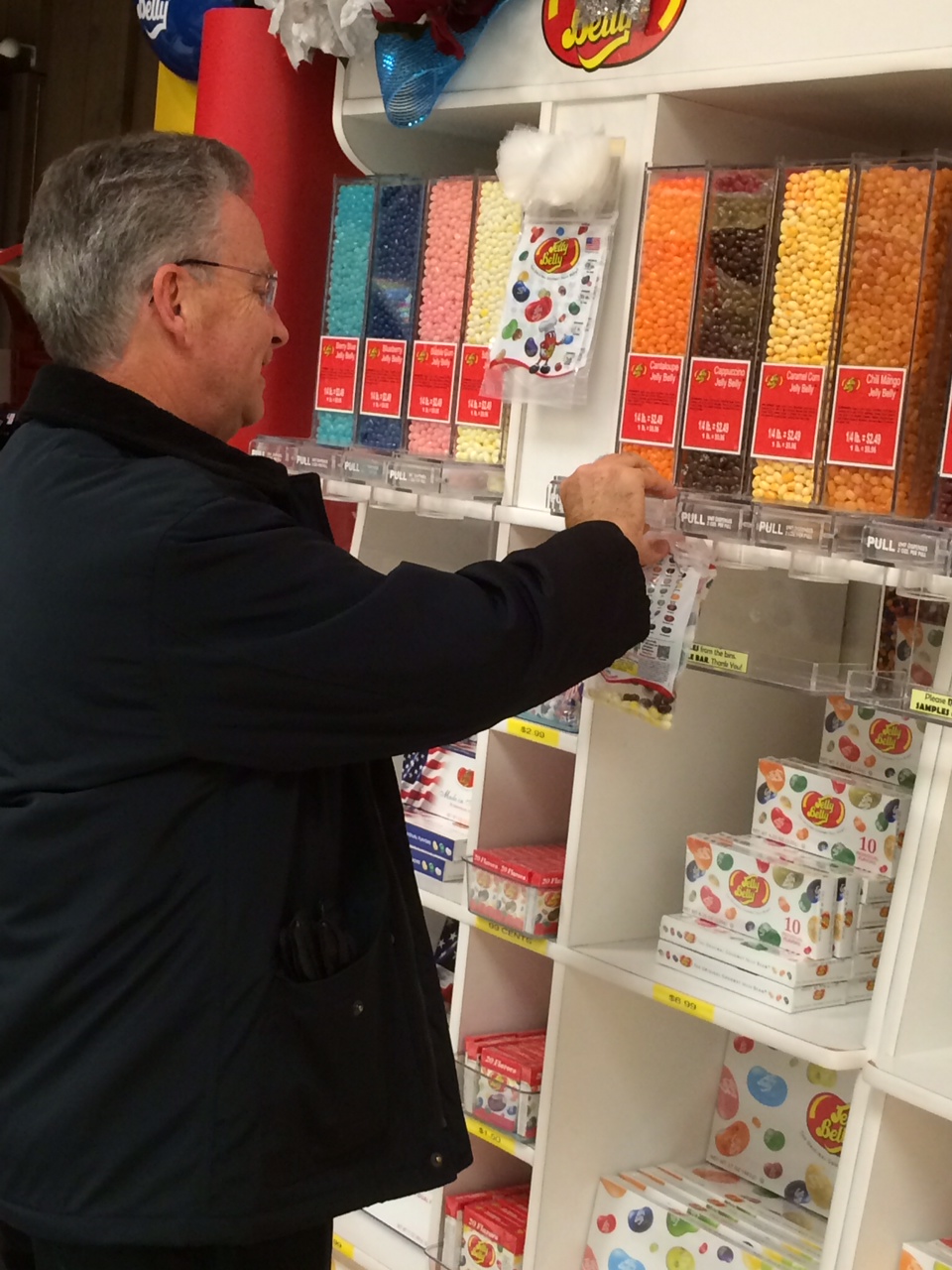
My Threshold Guardian at the Jelly Belly store.

My Threshold Guardian at the Jelly Belly store.

In addition to being a dear friend, Arnie is my personal threshold guardian. His appearances in my life always signal that change is a’comin’. The last time that I saw Arnie I left behind everything that I knew (literally and metaphorically). I began a long pilgrimage to the church of my self. It felt as if I stepped into my big wooden sailing ship and set a course for the edge of the known world and then, with great intention, sailed over the edge.

Two years have passed since our last meeting. In the interim, I have experienced Sirens and Cyclops, I lost my metaphoric ship and crew to the great whirling Charybdis, I was held captive on an island, I paid an extraordinary visit to the underworld and, at last, returned to the light with new knowledge. And, this week, as is his custom when I am ready to pass through the next portal, Arnie came to visit.

Saul’s voice roared in my head as Arnie and I debriefed my two-year journey: address your self to the field of possibility, not to the opponent. Possibility, I learned, becomes visible when we are vulnerable and available to it. It appears when we place our focus on it, when we seek it. Pushing and protecting and fighting and resisting obscures the field of possibility because our focus is on the opponent, not on the possibility.

And, of course, the greatest opponent is our self.

In the language of story, for great personal transformation to occur, we must leave behind everything we know and go on a journey into the unknown. That includes leaving behind who we know ourselves to be. In other words, we are required to let go of all the things we believe that we can control – but in truth cannot; we are required to release our insistence on keeping things “as they are.” In the end, we are required to face and then release the things that we are trying “to make work” but cannot – and let go of all the things we want to force into existence but cannot. That is the moment the opponent in our self disappears and we are at last able to turn our eyes outward and see the field of possibility that has been available for us all along.

title_pageGo here to buy hard copies (and Kindle) of my latest book: The Seer: The Mind of the Entrepreneur, Artist, Visionary, Innovator, Seeker, Learner, Leader, Creator,…You.

Eve, by David Robinson

Eve, by David Robinson

Go here to buy fine art prints of my paintings.


Doubt

Pidgeon Pier - acrylic on canvas

Pigeon Pier – acrylic on canvas

It’s been months since I had a good chat with the stained glass window. I hadn’t realized that the conversations had stopped. The summer was a blur of unplanned travel and I suspect during the chaos of coming and going that I simply stopped asking questions.

This morning we awoke to snow, the first of the season. Snow arrives silently and inspires inner silence. Steeped in the snow’s quiet I heard the window’s greeting. “Ah, Welcome back.” And so began our conversation about doubt.

Doubt is a double-edged sword, it has two distinct faces. The first face, unlike the snow, is noisy. Doubt does not arrive in silence. It demands to be heard. In the middle of my conversation with the window I heard P-Tom say, “Fear makes us doubt our belief and believe our doubts.” This face of doubt is a crazy maker. It makes muddy the inner waters. It makes all fears come true.

There is another face of doubt, not born of fear but arising from love. The 5th Agreement of Don Miguel Ruiz is this: doubt everything that you think. To doubt what you think makes little sense without the preceding agreements, the most powerful (to me) is this – Be impeccable to your word: speak your truth and nothing else; do not blame or accuse or make others responsible for your pain (your thoughts and actions); own your thoughts; own your actions. Or, better said, love yourself enough to express your love and nothing else. Don Miguel writes that impeccability to your word requires self-love. In this context, this other face of doubt is a step forward. Coming from love, to doubt what you think is akin to cleaning up the dirty dishes. It is to not take anything too seriously. Thought is nothing more than storytelling and to doubt the story births detachment from investment in the story. Detaching from the story-investment brings quiet, like the snow.

title_pageGo here to buy hard copies (and Kindle) of my latest book: The Seer: The Mind of the Entrepreneur, Artist, Visionary, Innovator, Seeker, Learner, Leader, Creator,…You.

Yoga Series 7Go here for fine art prints of my paintings

Tell A Good Story

The Storyteller emerges from the forest. Lucy & The Waterfox

The Storyteller emerges from the forest. Lucy & The Waterfox

Over the years I’ve tried countless marginally successful ways to define for others what I do. It would seem obvious: I am a painter. I am a writer. Oh, and a theatre artist. And a consultant. And I’ve maintained a coaching practice. I’ve worked in education, the corporate world, with non-profits, and with entrepreneurs. So, in conclusion, I do too many things.

Well, that’s not exactly true. I do one thing. I deal in story.

I speak the language of story and that is confusing in any arena. What does it mean? Such a simple word, story, and yet it can mean so many different things. For instance, a truism in effective, transformational coaching is that the story doesn’t matter. By story, coaches mean the circumstance; in transformation, in the fulfillment of potential, the details of what happened – the story – are not useful. The circumstance story usually equates to blaming or endless attempts at self-fixing. The circumstance story gets in the way of growth. It is an anchor in the sea of dysfunction.

I don’t work with circumstance stories.

By story, I mean inner monologue, the-story-you-tell-yourself-about-yourself. By story, I mean the language that we use within ourselves to articulate belief. I work with the orientation story, the personal and communal mythology. Rather than get in the way, the orientation story defines the way. It defines what we see. It defines our relationship with time, with nature, with god, with community: it is the lens through which we make meaning. I help people change their lenses. Try explaining that to a CEO!

Last year, when Skip and I shuttered our business, I also shuttered my coaching practice. I ended my corporate work. Much of it came to feel like wearing an ill-fitting shirt –or a host of ill-fitting shirts – so I decided to clean out the closet. I wanted to drop all the definitions, the old forms, to make space for the new.

Last week I decided it was time to peek into the empty closet. And, as serendipity would dictate, I happened to be reading Frank Delaney’s engaging book, The Last Storyteller. On page 99 of this fictional tale, this is what I read:

“…every legend and all mythologies exist to teach us how to run our days. In kind fashion. A loving way. But there’s no story, no matter how ancient, as important as one’s own. So if we’re to live good lives, we have to tell our own story. In a good way. A way that’s decent to ourselves.”

I threw my head back and laughed. There is no story as important as one’s own. To live a good life we have to tell our own story in a good way. And then, there was this:

“…I don’t give anybody advice. All I do is release the good thinking that’s already inside of you. You’re the one who acts on your own advice, and I have the pleasure of helping you reach those thoughts about yourself. So it’s not me helping you. It’s you helping you.”

Ask me today what I do and I will say, I write. I paint. Ask me for more detail and I’ll open the book to page 99.

[to be continued]

title_pageGo here to buy hard copies (and Kindle) of my latest book: The Seer: The Mind of the Entrepreneur, Artist, Visionary, Innovator, Seeker, Learner, Leader, Creator,…You.

All digital forms of The Seer can be found here

Learn To Swim

from my children's book on how to play, PLAY 2 PLAY

from my children’s book on how to play, PLAY 2 PLAY

Hoodie tells me that he is sarcastic by nature but I don’t believe it. I’ve spent a lot of time in nature and I find no sarcasm there. I also understand much about human nature and know that sarcasm is not a native plant; it is invasive. It is introduced into fertile, unknowing soil.

Sarcasm is the tool of the drowning man. It is an act of desperation to push others under the water in order to elevate the self. I’ve walked many paths and worked with many powerful and not-so-powerful people. There is a rule on the stage that applies: the king never needs to act powerful because the king is powerful. Those who need to demonstrate power have none. As Quinn used to tell me, if someone has to tell you that they’re important, they really aren’t. Sarcasm is a form of importance-telling. Powerful people create power with others. Power is a creative act. It is a communal act. They have no need to diminish or reduce others because they recognize that reduction also reduces. People who must reduce others are not powerful; they’ve confused control with power. They want to be king. They want to be seen as king. But, they do not believe they are king. Sarcasm is a form of perception control.

No one is by nature sarcastic. Sarcasm is learned in batting cages, at dinner tables, and on the field of play. Sarcasm is a mask. It is a place to hide smallness. It is passed down generationally. Masks both conceal and reveal and while it might feel good to pull others under the waves, it also reveals a non-swimmer. It is habit. It is learned.

Hoodie is not by nature sarcastic. Hoodie is a swimmer. He has the stuff of kings. He also tells me that his nature is to give comfort, to help others. He will one day realize, after he transcends his habit of drowning, that his nature to lift others is the center of his power place. Sarcasm separates him, reduces him, as do all forms of self-diminishment/control. Sarcasm is a lonely planet. Power is always a movement toward others. It is generative, as is all of nature.

title_pageGo here to buy hard copies (and Kindle) of my latest book: The Seer: The Mind of the Entrepreneur, Artist, Visionary, Innovator, Seeker, Learner, Leader, Creator,…You.

Go here to support my kickstarter campaign for The Lost BoyDSC_1196 copy


Simply Listen

Pieta with Paparazzi

I call this one Pieta with Paparazzi

I am standing in a lobby listening to people compare their tragedies. It is more than comparison; it is a festival of one-ups-manship. “If you think that’s bad, my niece was just diagnosed with a terrible cancer….” The first speaker, now crestfallen, reaches into her story-bag of pain as another member of the group competes, “That happened to my brother just after his daughter was hit broadside by an enormous truck!” The group coos in sympathy, each in a hurry to make their personal story of hurt the center of the conversation. I wonder at their need to outdo each other in tragedy.

I suppose it is human, this feeding frenzy of drama. I want to reject my supposition outright. Suppose it is not human? I wonder if this dis-ease is cultural, an expression of the fragmentation that comes from the too-busy, the clan that avoids internal quiet at all costs, filling every moment with television, gaming, texting, emailing, gossip-news. As Anne Morrow Lindbergh wrote in Gifts From The Sea, it is impossible to know who you are without dedicated inner spaciousness and quiet. To listen to your self is the only way to really know your self. Filling the quiet space with incessant noise withers the root.

Maybe.

All stories require conflict to move forward but it is also true that the point of all storytelling is transformation. Through the conflict we are transformed. Perhaps that is what bothers me as I listen to this pain frenzy: the emphasis is on the suffering. The investment, the identity, is in the wound, not the transformation.

There is a simple Buddhist prayer that I like:

May I dwell in my heart. May I be free from suffering. May I be healed. May I be at peace.

The prayer is like a musical round that progresses from the “I” to the “You” to the “We.” The emphasis is on the transformation. It begins with dwelling in the heart.

Maybe.

What bothers me most is the absence of the capacity to listen. The first speaker needed to be heard, not outdone. I wonder what might have happened if the group had simply said, “Tell us.” I wonder what might have happened if they had been able to be present with another’s pain. To listen, simply to listen, must be a route to free each other from suffering, to heal, to create peace.

title_pageGo here to buy hard copies (and Kindle) of my latest book: The Seer: The Mind of the Entrepreneur, Artist, Visionary, Innovator, Seeker, Learner, Leader, Creator,…You.

Or, you can go here for all forms of digital options


And, you can go here for fine art prints of my paintingsYoga.Meditation


Leave Your Ghost

from the archives. I call this painting "Demeter."

from the archives. I call this painting “Demeter.”

As Alan said, this year for me is a year of departures. First Tom, then Kathy, Bob, and Doug passed; mentors all. Earlier this month Casey, who lived a long season and once told me that heaven didn’t want him and hell wouldn’t have him, finally found his way out of this life and into his proper place in the mystery.

When I was a boy my favorite book was an old college text of my father’s on comparative religions. It was moldering on a shelf in the basement with other long forgotten books. Finding it was like uncovering buried treasure. I fell into it, reading and rereading it. Among other things, it helped me understand that religion was not fact but a cultural expression of universal experiences. Human beings have to deal with the enormity of existence (who am I?), birth (where do I come from), death (where am I going?), and everything in between (what’s my purpose?). Human beings deal with the enormity of existence like they deal with everything in life: they story it.

Since there has been so many significant departures this year I’ve been doing some reading about death and dying. Lately, I’m reading Deepak Chopra’s book, Life After Death. He weaves the book around a parable of a young woman who must confront Death. The woman seeks the help of rishi, a wise contemplative who lives in the forest. In one of my favorite sections of the parable, the rishi introduces the young woman to ghosts. The first is a toddler; the second is young girl. The woman soon recognizes that the ghosts are her past; they are the phantoms of various stages of her own life. The rishi tells her, “Every former self you have left behind is a ghost. Your body is no longer the body of a child. Your thoughts, desires, fears, and hopes have changed. It would be terrible to walk around with all your dead selves holding on.”

He teaches her that death has been with her every moment of her life. “You have survived thousands of deaths every day as your old thoughts, your old cells, your old emotions, and even your old identity passed away. Everyone is living in the afterlife right now. What is there to fear and doubt?”

title_pageGo here for my latest book

Go here for fine art prints of my paintings.

Return To Your Self

DSC_1914

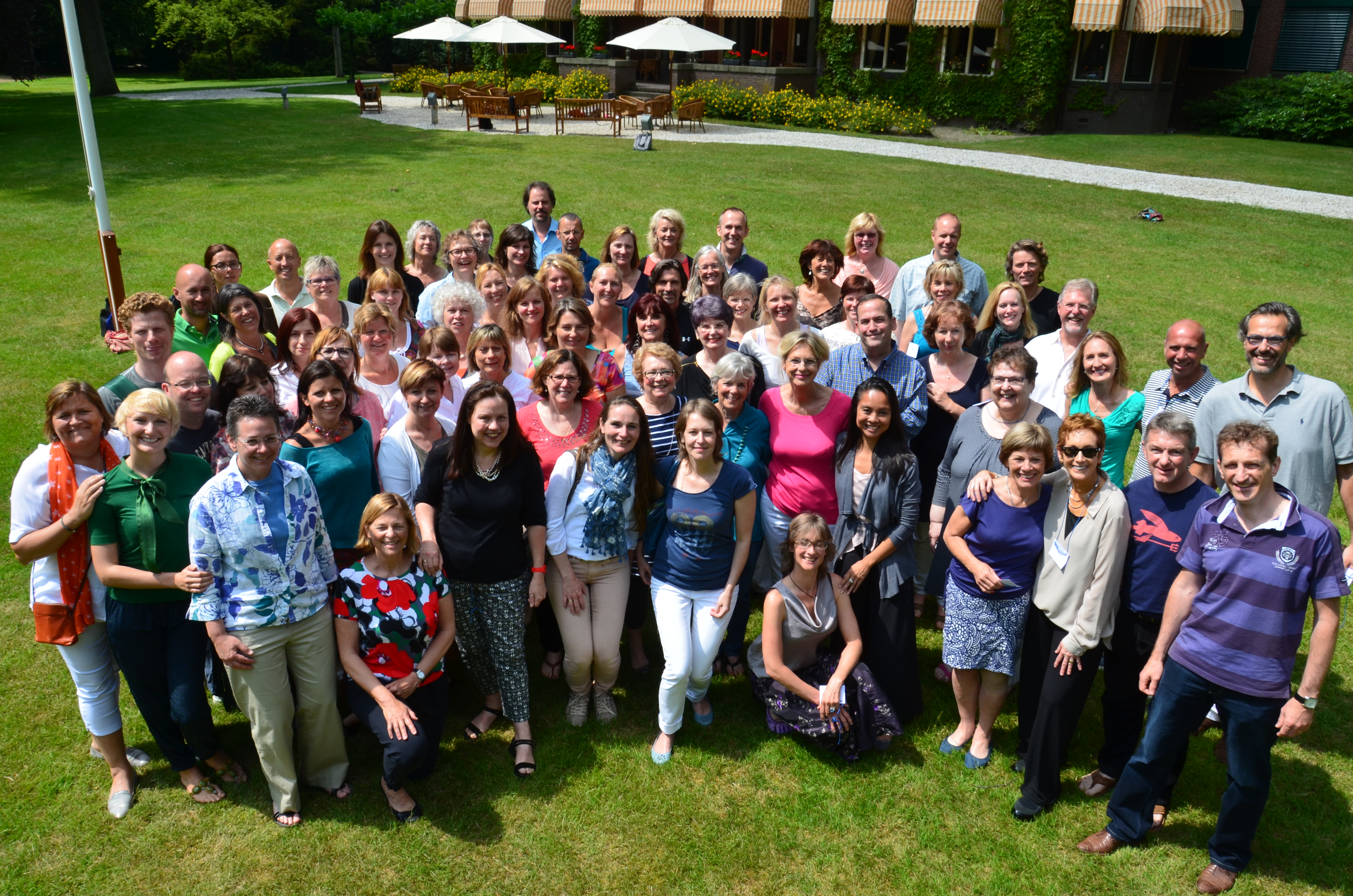
The 2014 Transformational Presence Global Summit in Vught, Holland

While in Holland I led a group through a segment of an exercise called The Dream Police. I created the exercise years ago with John Langs and Lisa Paulson – two master teachers and performing artists – while doing some work with young actors at PCPA Theatrefest. The original exercise is deeply rooted in ritual and communal transformation. The group in Holland was engaged in a more personal exploration so I only led them through the first part of the exercise.

It is surprisingly potent and I’ve learned to use it carefully. The first part of the exercise sounds simple but can be explosive: Write for 5 minutes as if, in 5 minutes, your memory will be wiped clean. All that you will know of your life, of your values, your relationships, your dreams, your identity… will be what you capture in those few moments of writing. After the writing, in a ritual act, the scribbles on the paper are left behind. Most often, people destroy the paper. They shred it. The writing is lost. The question becomes, “Who are you without your story?” It is intended to disorient so the participants might reorient to the essentials of their lives; it is a great exercise for cleaning the gunk. It can be freeing. It can be terrifying. It is always illuminating.

The reorientation process is impossible to do alone. Reorientation is communal. Until Holland I’d never left a group midway, I’d never let the exercise stop in the middle of the disorientation and had always before made sure the reorientation process was at least initiated. IN Holland, the exercise was interrupted. The disoriented community fragmented. Some left the exercise feeling liberated. Others were angry. Some were confused or frightened. All left by themselves. Disorientation makes lonely introverts of us all. Disorientation is an individual sport.

The ritual of coming back to yourself is always a ritual of returning to the community. Clarity is a boon that requires sharing with others. To come back to yourself is to come back to relationship. No one walks this earth alone. No one is capable of saying “This is me,” without the presence and assistance of others. The process can be volcanic. It can be quiet and intense. It always requires another question: “Will you tell me what you see?”

24 hours later we completed the exercise. The individuals returned. They gathered, reoriented and a new form of the community was born. I knew all was well when the newly reformed community asked, “What do we do now?” and the only available answer was, “We don’t know – but let’s find out together.”

Go here to get my latest book, The Seer: The Mind of the Entrepreneur, Artist, Visionary, title_pageSeeker, Learner, Leader, Creator…You.

Or, go here for hard copies.