Expose The Value

photo-3We debated our costumes for Brad and Jen’s Halloween extravaganza for months prior to the party. The letter for this year’s costume theme was “T” (with extra credit for using a “Q”). During the long hours of our summer road trips, our conversation sounded something like this:

“We could be Trollops.”

“Trollop is good. We could be Tin men.”

“I like that. What about Tootsie Pops!”

“Someone will come as a Tootsie Pop. How about Tramps.”

“No. I did that when I was twelve. What about tsunami! We could be a tsunami!”

And on and on we’d go. We finally settled on this bit of whimsy: Too-many-ideas & Too-many-questions. Kerri was going to be Too-many-ideas and I was intended to be Too-many-questions – but we changed our minds in the final hours.

At the party you might have asked, as many people asked us, “What is a Tarving Artist?” We wore paint-spattered clothes and artist aprons filled with paint and brushes. On the aprons we wrote: Dying Of Exposure. Between us we carried a donation bucket with a sign that read: Our “S” was repossessed. Please help us buy it back.

In the week prior to the party, Kerri was asked to play for an event. Every artist in the nation is used to hearing the words she hears weekly: “We have no money to pay you but it will be great exposure for you.” She is a consummate, career musician with 15 albums, (going on 16) and needs no help with her exposure. I loved her response: “Let me call my accountant and ask if she accepts exposure for payment.” Her latest encounter with empty exposure started a long hysterical conversation and note-comparison session of all the amazing ways people have asked us to work for anything and everything but money (Yes, it is true. When artists make art they are working as surely as a plumber who plumbs or a doctor who diagnoses. When was the last time you asked your dentist to work for exposure?).

The common mistake at the center of every work-for-exposure offer: it will be good for the artist. It’s never good for the artist. For two reasons it’s a notion that is good for everyone but the artist. First, no artist wants the kind of exposure that reinforces that their work is without real value. Second, no creative artist wants to be defined as a player of background music or drawer of dog portraits (unless, of course, their dream in life is to draw dog portraits). The act of drawing or playing a musical instrument is not what defines the artist or their art. It is a mistake to assume that because I can draw and paint that the act of drawing and painting is what constitutes the art. A carpenter uses a hammer but the hammer does not define their work. It is a tool. The keyboard, the paint and brushes are tools.

People who pay artists with exposure see the tool but not the artist. That is why Kerri and I opted to change our costume. Certainly dressing as a Tarving Artist was a statement but more than that, we realized that only a starving artist would agree to play for exposure; only a starving artist would agree to hammer incessantly to get the attention of people who can’t see them to begin with. It’s never good for the artist and is always a costume or role they assume for the empty promise of exposure. The cost for the artist is always greater than the exposure and at the end of the day, after trading a bit of their integrity, they still aren’t able to pay the bills.

title_pageGo here to buy hard copies (and Kindle) of my latest book: The Seer: The Mind of the Entrepreneur, Artist, Visionary, Innovator, Seeker, Learner, Leader, Creator,…You.

Yoga.ForwardFoldGo here for fine art prints of my paintings


Explore The Human

photo-2

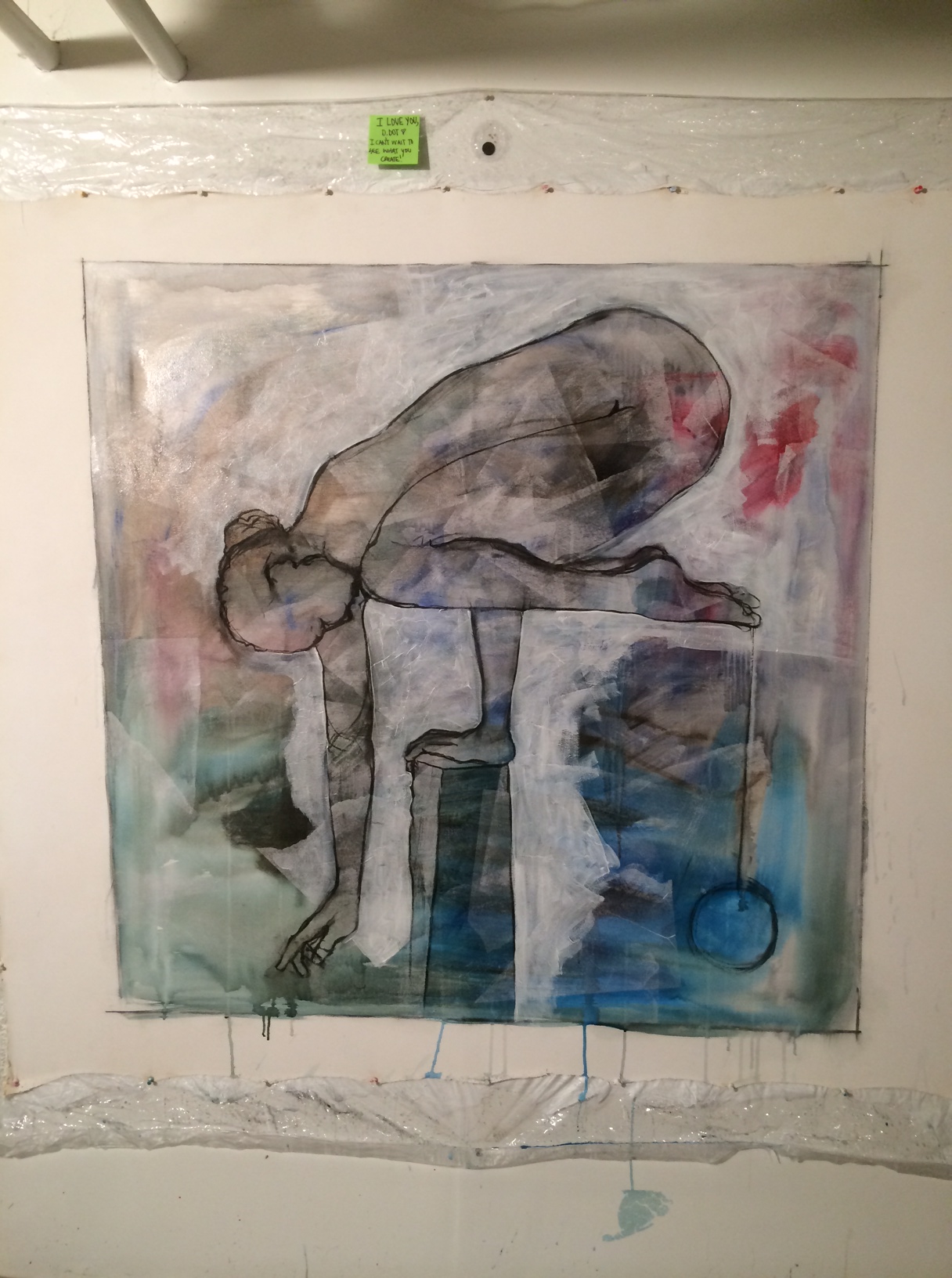
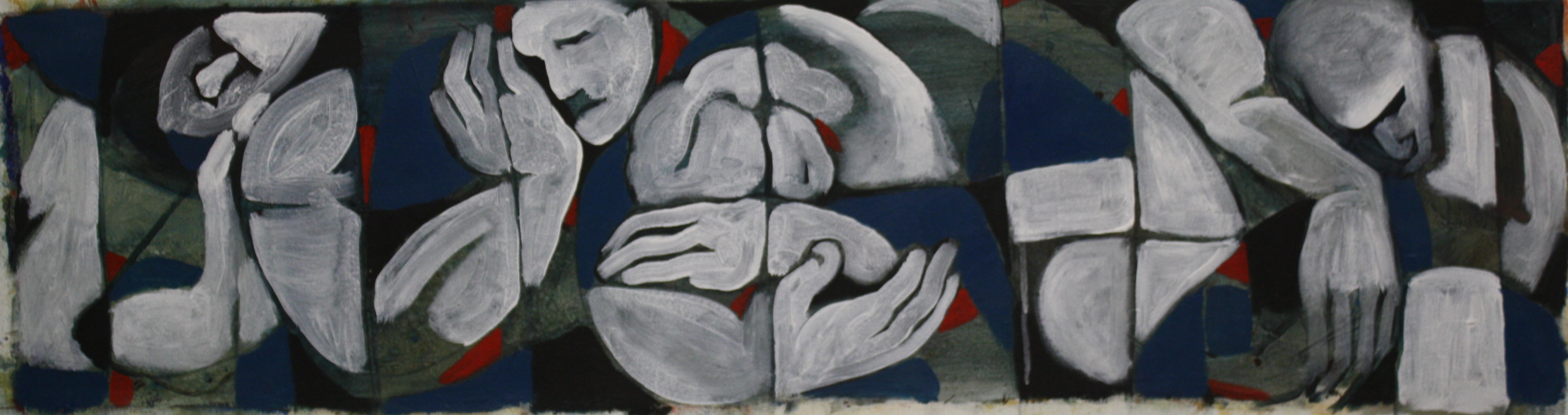
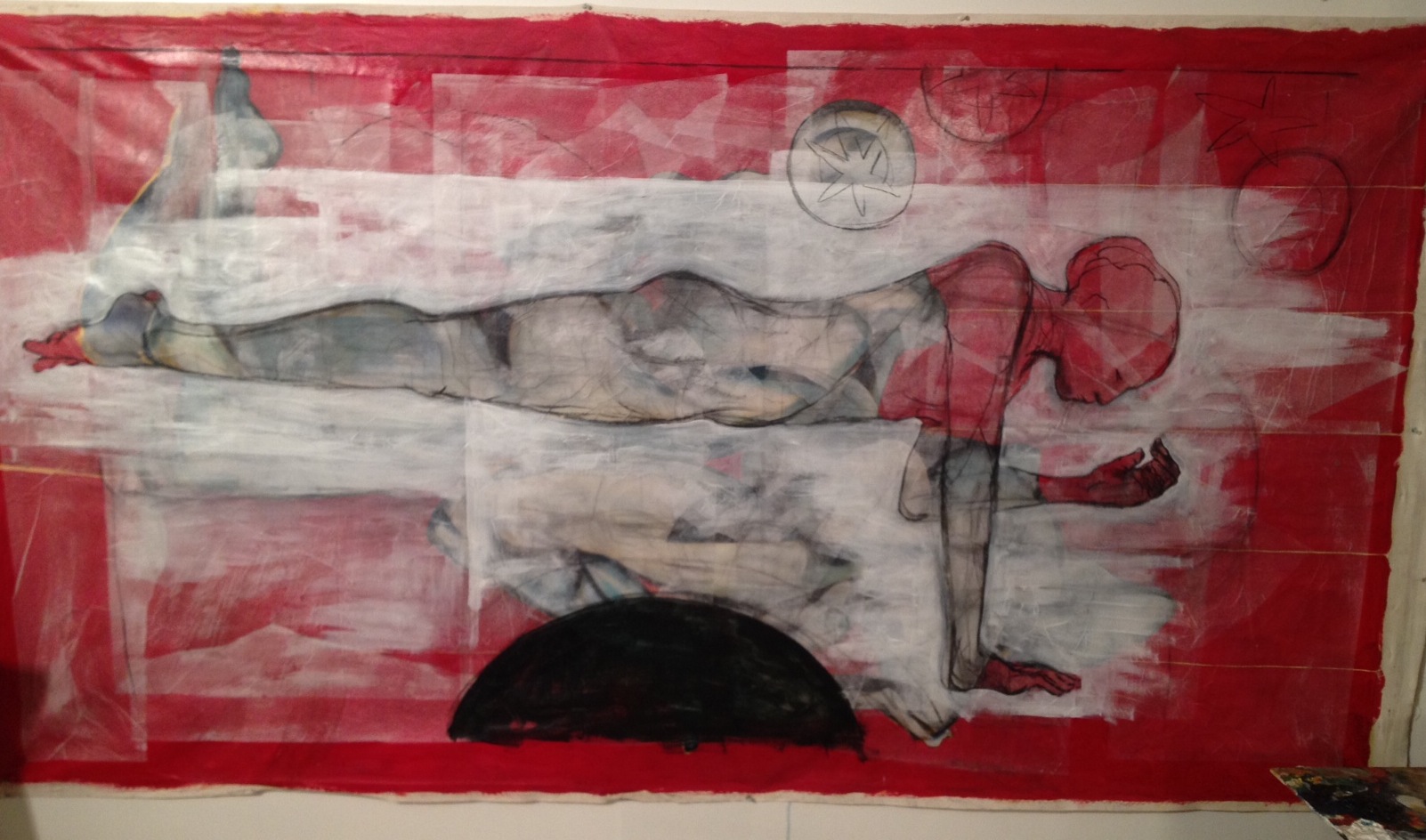
my latest work-in-progress. No name yet, approximately 5ft x 9ft.

Standing on the stair to her studio, Pam said, “I’m not sure where my work is going. I’ve pulled out all of the old paintings so I can see where I’ve been, what I’ve been doing, and maybe that will help me live into what’s next.” Like me, Pam has been a painter most of her life. She’s been through this transition many times before and recognizes the necessity of fallow artistic fields. Rather than push or panic, she’s matured as an artist and knows enough to value the emptiness.

With maturity comes faith. The muse never leaves. She rests. Artistic cycles are no different than seasons. Like a farmer living through the winter months on the harvest of the fall, Pam will spend hours sitting with her old work, thinking nothing, drinking in the nutrient of her artistic yield, allowing her inspiration fields to recharge and rejuvenate. She will allow herself to go empty, creating ample space for the new work when the muse reawakens. And then, one day, she will pick up a brush and be surprised by what comes through her.

Hans said, “An artist matures when he or she ceases working from their pain and begins exploring the human condition.” Working from the wound is necessary as adolescence is necessary. Most artists in our western tradition begin in rebellion, pushing against, making statements. We celebrate the outsider, the margin-sitter and so the wound can be difficult to escape: artistic pain becomes a role, an expectation. In practice it is akin to a developmental stall. The only place to go when pain is the norm is into the intellect: to produce, to make statements. Pain isolates and ultimately, an isolated artist is ineffective. Artistry, like all things vital, must occupy a shared space. It is communal or it is impotent.

Potency comes when the eyes turn out, when the question of “we” becomes more vital and interesting than the question of “I.” Artists mature when they reorient, when instead of the art expressing their pain, they serve the art and, make no mistake, art is another word for “human condition.” Art is bubbling life in all its forms: visual, kinesthetic, aural. As Hans said, “I want to fall deeper and deeper into the music. I want to find the edges and follow where it takes me, give myself over to it.”

title_pageGo here to buy hard copies (and Kindle) of my latest book: The Seer: The Mind of the Entrepreneur, Artist, Visionary, Innovator, Seeker, Learner, Leader, Creator,…You.

DSC_1196 copyGo here to support the kickstarter campaign for my play, The Lost Boy.

Do.

from my children's book, Play 2 Play

from my children’s book, Play 2 Play

About the river, Jim said something like this: I had to stop complaining, leave town, or do something about it.

Jim chose to do something about it. He got busy. Now, he’s dedicating time each week to clean and care for a stretch of the river. He’s working to make people aware of the rich life that the river supports. He’s drawing the plant life. He’s made and delivers an incredible Powerpoint presentation.

Jim came to an awareness threshold: complaining is not doing – but unlike most people, he crossed the threshold and changed. The first necessity in any change process is to change yourself. Complaining is a first step but it is where most people stop. Complaining feels good because it provides the illusion of action. Complaining can become fuel if it is followed with a step toward action.

I’ve worked with scores of people who wanted to write books or paint paintings and most came to me with a complaint: lack of time, no quiet space, or some other circumstance that blocked their happiness. When we removed complaining as an option, they created time or quiet space. They wrote. They painted. It was not magic. It was practical. Complaining requires dedicated energy. It also takes time and more than a little thought-space. Painting, writing, or cleaning the river also requires dedicated energy. The question is about where the energy is dedicated.

Ultimately, as Jim described it, the move from complaining to doing changed how he was in the world. He changed so his world could change. He stepped from helpless witness to active participant.

title_pageGo here to buy hard copies (and Kindle) of my latest book: The Seer: The Mind of the Entrepreneur, Artist, Visionary, Innovator, Seeker, Learner, Leader, Creator,…You.

DSC_1196 copyGo here to support my kickstarter campaign for my play, The Lost Boy


Ask, “Now What?”

photo-1On one of the many Post-It notes that line our idea wall is written, “Say ‘I Don’t Know.” It is especially relevant today as a few days ago, in a fit of spontaneous remodeling, we tore the five-decade-old laminate off the countertops. After the moment of deconstruction we looked at each other, shrugged our shoulders, and asked “Now what?”

I delight in moments like this for two reasons: 1) the first action (tearing off the laminate) always comes from years of wanting change but seeing only obstacles. In what feels like a spontaneous moment, the focus shifts from the obstacle to the action. 2) When the focus shifts only a single step is visible and that step is always some variation of, “I don’t know but I’m going for it anyway!” Second steps are generally invisible until there is a committed action, until there is a first step taken.

These two steps together are a good working definition for the creative process. Shift your focus from the obstacle to the only action you can see. Take the action. Repeat until the action takes hold of you.

The first step generally feels like deconstruction. It feels like breaking things or breaking out of things (like a focus on obstacles). A committed step into, “I don’t know” creates motion and motion begets motion. Rip off the old laminate without a plan and a plan will emerge. Or a mess will emerge followed by a new plan.

title_pageGo here to buy hard copies (and Kindle) of my latest book: The Seer: The Mind of the Entrepreneur, Artist, Visionary, Innovator, Seeker, Learner, Leader, Creator,…You.

Go here for all digital forms of The Seer.

Or, go here for fine art prints of my paintings (and other stuff, too)

Eve, by David Robinson

Eve, by David Robinson

Aim For The Field

An illustration from my children's book, Play To Play

An illustration from my children’s book, Play To Play

Lately, Saul the Tai Chi master has been much in my thoughts. It is now September and it has been a year since he taught me a lesson that has become the new mantra of my life: orient to your own concern. Actually, he said that I should look beyond my opponent into the field of possibilities and orient to my own concern. “In this way,” he instructed, “you will no longer have an opponent.” He used the word “opponent” loosely. Any limitation or form of internal resistance is the opponent.

Beyond the opponent is a wide-open field of possibilities.

In the intervening year I have learned that I have been both my greatest opponent and the one who can look into the field of possibilities. Isn’t this true of all people? All stories worth telling (and hearing) are ultimately tales of transcending the inner opponent. If you need help identifying your personal mythic journey simply listen to the areas in life in which you say to yourself, “I can’t.” In that place you will find your opponent. You will also be surprised to find that your inner opponent is most often an orientation to other people’s concern; the fear of what others might think is a mighty inner-monster creator.

I’ve also learned that Saul’s lesson has come to me in many forms throughout the course of my life. For instance, many years ago I directed plays and, because I am also a visual artist, I was often in the position of designing the sets as well. With great love and humor, another terrific mentor watched as I struggled with my dual role. He gently showed me that I was orienting my designs according to the budget and construction limitations I perceived. I was working in the wrong order, asking “how” before lingering in the potential.   He told me that I needed to “Live first in the possibilities.” Design/orient according to the potential and not the limitations.

To live first in the possibilities is to walk the imagination without a leash. It is to let the imagination run wild. What is beyond your capacity to imagine? What is possible beyond the boundaries of belief? At one point in my life cell phones were science fiction. Today, they are ordinary.

Look beyond the opponent. Orient to your own concern. Imagine how life might change if instead of asking, “Can we do this?” we began by asking, “What’s possible?” And then aim for the field.

title_pageGo here to buy hard copies (and Kindle) of my latest book: The Seer: The Mind of the Entrepreneur, Artist, Visionary, Innovator, Seeker, Learner, Leader, Creator,…You.

Go here for all digital forms of The Seer.

Yoga Series 7Go here for fine art prints of my paintings

Bring Your Boon

This painting is called Icarus.

This painting is called Icarus.

During my call with Skip I used the word, “boon.” He scribbled a note saying, “You’ve not used that word before.” The word came up because he’s been overrun by well meaning advice-givers that think he needs to know about the hero’s cycle. Skip said, (and it’s true) that he’s forgotten more about the hero’s cycle than most people will ever know. “I’m a business guy so they think I can’t possibly know about it!” he exclaimed. “If another person tells me about the hero’s cycle I’m going to explode.”

My thought for him was to pay attention to why so many people are coming up with the same response when they hear about his work. What’s evoking the common response: have you heard about the hero’s cycle? I always pay attention when a book title repeatedly drops into my world (I get the book) or when a place or a metaphor seems to pop up everywhere. What’s there that I may be overlooking? What is hammering Skip that he may not see? That’s what sparked the word, “boon.”

When the hero (and we are all heroes in our personal story) emerges from the ordeal of change, when they escape the belly of the whale, they are transformed. They know something that they didn’t before understand. This is the boon. They have a new gift or insight that will, in turn transform the community. Personal change is communal change. They are one and the same thing.

There is a small catch when dealing with boons: communities (like individuals) talk a lot about the need for change but mostly resist it. When you are the bringer of the gift, the carrier of the insight, often you are not welcome when you share it. New insights are dangerous to the status quo. History is resplendent with visionaries banished for sharing the boon of their transformation or bringing to the community the gold that they need but are incapable of recognizing.

Skip has arrived back to the world with a boon. He sailed to the edge and has returned with strange knowledge and a unique perspective. His insight contradicts common models of business. His boon describes motion, a flow, which is hard to see when the landscape is dominated by bottom lines and outcomes. His community mistakenly thinks he needs to go on a hero’s journey when, in fact, he is just returning. His hands are full of gold that they cannot see.

The best we can do is share what we hold. How it is received is out of our hands. If it is received at all is not in our control. Vincent Van Gogh died having sold one single painting – and that to his brother. The glory of his life – and the lives of all visionaries – is that he kept painting regardless of whether the world might someday see the boon, or not. It didn’t (and doesn’t) matter. Bringing the boon home is all that is required.

title_pageGo here for my latest book, The Seer

Go here for Fine Art prints of my paintingsYoga.Meditation

Welcome The Bump

With Kerri on the top of a mountain

With Kerri on the top of a mountain in Colorado.

Just beyond Vail, Colorado there is a tiny two street town called Minturn. It began as a mining town when people were rushing for gold but these days it survives as a place for tourists. It is radically different than its founding fathers intended. We stayed there for a few days of rest and recuperation after our two-week double loop through Middle America.

The double loop through America was nowhere in the plan a month ago. Things just seemed to pop up. A death. Kerri’s daughter stumbled into a new job that necessitated an immediate move. Plans changed. Our intentions for the month went out the window. All of the artistry went on hold. We quickly packed the car and hit the road.

Just as plans change it is also true that change is rarely planned. I’ve yet to meet a person who doesn’t resist change (despite their rhetoric). Change requires a step into the unknown and that’s precisely the point: real change comes when we simply don’t know. Most of us like to know where we are going before we step. Change finds its way through the cracks that happen when patterns are disrupted, when things just seem to pop up, when we have no idea what the next step is. Change happens when we are making it up as we go. Change is a creative act, a tap dance on the event horizon.

Last week we drove to Colorado from Wisconsin through Iowa and Nebraska to attend my grandfather’s funeral. After the service we drove to Columbia, Missouri, crossing the full expanse of Kansas, to deliver some treasures from Beaky (Kerri’s mom) to Wendy (Kerri’s niece). Since we were driving to Denver, why not go home via Missouri? We returned home long enough to wash our clothes, pet the dog, and repack the car and head to Minneapolis. We packed up Kerri’s daughter and moved her to Vail via South Dakota with a sharp turn through Nebraska before arriving again in Colorado. After a rest in Minturn, a few hikes, some time with wine sitting on a porch, and a few precious nights with my parents, yesterday we returned to Wisconsin through Wyoming, South Dakota, and Minnesota.

It was a tap dance. Change found its way in as our patterns disappeared in the spontaneity of the double loop. We arrived home exhausted and exhilarated, with renewed eyes, a riches of profound and varied experiences, and much clearer intentions. What seemed initially like an interruption in our path was, in fact, a crack in the pattern, a necessary bump into the unknown.

title_pageGo here for my latest book

Flow With Your Constraints

a rough draft from my soon to be released children's book, Play to Play

a rough draft from my soon to be released children’s book, Play to Play

Margie said, “You two need to learn how to be cool and calm.” We repeated her words as if in a trance, “Cool and calm,” I muttered. “Cool and calm,” Kerri said and then looked at me and asked, “Can we do that?” I shook my head. We smiled. The previous day we jumped out of bed at 1:30am and drove 4 hours to Indianapolis to help Craig move out of his apartment. We made it back home by 10pm.Tomorrow we drive to Colorado and then on to Columbia, Missouri. Next week we drive to Minneapolis and on to Colorado again. “You have to learn to sit still!” Margie chirped.

Many years ago Makaela told me that I was like a feral cat. “There’s a part of you that flees from any form of containment,” she said. I was at first surprised by her comment. From the inside, my life seems ordinary. I go to the grocery store. I pay bills. Makaela has a Cheshire Cat grin and it flashed across her face. In truth, I can’t wear lace-up shoes. Neckties are deadly to me. I am brilliant at starting things: programs, theatres, companies,.., just don’t ask me to maintain them once started. Neckties, cubicles, and commutes suffocate me. “See? Feral,” she said.

Cool and calm? Feral?

Neckties and lace up shoes restrict movement. To me, they are improper constraints. Improper constraints are akin to knots in a muscle: they impede flow. Toxins collect around the knots. Disease in a body is the result of an improper constraint. An improper constraint can be literal, a knot in a muscle, or a thought pattern, like the expectation of being perfect. “Perfect” is a mental knot. It stops flow. It stresses unnecessarily. It blocks the movement of free self-expression and engenders judgment. It becomes toxic to the system. Gossip is an improper constraint.

The flip side an improper constraint is a proper constraint. Proper constraints facilitate movement in a direction. They focus energy. Proper constraints define clear and open channels of movement. In a healthy body, air and blood and lymph move unimpeded through channels of proper constraint. Proper constraint is necessary to feed the body. Proper constraint is necessary for vital artistic expression. Healthy communication works just like a healthy body. A choice is a proper constraint. Proper constraint frees the movement of self-expression and engenders connectivity. It clears toxins from a system.

“Wait a minute,” Kerri said as Margie retreated down the stairs, “I think we’re always cool and calm.” I agreed. Our proper constraints look a bit different than most peoples. More than once Craig has looked as us and said, “You two are not normal.” Too true. What is normal, after all? A proper constraint for me is improper for others and vice versa. Kerri and I know for ourselves what engenders flow and what interrupts it. Jay Griffiths wrote that a society has to be tame to need the concept of wild. If there is no break in the natural world, if there isn’t a need for dams and fences, there is no need to distinguish between wild and tame. I am not feral after all. Kerri and I work at having no internal dams or unnatural fences. Our business is to create our own version of flow. Isn’t that what everyone wants?

title_pageGo here for my latest book

The PoetGo here for fine art prints of my paintings

Say Yes To How

This is one of my first test paintings for the yoga series. It's small, maybe 10inches square.

This is one of my first test paintings for the yoga series. It’s small, maybe 10inches square.

I’ve spent much of the past week shooting and cropping photos of my paintings. I’m cataloguing. I’m gearing up to show again.

I took an extended hiatus from showing when I went on my walk-about. Actually, in the few years prior to walking about, I stopped showing except for open studio nights and the few opportunities that found me. I continued to paint. I drew a comic strip. I wrote a book. There was lots and lots of energy output but very little energy to calling attention to my work.

The process of shooting the photographs has been a process of rediscovery: I painted paintings and stored them. More than once, now, I’ve unrolled a canvas and exclaimed, “Ah! I forgot all about you!” It’s a paradox: it’s as if I stumbled upon the work stash of some long ago artist; each roll holds a surprise. Each roll also holds a homecoming.

Early sample from the Yoga series. 18" x 24"

Early sample from the Yoga series. 18″ x 24″

Because I’ve been painting but not showing, I’ve inadvertently created an opportunity! I have an intact series: my yoga paintings. This series is a great gift because I can track my growth, I can trace the development of a technique and a visual stream of consciousness. I can see the seed. I can see the the seed cracking open, the green tendrils that grew from the seed. I can see the blossom. And, there is more to come that remains yet unknown.

When I started the series I had no idea that I was actually starting a series. At the time I was bored with my work. A friend, an acupuncturist, asked me to create some paintings for his office. Bodies in motion. I was messing around with different surfaces so I took the opportunity to play. I thought few people would see the paintings so there was no pressure to produce. I actually practiced what I preach: I played. I loved the mess. The point was the process and not the product. No single painting was an end in itself. There was no thought to being good or investing in any of the games that make art a labored mental exercise. It was fun. It was a discovery path.

The Yoga series all grown up. This piece is  4' x 4'

The Yoga series all grown up. This piece is
4′ x 4′

It continues to be fun. It continues to be a path of discovery. The pieces are becoming more complex; the figures at first were suspended in space. Now, they exist in environments. The pieces started small. Now, they are quite large (and getting bigger).

I’ve been writing these past few weeks about the question “How?” I realized yesterday, as I shot the latest painting in the series, that over the past few years I’ve often asked myself, “How am I going to paint that?” The answer has always been a rich and vital, “I don’t have the vaguest idea! Let’s find out.”

The latest in the series. This piece is almost 5ft x 5ft

The latest in the series. This piece is almost
5ft x 5ft

Peter Block wrote a great little book entitled, The Answer To How is Yes. As it turns out, these paintings are my visual record of how I said and continue to say Yes to How.

Go here for art prints of my yoga series. The newest pieces will be available soon!


title_pageGo here for my latest book

Let Yourself Go

I have no idea how, but I'm making a mess of sound and will one day play the ukulele.

I have no idea how, but I’m making a mess of sound and will one day play the ukulele. Kerri says that I already am…

My meditation on the word “how” continues.

At our recent Summit in Holland, Alan and I asked the question, “What would you do if you didn’t have to know how?” It is a great question. The short answer is this: you’d figure it out. You’d try things. And if your first attempts led nowhere you’d try something else.

In this musing I have often written that “how” is something that is known at the end of the journey. We can’t answer “how” with any honesty until the story is played. Today I recognize that there are two distinctly different “hows:” 1) the explanation, “This is how I did it. This is how you do it. This is the “how” that presumes a path or a prescription. When dealing with this version of “how” I ask groups or clients to consider their life story and tell me how they got to this day in this place doing this job, etc.. The answer is mostly, “A clear path with a lot of happy accidents,” or something like, “I have no idea. I didn’t try.” Yes. Ask me how to paint a painting and I will tell you that I have no idea. I’ve painted a thousand of them and I can teach color theory or composition but I cannot tell you how to open to the muse, how to become a channel for something greater to come through. To paint a painting, to act in the play, to write the book, there is something akin to letting go. There is a divine surrender. So, how did you get to this place in your life? Divine surrender. Happy accident. Unstoppable forces.

If the first form of “how” is an explanation, the second is akin to giving permission. I have worked with a legion of blocked artists who set up studios, buy musical instruments, sign up for improv class,…, and then sit in their studio, stare at their musical instrument, and forget to go to class. When they call me, they tell me their story and always finish the telling with, “I don’t know how….” For my fee, I could say a single, simple word: start. Instead, what we usually do in our work together is find their internal permission. When they realize that their block has nothing to do with “how” and everything to do with the fear of being judged (“how” is an internal braking system meant to prevent starting), when they are ready to, as Saul would say, “Orient to their own concern,” they allow that their opinion of their work trumps all others, they give themselves permission. They start. They play.

Recently, a brilliant woman, an attendee of the Summit, a maker of incredible mandalas, sent me an email with a photo of the start of a painting. She asked for my advice. I wrote: make a mess. Paint on top of the mess. Then repeat. Today in my inbox I received her beautiful mess with a note that their would be more messes to follow. She started. She picked up a brush. She splashed some paint. She splashed some more paint in response to her first splashes. That is how art is made. That is how light bulbs were invented.

This morning I laughed when I realized the double definition of the phrase, “Let yourself go.” In common parlance, it is used as a negative, when people give up, when they stop trying to maintain their health or their appearance, “He really let himself go.” The second possible meaning is to start. To go. The next time someone is sitting in their studio and asks me the question “how,” I will respond like this: let yourself go.

Go here for my latest book. title_page

Yoga Series 7Go here for fine art prints of my yoga series (and more).