Know Your Why

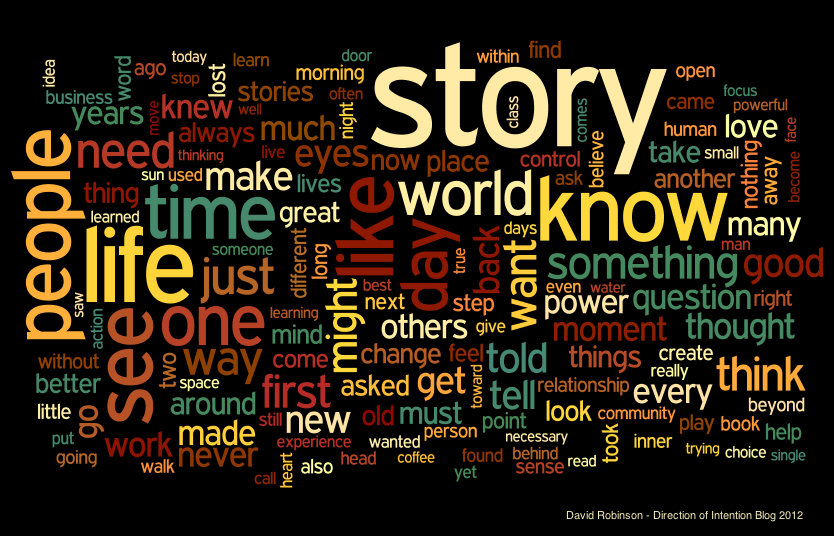
Mark Seely's gift to me: A Wordle of my blog

Mark Seely’s gift to me: A Wordle of my blog

This morning I had another world-class call with Skip and Barney. I could populate a year’s worth of posts from our conversations. I treasure these two men. They feed me and keep me connected to a deep, rich river of curiosity and questioning. They challenge my thinking and shake my perceptions.

We meet weekly on a conference line to discuss Skip’s upcoming book, Emails To A Young Entrepreneur. It is a remarkable book and since Skip is the consummate student of life, our calls, although on the surface are about the book, in truth dive into matters of essence and heart and meaning-making.

Skip told a story of working with student-entrepreneurs. He provided them with an experiential process that helped them see, if only for a moment, that their business is different than their product. This might seem like an easy concept to grasp; a Big Mac is not the business of McDonalds, however entrepreneurs and small business owners consistently confuse their idea, their product, with the business. It’s a confusion that leads down the path to ruin (in the world of education, the parallel is to confuse test scores with learning).

In our business-product conversation, Barney offered this phrase that I love: the energy of “why” is different than the energy of “how.” How I make art is a remarkably different question than why I make art. How I do business is a remarkably different question than why I do business. How I walk this earth is a remarkably different question than why I walk this earth. Peter Block, in his book, The Answer To How Is Yes, reflects that in a lifetime spent helping businesses grow and fulfill their potential, that not once did the organization start with the question “Why?” They were invested in “how” and, therefore, blind to the actions that might help. They were frozen with the notion that “how” was something they needed to know before they took action. In fact, what they  needed to know prior to action was “why?”

The north star of action is always found in the question, “Why?” How is a matter of taking steps without knowing the end (just like life). Know your why. Take a step. Live in the life-giving energy of why, take a step and call it “how.”

Go here to get my latest book, The Seer: The Mind of the Entrepreneur, Artist, Visionary, title_pageSeeker, Learner, Leader, Creator…You.
Go Here for hard copies

Roll Up Your Sleeves

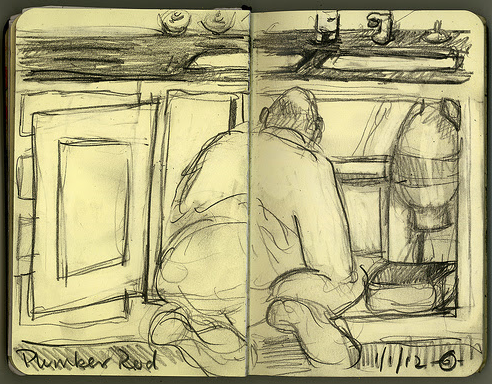
"Plumber" by Marcia Milner-Brage

“Plumber” by Marcia Milner-Brage

I’ve never owned a house so I’m not much of a repairman. I don’t come with tools or know-how. So, when the bathroom sink plumbing failed yesterday, I was contemplative, which is to say, not much use. I watched Kerri roll up her sleeves and get to work. She crawled under the sink, swore like a sailor, and pulled apart the offending pipes. I ran to fetch tools, paper towels, buckets, and anything else that she needed. I became the plumbing equivalent of a sous-chef.

All the little rubber rings (a technical term, I’m sure) in the pipe joints failed. I like to think that after many years of fine service they simply decided to retire and since they started their careers together they retired together. It was a group retirement without prior notice.

Since we’d entirely deconstructed the fittings, we decided to replace everything so we went to the hardware store, stood in an aisle and consulted with a man who knew less about plumbing than I did. Kerri rolled up her sleeves, swore like a sailor (the unhelpful man fled), and she began pulling parts off the rack until she’d discovered what she needed for reconstruction.

Like true plumbers we had coffee and delayed the inevitable descent beneath the sink. After a healthy interval, since all the heavy lifting and brainwork was already done, I did the deed. Following the example modeled for me, I rolled up my sleeves, swore like a sailor (though my repertoire of words was less imaginative than Kerri’s), and crawled under the sink. Like a control tower helping a passenger land the plane after the pilot passes out, Kerri talked me through the assembly. I was triumphant when the pipes did what pipes are supposed to do, when no water dribbled to the bathroom floor, when the sink was once again open for business.

In my work and my life I rarely experience a sense of real completion. It’s the reason I like to do dishes: there’s a clear beginning, middle, and end. Right now I’m trying to find ways of getting my book into the world and I’ve run through what I know to do. I’ve exhausted my first level of ideas. I realized that the challenge is a lot like plumbing. At the beginning, contemplation is not very useful. Asking the question, “How will I do it?” is necessary but needs to come somewhere in the middle of the process. And, “how” is never a definitive answer, it is a good guess at a next step. “How” never reveals itself until after the job is done.

I work with lots of people and the number one block to meaningful action is the question, “How?” Yesterday in the role of plumber’s apprentice, I learned what I teach: the answer to “how” is this: pull things apart, put your hands in the muck, swear like a sailor, see what’s there, ask for help, know when help is or is not useful, look at the pieces, run and get buckets because there will most likely be a mess. Then, take another step based on what you find.

Go here to get my latest book, The Seer: The Mind of the Entrepreneur, Artist, Visionary, title_pageSeeker, Learner, Leader, Creator…You.

For hard copies, go here.

[Continued from Know Your Net]

In addition to using the phrases “honest moment” and “honest action,” I used the term “honest pursuit” and Skip asked, “Pursuit? Same or different from honest action and honest moment.”

One of my favorite terms from the theatre is “split intention.” It has come in handy most of my life and is useful in all settings from corporate to non-profit to education. Viv gave me the perfect shorthand definition for a split intention. It’s from a Chinese proverb: chase two rabbits and both will get away. Chasing two rabbits splits your focus and confuses your action. For actors, a split intention happens when the actor believes they can determine what they audience will think of their performance. They focus on audience response rather than pursue their intention on the stage. The split focus also splits the audience from entering the story. The actor engages in a power game by trying to please or be seen as…. The performance experience for all concerned becomes a lie rather than an opening to a deeper relationship, a shared moment of truth. The pursuit is a false.

In my past life facilitating change processes in education and organizations, I often used two related phrases that are aspects of a split intention: circumstance driven and intention driven. Organizations spend oodles of time defining their values with the notion that they are driven by a clean set of aligned values. It’s nice on paper but falls apart when the money dries up. Nothing goes out the window faster when the economy tanks than the phrase, “We value our employees.” If you want to know what an organization or nation really values, watch what they do when the cash flow disappears. An honest pursuit doesn’t waver when the circumstance changes. This is one reason why I love artists and the artistry in myself: we do the work whether there is money or not. The artistry trumps the circumstance. The imperative runs deep.

Entrepreneurs and artists are a similar breed of cat. Both are marginally feral. They desire artistic/creative freedom. They want their ideas to be manifest in the world and desire to prosper from their efforts. They want to create their own constraints. Usually (but not always), entrepreneurs are trying to fill a need. They are in a service profession (whether they recognize it our not). They have fun creating cool things that make life easier for the user. Entrepreneurs split themselves when they succumb to the illusion that an investor controls their destiny. They split themselves when they give away their intention for investor dollars. They essentially become circumstance driven and, like the actor attempting to be liked by the audience, their pursuit becomes false. They give away the essential for the immediate.

The split becomes visible in their pitches. Are they pursuing the creation of their idea or hunting for dollars? This distinction is a swords edge but the difference is dramatic. After all, a pitch is made to investors. However, in the first case, the pursuit is intention driven and the second case it is circumstance driven. How much of the idea/dream will be sacrificed for the funding? It takes dollars to make an entrepreneur’s idea manifest. It also takes boundaries. Actors succeed when their pursuit is in service to the play and not themselves. Entrepreneurs succeed when their pursuit is in service to their users and not to their funders.

[to be continued]

For a humorous look at the wonderful world of innovation and new ventures, check out my new comic strip Fl!p and the gang at Fl!p Comics.

Dream And Follow

869. Join me in inspiring truly powerful people. Each day I will add a new thought, story or idea to support your quest and mine.

Patti used to say that she refused to make business cards because a business card was a commitment. Say it and you will have to walk it. I’ve learned in the past several months that entrepreneurs resist talking to potential customers for fear of learning that their idea – their dream – may not have merit. Today Sean said it best: people are afraid of failing at their dream so they find a thousand reasons not to pursue it.

Dreams can be deferred but they will not be denied. A dream rejected becomes a knot in the belly. A dream ignored becomes low-grade anxiety, heart palpitation, road rage, a good reason to drink too much, an investment in notions like perfection or not-good-enough, a deathbed regret. Ignore a dream and it will twist and block all flow.

“What if…?” is a powerful question when in reference to the future. It is a call to action, a fount of possibility, an imagination tickler. “What if…? is equally powerful question when in reference to the past. No action is possible. It is an imagination tormentor. it is an abdication of responsibility to your self.

It is an old adage: the only certain road to failure is to not try. Failure is an abstraction. It is a construct that exists only as a story in your mind. It is an investment in what other people might think. Hint: other people have their own dreams and usually if they are negative about your dream it is because they are ignoring theirs; they need allies in their impotence.

As Tom used to say, “A painter paints.” A Painter does not succeed or fail. A painter paints and becomes a better painter. Failure is not an option when you are following your dream. Success is not an option when you are following your dream. Dreams do not dally with failure or success. Dreams call. All that is required is to follow, to grow, to learn, to live. To love.

Look For The Crossroads

855. Join me in inspiring truly powerful people. Each day I will add a new thought, story or idea to support your quest and mine.

I’m having an ongoing email conversation with Rafael. We are discussing educational change but more specifically asking how to change a culture of exclusion. I won’t go on a rant so let it suffice to say that the idea that we have equal access is just that: a nice idea but is nowhere apparent in the national fabric or the lived narrative of our nation. Our tax codes are created to keep the poorest poor and the wealthiest wealthy. Revolutionizing education is to revolutionize the economy and that is why it has become such a wicked problem. The forces in play do not favor the many. The voices in power represent the few.

I’ve spent a great deal of my life pushing against the public school system. And despite my capacity to fling around phrases like, “You can’t solve a problem at the level of the problem,” I’m only now seeing beyond the level of the problem. Inequity is institutionalized and deeply embedded in the national narrative so it is a fool’s errand to push on the institutions. As Buckminster Fuller advises, move toward what you want to create. This requires a new narrative. It requires to look at something other than what currently exists.

We go where we look. Where are we looking? We can hit division every time if we insist on seeing division. What’s good for business is not always what’s good for community and I often think that business wins the contest every time because we have a fleeting sense of community. We define our national health by the stock exchange. We are up or we are down. When I listen to the news or read the papers I am filled with the narrative of division. It is Us and Them on every page. This is not a new narrative. It is as old as our nation. Life, Liberty, and The Pursuit of Happiness refers to land ownership and at the time those words were penned those privileges were extended to a few white males with resources and no others. A system does what a system was designed to do.

A new narrative would be one of unity. A new narrative is one of inclusion. A new narrative would consider the health of the system – in fact it would demand a healthy system and that is impossible to realize if any segment of the system is impoverished. A healthy plant cannot grow in exhausted soil. This is not an abstraction. Grow a garden in polluted soil and tell me what you discover.

It feels as if we are standing at the crossroads of “Every man for himself,” and “I am my brother’s keeper.” Both of these phrases are philosophies of an economy. The great thing about a crossroads is that the roads cross. They come together and are neither this nor that. They are a meeting ground and places of commerce accessible to all. Meeting grounds are also the place where new narratives are created. They are places of possibility. We know that our political climate is averse to seeing crossroads. We do not have to go where they are looking. We are capable of telling a different story if we are courageous enough to look where the roads cross and decide to stand in the place of an economy that includes instead of an economy that excludes.

Bring It

768. Join me in inspiring truly powerful people. Each day I will add a new thought, story or idea to support your quest and mine.

This afternoon I taught a Business of Theatre class at Cornish College for the Arts. The students were seniors in the final weeks of their degree programs. Their assignment was to make project pitches as if we, the class, were granters or investors. My job was to support them to get better at doing project pitches. Through the several pitches, two themes emerged that became the focus of our conversation.

The first theme: rather than pitch their ideas as great, almost all the students justified or somehow diminished their idea. They defended it prior to an attack.They were unconsciously seeking reinforcement or approval of their idea. Or, to be clear, they sought approval as if I was the keeper of worth for their idea. Had I said, “What a stupid idea,” they might have agreed with me. The need for my approval trumped their personal point of view. My approval was more important than their idea.

Theme number two is related to theme number one: they entered the relationship assuming that the granter (me) had all of the power. As pitch makers they cast themselves in an unbalanced, powerless position. They came as supplicants. They assumed that the grant maker held the golden key to open the door to their project/dream. In this play (a pitch is a play) they cast themselves as impotent.

Both themes were unconscious. Both were based on assumptions of lack.

Every artist, if they are to thrive, must reorient at some point in the arc of their career. They must leave behind orientating according to what they might get from the world and reorient according to what they bring to the world.

Grant makers, foundations, investors and auditors have no power over an artist – unless, of course, the artist is oriented in the relationship according to what they might get from the relationship. At best, a granter can support a route. They might open a pathway to fulfilling an idea. There are hundreds of routes. There is one dreamer. The responsibility for manifesting the dream is the dreamers not the granters.

No one need apologize for his or her dream. No one need justify why it is important. It is a dream. It is an idea. It is a desire. No one else need approve; the approval belongs to the dreamer.

The students and I discussed the power of bringing the dream to the world. We played with the perspective shift that happens when artists own the responsibility for their dreams and refuse to define their role as impotent. Bring the dream. Stop seeking your worth in the responses of others. Bring it. The granter will fund it or not and that should have no impact on whether the dream is pursued or not. Bring your best game. Bring it everyday. If you have a dream, create it. There are many routes. Explore them all and in each case pitch your best game.

Choose Your Experience

767. Join me in inspiring truly powerful people. Each day I will add a new thought, story or idea to support your quest and mine.

It’s after 7:00pm and I just realized that it was Sunday. One of the privileges of wandering is that days of the week blend and become one. There are relatively few patterns so markers like workday and non-workday do not exist. This has been somewhat true most of my life. The line between work and play is indistinct. My play and my work have mostly been the same thing.

This afternoon Skip and I did a test run of experiences for our new start-up business. The audience is entrepreneurs. Some members of our team are young entrepreneurs so we gathered and talked through the content with them and then threw them into some experiences. Having been a data-basher most of my life it’s an interesting flip to do things to gather data and adjust my work based on audience responses. I learned a lot today!

What came clear to me was something that I’ve known for a while but did not fully grasp the magnitude until today. Human beings come into the world oriented to the unknown and strive to pretend that we are oriented to the known. We make meaning of chaos. And, what is chaos really? It’s a made up concept. It means, “I don’t know!” It has no use outside of the human need to make story and project order onto the world. It’s like the word, “wild.” Wild is only useful when there is an expectation of tame. Chaos is only meaningful relative to an expectation of order. Both are categories. One is generally comfortable because it provides the illusion of control and the other is uncomfortable because the illusion is of no control. Tame and wild follow the same general principle. I was in the Northridge earthquake in Los Angeles and as the earth threw my house off of it’s foundation and hurtled me through the air, I learned that control was not mine to assign. I learned that wild is tame and tame is wild and chaos drives order and order collapses into chaos. It’s a dance.

It’s not the nouns that matter. It’s the verbs. It is the movement. Nothing is static. Nothing is fixed. The answers are not important. The questions matter, it is the conversation and the relationship that hold the real stuff of life. Questions and relationships are fluid. They move. Orient to the unknown and you orient to the questions. The questions will open you to discovery. Orient to the known and you orient to the answers. The answers will close you to rules and righteousness. This would seem obvious but it is not. The most potent revelation of all: how you orient is a choice. Choose to open or choose to close. Orient to the unknown or orient to the known. Orient to the infinite game or to the finite. Choose your experience.

Change Your Song

675. Join me in inspiring truly powerful people. Each day I will add a new thought, story or idea to support your quest and mine.

It is funny to me the confluence of thought-rivers meeting in my life. For instance, Lexi recently introduced me to the Pete The Cat series of children’s books. When Pete’s white shoes turn red from treading in strawberries, is Pete upset? Goodness, no! He simply changes his happy song from “I love my white shoes” to “I love my red shoes.” A very complex thought delivered through a children’s book simplicity; motivational speakers the world over try to convey the same message with startlingly less finesse.

Just as Pete The Cat flowed into my day, Skip and I are in the midst of collaborating on a series of support mechanisms for entrepreneurs. For me, the heart of the series lives in my passion wheelhouse: change your story, change your world. This thought is a simplicity that gets lost in the adult world’s need for complexity. More than once in my consulting life I’ve heard, “But it can’t be that simple!” Translation: that is something I can do so I can either embrace it or insist that it is not possible. Often in the world of adults, complexity is equated with value. If it is simple, it is suspect (note: this is why our education and health care systems are in advanced states of collapse). Our attachment to complexity is often protection against owning our responsibility for change we know is necessary.

And, because Pete The Cat met Skip in the playing fields of my mind, my work with Skip is now finding children’s book simplicity. I heard the adult in me (admittedly a very small, some would say, stunted part of me) just exclaim, “It can’t be that simple!” The voice of Pete The Cat followed immediately saying, “Oh, but it is. It is so simple. Change your song, celebrate your world!”

Click, Click, Click

667. Join me in inspiring truly powerful people. Each day I will add a new thought, story or idea to support your quest and mine.

SeaTac airport. 5:30 am. I’m sitting in the atrium holding coffee with both hands, staring into the void waiting for consciousness to catch up with my body or at least to know that my heart is beating enough to sustain life. I am not alone in my stupor though my stupor is decidedly less active than the stupor practiced by others. There is a different dull hum of voices in the morning; luggage wheels click over tile at a slightly slower rate, setting a tempo for the morning rush.

There are more business folk than families at this obscene hour. If I were a farmer I’d fly at this time of day and I’d move through the airport as if it were one of my fields. Slow, respectful. Business travelers have forgotten their inner farmer and walk with a deliberate goal in mind: get “there.” Even at this early hour and in their pre-coffee diminished capacity, they move with a studied determination. Click, click, click. No time to waste. A plane to catch. A sale to close. A deal to make. Ten minute rest interval. A trip to the gym. A light meal. Most have heads down and are answering emails as they move with intention to their portal.

Don’t get me wrong. I love business people. I work with business people. They live in a different culture than I do. They play by a different set of rules; they hire me because my rules are different and so I can see what they cannot. For instance, I do not believe that “time is money;” were we living in the industrial age that might still be true but it was an antiquated notion before my parents were born. I’m certain that “relationship is money,” that the path to efficiency is to slow down and not speed up (I can prove it). From my vantage point the prerequisite for success is cooperation, not competition. Cooperation is an infinite game and competition is finite; competition can live within cooperation, but not the other way around. I’ve learned from famous consultants that the only real purpose of a business is to serve a customer – that is cold language until you realize that the verb is “to serve” and “customer” is an antiseptic word for “human being.” Do you want to succeed in business: serve a human being. Serve lots of them. Focus on what you bring to them and not what you can get from them.

As I contemplate another cup of coffee (oh, okay…if I have to…) I want to whisper to the morning sprinters, “Markets are made-up just as are economies; they are constructs and not forces of nature; we make the rules, we thrive or suffer according to the world we make up. Let’s play a different game. Let’s practice health. Slow down. Live today. Take a look around: you are surrounded by those you serve.

Tug On The Idea

631. Join me in inspiring truly powerful people. Each day I will add a new thought, story or idea to support your quest and mine.

Sean drew a picture of a tug-of-war. The rope was taut. He said, “Any good process has two sides pulling on the idea. To stay out of the extremes and off the margins we need the tension from the other team. We need the other side to pull as hard as we do; that’s what makes it all work. That’s what keeps us playing in the center. ” And then he paused and thought about it, adding, “In a way, it’s this kind of tension that makes collaboration happen. Collaboration isn’t about absolute agreement – that’s not generative at all; collaboration is how we do conflict. Collaboration is healthy conflict.”

I laughed at the phrase and I think it is accurate. If we can pull on the idea rope without negating each other, if it’s not personal, then it is healthy. It’s all about focusing on the idea, pulling on the idea instead of diminishing the other; a great collaboration is subject centered, it is about a better idea and that requires some tugging. It is not about being right or winning; it is the game that is essential.

I once took a class from the great Kichom Hyashi. One day he divided the class into two teams from a mock organization: 1) the finance folk and 2) the creative team. He posed a challenge and asked the two teams to try and pull the other side into their point of view. We immediately began diminishing the ideas of the other side. Kichom stopped us. He asked us to begin again only this time he would facilitate our conversation. He did not allow us to diminish or negate the other team. We entered the heat, argued the idea instead of negating the people, and an extraordinary thing happened: the tension mounted until it was palpable, crackling, and then a 3rd channel broke open. A better idea, previously hidden, burst forth. It was not a solution but a better idea, an expanded vision. The tension transformed into excitement. The two teams were now one voice chattering about the possibilities.

Kichom sat back in his chair and smiled, saying, “It’s not a mystery. This is how it is supposed to happen.”