Unbridle Your Enthusiasm

Tripper Dog-Dog-Dog's trophy collection

Tripper Dog-Dog-Dog’s trophy collection

Tripper Dog-Dog-Dog is tough on toys. He does well with hard rubber Kongs and rawhide bones but the stuffed animal variety haven’t got a prayer. We long ago stopped buying them for him. Even as a small puppy he’d make short work of anything that squeaked or resembled a creature. More than once, moments after giving him a new toy, I found him sitting happy and content amidst a nest of fiberfill with the empty body-shaped sack of toy remnant clutched firmly between his paws. Dog-Dog has several admirers who are unaware of his destructive talents and bring him stuffed animals as gifts. Like offerings to a high priests in days of old, Tripper graciously accepts their offer and removes to the backroom for immediate slaughter. For reasons I can’t explain, we keep the heads from his sacrifices. We use the heads as sleeves for our knife set or as wine bottle covers; it’s our own little version of Game of Thrones.

I’m learning much from master Dog-Dog. Lately his lessons are about faith and exuberance for the sheer pleasure of being alive. For Tripper, every doorway is an opportunity for bounding, every fence an opportunity for discovery. Even if he hopped at the fence 30 seconds prior, his return to the same spot is no less enthusiastic. He does not assume that he knows what he will find there, in fact, he assumes that the world is new no matter which way he looks. He does not blunt himself with notions of knowing like we bipeds. He is a four-legged master of beginner’s mind. If he had an inner monologue I’m certain it would be, “Oh my god, oh my god, oh my god,…”

During our late night pre-bed visits to the backyard, Dog-Dog routinely stops and stands very still (unusual behavior for an Australian Shepherd), and for several moments he listens. He feels the breezes. He smells the air. He checks in with me to make sure that I am standing firmly rooted in the present moment. When he is certain that I am present with him in his quiet enthusiasm for life, that I have given up all of my stories and distractions from the day, that I, like him, am breathing in the miracle of existence, revels for a moment longer and then lets me know that I am ready for sleeping. He turns and prances toward the house, satisfied with my progress and exhausted by the sheer wonder of it all.

Go here to get my latest book, The Seer: The Mind of the Entrepreneur, Artist, Visionary, title_pageSeeker, Learner, Leader, Creator…You.

Or, go to Amazon for hard copies and Kindle.

Walk As One

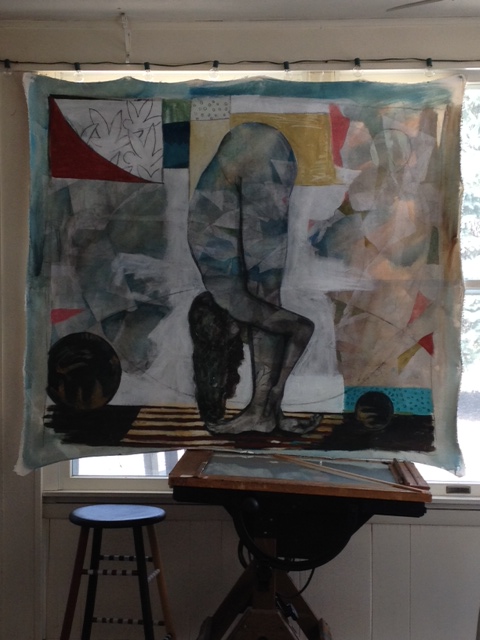
From my archives. I call this painting, "Alki."

From my archives. I call this painting, “Alki.”

Alan and I talked today. We are planning our upcoming Summit in Holland in June. Our conversations are always as wide-ranging as they are deep dives into sense making and soul. There seems to be no horizon that we won’t step towards, no secret passage that we won’t explore. This has been true since the moment we met. We’ve always been verdant collaborators. We joked that someday clients will hire us just to listen to how our minds spark each other. And, given our conversation today, we’d be worth every penny. We are both in the business of facilitating perceptual shifts and transformation so we do it for each other. Our planning sessions are a festival of insight upon insight, shift within shift. Together, we are innovation squared.

Recently, I shared a short TED talk by neurologist V.S. Ramachandran about mirror neurons and how deeply and concretely we are connected despite our belief/experience that we are separate. It came up again for me because during our call Alan and I discussed the waves of far-reaching impact that any simple action or word generates. Paul Barnes used to say to young actors, “Never underestimate the power you have to influence another person’s life.” Most of us are unaware of the impact that we have on lives that we never directly touch. For instance, I have had great teachers in my life and I carry their work forward in every word I write and every group I facilitate. My teachers will never know the many lives they touched and continue to touch. And, neither will I. And, neither will you. The best we can do is know that our actions matter, our thoughts matter, our intentions matter. We are more powerful than we understand.

No one lives in a vacuum. No one creates without influences. No one has a purely original thought. In fact, if you grasp what V.S. Ramachandran is addressing, no one thinks or feels independently of others. We are not as isolated or as separate as we believe ourselves to be. We have to work at separation. We are, each of us, continually co-creating (to use Alan’s term) our world in every moment of every day. What might you see if you stopped and pondered the implications of co-creation, if you took a moment and considered that you are not merely a bobber in an ocean but, in fact, are the ocean? How might you read the news of the day or address your dreams if you understood that you were a participant, a dynamic part, a burning point for the ancestors, a sender of ripples through space and time, and not simply walking this path all alone?

Go here to get my latest book, The Seer: The Mind of the Entrepreneur, Artist, Visionary, title_pageSeeker, Learner, Leader, Creator…You.

Or, go here for a hard copy.

Intend And Forget

I have many titles for this painting and have used it a few times for posts. It is ultimately about intention and inner guidance.

I have many titles for this painting and have used it more than a few times for posts. It popped up for me again today. It is ultimately about intention and inner guidance.

I just finished writing this post and realized that, in many ways, this is the continuation of yesterday’s thought: clear the mental static and the channel to full expression opens. So, here is part two of my meditation on inner static:

John and I were having a conversation about the passage of time. He told me that he’d recently found some old lists that he’d written of life goals and intentions. The interesting thing about discovering the lists was 1) that he’d forgotten writing them and, 2) that he’d achieved most of what he’d written. He said, “The form of what I created was different than what I’d originally imagined but I was surprised to see that I’d actually created what I intended.” It was as if he had to write the intention in order to activate it. Forgetting the intention was necessary to give it space to manifest and grow. Write and forget.

When I was first training as an actor, late in every rehearsal process, my teachers consistently advised that we let go of everything we’d rehearsed and just show up. “You’ve done your work,” they’d say. “Now, let it go and trust.” Many years later when I was directing plays and teaching actors I gave the same advice. “Let go and trust. You’ve done your work. All that remains is to be present.” From the teacher/director seat, the moment of letting go is palpable; you can literally see and feel the phase in the process when an actor needs to let go of their work to come alive. They need to get out of their own way. They need to get out of their head and give all of their focus to the relationships on the stage. The work moves from the head to the body. It is this last step that transforms their study to a living pursuit. Forgetting the work creates spaciousness and allows the art to happen. Art is always about relationship and great art happens when the relationship is clear and expansive enough for all comers.

One of the most profound lessons I gained from my time in Bali concerned this dynamic connection between setting an intention and letting it go. While I was on the island my internal monologue disappeared; one day I realized that I was completely quiet. Thought was a choice and not a plague or chattering background noise. Silence was simple when no story was necessary, when no interpretation was needed. In the middle of that silence I could set an intention (“This is what I want to do/find today”) and then forget it. Before the day was over I would have found what I intended. The steps came to me; I did not have to seek the steps. Sometimes the intention was simple and sometimes seemed complex but that didn’t matter. If I clearly stated what I wanted and returned to silence the necessary coincidence always found me. I felt as if I could see the pieces on the game board moving on my behalf. There was no internal noise to compromise my intention so there was no external discord confusing my choices. I was conscious of my connection.

Alan calls this co-creating. Work with the energy and cease trying to force things to happen. John told me of his lists and I wondered how many people have had the same experience. We make lists, we try to make the list happen, life gets in the way and we forget. And, in the moment of forgetting, we relax our grip on how we think things need to happen. We forget the form and inadvertently open to possibility. In the forgetting we create the steps necessary for fulfillment: spaciousness, trust, and quiet participation.

Go here to get my latest book, The Seer: The Mind of the Entrepreneur, Artist, Visionary, title_pageSeeker, Learner, Leader, Creator…You.

Go here for hard copies.

Clear The Static

'John's Secret' by David Robinson

‘John’s Secret’ by David Robinson. I’ve used this image before but this painting came to mind while writing so I’m using it again.

So many of my conversations with the stained glass window have to do with returns. For instance, the first conversation was about the return to silence. Over the year, we’ve had lengthy chats about the return to the sacred, a return to light, gratitude, alignment, unity, presence and love. Today our conversation was about the return to voice.

When people talk about voice they generally associate the verb “to give.” Give voice to your thoughts. Give voice to your ideas. Giving voice implies that you have something inside that is unexpressed. It implies that your inner editor has run amok and has a choke hold on your communication. Release the grip and give rein to your voice.

Free expression is all well and good but giving voice also comes with a caveat. Someone I once knew told a great story of a woman who grew tired of hearing her associates complain about not having a voice. This woman, in a fit of frustration, asked, “If you had a voice, what would you say?” It is a potent caveat: it is not enough to have a voice. In addition to the capacity to give voice you also need something meaningful to say. The 24-hour news cycle is rife with great examples of voice sans content.

My conversation with the window had nothing to do with giving voice to the unexpressed or to the necessity of useful content. The window surprised me. The window reminded me of a favorite quote by Vincent Van Gogh: If you hear a voice within you say, “you cannot paint,” then by all means paint, and that voice will be silenced. Oddly, my discussion with the window about the return to voice had to do more with with silence than with sound. It had to do with the quieting the static. In other words, full expression is available when the inner radio station is properly tuned. Clear the noise and the channel opens. Clear the noise and act: paint the paintings, write the next book, create the Be-A-Ray performances, give life to my play, The Lost Boy. The return to voice is a path that leads through quiet. It is a paradox and to my great delight it is a paradox that loops back to my very first conversation with the window. Silence and voice, voice and silence: they are dynamic and intimately connected.

Go here to get my latest book, The Seer: The Mind of the Entrepreneur, Artist, Visionary, title_pageSeeker, Learner, Leader, Creator…You.

Or, go here for hard copies.


Stand Rooted

I awoke this morning with this phrase hanging in my dream space: you can’t control your circumstance but you have infinite control over who you are within your circumstance. It is a well-worn phrase for me, like an old sweater, relevant to much of the teaching, coaching and facilitation I’ve done. It is useful to remember when the hurricane hits or the job disappears or life seems to be a festival of obstacles. The ability to discern between circumstance and personal center is of great value. It is a skill that lives atop of Maslow’s hierarchy.

A work in progress: K.Dot & D.Dot See An Owl

A work in progress: K.Dot & D.Dot See An Owl

We have these words in our canon of health: centered, grounded, rooted, conscious, present…. They are all terrific metaphors, earthy with eyes wide open. Flip them over and you get a good sense of what happens when you confuse your self with your circumstance: off center, uprooted, ungrounded, unconscious, not here; up in the air with eyes squeezed shut.

There is a Buddhist phrase that I appreciate: joyful participation in the sorrows of the world. It is necessary to know the difference between self and circumstance to really grasp the meaning of this phrase. Life is going to bring you trials, tribulations, and lessons. You can never know what is just around the corner. As Kerri often reminds me, it is what you don’t know that makes you grow. So, when the storm comes, participate. Stand in it. Love life in all of its forms and textures.

So many times when working with business clients I’ve had to say, “Don’t eliminate the wolf from your story.” In the story of Little Red Riding Hood, the wolf moves the story forward. In fact, without the wolf, there is no story. In business as in life we attempt to protect ourselves from the wolf. We resist the very thing that can bring growth and renewal. Circumstance is often the wolf. The storm comes. The relationship suffocates. The wolf always creates movement where the energy is stuck. It is uncomfortable. It hurts. It is scary. Yes. So, participate. Engage. Be-with-it. Within the circumstance, within the storm, learn to stand rooted, centered: earthy with eyes wide open.

The circumstance will pass and you will remain. You will know more. You will have grown. This simple understanding, that you are separate from your circumstance, allows for the joyful part of participation. Joy lives at the choice point. The world is and always will have plenty of sorrows to help you grow. Things happen. The question is, “How do you choose to participate?”

Go here to get my latest book, The Seer: The Mind of the Entrepreneur, Artist, Visionary, title_pageSeeker, Learner, Leader, Creator…You.

Or, go here for hard copies.


Speak Out Of Turn

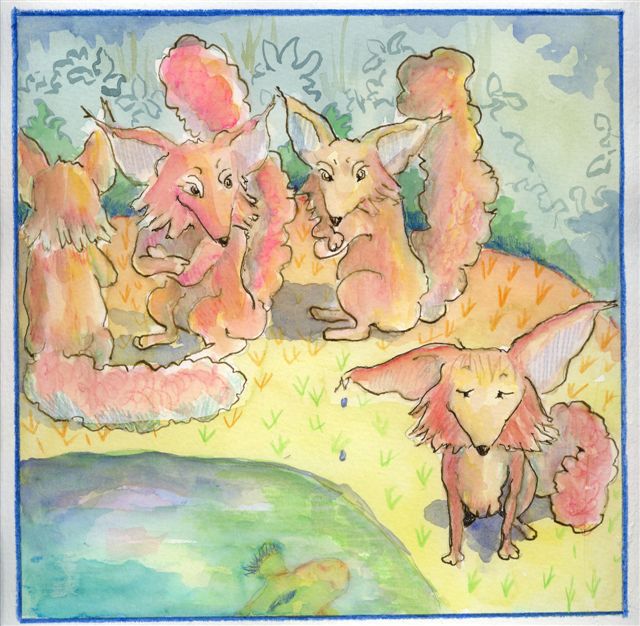
From my book, Lucy & The Waterfox. The waterfox is shunned for deviating from the norm.

From my book, Lucy & The Waterfox. The waterfox is shunned for deviating from the norm.

I’m not supposed to be writing about the system of education in America. It is a topic that I made off limits for myself because I was ranting too much. I finally allowed myself to admit what I’ve known for years but refused to accept. Our system of education is not broken and never has been; it was designed to create maximum docility and is succeeding magnificently. I decided to open the off-limits file because I just posted a question concerning education inspired by my friend and retired superintendent, Arnie Glassberg, and then this morning the same news story featuring the resignation letter of a teacher came across my screen three times. It is tragic to read and resonated with me: after a career playing in the fields of innovation and change in education, I now have a hard time driving by a public school without shuddering.

For grins I googled “origins of education in America (it was the subject of Arnie’s comment to me),” and came up with more than a few options but was struck by how many of the links topping the list concerned the reprehensible origins and intentions behind this thing we continue to call school. Several were articles, speeches, and youtube clips of John Taylor Gatto, a former New York state Teacher of the Year and most well known for his book, Dumbing Us Down. Here’s a bit from a speech he gave several years ago to a home schooling conference in Vermont:

The secret of American schooling is that it doesn’t teach the way children learn — nor is it supposed to. Schools were conceived to serve the economy and the social order rather than kids and families — that is why it is compulsory. As a consequence, the school cannot help anybody grow up, because its prime directive is to retard maturity. It does that by teaching that everything is difficult, that other people run our lives, that our neighbors are untrustworthy even dangerous. School is the first impression children get of society. Because first impressions are often the decisive ones, school imprints kids with fear, suspicion of one another, and certain addictions for life. It ambushes natural intuition, faith, and love of adventure, wiping these out in favor of a gospel of rational procedure and rational management.

Compare this quote (or read the text of his speech) with the teacher’s resignation letter making the news today. I’ve read a similar letter each spring for the past several years; a teacher – probably a great teacher – can no longer participate in the creation of docility in children and in themselves. They admit what they’ve known for years: the intention of they system they serve is the opposite of what it purports: they can no longer wipe out their natural intuition with the gospel of rational procedure (standardized tests).

John Taylor Gatto’s quote reminded me of the first few pages of one of my favorite books, Teaching As A Subversive Activity, by Neil Postman. It was published in 1969. Here’s a snippet from page 2:

In our society, as in others, we find that there are influential men at the head of important institutions who cannot afford to be found wrong, who find change inconvenient, perhaps intolerable, and who have financial or political interests they must conserve at any cost. Such men are, therefore, threatened in many respects by the theory of the democratic process and the concept of an ever-renewing society…Such men as these would prefer that the schools do little or nothing to encourage youth to question, doubt, or challenge and part of the society in which they live, especially those parts that are most vulnerable.

Retarding maturity has long term consequences: a population that is 1) incapable of the necessary self-awareness that comes with maturity cannot recognize how far it has drifted from it’s center and, 2) even if it did see the tower tipping, it is incapable of meaningful action as the conjoined twins of passivity (born of fear of speaking up) and divisiveness (do you really think the red state/blue state nonsense has no origin or implication?) have been so thoroughly thrummed into the national anthem.

To loop back a few posts to Master Marsh’s quote that keeps on giving: I’ve come to believe this is less about can and can’t than about the challenge of doing. And not doing is always easier.

Complaining is no substitute for doing. Neither is ranting, which is why education is off limits for me. I do not know what to do and have no belief that a butterfly will come from a system directed by a few small minds so hell-bent on remaining a caterpillar.

The only thing I can think to do is echo a sentiment offered by John Taylor Gatto in this short clip: the system is great at hammering the individual deviant but is incapable of handling a mass of deviants. To the teacher who resigned in frustration and all those who have, will, want to, or do not yet know they can, join hands. Become a mass and deviate. Do the thing that you’ve been so trained not to do: speak out of turn. Stop raising your hand and join hands. The kids can’t resign and they need you to, as Neil Postman writes, become a “shockproof crap detector.”

Go here to get my latest book, The Seer: The Mind of the Entrepreneur, Artist, Visionary, title_pageSeeker, Learner, Leader, Creator…You.

Go here for hard copies.

Give Yourself Some Advice (2)

Finishing a painting is really about having a conversation with yourself. This one is talking!

Finishing a painting is really about having a conversation with yourself. This one is talking!

[continued from Give Yourself Some Advice]

Here’s the next bit of an email Horatio sent to me with his Advice To Myself. He wrote it following a question from a reporter about advice he’d give to emerging filmmakers. I am particularly fond of this section as many of my teachers, mentors, and guides are now passing away and I am revisiting what is mine to add to this “ancient conversation.” Here is the next section of Horatio’s advice to himself (for the full text, visit his blog at www.fidalgofilms.com):

Respect the boundaries of others; do not seek to control anyone else. You can only control your own choices.

Learn and honor with absolute integrity your own boundaries so that others may not try to control you or your work. Unfortunately, this is usually only learned through a certain amount of trial and error. 

Learning to trust is an art, and absolutely necessary. Learn to trust yourself first. Learn to trust others.

Always respect the tradition of your work, its ancient human conversation.

Connect to tradition, to all your teachers and your teachers’ teachers. Give yourself to it so that it can give to you and to your work. Honor it with rigor and doubt, with hours and hours of study and practice.

Then let your teachers go, follow the path that you understand as truth. You will know it when you see it. It will be your part of the ancient conversation. Likely, you will find that parts of one or two of your teachers have become part of you.

If you do not let your teachers go, your part of the ancient conversation will not be yours, but rather what you think other people want you to add to the conversation. That is not from you and only clogs up the conversation.

[to be continued]

Horatio asks great questions: What is the tradition that you carry forward? I follow the line of Tom and Marcia McKenzie, who learned from DeMarcus Brown, who learned from Eva Le Gallienne, who learned from…. What teachers/teaching do you need to let go?

Go here to get my latest book, The Seer: The Mind of the Entrepreneur, Artist, Visionary, title_pageSeeker, Learner, Leader, Creator…You.

Or, go here for hard copies (Amazon)


Let Owl Guide You

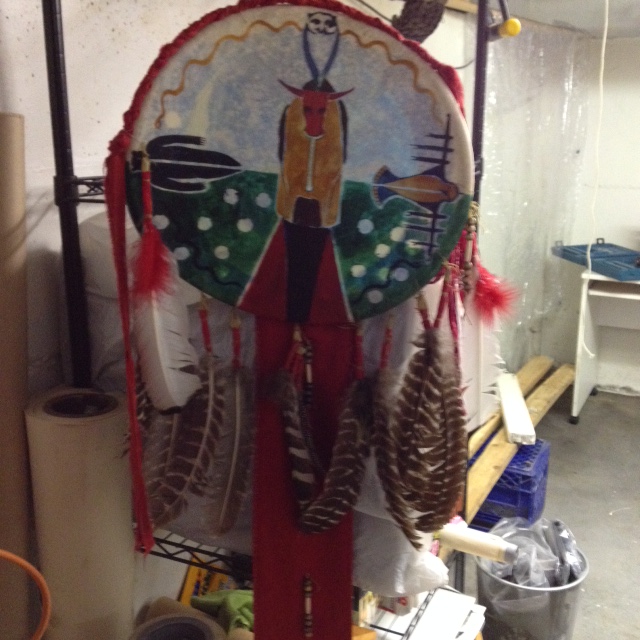
With the guidance of an elder, I made this medicine shield years ago.

With the guidance of an elder, I made this medicine shield years ago.

“Your vision will become clear only when you can look into your own heart. . . . Who looks outside, dreams; who looks inside, awakes.” Carl Jung

For a few disconcerting moments, I thought the crows had followed me across the country. You will remember that while living in Seattle, I was plagued by crows. They swooped me on a daily basis, picking me out of crowds for a sneak attack. I came to the conclusion that they were trying to wake me up. According to Crow Medicine, crows are an omen of change. When crows are around, something special is about to happen, consciousness is about to change and dis-ease will be dispelled. Since we can only connect the dots backward I can now say with great confidence that I took the medicine and it worked. They hammered me on the head for months before I stepped into the void and allowed new forms to emerge. Needless to say, I have a love-hate relationship with crows.

Yesterday afternoon our backyard was a festival of crows frantically barking. It brought back visceral memories and I went on high alert. As it turns out, the crows were focused on our owl and not me. I haven’t heard the owl since autumn and had forgotten that we have an owl in the backyard. I was happy that the owl was back. The crows were not happy as owls are great nest robbers and also, if hassled excessively, will make a dinner of an adult crow.

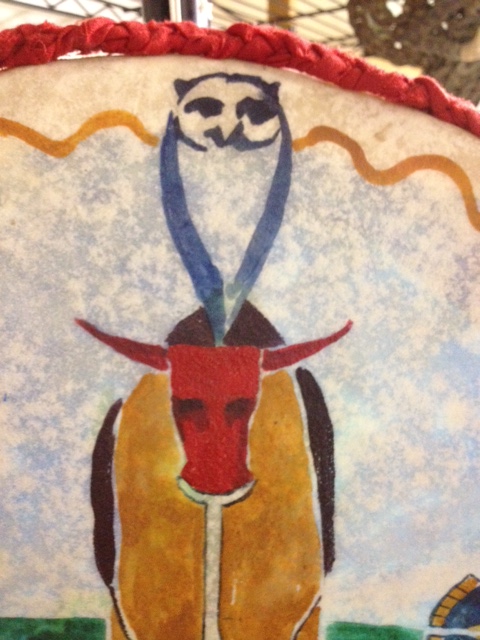
A detail from my shield. Owls have been with me for a long time. The owl is the top symbol.

A detail from my shield. Owls have been with me for a long time. The owl is the top symbol.

Last fall I googled Owl Medicine when the owl hooted above my head almost every night. I learned that, as a totem, Owls have great intuition. They follow their instincts. They see clearly (meaning they cannot be deceived). Owls see what others cannot. For instance, Owls see into the inner life of others; generally, they know more about a person’s inner life than that person knows about him or her self. This is why people do not sit next to me at parties! Also, owls are fierce warriors if something dear to it is threatened.

What a fantastic collision of bird archetypes for the crows and the owl to return to my world at the same moment. The owl was mostly indifferent to the incessant crow barking and attacks. There was no contest. In the evening the owl flew away to hunt and I wondered if there might be one less crow barking in the morning.

Both owl and crow are harbingers of change. They both speak to a comfortable relationship with the unknown and an attraction to the mysteries of life. I laughed when I re-read the symbols as I’ve lately been preaching through my book, The Seer (owls and crows are both seers) to cultivate “not knowing” as a necessary step on the path to health and creative vibrancy. In the practice of “not knowing,” one learns to see.

Later in the night, while driving back from Chicago, Kerri and I were talking about the extraordinary and meteoric changes in our lives this past year. She encapsulated my crow and owl commentary when she said, “We make plans according to what we know. It’s what we don’t know that changes us.” Her thought reminded me of another Carl Jung quote. He famously wrote that, “Religion is a defense against a religious experience.” Just so, a life plan is often a defense against a vital life. Adventure and discovery are never in the direction of the known. When you pay attention to the symbolic crow hitting you on the head you can also rest assured that when you step into the void there will always be an owl waiting to guide you.

title_pageGo here to get my latest book, The Seer: The Mind of the Entrepreneur, Artist, Visionary, Seeker, Learner, Leader, Creator…You.

Or, go here for hard copies (Amazon…Kindle version available here, too)


Return To Life

Tripper-dog-dog-dog listens to birds

Tripper-dog-dog-dog listens to birds

I’m writing this from the choir loft. It’s gorgeous outside and I wonder what I’m doing inside on such a beautiful morning. Kerri is playing the organ for an early morning service. I’ve decided – just this moment – that the organ is an instrument for the dark days of winter. It is heavy and fills your belly like good hearty stew. Birdsong is the music of spring.

Before coming here this morning I was hanging out in the back yard with Tripper-dog-dog-dog. We were watching birds. We were listening to their worship service. He is mystified by them. They are a relatively recent discovery for him. He cocks his head sideways as he stares at them as if to say, “What the heck!” Then he looks to me to see if I’m having the same revelation. I say, “Pretty incredible, huh!” He nods in agreement (no exaggeration. really. no really).

My conversation with the stained glass window continues. The three panels of the window are, of course, the nativity on the left, the crucifixion on the right, and the resurrection in the center panel. It is the largest image. The focal point. The return to life is the center and perhaps this is the meta-point of my window conversation. Many years ago in a class on ritual and life cycles, the instructor said that each one of us would die and be reborn 12 times in the course of our lives. These mini deaths and rebirths were preparation for the main event. Energy does not die, it changes form.

The window is a perfect cycle of the seasons. Throughout the winter the window and I have been talking about the return to life. We’ve talked about birth and rebirth. We’ve talked about pilgrimages. Every life is a pilgrimage. There are long stretches of walking, rich with discovery, sometimes with achy legs and exhaustion. There are days of rest. There are arrivals and departures. Sometimes the weather is fair and sometimes not. The bad weather days make better stories; protagonists need obstacles to move things forward. Flow rarely requires lengthy recounting. Sunrise and sunset are, of course, our daily birth and death cycle, a solar pilgrimage!

Birth and rebirth is the mirror image of death and resurrection and, of course, this is the season of things coming back to life. Both are progressions, movement through the cycle of life. This cycle, punctuated by my first Wisconsin winter, is especially pronounced for me. Three weeks ago we were knee deep in snow. I can see and feel the return of life, the warmth of the sun’s return.

One year ago I was wandering, in the exhaustion phase of my pilgrimage, dropping the old knapsack; it was too heavy to carry any longer. I enacted and presided over one of my mini deaths. This morning I breathed in the cool air and watched the worship of birds. Nests are being built and I am enjoying the sweetness of life’s return.

Go here to get my latest book, The Seer: The Mind of the Entrepreneur, Artist, Visionary, title_pageSeeker, Learner, Leader, Creator…You.

Or, go here for hard copies.

Hold A Vigil For Kermit

My studio moves into the light.

My studio moves into the light.

Life returns slowly. It is the time of year that the goddess Demeter ceases grieving because her daughter, Persephone, is allowed to return from the underworld. Demeter’s joy ignites earth’s renewal.

This morning we sat outside on the back porch, wrapped in a blanket, our chairs facing the sun, our backs to the wall so we could feel the radiant heat. We drank coffee, soaked up the sun and talked about everything and nothing at all.

We are feeling the stirring. We moved the studio from the basement into the light. A stalled project now has life and is arcing toward production. Inspiration and enthusiasm are playing chase through our creative sessions. A few days ago I found my sketchbook and spend time each day filling its pages. There are new canvases sitting on my easel.

It is the season of resurrection. We are holding vigil for our pond frog, Kermit. Although his name is common his story is extraordinary. Last summer, after we dug the pond in the backyard, Kermit suddenly appeared. All through the fall we checked on him. He looked out at us from his hiding place in the rocks or if caught him by surprise, he’d dart to the opposite side of the pond. This winter was harsh and the pond froze solid. We worried about his fate. When the pond melted, we found a seemingly lifeless Kermit on the bottom with the leaves.

Many species of frogs hibernate. In fact, we learned that certain wood frogs freeze solid to the core. When winter comes their bodies replace the water in their vital organs with a protective “anti-freeze.” All signs of life cease. The heart stops (it is frozen). All measurable electric impulses close down. When the weather warms, their core thaws, and they quite literally come back to life. If you’ve ever doubted the magic and mystery of this life, spend some time watching frogs.

We don’t know yet if Kermit is hibernating or not so we watch. A layer of ice returns to the pond each night. The temperatures are bobbing just above and way below freezing, so we wait, drink in the sun and good coffee. We watch Tripper-dog-dog-dog discover birds and bark at raindrops on the pond; this is his first-ever spring. We fill with hope and ourselves slowly revive from a long winter of hunkering down. We stretch our limbs, we thaw, we breathe.

Go here to get my latest book, The Seer: The Mind of the Entrepreneur, Artist, Visionary, title_pageSeeker, Learner, Leader, Creator…You.

Or, go here for hard copies.