Get Out Of Your Head

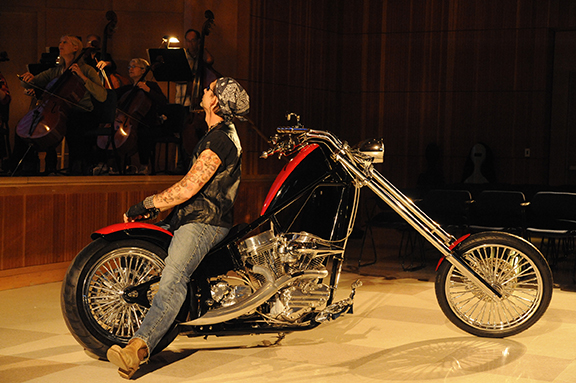
from my comic, FLUB. Don't ask why I think it belongs with this post...

from my comic, FLUB. Don’t ask why I think it belongs with this post…

When I was in school I was constantly amused and disconcerted by the disjoint between the arts and the academic interpretation of the arts. For instance, pick up any literary critique on the play HAMLET and you will read a lot of well-meaning but clueless intellectualizing on the inaction of the character Hamlet. And then, go to a rehearsal. Plays are about action. Hamlet is one of the most active characters in the canon. The play is essentially a detective story with the main character, Hamlet, trying to determine whether the ghost of his father is from heaven or from hell. He needs proof. Every action that he takes is to uncover the truth of his father’s death.

Yesterday I was witness to the arts/academic disjoint in person. A fantastic Christopher Wool retrospective is opening at the Chicago Art Institute. Kerri and I took the train in to the city to see the exhibit and attend a lecture by the curator of the exhibit. In a surprise appearance, Christopher Wool, the artist, took the stage with the curator. The curator was unprepared. She didn’t want him to talk. Over and over again she told him what his work was about and then asked him to confirm it. He was gentle with her and kind and contradicted her analysis. Five times she told us that his work was about self-annihilation (he makes gestural lines on canvas and then wipes them off) and he would counter by saying something like, “Well, actually, I didn’t like the line so I wiped the canvas but then I liked what was happening with the wipe so I left it.”[a long silence would follow]

She needed his work to have deeper, darker meaning. He is an artist in a relationship with his material and works intuitively. There was no intellectual meeting ground between her need and his work. Had she asked him about the greater meaning of his paintings (she didn’t) he might have said, “Well, what do you see?” As Joseph Campbell once said, “If an artist doesn’t like you, he’ll tell you what his work means. If he likes you, he’ll let you have your own experience.”

The curator needed the body of work to be sourced in the artists suffering. The artist did not suffer and, in fact, told us that his art was a form of play. In play, we assemble meaning (and the curator missed this fine point).

It finally came to this simple statement: Christopher Wool, the artist, stopped the curator in the middle of a lengthy pedagogical rant and said, “All this talk of process and technique! No one needs to know any of it.” He looked at the audience and continued, “I hope that when you see the work, that it engages you. I hope you have a relationship with the work.”

Artists know that the audience recreates the work. A work of art is never complete without the other, the viewer, who is not passive but becomes an artist in the moment of engaging. The viewer recreates the work anew, unique, and special to their eyes.

Go here to get my latest book, The Seer: The Mind of the Entrepreneur, Artist, Visionary, title_pageSeeker, Learner, Leader, Creator…You.

Go here for a hard copy

Take The One Action

a work in progress. I'll call it "Salutation"

a work in progress. I’ll call it “Salutation”

It is true that, at the end of the day, we are our own best obstacle. Nothing is better at blocking meaningful action toward a dream than our personal story of doubt and fear. It comes in many forms, like, “Who am I to think that…,” or “If I only had some time I’d…,” or “If I only knew how to start, I’d….”

Lately, I’m fascinated with a specific form of the best-personal-obstacle canon: why do we take any action EXCEPT the one action that matters. For instance, I hear often statements like this: “I want to be a writer, but….” Anything following the statement of desire is a self-generated obstacle. There’s not enough time. No one will like what I write. Fill in the blank. The single action that matters is to write. Sit down and write. That is how one becomes a writer. And, if the writing happens everyday, one will become a better and better writer. Anything else is a well-placed, self-generated obstacle.

The question is, “Why do we need our obstacles?” What does placing a boulder in the road do for us? There is an obvious answer: it keeps us from the scary prospect of fulfilling our dreams. Fulfilling a dream requires showing up and expressing a personal truth. Personal truth is, well, personal, and will always meet resistance because there are billions of personal truths walking around out there.

The refusal to take the single-action-that-matters applies to the everyday. How many times have you swam in a pool of overwhelm rather than pick up the phone and make the call that you know you need to make? Once, when I ran a theatre company, I knew I needed to fire an employee but I didn’t want to do it. She was a nice person. She wasn’t doing her job. We had countless meetings discussing why she wasn’t taking the one single action that mattered (doing her job). And, so, I didn’t take the one single action that mattered (letting her go). When I finally mustered the courage to fire her, she thanked me. She wanted to do something else with her life but didn’t have the courage. When I fired her, I pushed her out of the nest. I became the circumstance that pushed her into the one action that mattered.

I think that’s the point of not taking the one action that will actually matter. We allow circumstance to decide for us. We delay until the bill collector comes or until the boss fires us or until we are sitting in a rocking chair telling the story of why we never had time to write. If only….

Go here to get my latest book, The Seer: The Mind of the Entrepreneur, Artist, Visionary, title_pageSeeker, Learner, Leader, Creator…You.

Go here for hard copies

Meet The Shadow

SHADOW[I bumbled into an old bit of writing and reworked it a bit; an old post becomes new]

“The artist’s vocation is to send light into the human heart.” George Sand

The first of the Four Noble Truths of Buddhism is that all of life is suffering. In this context the predicament of the artist is no different than that of a plumber or a president though I’ve yet to find a plumber who considers suffering necessary to his or her vocation. With artists, suffering seems to be a prerequisite. Why do artists think they need to suffer or believe that suffering unlocks the door to their artistry?

The healers in Bali are mostly artists and they believe their healing powers come after a wound. Suffering, they believe, the wound, opens them to a greater perception; it opens them to new powers. Suffering helps them walk into and get comfortable with their shadow. They learn to cease resisting their shadow and to make peace with it.

As a nation we do not easily walk into our shadow. One of the roles of “artist” is to go where others choose not to go. A walk into the shadow may be uncomfortable but it is equally as liberating. An artist is supposed to see what others cannot and sometimes that is painful. An artist may act as a bridge between worlds of perception, living on the edge of the village, traveling into the netherworlds to retrieve a truth or a lost soul. This at times may be solitary or scary but it is always transforming. An artist rarely “fits” the social norms – and sometimes that is disconcerting – but always serves the health and growth of the pack.

Artists walk into the shadow of their tribe and return with greater vision, insight, and guidance.

I love shadows – literally and metaphorically. Most stories are about people walking into their fears and fears always lurk in the shadows. Shadow work leads to an inevitable realization: you create the fear because you are the teller of the story. Recognizing that you are the teller of your own story, the interpreter of your experience, is great for releasing shadows. The walk through the shadow lands always leads to the heart and, at the end of it all, isn’t that what artistry (or life) is all about?

Go here to get my latest book, The Seer: The Mind of the Entrepreneur, Artist, Visionary, title_pageSeeker, Learner, Leader, Creator…You.

Sit With Sadness

Demeter by David Robinson

Demeter by David Robinson

I awoke this morning deeply, profoundly sad. It is unusual for me to emerge from sleep with sadness; I’m generally a happy person. It was the brand of sadness that has no attachment to a reason. I was earth-sad. I’ve learned that when I come into possession of a sacred sadness, I need to pay careful attention to it rather than struggle to find a way out. It will inevitably illuminate something important if I sit with it, feel it to my bones, honor it, and listen.

I brought sadness with me when swam out of my dreams and broke the surface of consciousness. It was as if I was pulling a drowning man from the ocean floor to the surface; he was heavy and I was exhausted by the effort. I gasped for breath when I broke the surface and I can only imagine that my companion, sadness, gasped, too. I lay in bed. He sat with me. Our breathing calmed. Both of us were quiet. I wanted to say, “What?” but I know better than to force the conversation. Sadness talks when sadness is ready.

Khalil Gibran wrote that, “Sadness is but a wall between two gardens.” In his Letters To A Young Poet, Rainer Maria Rilke advises, “Go into yourself. Search for the reason that bids you write: find out whether it is spreading its roots in the deepest places of your heart, acknowledge to yourself whether you would have to die if it were denied to you to write. This above all – ask yourself in the stillest hour of the night: must I write?” If the answer is yes, Rilke advises the young poet to build his life according to this necessity.

I believe everyone has an inner imperative. For some it looks like having a family. For some it is tending a garden. Some need to travel. Some people need to seek spirit. It’s hard to explain a drive that must either be satisfied or kill you – especially when that drive looks like an art form. What must you do or die? What inner necessity transcends physical comfort or safety or security or measures of success? Twice in my life I denied myself my artistry in an attempt to have a normal “career” and twice I nearly died (not metaphorically). Of course, on the up side, following an inner imperative makes you bullet proof. Social norms wad like wet tissue paper in the face of do-or-die necessity. Fear has no footing when the alternative to acting on the imperative is to die.

I’ve known since I was a small child my answer to Rilke’s question. After a long silence, Sadness looked at me this morning and said, “Well?  Are you ready to redesign your garden?”

Go here to get my latest book, The Seer: The Mind of the Entrepreneur, Artist, Visionary, title_pageSeeker, Learner, Leader, Creator…You.

Or go here for hard copies.

Take The Train

Screen Shot 2014-02-04 at 4.47.26 PMIt’s Friday night and we’re on the train from Chicago. We’ve just spent a great day wandering through the Art Institute with my brother, the professor. He’s in town doing portfolio reviews for potential graduate design students. There’s nothing better than going through an art museum with a man who’s spent his career teaching aspiring artists. I admire him and treasure the rare days that we get to spend together. I learn something new each time we have the opportunity wander and talk.

Our train car is slowly populated by people carrying musical instrument cases. There are guitars and banjos and penny whistles and contraptions that I do not recognize. They get on the train at various stops but it seems our car is the rendezvous spot. A woman named Kate joins them. She sits across the aisle and tells us that she is the singer of the group. They gather once a month and head north to Kenosha (our town) to play Irish music at a place called Pete’s. “Best fish fry in town,” Kate says as she offers us chocolate. We are now part of the family.

Just then, the man sitting in the seat adjacent to us opens his case and pulls out a banjo. A man sitting next to him asks, “Is it time?”  Banjo man nods and others pull their guitars and harmonicas and whistles from cases and pockets. A man with a penny whistle starts to play and banjo man picks up the tune. The guitars join. They know Kerri is a musician and Kate says to her, “We take requests.” They want Kerri to sing with them.

The train car is transformed into an Irish music jam session. Commuters tap their feet and applaud. A backpack filled with beer appears in the aisle. The conductor walks in and smiles. He was hoping the musicians would be on the train tonight. He accepts a chocolate, refuses a beer (“I’m on duty!”), and banters with banjo man. They seem like old friends though their entire relationship transpires on Friday night train rides to Kenosha. Banjo man invites the conductor to Pete’s and the conductor asks if they’ll still be playing at 1am when he’s off work. This is a ritual that they perform each trip. “Someday!” they both agree, knowing that it is not likely to happen. It would spoil the magic of their once monthly encounters.

By the time we reach our stop, the end of the line, perfect strangers are laughing together, sharing stories, clapping with Kate and the boys, sharing chocolate and beer, and feeling that their random choice of train car was not so random after all. The week of toil and work is transformed. I hear a man say to his seatmate, “It was a good week, I think,” and I wonder what he might have said had the musicians not opened their cases. I wonder if he’d have acknowledged the presence of his seatmate had the musicians chosen another car. Sometimes we miss the simple miracles, the seemingly small moments in which huge events occur. When was the last time in the harsh anonymity of an urban world that you put down your smart phone, turned to a perfect stranger, shared a chocolate, smiled and told them about your week? It seems so small but is in truth profound for a stranger to reach a hand across the chasm and say, “It’s nice to meet you.”

This is the power of the arts and our general inability to recognize the profound in the small moment is one reason why we misunderstand the purpose of the arts. People go to war because they cannot find a way to reach across the chasm and touch the humanity of their earth-mate. A car full of commuters went home less lonely on Friday night and a few were swept by the music into a place called Pete’s where they ate some fish fry, drank some dark beer, and celebrated nothing more than being fully alive.

Go here to get my latest book, The Seer: The Mind of the Entrepreneur, Artist, Visionary, title_pageSeeker, Learner, Leader, Creator…You.

For hard copies, go here.

Take The Time

Marc Chagall  'America Windows'

Marc Chagall ‘America Windows’

I finally saw Marc Chagall’s ‘America Window.’ It’s at the Art Institute of Chicago and has long been on my must-experience list. It’s a long list! Unlike most bucket lists, my list cannot be contained in a bucket and I have no illusion that I will experience everything on the list before I die. It’s not possible to experience everything on my list in a single lifetime. I keep my list to remind myself that my life is both finite and that this life holds more miracles than any single life-bucket can contain. Finite lifespan nests within the infinite awe.

The Window provided me with an extraordinary perspective flip. When first approaching it I thought, “How spare!” It was breathtaking in color but seemed narratively sparse, like a Mark Rothko instead of a Marc Chagall. And then I stepped closer and the story of the Window began to emerge. An entire world opened for me. The longer I looked the more I saw. The more I saw the more I wanted to look. It was as if I was at first hypnotized and then drawn into the world of the Window. When I finally decided to leave, I walked several paces away and turned back for one more look. The world that had at first seemed spare was now too full to comprehend. I was seeing beyond my thinking.

What a great metaphor for the process of stepping into presence! It’s a process of moving from the conceptual to an experience. Our thinking, our relationship with language, requires us to generalize and a generality is always an abstraction. It is made up. For instance, right now, looking out my window, I see many “trees” and, in truth, I’m not seeing them at all. I’m seeing the abstract concept “tree” that I attach to many, many unique forms. I’m seeing what I expect to see. If I take the time to go outside and touch, smell and feel them, I see that each “tree” is vastly different than all the others. No two forms are ever the same. They are vastly different than my expectation. It is not until we take the time to move beyond our words that we regain our capacity to see.

Chagall, like all great artists, knew this. He knew that people need help seeing and that seeing is vastly different than looking. Vital life, dare I say the rich meaning of life, is available when we learn to see beyond our abstractions. Vital life (the infinite) dances in front of us all of the time. It is the role of the artist to help us move beyond our expectation and engage with the dance. The Window reminded me that sometimes we need only take the time to open our eyes and see.

Go here to get my latest book, The Seer: The Mind of the Entrepreneur, Artist, Visionary, title_pageSeeker, Learner, Leader, Creator…You.

For hard copies, go here

Learn To Play

Illustration from Play-to-Play by David Robinson

Illustration from Play-to-Play by David Robinson

This is from a yet-to-be-published children’s book I wrote and illustrated based on concepts from James Carse’s book, Finite And Infinite Games. The girl wants to play but the gorilla is reticent to start a game until he knows what she means by the word, “play.” Are they playing to win or playing to play? The gorilla helps the young girl make the distinction and set an intention to play to play.

At first glance this might seem like a ridiculous distinction until considering that one definition of play (playing to play) leads to mastery and the other definition (playing to win) leads to an outcome that might include a temporary sense of gratification (or despair if you lose). Do you remember the school lesson about angles? At the inception of the angle, a single point, vector variance seems minute but the further the vectors travel from their source the greater the paths diverge. Artists that play to win inevitably stop making art: losing is a painful business. Artists that play to play master their technique; mastery, in James Carse’s terminology, is an infinite game. There is no such thing as losing if mastery is the aim. If mastery is the aim, how an artist creates is as important as what they create. A life of mastery is a simple matter of where the focus is placed at the beginning of the journey.

This distinction is at the core of what ails many organizations. When the focus drops to the bottom line and stays there, organizations play to win and lose their reason for being. In fact, in today’s world, the rules of the game modify every few months amidst the rapid pace of change; playing to win is a great strategy for losing everything. Playing to play makes an organization nimble enough to survive and thrive amidst ever changing circumstances. Business, like learning, like art, is primarily centered on relationship and gets lost at sea when the focus becomes achievement. Relationship is an infinite game.

The power is in a choice made before the game begins. Are you going to play to win? Or, will you walk a mastery path and play to become a better and better player?

Go here to get my latest book, The Seer: The Mind of the Entrepreneur, Artist, Visionary, title_pageSeeker, Learner, Leader, Creator…You.


Wake Up

ELDERS

The Elders by David Robinson

Many years ago I took a class called Art and Transformation. Over several months we studied the art of different culturals, specifically cultures that understand art as central to their health and wellbeing. It is not correct to say we studied: we made art. We drummed our way into trance and drew what came to us in the trance. We participated in a sweatlodge to find the symbols necessary to make medicine shields. We meditated and made sandpaintings. We sat still in nature, drew with our nondominant hand, gathered dream symbols, made mandalas and explored what it means to be connected through art to “something bigger.”

In the weeks following a class session, we painted work inspired by the class experience and then gathered to share our new work. It was amazing to see the change in my own work when I was rooted in the deeper rivers of life. When I was working from the actual experience of connectivity – and not a mental abstraction or a concept – my paintings startled me.

We worked for months – consciously –  with transformation as the central impulse driving our visual forms. I learned through the class that “transformation” and “connection” were the same thing. Growing in consciousness is almost always a recognition of unity. As Joe said, “The universe tends toward wholeness.” Becoming more aware, opening the doors to greater consciousness, is how that tendency toward wholeness shows up. We see.

I also realized during the course that “story” was central to transformation. Art in its purest form is meant to be the keeper and transformer of the identity of a community. Identity is a story based on certain agreements a community makes about nature and time and god. Story needs context to make sense. I know this sounds like a loop and it is. Transformation is usually a movement toward wholeness (unity) and the movement is made visible through a change of story. I used to say, “Change your story, change your world,” but stopped because the phrase generally invoked wrinkled brows, protests and confusion. Most folks see their story as “reality” and will do anything to defend their reality. Initally a change of story can feel like an assault on reality.

I was once called on the carpet by a superintendent because a play I did with students challenged the reality of the teachers and parents. The superintendent shouted, “Art is supposed to entertain.” Well, yes. Art can entertain. Art is supposed to challenge, to shake the tree of assumptions, to help the community see itself. Art is supposed to help a community ask, “Is this who we are? Is this who we want to be? Is this what we believe?” I sighed and asked  the red-faced superintendent, “Why are you so upset?” Her response: “The play made me uncomfortable.” Yes. Powerful art will always make us uncomfortable. Growth is always in the direction of discomfort. When the universe within us tends toward wholeness we will inevitably walk into vast fields of discomfort. It is how we wake up and see.

Go here to get my latest book, The Seer: The Mind of the Entrepreneur, Artist, title_pageVisionary, Seeker, Learner, Leader, Creator…You.

Ask Sam To Recite

The PoetI did this painting about my friend Sam. He is a brilliant poet who for years hid his poetry because he told himself the story that his poems weren’t good enough. He’s committed to memory the works of many other poets. At the drop of a hat, Sam can recite the perfect poem to fit any situation. Poetry is in his Irish blood.

He is remarkable in his love of language. In spirit he is a bard though he so feared his gift that for years he vehemently denied that he wrote poems. After cajoling him for months, he admitted to being a secret poet and in a parking lot behind an abandoned building he finally slipped me a sheaf of original poems. The experience was more drug deal than art share and I adored it. It took enormous courage for Sam to share his poems with me. I knew the moment he slipped the envelop of poems to me that I was holding in my hands the tender soul of an artist. It was big magic; like all artists, this man could change the world if he embraced his gift.

I never underestimate the courage and vulnerability necessary for an artist to open him or her self to the possibility of being seen. I am always honored when someone whispers to me, “I have something I want to share with you.” The artist-soul is a wild animal and does not easily come out of hiding.

I am convinced that all humans are artists because all humans have the capacity for presence. Artistry is not something mystic or out of the ordinary. Artistry is a way of being in the world. An artist sees beyond the abstraction of their thinking. An artist sees beyond the separation into the deep, fecund, shared space. Artistry is always about connectivity to that “something bigger” than the self. And then artists share what they see. There are as many ways to share the soul-space as there are people on the planet.

Sam’s poems are brilliant. He’s changed his story. The world outside changed when he changed his story and began sharing his poems. Eventually, when he was ready to let his wild animal run free, he published several poems under the title Fully Human. Find him. Ask him to recite a poem. And then ask him to recite one of his poems. You won’t be disappointed.

Go here to get my latest book, The Seer: The Mind of the Entrepreneur, Artist, title_pageVisionary, Seeker, Learner, Leader, Creator…You.

Feel The Peace

Last night I went to the Taize service. It is a meditation service with lots of candlelight, repetition of music and lyric, and great opportunities for silence. It is hypnotic and peace-full. It was crackling with energy though I recognize that sounds paradoxical. Lately in me peace is vibrant.

Two days ago I talked with Heather who is starting a coaching business. The focus of her practice is based on the premise that outer space reflects inner space. Inner clarity often comes when outer clutter is cleaned and sorted. Inner space opens when outer space is organized. As I move into my new home, Kerri and I are cleaning and sorting. We’ve cleaned our space of multiple bags of old clothes, ancient files, furniture, and equipment. We are opening space and will work on it all winter. This week I will close my business to open space for the next possibility. To me, Heather’s premise is right on. I feel the space opening inside me.

Many years ago Ana challenged me “to make all the world my studio.” That challenge has been my North Star. She asked me to erase the boundaries between art and not art. Erase the boundaries between sacred and not sacred. I’ve learned since Ana issued the challenge that, like my house, I needed to cleanse myself of several trash bags of old stories (bad patterns). The trash stories concern what is mine to do and what is not. I’ve tossed out notions of who I think I need to please. I’ve dumped loads of obligations and expectations. As the space opens I’m more able to clarify my gift. I routinely ask myself these days, “What is my service (how do I bring my gift to the world)?” The cleaning now reaches deep. I have much more space than trash. I now understand that for the world to be my studio the space inside me must be vast so the space outside can be infinite with possibility.

Saul recently taught me to address myself to my concern and no one else’s. He told me I was all the time orienting myself to others concerns. He said, “Look beyond the opponent and place a soft focus on the horizon in the field of possibility. In this way, you will have no obstacle. You will offer no resistance.” Saul was teaching me to clean house. He was teaching me to seize the great opportunities that become available when the tug of war ceases and all that remains is vibrant crackling peace.

For a humorous look at the wonderful world of innovation and new ventures, check out my new comic strip Fl!p and the gang at Fl!p Comics.