Follow The Hummingbird [David’s blog on Not So Flawed Wednesday]

If you want to understand the power of story – if you care to discover how every cultural story is both universal and deeply personal, take the time to read and reread and reread Martín Prechtel’s small book, The Disobedience of the Daughter of the Sun. After telling the story, he peels back the layers of understanding, the story of the daughter’s disobedience is a roadmap to an intentional life. It is connective tissue to generational wisdom:

“…that though we as listeners have the illusion that we have jumped into the story, the story has actually jumped into us and uses our lives to tell out its story.”

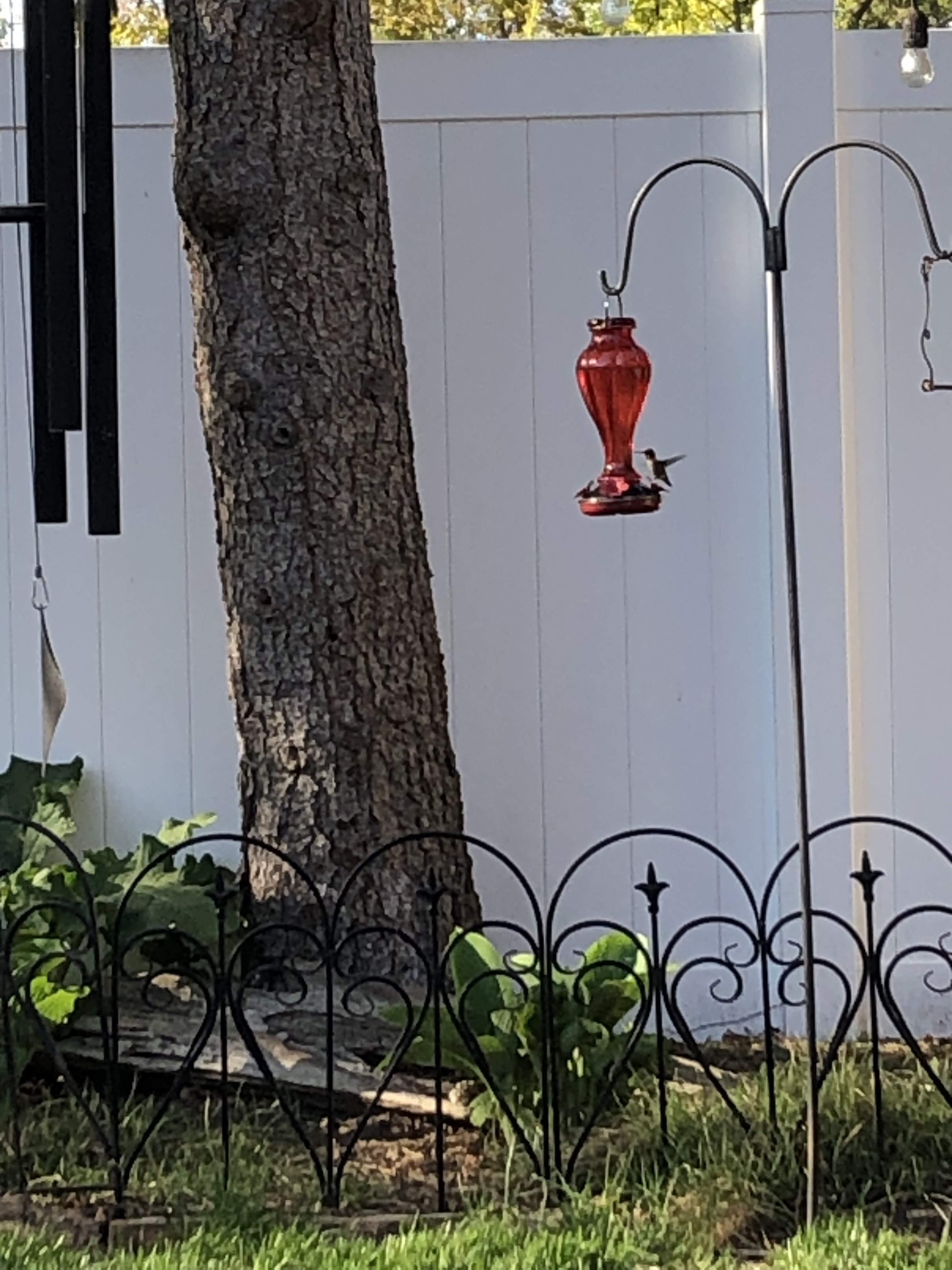
Sitting in our backyard, the sun lowering in the sky, the hummingbird arrived. A hummingbird is featured prominently in the The Disobedience of the Daughter of the Sun and this little visitor brought the story to my mind. Like all deep-story-roots, it is a tale as relevant to us as it is to the Indigenous people who live it – to keep the story alive.

“This is a commentary on the inevitable human problem of tribalism and the tragic results of ethnocentricity. It reminds us that a preoccupation with purity is a sign that a people have lost their real stories, lost their place in history, lost their land and relationship with nature and in an effort to be “someone” they engineer mythologies that are rationalist inventions to corroborate a pure ancestry. This same rationalism probably killed their stories and their Indigenous relationship with the land to begin with.”

Have you ever read anything that so accurately describes our struggle in these un-United States? As we witness the scrubbing of DEI initiatives, the blatant and brutal whitewashing of our nation’s history in order to engineer and perpetuate a mythology of white male purity, a made-up tale planted in the shallow barren soil of nationalist Christianity…we see the undeniable sign that we have lost our real story.

As is true of all great storytellers, Martín guides us toward hope and renewal:

“The story of their cultural loss should be their story, and from that grief they could grow a new culture. If you go back far enough, all people are mixed no matter what they say, and that is no disgrace.”

There is a path. It begins with grieving our loss. Together. And then, there is this:

“The story also says that a peoples’ attachment to their homeland and customs is necessary, wonderful, and life-giving, but should never be allowed to fuel a destructive chauvinism that excludes the rest of the world’s love for its own life and land.”

These are just a few of the lessons carried within an ancient Mayan tale. They are relevant to us today. We need only care enough to open our hearts and listen. And listen again. And then simmer in the slow opportunity that avails itself in the land beyond “problem-solving”.

The promise of our crossroads nation: to grow a new culture. Isn’t that the heart of our matter? Out of many, one.

There’s a hummingbird that can show us the way.

read Kerri’s blogpost about THE HUMMINGBIRD

likesharecommentsupportsubscribe…thankyou.

Incite Some Deviance [David’s blog on Merely A Thought Monday]

I searched for it but couldn’t find it. A short clip of Carl Sagan placing life on our tiny planet into the perspective of the enormity of the universe. A little sun in a galaxy of suns in a universe of billions and billions of galaxies. Through this lens, it is mind-boggling, the hubris necessary to believe we are the center of it all.

Initially this morning, I wrote a post about grace but cut it. I asked a question about the collision of values: loyalty-to-a-group smacking down telling-the-truth. It’s a uniquely human dilemma. The insistence upon tribe, Us-and-Them, spins some very dark necessities. I tossed it because grace was overshadowed by gloomy.

This is what I intended to write: on this tiny blue ball there is a group of Us defined as “All Humans”. Loyalty to this group is understood as idealistic. How can we possibly reach across so many imagined boundaries? What would we do with a definition of Us that was all inclusive? We would invite grace. Float all boats.

Each year, everywhere I wander, I am steeped in songs-of-the-season that appeal to the best of our nature. Peace on earth. Goodwill. Love one another. Perhaps we should listen to the lyrics of these songs. They are written by us for us as an appeal to our idealism, a sentiment central during this season of light’s return. Peace. Peace. Peace. We should “take it to heart.”

Let’s face it, loving one another is deviant if it is all inclusive.

It’s a reach, I know, but it’s really not so hard to imagine Us in the context of this vast universe, on this tiny ball spinning and spinning around our minuscule sun, one of billions and billions and billions. In such a context, the boundaries-in-our-minds dissolve and invite a different set of questions to arise: How can we better share this blue dot together? Conflict makes money yet collaboration creates possibility.

Pouring a little light into so much dedicated tribalism is deviant. It requires a touch of dignity. Pouring light into darkness is called Grace. Grace, in the face of so much division, is deviant.

When I cut my initial post I wondered what it would take to breach the code of tribe, reach beyond the singing platitudes, and incite some deviant behavior like peace-on-earth and all-inclusive love-of-one-another.

read Kerri’s blogpost about DEVIANT BEHAVIOR

like. share. comment. support. lending a hand to anyone is a way to support us. think on it.

buymeacoffee is a force like gravity helping the artists you appreciate keep their feet on the earth.

Stand Out [on Two Artist’s Tuesday]

you be you bus copy

You be you. If you think about it, who else can you possibly be? As trite as it may seem, this appeal on the side of a bus captures in simple marketing language one of the greatest paradoxes of living life in the most individualistic culture on the planet. We are reinforced to be hyper-unique but hammered repeatedly to fit in. It is the ultimate split intention. It is why we have such a ubiquitous self-help industry and so many preachers-of-purpose-seeking. Asking, “Where do I fit in?” is a terribly hard question to answer when the expectation is to stand out.

I suspect our current dedication to division is, to some extent, built upon this paradox. Split souls are generally angry souls and anger is an easy organizing principle to exploit. Tribes of anger need nothing more than enemies to bridge the split. A good enemy, real or imagined, can provide to an angry tribe both a sense of individual purpose and a place to belong.

I heard a term the other day that frightened me: low information voter. Years ago I heard an economist speak at a conference and his message was profound. A healthy democracy requires an educated populace. Without the capacity to sort through the heaps of rhetoric, pull apart the agendas to see beyond the manipulation, without some simple capacity  for analysis, or a bigger picture, then votes will be cast from simple, uninformed and often angry belief. In other words, democracies fall when its members do not care enough to know what they are voting for. Power will always corrupt. The brilliance of a democracy is that the people are meant to be the ultimate check on power. In order to be the check, they have to look beyond the political party line and ask, “What really happened here?”

The leaders of angry tribes need low information voters. It’s the only way they can stay in positions of power. It feels good to fit in. But, in a culture known for its individuality, it feels all the more satisfying to stand up, to stand out and ask, “What’s really going on here?”


read Kerri’s blog post about YOU BE YOU


savannah selfie WEBSITE BOX copy

Bring A Little Hope [on Merely A Thought Monday]

emerging with frame copy


“Multiculturalism asserts that people with different roots can co-exist, that they can learn to read the image-banks of others, that they can and should look across frontiers of race, language, gender and age without prejudice or illusion, and learn to think against this background of a hybridized society. It proposed – modestly enough – that some of the most interesting things in history and culture happen at the interface between cultures. It wants to study border situations, not only because they are fascinating in themselves, but because understanding them may bring with it a little hope for the world.” ~ Robert Hughes

I read in my newspaper that tribalism is the new normal [insert eye roll here]. There’s nothing new in tribalism. Fear-full people lost in a very small Us-N-Them tale is as old as the old gods. It’s pulled out and paraded about when power structures are shifting.

I marveled at the utter absurdity of it. No one can deny that our airwaves and e-waves are choked with noisy proclamations of division and fear.  However, it only takes a quick scan through the rest of my newspaper to grasp the undeniable reality of our situation: global markets, global economies, populations on the move, United Nations, NATO, WTO, multinational corporations, Bitcoin, international space stations, satellites, not to mention some of our greatest challenges like global warming, and invasive plant and insect species (made possible through global shipping and the necessity of sharing/exploiting resources). Take a stroll down the aisle of your local supermarket and educate yourself on the scope, depth and breadth of your food sources. Count the countries represented on the shelves.

Tribalism is not new. It was normal a few centuries ago. Nowadays it is a construct, an old dry log to toss on a fire to stoke divisions and create distractions.  It’s a headline to sell newspapers. Division sells. Good theatre requires hot conflict. People are easier to control when divided. There’s nothing new there, either.

There is a truism in change processes: people hold on tightest to what they know just before releasing their fear and walking into the unknown future. They take a step back, temporarily entrench, before answering the call of growth and change. Call that tribalism if you must, or denial, or the conservative impulse. It’s a process step. “Age and stage,” as 20 likes to say.

What’s actually new? All the world is now a crossroads. People with different roots ARE coexisting – that, after all, IS the great experiment and central promise of these United States. Looking across the frontiers of race, language, gender and age – without prejudice or illusion – is the hope in our emergence. It is the cathedral we are building.

The other direction can only bring our decrease. And, as history has taught us again and again, that’s an ugly path. There’s nothing new in that, either.


read Kerri’s blog post on EMERGING HUMANS EMERGING