Step Into The Path [David’s blog on DR Thursday]

“When living simply, most people’s problems were part of the breathing and functioning of The Big Picture of life, for which few humans, if any, had a large enough vision or imagination to comprehend.” ~ Martin Prechtel, Long Life Honey in the Heart

Our snake plant has easily tripled in size since we brought it home. It resides on the deep window sill in our living room and will soon outgrow its nook. We tease about cutting holes in the ceiling to accommodate its astounding reach. It is a constant source of inspiration; sometimes it seems like an alien being, sometimes kelp-like and belongs in the ocean, often the light-play on its leaves makes Kerri run for her camera.

“To the Tzutujil, people were not put into this world to have a good time; they were put here to be beautiful.” ~ Martin Prechtel

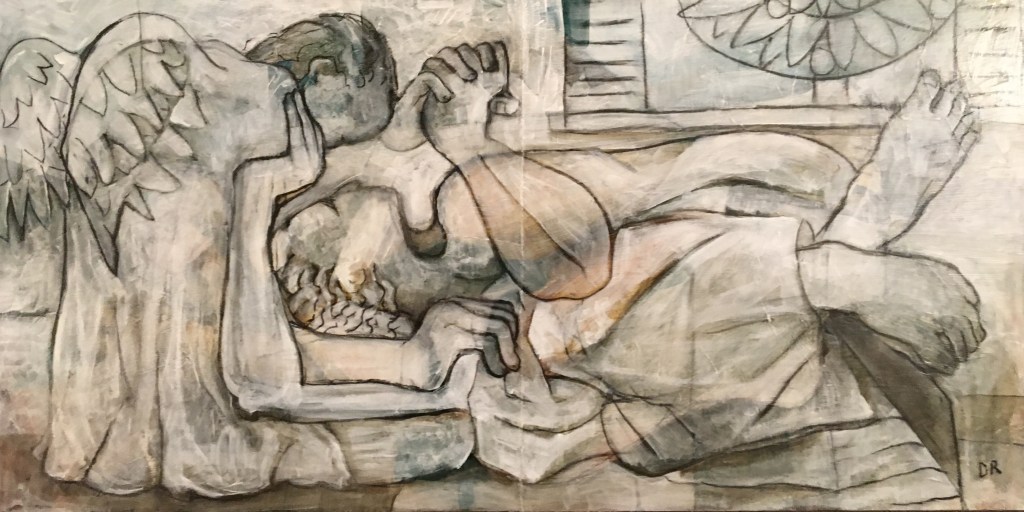
Following the recommendation of Horatio, I have been painting crap for weeks. To be clear, I haven’t been painting crap – that would be odd – rather, my work has been crap. Making messes. Rather than brushes I’ve been using rags and scraping tools. Wiping off, covering over, finger painting. It’s freeing.

My studio is a sanctuary where I can, for a little while, forget what is happening in-and-to our nation. Each day I read or receive an email with these questions: What is happening? What is going to happen? The first is easy to answer: our democracy is being systematically dismembered. The second is impossible to know.

I remembered a play titled The White Rose. It chronicles the arrest and ultimate execution of students from the University of Munich who protested against and resisted the Nazis. It prompted me to Google what the German people did to resist the rise of Hitler. It might surprise you to learn that the German people did not go quietly into the fascist dark night.

“How wonderful it is that nobody need wait a single moment before starting to improve the world.” ~ Anne Frank

Do you remember the pro-Democracy protests in Tiananmen Square and the man who stood in front of a tank? Not all people have had freedom of speech, a free press, a society striving for social equality, the privilege of voting…they would die – and have died – for what we have taken so for granted that it is now, by popular vote, being stripped away.

The potential loss is too great to comprehend.

Did you learn about The Selma Marches* in school? Black Americans were being prevented from voting. Thousands of non-violent protesters marched and were met by violence. It was a seminal moment in the Civil Rights Movement in the United States. We have in our history great examples of courage in the face of thuggery. John Lewis. Martin Luther King. Rosa Parks and Liz Cheney are cut from the same cloth.

Empowered people empower others. What is going to happen? What we allow to a happen.

Anne Frank wrote from her hiding place, “In the long run, the sharpest weapon of all is a kind and gentle spirit.” Kind and gentle spirits need not be passive or alone. They can join hands and march. Together they can face-down the corruption and indecency. They can harbor the persecuted. They can step into the path of an oncoming tank and with their courage touch the heart and shared humanity of the world.

*No matter what history the current administration attempts to erase, it is Black History Month and the history of the United States is rich with people of courage who faced incredible resistance to preserve and forward the ideals of democracy.
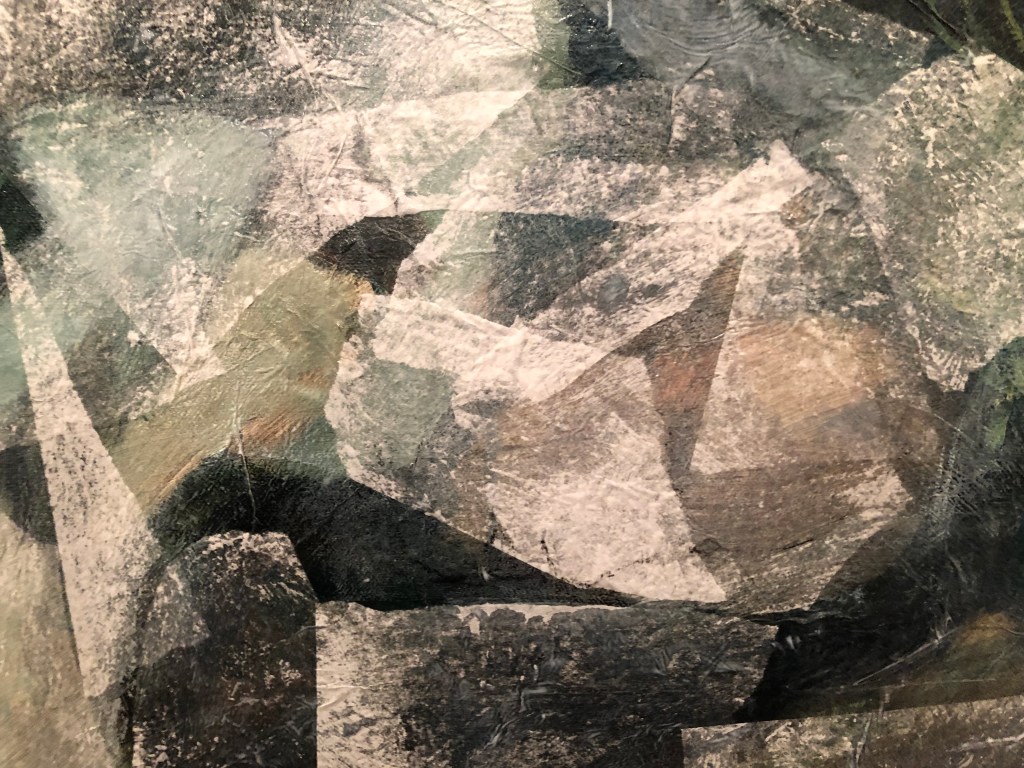
detail of a painting in progress: can you see her face?

read Kerri’s blogpost about SNAKE PLANT

likesharesupportcommentjoinhandssubscribe…thankyou.

Pioneers [David’s blog on KS Friday]

Never in my wildest dreams did the younger version of me imagine that I would someday research fun facts about wildflowers. But, because Kerri has a camera attached to her right hand and because we walk trails surrounded by meadows and because we use many of Kerri’s photos as prompts for our Melange, wildflowers and not-so-wild flowers have caught my attention.

Inevitably, one tidbit of information captures my imagination and today’s tidbit about Daisy Fleabane is this: it’s considered a pioneer species which means it is among the first plants to move into an area that has been disturbed – by natural disasters like fire or man-made like plowing or construction. They improve the ecosystem by accumulating nutrients and breaking up compacted soil, opening the way for other less hardy species to follow. Sub tidbit: because they are the first, some people treat pioneer species as weeds, invaders.

It is never easy to be the first. Ask Rosa Parks or Jackie Robinson.

Ask Barack. Ask Kamala.

People who know what they are doing, people attempting to restore health to devastated ecosystems, purposefully introduce pioneer species into a devastated landscape. They know the value of the pioneer in preparing the foundation for healing, breaking up hard-packed-minds and closed-angry-hearts. They know the necessity of the first, of the pioneer, to rehabilitate and nurture a healthy, unified ecosystem.

Ask Joe.

Grateful on the album AS IT IS © 2004 Kerri Sherwood

Kerri’s albums are available on iTunes and streaming on Pandora and iHeart Radio

Bonus and fitting for new beginnings. This is the song Kerri wrote and performed for our wedding. It makes me cry every time I hear it:

And Now © 2015 Kerri Sherwood

read Kerri’s blogpost about DAISY FLEABANE

like. share. support. subscribe. comment…thank you.

Look In [on Not So Flawed Wednesday]

“I want to stand as close to the edge as I can without going over. Out on the edge you can see all kinds of things you can’t see from the center.” ~Kurt Vonnegut

Yesterday I applied for a job that is all about narratives told from the edges of society. I’m not sure why it surprised me to find such a cool-to-me job; our community seems addicted to shattering so there are plenty of small edges to be found. Small edges are fallacious and serve a myriad of false centers. Our survival will depend upon whether or not we can awaken from the shatter-narrative and make the decision to direct our broken focus toward a common center. No small feat.

It is the role of the shaman, the explorer, the artist, the researcher to stand on the edge and report back to the community what is seen and unseen. The voice from the edge is rarely welcome since the report is capable of popping delusions or pulling the sheep’s clothing from the wolf. Page one of the autocrats’ handbook instructs the elimination of artists and educators. Making an enemy of the eyes-that-see, demonizing educators and thinkers – the people who recognize pattern and metaphor. The game of Us-and-Them necessitates silencing the voices capable of calling out the wolf. Autocrats require blind sheep that follow without question.

Some famous edge sitters: Galileo. Cesar Chavez. Rosa Parks. Nelson Mandela. Susan B. Anthony. Albert Einstein. Frederick Douglass, a former slave and leader of the abolitionist movement, wrote extensively about what we call Critical Race Theory; it was clear in his view from the edge. It’s not a new theory. It’s an old pattern with a new name. I think he might denounce his Republican party affiliation were he alive today; they would certainly silence his voice. He would be fired were he a professor in Florida today. As would Martin Luther King, another famous voice from the edge.

Voices of reason are often voices from the edges. Voices of the future are always voices from the edges. Galileo was silenced for suggesting that the earth circled the sun and not the other way around. Over time, the voices from the edge, when authentic, always make the center better, the community stronger. Susan B. Anthony spent her life on the edge, lobbying the center, to secure for women the right to vote.

Progress. Growth. They are rarely inspired from the tight grip at the center. Silence the edges and the community atrophies. Stop the movement and the body dies. That page was left out of the autocrats’ handbook for obvious reasons.

read Kerri’s blogpost about EDGES

Surface The Pattern [on DR Thursday]

Steve read my book and said he didn’t really understand the thing about pattern. His comment at first surprised me but then I realized he was actually reinforcing the point: we are unconscious to our patterning. We think in patterns. We see in patterns. Culture is pattern. Pattern is invisible and making it visible is a necessary first step in change processes.

The people who surface pattern are often seen by the mainstream as deviant or rebellious. Women demanding equal pay are attempting to make a pattern visible. The BLM movement is attempting to make a cultural pattern visible. Shining a light on longstanding oppression is never welcome in the halls of power.

The people who work to repress the visibility of cultural pattern, conserve the norms, generally claim a righteous superiority. They are keepers of the culture and feel threatened, even victimized, by the sudden visibility of cultural pattern. Exposure is always a threat to the existing pattern and no one relinquishes power or privilege without a fight. The current raft of voter suppression laws – made possible by the fantasy of a stolen election – is a great example. The Big Lie is a textbook example of how far people in power will go to hide a privilege-norm. It is, for us in these un-united states, not a new phenomenon; it is a longstanding well-guarded pattern.

Change happens when the patterns are surfaced. There will always be a tide that rises to extinguish the light of exposure. In the long run, those hardy voices that were, at first, branded as deviant or dangerous, we come to honor and respect. They refused to be silenced. We claim them as our heroes. MLK. Gandhi. Rosa Parks. Cesar Chavez. Susan B. Anthony. There are so many. It is no easy task to surface the patterns. The path of a light-shiner is dangerous and difficult.

John Lewis gave great advice for those dedicated to surfacing unconscious patterns: “Get in good trouble, necessary trouble, and help redeem the soul of America.” He also said that, “…transformation will not happen right away. Change takes time.”

Opening eyes to unconscious pattern, to what is obvious yet unseen, is an artist’s path. Seeing beyond what you think you see…seeing beyond your field-of-dedicated-belief, being curious enough to question what you are being told – can you imagine anything more necessary – more vital – in our age of rabid-misinformation and desperate-pattern-suppression?

read Kerri’s blog post about PATTERN

in dreams I wrestle with angels ©️ 2018 david robinson