For The First Time [David’s blog on DR Thursday]

As I have previously written, probably ad nauseam, I am a fan of the mythic tale of Parzival (not the opera) mostly because I sometimes feel that I am living the story. Completely bungling the opportunity in the Grail Castle by doing what he was taught to do, feeling full responsibility for the ensuing wasteland, fighting every ogre in pursuit of redemption, his trusty secret weapon shatters in a crucial moment leaving him unprotected and vulnerable to death. Stripping off the armor – his “role” – he walks away grieving the full-realization of his folly. Now, completely lost he follows a hermit who has no answers…and in his lostness, no longer trying to be found, he finds himself for the first time. The Grail Castle returns; he enters to meet again the Grail King, this time without armor or title or role or status or expectation. Fully exposed.

We walked a beach that merely a year ago was rocky and secluded. In a miracle of modern machinery, in record time, the state covered the beach with tons of sand and built a protective breakwater. It is transformed. Now, much more friendly for families and safer for swimming, for boats and jetskis, it is popular and populated. We strolled it as if we’d been transported to another era. It was at one time the same beach and a wildly different place. It is beautiful and protected, its natural rocky state completely covered over with appearance. “No worries,” I thought, “time has a way of washing away the facade, revealing the truth of everything.” In the meantime, the joy-squeals of children racing into the water was a delight.

“Can you see the dinosaur?” she asked, showing me the picture of the tiny breaking wave.

“A Tyrannosaurus Rex!”

“Yes! Look at its tiny arms!” she said, laughing.

Our feet in the sand, lost in time, nowhere else we’d rather be.

“Surrender to what is. Say ‘yes’ to life – and see how life starts suddenly to start working for you rather than against you.” ~ Eckhart Tolle.

read Kerri’s blogpost about THE SHORE

like. share. support. subscribe. comment…thank you.

Look Closer [on KS Friday]

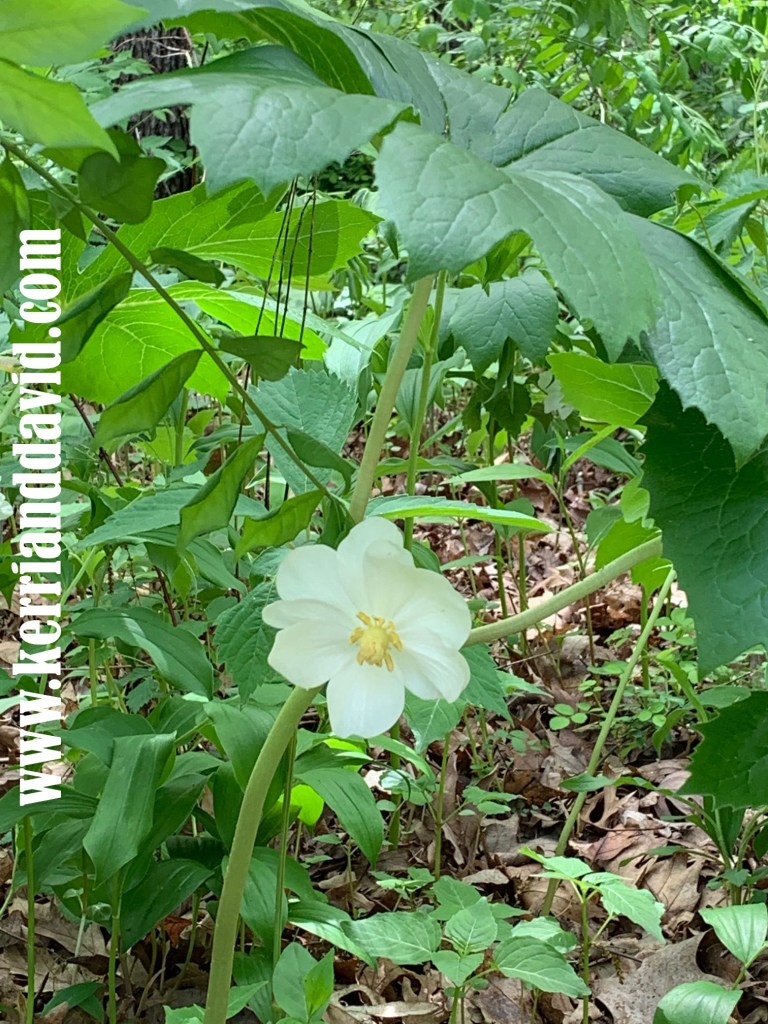
As the cowboy rode passed us he asked if we’d noticed the Mayapples. We laughed. This same cowboy, a few years ago, taught us about the Mayapples. He’d forgotten but seemed pleased when we reminded him. “That cowboy loves his Mayapples,” I said as he rode on down the trail.

We see each other through soda straws. A few brief encounters, a man on a horse dressed as if he just rode in from Wyoming, a lover of Mayapples. I really know nothing of his story or the realities of his life. I thought about him as we continued our walk. He might be a surgeon or a professor of botany. He might be an apparition. I doubt that “cowboy, lover of Mayapples” is the totality of his identity. I have many story-possibilities rolling for the cowboy, yet, my bet is that I’d be surprised if I had more than a straw’s view into his life.

Most of our judgments about others is a result of the straw’s view. We are master storytellers and only require the slightest prompt to spin a full tale. We see a 30 second news spot and believe we have the complete story of someone’s life. I suspect most of what we fear about other people is mostly soda-straw concoction. Laura Blumenfeld’s book, Revenge, is a great reminder of what is possible when the soda-straw view, the assigned role, expands into a full human portrait. A closer look always reveals a richer human story.

Later down the trail I howled with laughter. We’ve been fans of the Mayapple since our first encounter with the cowboy yet never knew there was a blossom hidden beneath the canopy of leaves. “Oh, my god!” Kerri exclaimed, lifting the broad leaf, exposing the white bloom. We lifted a few more leaves, each hiding a surprise flower. “I had no idea!” we chirped in unison.

“Have you noticed the Mayapples?” asked the cowboy. Apparently not.

Kerri’s albums are available on iTunes & streaming on Pandora

read Kerri’s blogpost about MAYAPPLES

nurture me/released from the heart © 1995 kerri sherwood

Put On Your Rubber Boots [It’s Chicken Marsala Monday]

A Chicken Marsala Monday nugget to help kick-start your week.

We were clearing the room of furniture. We needed wide open space to do our work. It was early in our collaboration and my business partner and I were facilitating a workshop for a group of high powered lawyers. “They’ll never do it,” she said.  The office was fairly ostentatious, granite and polished wood. “They’ll never do it,” she repeated. “You’ll never get a bunch of lawyers to play.”

I’ve long believed (and proven to myself again and again) that everyone, regardless of status, role, or title, wants to play. Create safety and ferocious playfulness rises to the top. And, more to the point – especially when facilitating workshops, with play comes open-hearts, vulnerability, and the capacity to speak personal truth. Pathways forward become obvious.

Status is a great liar, role is a very thick protective mask. There is no better road to honesty than laughter. And, most often, all that people need to find the honesty-road is permission to play.

A few hours later, suit coats tossed aside, sleeves rolled up and ties strewn hither and yon, we were no longer working with a room full of lawyers; the people behind the role had emerged and they were playing mightily. In their play, great truths emerged and fortresses fell. They laughed. They shared.

From studio melange on Chicken Marsala Monday, we suggest that you put on your rubber boots. Give yourself permission to play.

PUT ON YOUR RUBBER BOOTS reminder/merchandise


society 6 info jpeg copy

puddles CHICKEN TOTE BAG copy

puddles LEGGINGS copy

go play in puddles LEGGINGS

puddles FLOOR PILLOW copy   puddles CHICKEN SQ PILLOW copy

puddles BEACH TOWEL copy

BEACH TOWELS

puddles CHICKEN FRAMED PRINT copy

read Kerri’s blog about PUT ON YOUR RUBBER BOOTS

melange button jpeg copy

kerrianddavid.com

put on your rubber boots ©️ 2016 david robinson & kerri sherwood


Locate Your Self

title_pageHere’s a short excerpt from my book, The Seer, dealing with the dance between investments, limitations, and the roles we play in life. This conversation is a kind of coaching session and is happening via online chat:

Me:…All week I’ve asked myself, “why?” Why the dramatic shift in experience from role to role? I’m a bit shocked to realize that I play many, many roles each day. In each role I want something and what I want is different depending upon the people I am with. I realized that my roles are not about me in isolation – and what do I mean by that? I mean that I define my role by how I define the relationship I am in at the moment. For instance, in my workshop, I assumed the role of “guide” and I wanted to lead the young people to some new insights that might help them create their businesses. In my conversation with my parents, in the role of “son,” I wanted them to be pleased with my work. I wanted to share and I wanted their approval. So, my role is defined by relationship and in each different relationship I tell a specific story based on what I want or need. I’ve “cast” myself in these little mini-stories. Or to use your term, “role” is the way I “locate” myself in the story.

Virgil: And how does this knowledge help you with your questions about business?

Me: The first thing that occurs to me is that I have the capacity to locate myself in a different way if I don’t like the role I’m playing. I can change how I locate myself. Also, there is a dance with the words “limitation” and “investment.” I took notes all week and realized that I was using the verb “to invest” over and over again to describe my experience of different roles. So, for instance, during my dinner with my friend Bruce I invested in helping him. I wanted Bruce to know that I cared about his challenges. Then, I watched Bruce invest in being the wine expert. It was his way of caring for me and demonstrating his expertise. I began to see my investments as keys to discerning my limitations. In some roles I’ve invested in the idea that I can’t do something or that I’m not good at something. In some roles I diminish myself; my limitations are investments in being small.

Virgil: Just a caution: as you explore further the dance between investment and limitation, remember to practice suspending your judgment. Remember: you are having experiences first so you can see how you make meaning and begin to choose how you make meaning.

Me: Thank you. It’s a good reminder. I was beating myself up every time I     realized I was investing in being small.

Virgil: We tell ourselves stories. We locate ourselves within the stories. In fact, that is the next recognition: you locate yourself within your story. We do it physically (like your description of choosing the table in the restaurant); we do it through the roles we assume – specifically our assumptions of how we need to play our roles, what is ours to do, etc. Locating is simply a way of establishing comfort. We sort to the known. If you judge how you locate yourself, you miss the opportunity to change how you locate yourself.

Me: Right. Judgment blinds me to the choices I am making.

Virgil: Judgment is always a version of the “things are happening to me” story. In fact, judgment is a way of locating: it is the warning signal when we step too close to discomfort. When I judge myself and say, “I’m an idiot,” I’m actually locating myself, pulling myself back into my comfort zone. When I judge others, “They are idiots,” I’m locating myself in a higher status position. The action of diminishing “them” elevates me back into a comfortable status position. Thus, suspending your judgments removes the easy step back to comfort and allows you to stand in “not knowing” and see what is there beyond what you think is there.

Go here to get my latest book, The Seer: The Mind of the Entrepreneur, Artist, Visionary, Seeker, Learner, Leader, Creator…You.

Or, go here for hard copies.

Truly Powerful People (450)

450.
Join me in inspiring truly powerful people. Each day I will add a new thought, story or idea to support your quest and mine.

For years the question I have most dreaded is the cocktail party standard, “So, what do you do?” I’ve never had a simple answer. I’ve never had a single answer. And usually, my answer serves to complicate rather than simplify. Once I stopped feeling bad that I didn’t have a simple answer, once I recognized that I was never going to have a suitable answer, I decided to make the moment an opportunity for play: I used the untenable question to sort my encounters into “those people I want to know” and “those people that I do not.” I went on offense. Without hesitation I tell them whatever comes into my mind; the people that step toward the chaos go into the “people I want to know” bucket. Those that flee the chaos have self selected themselves from my future friend pool. Recently, my newest favorite friend took me to lunch and started our time together with, “Who the hell are you?” It’s worth noting that he also has no simple answer to the dreaded question.

Once, at a conference for doctors, I performed a piece that was written to seem autobiographical, but was fiction through and through. I played the role of a doctor. Off the stage, I was surprised and delighted when people called me doctor! They didn’t realize that I was an invention – and I did nothing to help correct their perception. It felt good fitting into an identifiable box. “Doctor Robinson,” they said, “Thank you for telling us your story.” I smiled and said, “Thank you for listening to my story.” All the while I was thinking, “Mom would be so proud!” For one glorious day through my invention I felt the simple joy of being identifiable to others. And, in that day, I realized with relish that it is all an invention. None of us is truly identifiable; no one is the role that they play. Double liberation!

There is an exercise I love doing with groups: pretend that your memory will be erased in 5 minutes; before your memory is gone, before 5 minutes elapse, write all that you want to remember, all that you think you value, all that you want to recall about yourself. People write about their families and relationships, they write phone numbers of important friends, they write of their dogs and their desires. I’ve done this exercise with groups hundreds of times and once, only once, at a retreat, a woman wrote that she loved herself beyond measure, that she was fulfilled and talented and caring. When I asked her about it she said, “If I have a clean slate and can only know myself through what I’ve written, why not tell myself a great story. Why not invent an amazing me.”