Our National ABOUT Page [David’s blog on KS Friday]

This quote by Reynolds Price has been on my ABOUT page since I began blogging:

“A need to tell and hear stories is essential to us – second in necessity after nourishment and before love and shelter.”

Since I already know what I am about (mostly) I rarely visit my ABOUT page. I’d all but forgotten this quote was a constant presence on my blog. It is the flag I planted, as much for myself as for others, so I might always have a north star, a way to locate and find my way HOME. I carried it in my pocket long before I enshrined it on my site. I remember typing it into the little “about” box – it felt like a declaration.

Lately the quote has been poking at me. It wants further consideration. It has renewed relevance in our current circumstance.

The disparate bubbles that we occupy, MAGA and WOKE, are stories. Although the characters are different in the respective bubbles, the overriding story is the same: there is a threat to our way of life and the threat is the other bubble.

Although I believe the MAGA bubble is filled with dangerous fascism, they believe the WOKE bubble is socialism run amok. Occupants of both bubbles follow their news-of-the-day as if it was essential, true. Both narratives fuel the division. Both bubbles tell the tale of a heroic fight for good over an evil villain.

This is the third time in our history that these bubbles have formed; irreconcilable narratives housed under a greater umbrella-story, ironically called The United States of America. Robin Diangelo wrote the story of white supremacy requires black inferiority. Conversely, the struggle of equality-for-all is pitted against the story of white supremacy. It is nearly impossible to reconcile the combating sub-narratives: the Manifest Destiny story of god-given superiority (MAGA) with the All Men and Women Are Created Equal (WOKE) story. Our national narrative, our essential umbrella story, is of this struggle for identity: superiority for the few or equality for all. So, here we are.

A need to tell and hear stories is essential to us because stories are the glue that hold us together. Stories are essential because they define “belonging”. In a nation of immigrants, with a long history of bloody fighting over this question of belonging, what might it take for us to recognize that this fight is the greater story that defines us? It is the legacy we perpetuate in our grappling; it is the trace we leave in time. When will we see that the loss of freedom, the collapse of love and shelter is the cost of our shared narrative of seeming irreconcilable difference?

We’ve built our house on a volatile fault line.

However, there is a greater narrative available. It has been on our national ABOUT page since the beginning of our nation. It is our motto, our north star that will guide us HOME. It is printed on our currency. What might it take for us to rise above the bubbles and embrace the story at the center of our rhetorical ideal? What might we need to reconcile to live fully the nourishing story of e pluribus unum?

[this may be my favorite piece by Kerri. If you’re feeling angst or overwhelmed, do yourself a favor: take a short life-break, close your eyes and listen]

PEACE on the album AS IT IS © 2004 Kerri Sherwood

Kerri’s albums are available on iTunes and streaming on Pandora

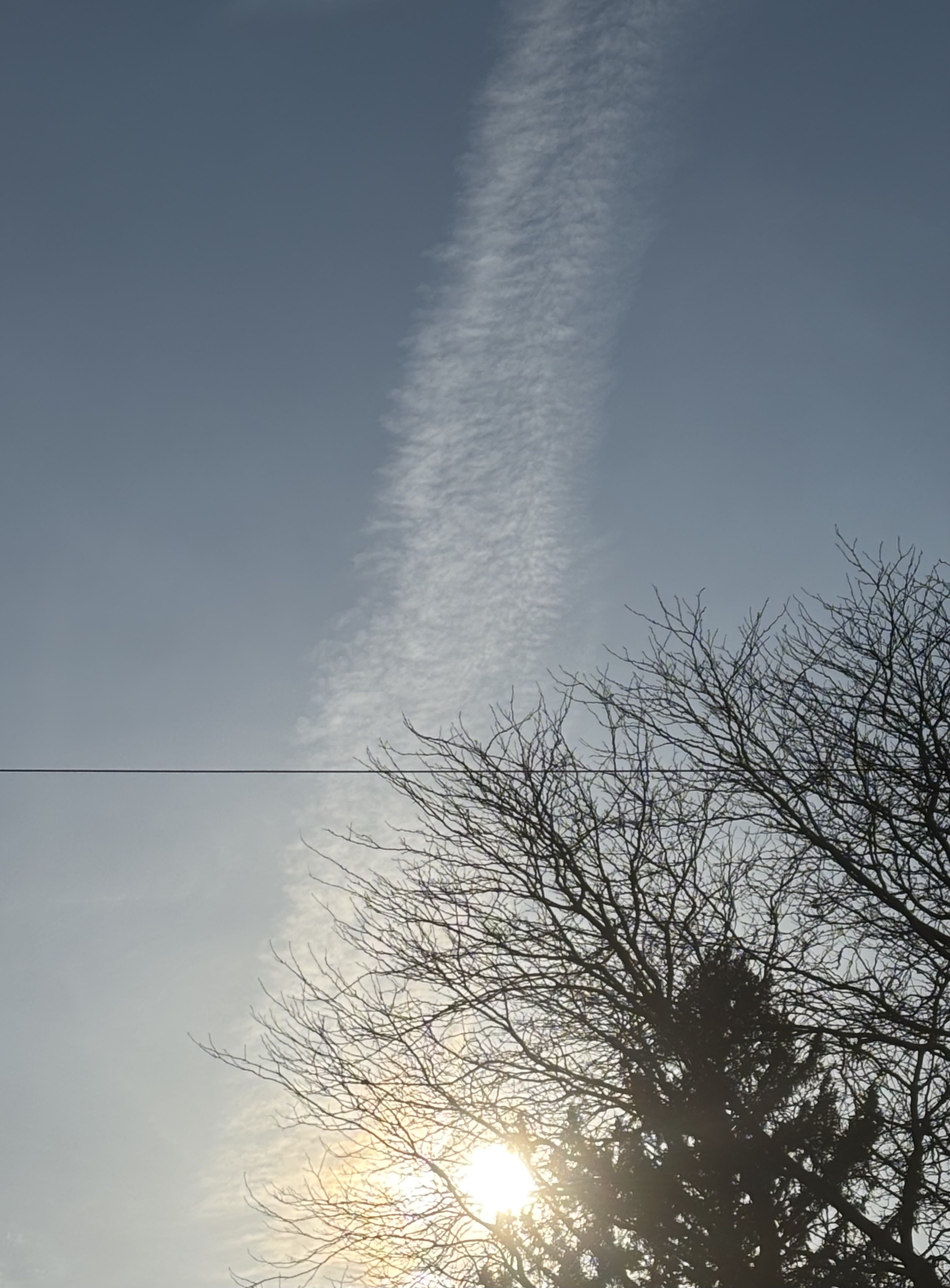
read Kerri’s blogpost about TRACES IN THE SKY
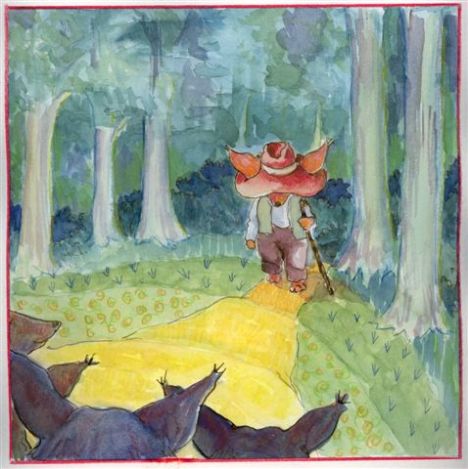
The Storyteller emerges from the forest.
Lucy & The Waterfox

http://www.kerrianddavid.com

likesharecommentsupportsubscribetellabetterstory…thankyou.

Teach The Moment [David’s blog on DR Thursday]

As I watched the curtain of grasses sway I thought they’d make an excellent set piece for a production of The Tempest. Their movement was hypnotic. I had the good fortune to design a minimal-budget-production of The Tempest several years ago and used huge pieces of driftwood and a bamboo curtain. I loved it.

The Tempest was on my mind because earlier in the day while doing some research I bumbled across the question, “Why is The Tempest a banned book?” The answer is a very sad statement about our times, the reason our nation cannot seem to mature: “The Tempest,” one of the playwright’s classics, is among the books removed, as teachers were urged to stay away from any works where “race, ethnicity and oppression are central themes,” the website Salon reported.

In our nation race, ethnicity and oppression are the central themes of our history: “246 years of brutal enslavement; the rape of black women for the pleasure of white men and to produce more enslaved workers; the selling off of black children; the attempted genocide of Indigenous people, Indian removal acts, and reservations; indentured servitude, lynching and mob violence; sharecropping; Chinese exclusion laws; Japanese American internment; Jim Crow laws and mandatory segregation…” (Robin Diangelo, White Fragility)

You’d think we might want to encourage teaching The Tempest and other great works so we might consider and discuss the full scope of our history. So that we might learn about ourselves. So that we might become capable of addressing and putting to rest the ugly fear – rooted in race, ethnicity and oppression – exploited for gain by the Republican party, that gave birth to the MAGA movement. It’s the Confederacy by another name.

In a nation of immigrants, you’d think it might be a first principle to teach our children about race, ethnicity, and oppression so we might learn how to reach across – and put to rest – division rather than perpetually recreate it.

The AI overview provided another related and currently more salient reason to teach The Tempest: “The main message of Shakespeare’s The Tempest is that forgiveness and reconciliation are preferable to revenge and punishment, especially when it comes to the restoration of social order and personal peace.

If social order and personal peace are the goals, our current path of revenge and punishment will not take us there. In the play, Prospero chooses release from his island prison through the power of forgiveness and redemption rather than perpetuating his imprisonment by seeking revenge.

In this teachable moment Prospero’s choice is an analogy worth teaching: a path provided to us by a play written in 1610 by one of the greatest poets of the English language; a way out of our national-soul-imprisonment.

I suspect that is why The Tempest and other great works of literature dealing with themes-that-matter are being banned. In the minds of this administration, continued imprisonment, revenge and punishment seem to be the goals.

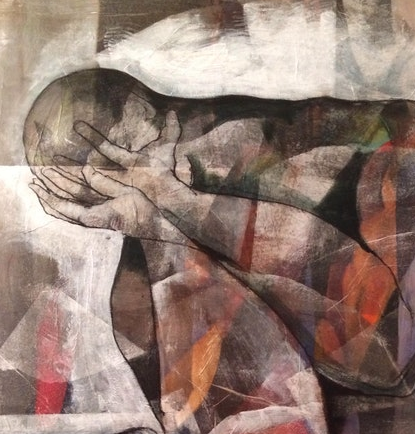
Angels At Our Side, 24″x48″, mixed media on board

read Kerri’s blogpost about THE GRASSES

likesharesupportsubscribecomment…thankyou.

Don’t Go Home [on DR Thursday]

House On Fire copy

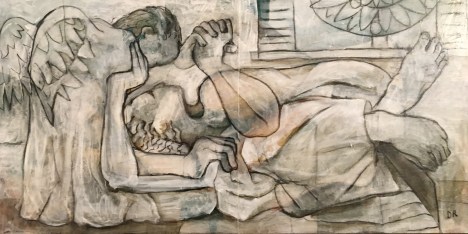
House on Fire. 2004-ish. Watercolor. And, yes, I was all over copying Guernica.

“The continual retreat from the discomfort of authentic racial engagement in a culture infused with racial disparity limits the ability to form authentic connections across racial lines, and results in a perpetual cycle that works to hold racism in place.” ~ Robin DiAngelo, White Fragility

I confess to rewriting this post. What I wrote initially was pedantic and preachy. So, this is a second go-round.

We’ve been hearing this question much in these past days: why don’t things ever change? Here’s an answer I learned in school: a society is a living system and, like all living things, it will fight to the death when threatened with change. Why we can’t seem to “solve” our problem with racial disparity and the dehumanization of black people? It’s built into our system. The system, a complex and living thing, will fight to the death to keep the injustice securely in place.

That’s a heady answer and somewhat hopeless. Its abstraction makes it a safe and somewhat antiseptic response.

I lived in Los Angeles in 1992. My apartment was in the hills so I had a good vantage point to watch the rioting and the city burn. When it felt too unsafe, I fled the city. I had a safe place to go.

A few years later, working with a school district, the head of the Black Student Union asked me to come in and work with her students. MLK day was fast approaching and the students, preparing presentations for the day, were in rebellion. They were mad. They didn’t want to read speeches about peace and justice when those ideals were nowhere on their horizon. I thought it was my job to help them give voice to what they wanted to say. It was my first conscious lesson in my white-blindness. The frightened parents of the students descended. I’ll never forget the mother and father that pulled me aside, saying to me, “You don’t understand. If they say what they want to say they’ll be killed.” Their terror was real. They had to teach their children a lesson that was the opposite of what my parents taught me.

To call it a problem is to reduce it to the level of mechanics. It is to pretend (or hope) that a few changes in the law or better policing will do the trick.  To treat it like a problem guarantees that we’ll recreate it. This is not a problem, this is a pattern. It is a cycle. It is a relationship.

The pattern is currently in our faces. The pattern is not only the death of another black person. The pattern is also what white America chooses to do – or not do-  with the knowledge of it. What is the story we tell ourselves about ourselves that makes it possible to stand in the fire with people of color during the protests but walk-on once the fire subsides? It is simply this: I get to go home. I get to drive out of LA when things feel too unsafe. I have someplace to go. I get to go home when the officer is prosecuted or a law is changed or a commission empaneled, dust off my hands, and say that I did my part.

Why don’t things ever change?

I was stunned when those parents pulled me aside. At first, I couldn’t believe that they were going to silence their children when their children had something so important to say. It made my head spin. And then I went home. And then I realized that they couldn’t go home. There was no place in this “living system” where they were safe. That was what they were trying to tell me. It was what Martin Luther King was trying to tell us. It is what the protesters in the streets today are trying to get us to see/admit/realize. We are watching a living system built on racial division and inequality fight to the death because change is knocking.

What if we realized that we cannot simply go home and forget about it?


read Kerri’s blog post about HOUSE ON FIRE


black box copy