Simply Listen

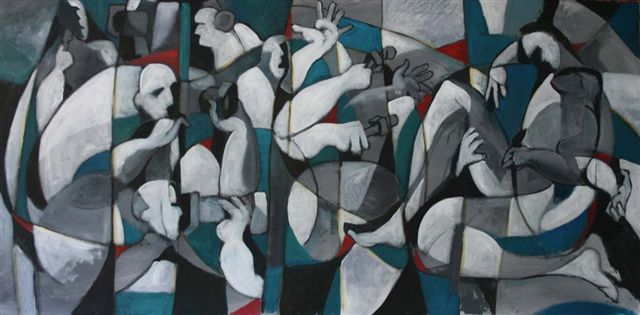
Pieta with Paparazzi

I call this one Pieta with Paparazzi

I am standing in a lobby listening to people compare their tragedies. It is more than comparison; it is a festival of one-ups-manship. “If you think that’s bad, my niece was just diagnosed with a terrible cancer….” The first speaker, now crestfallen, reaches into her story-bag of pain as another member of the group competes, “That happened to my brother just after his daughter was hit broadside by an enormous truck!” The group coos in sympathy, each in a hurry to make their personal story of hurt the center of the conversation. I wonder at their need to outdo each other in tragedy.

I suppose it is human, this feeding frenzy of drama. I want to reject my supposition outright. Suppose it is not human? I wonder if this dis-ease is cultural, an expression of the fragmentation that comes from the too-busy, the clan that avoids internal quiet at all costs, filling every moment with television, gaming, texting, emailing, gossip-news. As Anne Morrow Lindbergh wrote in Gifts From The Sea, it is impossible to know who you are without dedicated inner spaciousness and quiet. To listen to your self is the only way to really know your self. Filling the quiet space with incessant noise withers the root.

Maybe.

All stories require conflict to move forward but it is also true that the point of all storytelling is transformation. Through the conflict we are transformed. Perhaps that is what bothers me as I listen to this pain frenzy: the emphasis is on the suffering. The investment, the identity, is in the wound, not the transformation.

There is a simple Buddhist prayer that I like:

May I dwell in my heart. May I be free from suffering. May I be healed. May I be at peace.

The prayer is like a musical round that progresses from the “I” to the “You” to the “We.” The emphasis is on the transformation. It begins with dwelling in the heart.

Maybe.

What bothers me most is the absence of the capacity to listen. The first speaker needed to be heard, not outdone. I wonder what might have happened if the group had simply said, “Tell us.” I wonder what might have happened if they had been able to be present with another’s pain. To listen, simply to listen, must be a route to free each other from suffering, to heal, to create peace.

title_pageGo here to buy hard copies (and Kindle) of my latest book: The Seer: The Mind of the Entrepreneur, Artist, Visionary, Innovator, Seeker, Learner, Leader, Creator,…You.

Or, you can go here for all forms of digital options


And, you can go here for fine art prints of my paintingsYoga.Meditation
 

Truly Powerful People (445)

445.
Join me in inspiring truly powerful people. Each day I will add a new thought, story or idea to support your quest and mine.

I’m given to idealism; I know this is true. And, although I’ve harbored serious attempts to cure myself of my idealism, in the end I always come to this thought, “I do not wish to see the world through the eyes of “realistic.” There are too many dashed dreams in this world. There is too much lost hope. Too many people sit in front of the television and think, “There is nothing I can do.” I’ve tried that, too and it works if you can give up any desire for deeper meaning in your life. Numb is numb through and through.

Once, a client wanted to change the culture of his organization. He sought complicated interventions to cure the pathology of his business. He’d fostered a culture of negation; “Yes, but…,” was the standard reply to any request. All he need do was change one word: “Yes, and….” Building a culture on acceptance instead of negation was, to him, pie in the sky. “It can’t be that easy,” he said. He entertained it when I pulled my systems lingo from my pocket: “Complex systems are not changed through complexity. They are changed through local simplicities.” He entertained it just long enough to realize that he’d have to relinquish control and instead empower his employees. “Yes, and,” is surprisingly powerful. Change one word and the world can change. He wrote it off as too idealistic. Negation is negation through and through.

If you want to weep about the abuse of power (control wears a mask and we call it power) read Howard Zinn’s The People’s History of the United States. There is a nasty little theme lurking beneath the economics of the past 150 years of our history: the sale of weapons drives the health of the economy. War is not only profitable, it is necessary to float the boat and to unite an otherwise economically divided nation; we are not the first generation to recognize that 99% are pieces of a larger game; the 1% play a different game governed by different rules. It’s a national theme, a defining characteristic that when married to another defining characteristic – the easy distraction of the 99% – guarantees that future generations of the 99.9% will awake for a moment and say, “Hey! What about democracy and the ideals chiseled into the walls of our monuments! No fair!” Eisenhower warned us and that was a long time ago.

I am not so idealistic as to think that something other than a profit motive will drive our national action plan. I am, however, willing to entertain the pie in the sky notion that peace can easily be more profitable than war. What if we actually set aside our imperialist shadow side and walked our talk? War as we practice it is akin to digging a hole and filling it in again so we can dig a hole – all to wildly support the makers of shovels. I’m not kidding when I assert that the potency of life is found in what you bring to it, not in what you get from it. What do we bring? Numb is numb and negation is negation. Imagining the impossible (idealism) is at the heart of every innovation. Imagine what might be possible if we woke up!

