Do What They Do [on DR Thursday]

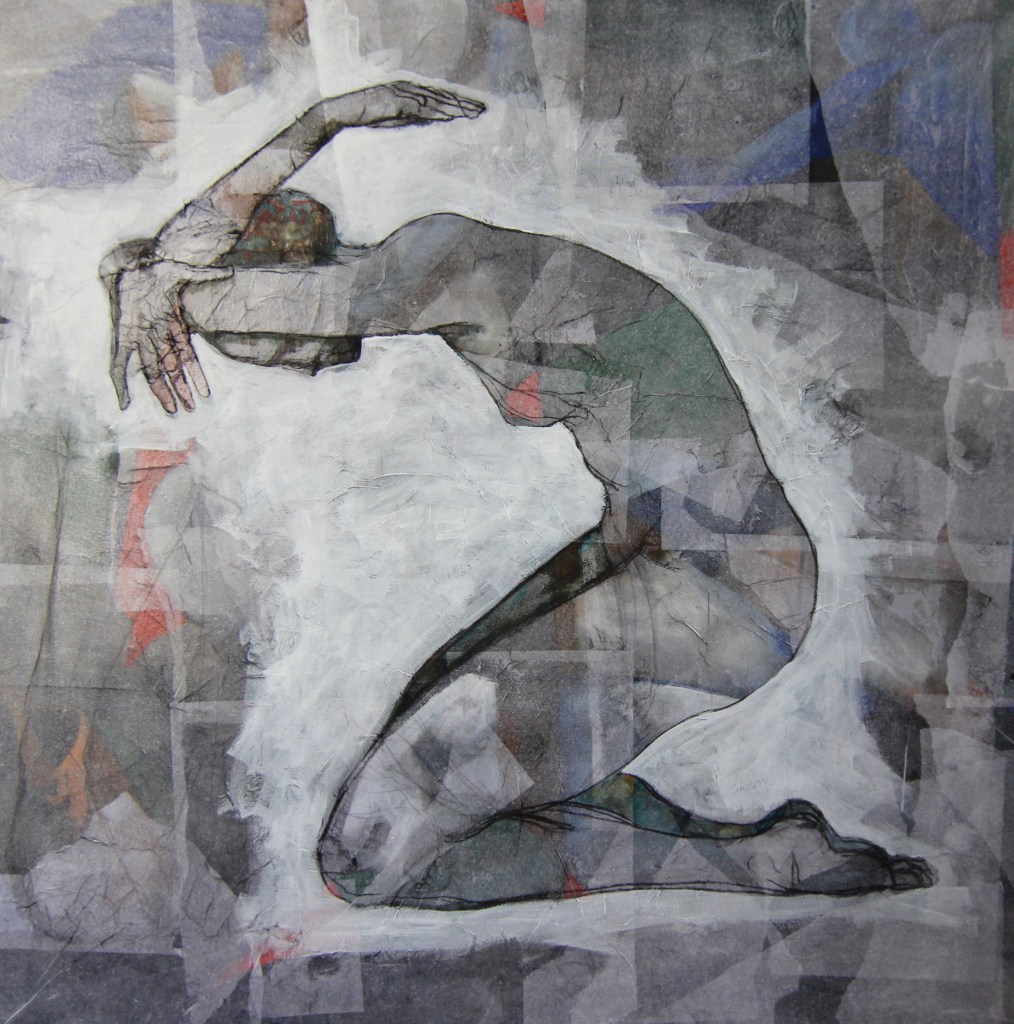
I’ve posted this painting more than any other in my stacks.

Some paintings serve as markers for new directions. This painting is one of those. What came before this painting was suddenly old. What came after was an exciting unknown path. Exploration and play. Big mistakes and messes followed by understanding. Materials can only be pushed so far. Bodies and shapes reveling in negative and positive space.

When I met Kerri, this painting did not have a name. I called it #7 in my yoga series. She called it “Iconic” and the name stuck. I liked the name. It seemed appropriate. An icon is a symbol. Something worthy of veneration.

Now, over ten years later, this icon, once the harbinger of the new, serves as the hallmark of what was.

I delight in this painting, Iconic. It is one of the few. And, although I am grateful for where it led me, I’ve come to realize that it no longer serves to locate me, except in a past chapter, like a yearbook photo.

Letting go. It is why I stand in my studio – I can’t even sit there of late – and look at the mess on canvas that sits untouched on my easel these many months. Somewhere, after this mishmash phase, somewhere, beyond the chaos and disorder and wiping away, there will emerge another marker. An icon. A compass.

Although I’ve written it many times in these past few months, it’s way past time that I admit – to myself – that I am, once again, in the wilderness. Someone once told me that we go to the wilderness to face our demons and find our gods. That seems a bit dramatic. Demons and gods are one and the same, like positive and negative space or comedy and tragedy. The lesson is always the same: stop taking yourself so seriously and the oppositions, the demons and gods, will stop pulling you apart.

Find a child and watch them play with paint. Do that. Do what they do. The wilderness is rich in sustenance if you know where to look.

Someday, in the midst of being lost, I’ll make an accidental mark that jolts me. I’ll turn it around, asking, “What’s this?” A new direction will emerge.

Read Kerri’s blog post about ICONIC

iconic ©️ 2010 david robinson

Set It Free [on DR Thursday]

Horatio told me that, according to the happiness index, the good folks in Iceland sit atop the happiness-mountain. One reason, he explained, is that they’ve removed failure from their national equation. They cheer the effort, not the outcome.

Removing failure from the equation is the main ingredient for fun and success in all arenas, especially the arts. It is impossible to learn color theory without making some extraordinary messes. Ask a dancer how many times they tried and fell before they made that astounding leap look easy. Throw many pots and, over time, mastery will come – and mastery is nothing more than the understanding that there is no such thing as failure. It is the feel and touch of a long relationship with clay that can only come from not being afraid to throw it, to see what happens if…

Sometimes, no matter how hard I struggle with it or adjust it, a painting just isn’t working. Usually it doesn’t work because I’ve forgotten the rule about failure-removal. My brush is too timid. My brain is in the way. And yet, sometimes, in the middle of a painting that isn’t working, there is a small piece, the actual inspiration for the painting, that isn’t stilted, that remains alive and free of my fear. It’s easy to see. It captivates my eye, a warm island in the middle of a frozen sea. Every so often, rather than paint over the whole thing, I’ll lift the island, cut it out, set it free from it’s too-labored surroundings.

“Brutal,” Kerri said. “I liked that painting.”

“I’ll do another,” I replied. And maybe, I thought, another and another and another. Who knows, learning to cheer the effort takes some not-so-serious practice. It’s the only road back to the freedom of finger painting and the joy of playing in the sand.

Beautiful K.Dot, 12 x 9IN, mixed media

read Kerri’s blog post about CUT OUT

beautiful k.dot ©️ 2021 david robinson

Catch His Hand [on DR Thursday]

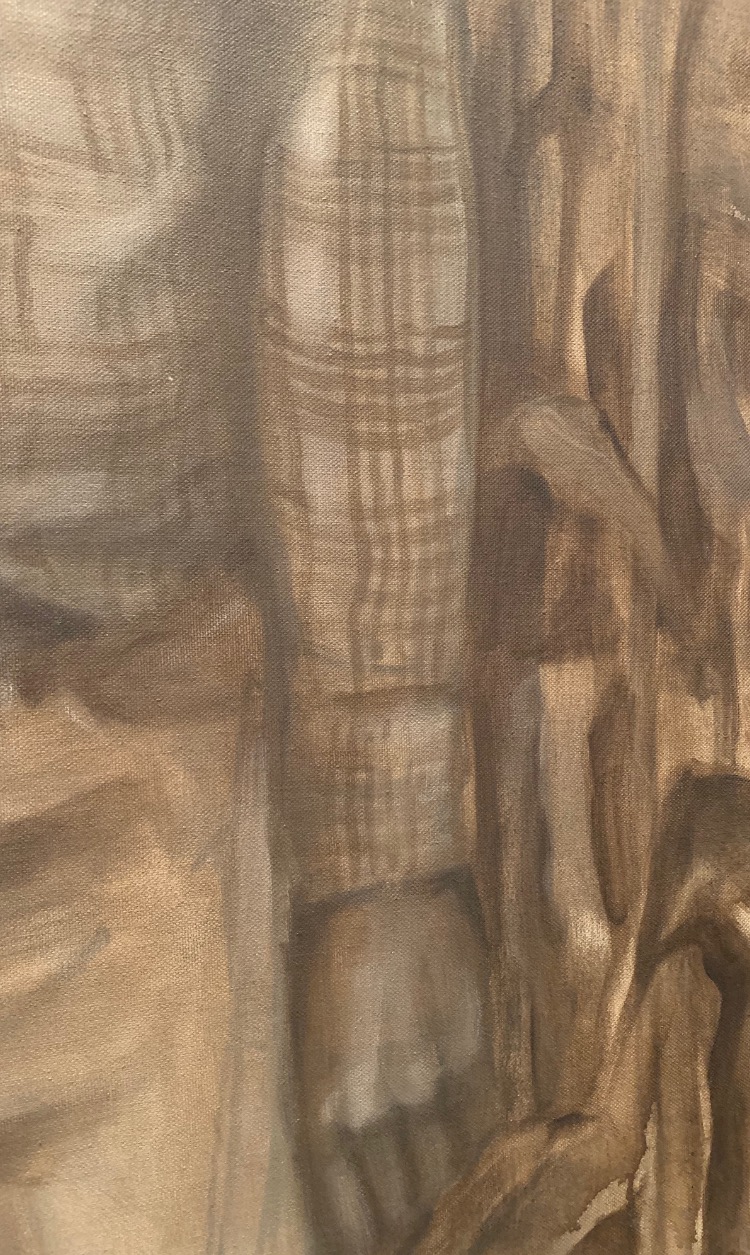
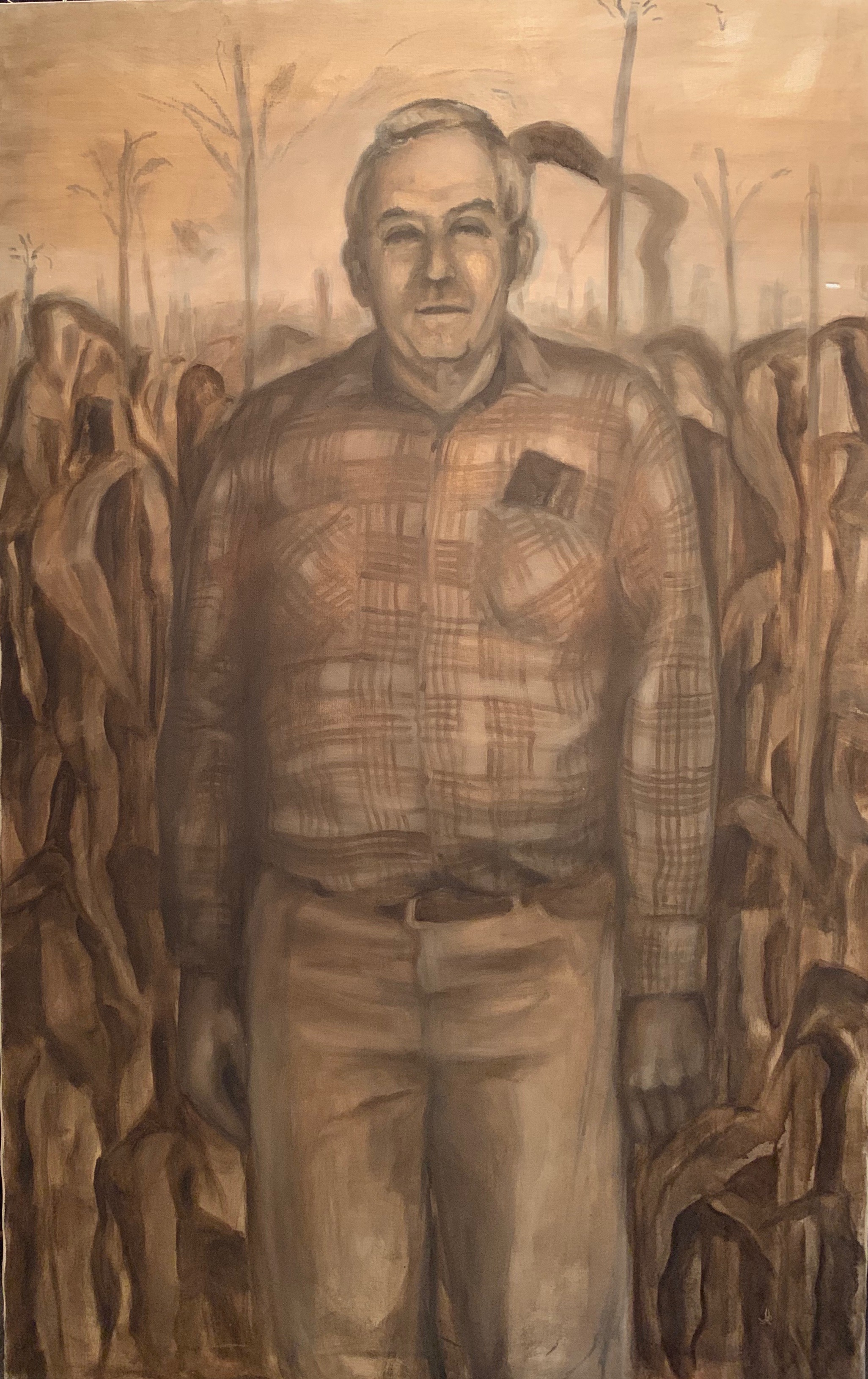
Many years ago, somewhere in the middle of the 1990’s, I painted a portrait of my dad. It is monochromatic and a fairly quick study. In the painting, he is either emerging or returning to the corn. Or both. I can’t remember why I painted him in the corn except that he was born in Iowa and wished his entire adult life to return to the small town where he grew up. Perhaps this is a painting about yearning. Perhaps it is a painting about returning home.

It occurred to me, when I found it while re-stacking paintings after the great studio flood, that I painted this when he was roughly the age I am now. For a fleeting moment I wanted to paint a monochrome self-portrait simply so I might place it across the room. We’d have a staring contest that reached beyond both of our lives.

I chucked the idea for many reasons but mostly because I had no idea what “field” I might emerge from or into? My symbolic return home would be…what? I am not connected to a single place, a tiny town in Iowa or, like Tom Mck, a ranch in California. I have been a wanderer.

I’ve always loved hands. They are, in many ways, more expressive than faces. They are not as guarded and rarely put on airs. My dad was a working man and has working man hands. He was proud of the work he did. It was hard and broke his body but he loved it. It was out of doors under the open sky. He started his career as a teacher and, although he never confessed as much, I think he hated teaching. The classroom was suffocating. He needed to get his hands in the dirt, feel the sun on his face. Even after he retired, as he aged, he sat on the porch in the mornings, he worked his garden or clipped his grass or cleaned his gutters; anything to be outside.

I had a dream many years ago that has stayed with me. My dad and I were free-falling through time. As we fell, he reached out his hand. I stretched out my arm, tried to grasp his hand, but in falling, we were just out of reach. In the dream I stared intently at his hand as I tried to extend my arm, tried to grasp his hand. I knew, if I was successful, if we could catch his hand, it might not stop our fall, but we, neither of us, would fall alone.

read Kerri’s blog post about COLUMBUS HANDS

Add Another Layer [on DR Thursday]

Were you to meet my easel in a dark alley it would, no doubt, frighten you. It’s big. Substantial. Rough. Weathered from hard life. Knobby, bent and encrusted.

I see it with different eyes. It is one of my most sacred possessions. It was given to me, a gift of celebration, following the opening of my very first solo show. Prior to its arrival in my life I propped my canvas on chairs or tables, I leaned them against walls, kneeling to paint. My easel allowed me to stand.

Caked in charcoal and layer upon layer of paint, artifacts of the hundreds of paintings that it has held for me, I find it beautiful. It has traveled with me through many states and life stages. Its main support is bent. It creaks when I adjust the angle or drop the arm. It occurred to me this morning, as I rebuild my studio following the great flood, that I also creak when my angles adjust, when my arms drop. We’ve aged together.

In a life with very few constants, my easel has served as my single steadfast companion through every move, every triumph, every tragedy. It has stood with me when I was artistically productive and a barren wasteland. It’s listened to me rant, ramble, and recite. It’s been witness to my laughter and my fears. It has been the silent sentinel during my mini-deaths and slow rebirths.

This morning, as I carried my easel back into the studio, I realized how out-of-order my world has felt. If my studio is in disarray, as it has been since the flood, I am also in disarray. Returning my easel to its proper spot in the studio I felt a flood of relief. All of my pieces are nearly put back together again. My trusty companion, my reliable easel and I will soon stand together, paint will spatter, charcoal and matte medium will crust another coating onto our already layered archaeology.

Art hollers. Possibility beckons.

read Kerri’s blog post about the EASEL

Listen To The Painting [on DR Thursday]

Surrender Now, 24 x 24IN, mixed media. 2016

This painting is called Surrender Now. In this moment. in my life, I can think of no more appropriate sentiment. Surrender. Now.

The playwright John Guare wrote that it is necessary to write ten bad pages to write one good one. I am the visual artist proof of his thought. In my life I have painted a lot of crap and will continue to do so. This painting is one of my good pages, one of my good paintings. I’m doubt if my ratio is as good as ten-for-one but, mostly the ratio doesn’t matter. As Tom McK said, “A writer writes, a painter paints.” The rest is not really that important.

The great gift of being a painter is that your paintings talk back to you. Sometimes they are sassy. Sometimes they are sage. This one is the latter. It reminds me in times of contention to open my hand rather than make a fist. It reminds me to let go. Palms to the sky.

So much these days is out of my control. I suppose that is always true but currently it is in my face. The castle crumbles. So, I look to the painting for solace. The advice is abundantly clear.

read Kerri’s blog post about SURRENDER NOW

surrender now ©️ 2016 david robinson

Try, Try Again [on DR Thursday]

shared fatherhood

This morning, as I looked through my stacks, I could find no more relevant painting for this day, for our times.

Ironically, I made two runs at this painting. Both times it evolved into something else. It started in violence and ended in shared fatherhood. In the final paintings, you cannot see is the inception, the original impulse, the story that made me pick up my brushes. Polynices and Eteocles. Brothers fighting for the control of the kingdom. Both die. They kill each other rather than share.

The story is ancient. Like all Greek stories, it’s a cautionary tale. It’s a story of fate. Oedipus’ children. An original sin playing to its inevitable conclusion. It’s been one of my metaphors for these now-ridiculous-united-states. Brothers fighting for control, forgetting that they are brothers. It’s a lose/lose story. Hubris kills all.

The mystery to me is why – in both attempts – did my if-wishes-were-fishes subconscious kick-in and transform this horror story into something positive? Out of the fire, I argue in the naive recesses of my being, we will forge a union.

I’ve always known that I am an idealist but, this morning, listening to the trickster fox whip its gullible crowd into an election fruit-smoothie, amplifying the bloviated rants of a shyster, creating fraud-fantasies from thin air, I recognize that I am perhaps the most foolish of all, the blue ribbon winner of witless. Perhaps not.

I will make a third go of this painting. I have the drawings. This time, my realist might punch through the wall of hopeful idealism. The tale is cautionary. It is ancient. It is worth telling. To look with clear eyes at “what is” does service to “what might be.”

Kerri just reminded me that, on our walk yesterday, I waxed poetic about how what we focus on matters. It’s true. Possibility needs to be firmly rooted in reality.

Bubbles always burst.

The brothers kill each other rather than share a kingdom. Is it their fate [our fate]? Is it inevitable – human nature – to be so blinded by the lust for control that we plug our ears to possibility, that we refuse to see the promise we lose in our petty penny struggle? Do people always need to sacrifice the greater for the lesser en route to waking up?

The pandemic rages. The Fox feeds lies to hungry-angry listeners. The brothers fight over something as silly as a mask. The map sprouts virus-red. The populace dies in the struggle.

Is this merely a chapter in the story of becoming? I guess we’ll see.

read Kerri’s blog post about SHARED FATHERHOOD. With any luck, her thoughts will be more hopeful.

this is my second run at my subject. Shared Fatherhood 2

shared fatherhood 1 & 2 ©️ 2017 david robinson

Study Opposites [on DR Thursday]

a haiku for today.

study opposites,

we reach forward, move backward.

life is a yoga!

read Kerri’s FORWARD BACK haiku

forward back ©️ 2012 david robinson

Leave The Studio [on DR Thursday]

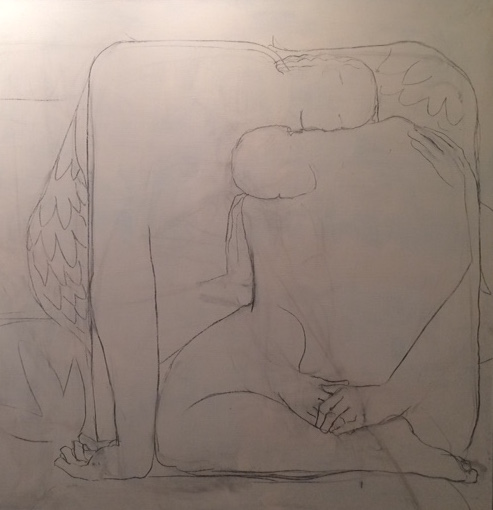
Kerri calls this snippet REACH

One day at the farmer’s market we saw a little girl chasing an enormous soap bubble. She was gleeful, squealing with delight. Looking at the faces of the adults watching the little girl, it was clear that they wished they were also racing across the grass, gleefully chasing bubbles. It was clear that they yearned to feel that carefree. In some distant place, they remembered.

These days I occasionally sit in my studio but I do not touch my brushes. There is a canvas on the easel. It’s good and worn and chunky just as I like them. It is waiting. I am waiting.

I believe, as Tom McK. taught me, that “a writer writes and a painter paints.” There is no magic to it. Well, that’s a lie. There’s plenty of magic when the painting begins, when the artist disappears. But first, the paint has to hit the canvas. Before disappearing the artist has to show up.

Yesterday, Skip sent me this lovely reminder. It’s from a tweet:

“I believe it was John Cage who once told me, ‘When you start working, everybody is in your studio – the past, your friends, your enemies, the art world, and above all, you own ideas – all are there. But as you continue painting, they start leaving, one-by-one, and you are left completely alone. Then, if you are lucky, even you leave.'”

That little girl chasing bubbles, her glee, is what happens when “even you leave.” All of the ideas of who you are or what you need to do or achieve, the expectations, the burdens and worries, the pandemic, the politics, the notions of success and failure, all leave the room. That’s when the bubble chasing begins. That’s when there is ample space for glee and delight.

Kerri chose this morsel for today and I’m so glad she did. “I want to do another version of this painting,” I said. That little girl, so long ago chasing an enormous soap bubble at a farmer’s market, is calling me back to my easel, she’s pointing to the studio door and asking me to leave.

Chasing Bubbles, mixed media, 33.25 x 48IN

read Kerri’s blog post about REACH

reach/chasing bubbles ©️ 2019 david robinson

Honor The Line [on DR Thursday]

“We often need to lose sight of our priorities in order to see them.” ~ John Irving

Walking down the trail a few days ago, Kerri and I had a hysterical conversation. If you could go back in time, who would you tell to f**k off? There was a long list and some seriously funny stories of misplaced tolerance. We laughed at the moments when younger versions of ourselves were silent, when we should have spoken. We groaned at the moments that we let someone run over us. When we should have held a boundary but did not.

“Why didn’t I say something?” We chortled. Grace comes with time. What was years ago a violation is now head-shaking-story.

The next day, about to enter the local corner market, someone called Kerri’s name. Before she could stop it, in the middle of this pandemic, a time when we’ve been religious about social distancing, a woman threw open her arms and locked Kerri in an embrace. It was an awkward and short-lived hug; Kerri was like a stone cold post, her hand that was rising for protection was squished in the unwelcome clutch. The woman shrunk and retreated. We ducked into the store.

“Why didn’t I stop her?” Kerri asked as we walked home. There was no time. “Doesn’t she know there’s a pandemic?” A space violation.

Context is everything.

I was delighted when Kerri chose this snippet of a painting for the Melange. For her, it represented the moment that she could have interrupted the unwanted hug. She named this little morsel “Back Up!”

For me it is something entirely different. This full painting is called Pieta With Paparazzi. I’d mostly forgotten about this painting since I only showed it one time and that was over a decade ago. It is more relevant today than it was when I painted it. It is about the flattening of importance, the loss of perspective. It is about how – even a decade ago – everything seemed to be a media event. Mary contemplates the body of her dead son while the media circus swirls around her.

The shorthand phrase for our time: nothing is sacred. The line between a simple truth and a manufactured event has been blurred, perhaps irreparably. Lies are celebrated and vehemently defended. Truths discarded. Boundaries crossed. Hugs taken. Shots fired. The other day I heard someone say, “People say things on Facebook that they’d never say in person.” Too true. Social discourse and public policy are tragedies enacted on a social platform for a ready-made audience. All the world’s a stage.

In time, we might ask ourselves, “Why didn’t we do something?” or “What were we thinking?” Perhaps, in time, we’ll have the distance and the grace to see why we should have stepped back and stopped this incessant crossing of boundaries, this white house media circus. Perhaps, in losing sight of our priorities, they will someday come back into focus and we will see them again.

pieta with paparazzi

read Kerri’s blog post about BACK UP!

pieta with paparazzi ©️ 2010 david robinson

Touch The Invisible [on DR Thursday]

KDOT sketch copy

a close up of One Chord Ahead (a work in progress)

I started my artist life by drawing people. I was never really interested in landscapes or still life drawing. I was interested in the eyes. As a boy I copied photographs from National Geographic magazine and repeatedly sketched The Colonel from the side of the bucket of chicken.

I understood early on that the surface image was not what I was after, I was on the hunt for what was “beneath.” My dedication to the invisible made me a not-very-good portrait painter though I managed to do more than my share. They were technical exercises and for a while served a purpose.

It’s been over a century since the development of the photograph relieved artists from the necessity of capturing the visible. Optics to Impressionism to Expressionism to all the Neo-phases to pulling it into Cubes and Surrealism and Abstract Expressionism to just plain abstraction and conceptual-what-the-heck-does-it-mean-ism?

It’s an odd admission for a visual artist to declare a dedication to the invisible. Ellsworth Kelly caught the invisible in his Austin. John Singer Sargent captured it in his Lady Agnew. You know when an artist reaches the invisible when the painting/architecture stops you in your tracks. They make you catch your breath. More than once in my life I’ve stood in front of paintings and cried. The artist reached through the veil and touched the “beneath.” Picasso regularly kills me. I’ve spent hours staring at Richard Diebenkorn’s Ocean Park series.

At this late date I know that I will not shake the halls of history with my paintings, I am innovating nothing and now working for no other reason than I have to. I need to. There is no other reason. There is no better reason.

A few weeks ago Kerri was leading a rehearsal through Zoom. I caught my breath watching her and thought it might be time to attempt another portrait. Fun. Nothing formal.

Sometimes the circle comes around to shake a complacency or reconnect to the root. I feel as if I’m waking up some long-still muscle memory. I had to do a few drafts to remember how not-to-control. I’m learning in this latest iteration of One Chord Ahead that I’m more and more interested in reducing all things to a simplicity, to use the fewest lines to say the most. It’s the imperative of the pursuit of what’s beneath. A lesson, I recognize, that I learn again and again and again…


read Kerri’s blog post about ONE CHORD AHEAD

Kerri remains in Facebook lock up. When you click over to read her post please consider subscribing to her blog.


their palettes website box copy


columbus

columbus (my dad), circa 1995 or 1996

www.davidrobinsoncreative.com

one chord ahead (work in progress) ©️ 2020 david robinson