Pluck The Symbol [David’s blog on DR Thursday]

Tonight, as we near the day of clover, the celebration of St. Patrick’s snake dance, we will make corned beef and cabbage for our weekly dinner with 20. There will be Guinness, too. The snakes in the story, by-the-way, are symbolic. There were no actual snakes in the region. Remember, as I will when tipping my Guinness, it’s a religious holiday though, through the advent of Guinness, pagans like me can play, too.

One of my favorite things about human beings is how blind they are to their natural curiosity. For instance, read the wikipedia entry for four-leaf clover! There’s layers and layers of data on the odds of finding a four-leaf clover. Sometimes curiosity looks like study. Sometimes it looks like science. Or engineering. It’s one of my least favorite things about human beings: we can kill the spark, snuff the magic of the curious story-telling-mind, by how we tell the story.

Believe the snakes are literal and you miss the point of the story and misunderstand the reason for the holiday. The same is true with arks filled with animals and the Red Sea parting. Metaphors made literal: the apple remains uneaten. Knowledge dies on the vine.

Symbols open stories. Symbols make the story universal which is impressive if you stop and think about it. How can two people, living in two different cultures, who don’t share a common language, understand in-a-flash the same idea? Symbol. Metaphor. Heart openers. Mind expanders. Experience joiners.

In the epic of Saint Patrick, as a pagan I’d be one of the metaphoric snakes driven into the sea.

And remember, the data suggests that for every ten thousand three-leaf clover that you spy, you’ll find one stem with four. A symbol of good luck, no matter what the data suggests.
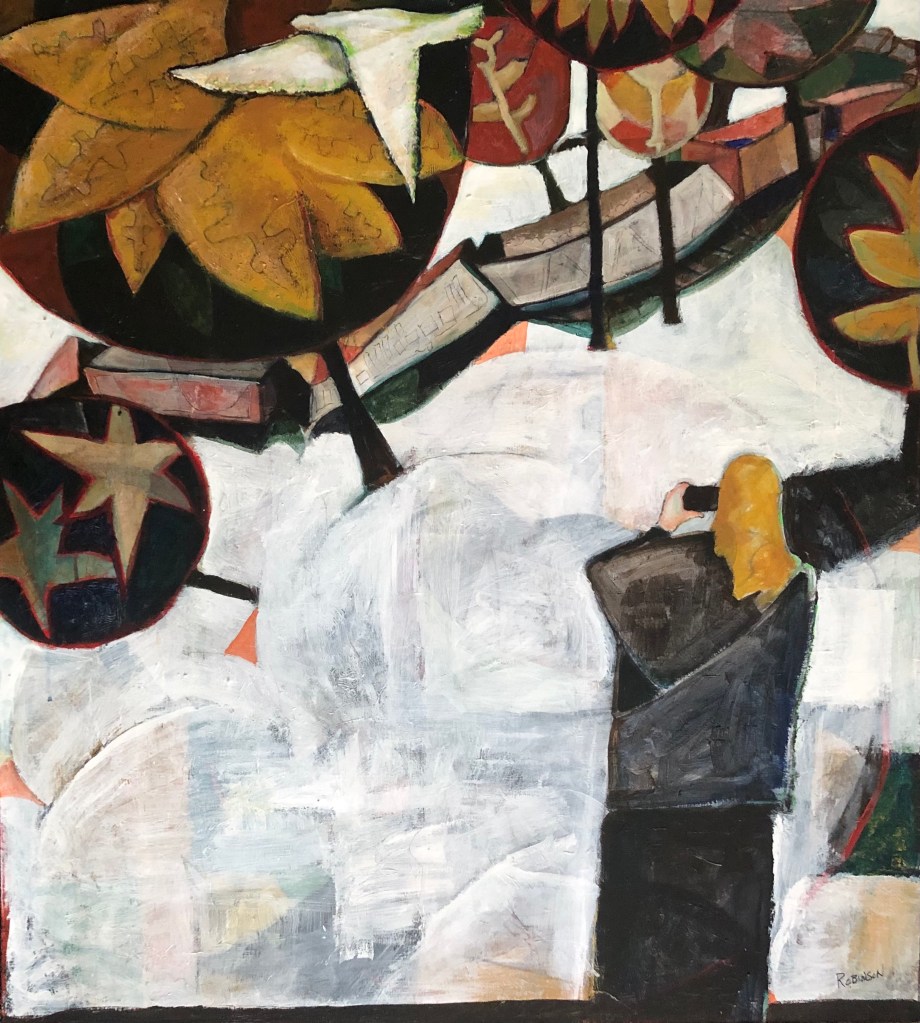
Train Through Trees, 51″x46″, mixed media

read Kerri’s blogpost about CLOVER

like. share. subscribe. support. comment. (thank you)

Share The Symbols [David’s blog on KS Friday]

When I was a wee-turnip I found a textbook on the shelf from a course my dad took in college. Comparative religions. It’s a big-big book full of many-many comparisons. It now resides on my shelf. This book sparked a life-long fascination for me. The universal nature of myth and story across individual cultures and how these stories and symbols are, over time, pulled and twisted like taffy, co-opted, integrated and sometimes claimed as the private property of religion x or y.

Today, as I write this, we sit squarely on the solstice. I thought a few tidbits of story-symbol might be fun to visit so, together, we might taste the taffy.

In Italian tradition, La Befana is the goddess of the solstice. She rides a broom through the skies leaving candy and presents to the good little boys and girls. As a broom-riding pagan goddess, she predates Saint Nick by more than a few centuries. The Christian tradition snagged her and after a bit of twisting, she became a character in the Magi story. On a cold, cold night she gave shelter to those three wise-men but declined to join them on their quest because she had unfinished chores. After they left she had a change of heart but couldn’t find the manger on her own so she gave the gifts she had in tow to the nice children she met during her manger-search.

On the solstice, the goddess Isis gave birth to her son Horus, the sun god. Leta gave birth to Apollo on the solstice. The Persian god of light, Mithra, was born on the solstice. These births were technically virgin births since the conception in every case was immaculate. Egyptian. Greek. Persian. These stories predate the Christian story by centuries. It’s a ripple across time and culture of the same human impulse: after a long dark season to celebrate the return of the light.

We lose more than we know when we – to borrow a great term from Joseph Campbell – concretize a symbol. The stories and myths are meant to open us to greater unity with each other and the world we share. They are not meant to be taken or understood literally. Holding them literally slams the door on their greater meaning and unifying power. It renders them a possession, a plot point on a map.

On this winter solstice I can imagine no greater gift to this divided world than to recognize we are, through our unique symbols and characters, telling the same story, yearning for the same possibilities, sharing the same ideals whether they soar through the air on a broomstick or in a sleigh, both rides brimming with toys for good girls and boys. We borrow each others best ideas and ideals, rewriting them to fit our unique audience. From Isis and Horus to Mary and Jesus, it’s time once again to celebrate the rich warm return of the light through our myriad forms and cultural traditions, to feel the push and pull of something ancient and deeply human. Together.

this season/this season © 1998 kerri sherwood

Kerri’s albums are available on iTunes and streaming on Pandora and iHeart Radio

read Kerri’s blogpost about THE HOME IN THE TREE

like. share. support. comment.

buymeacoffee is a surgically implanted intention, a medicinal tradition stretching back eons to a time when beauty and analytics held hands and shared meals. together.